Property Trading Board Game Rules, Explained Step by Step
 Play Estates
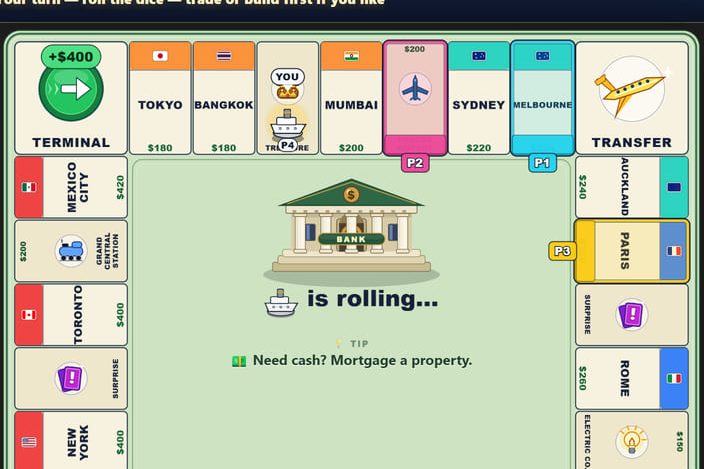
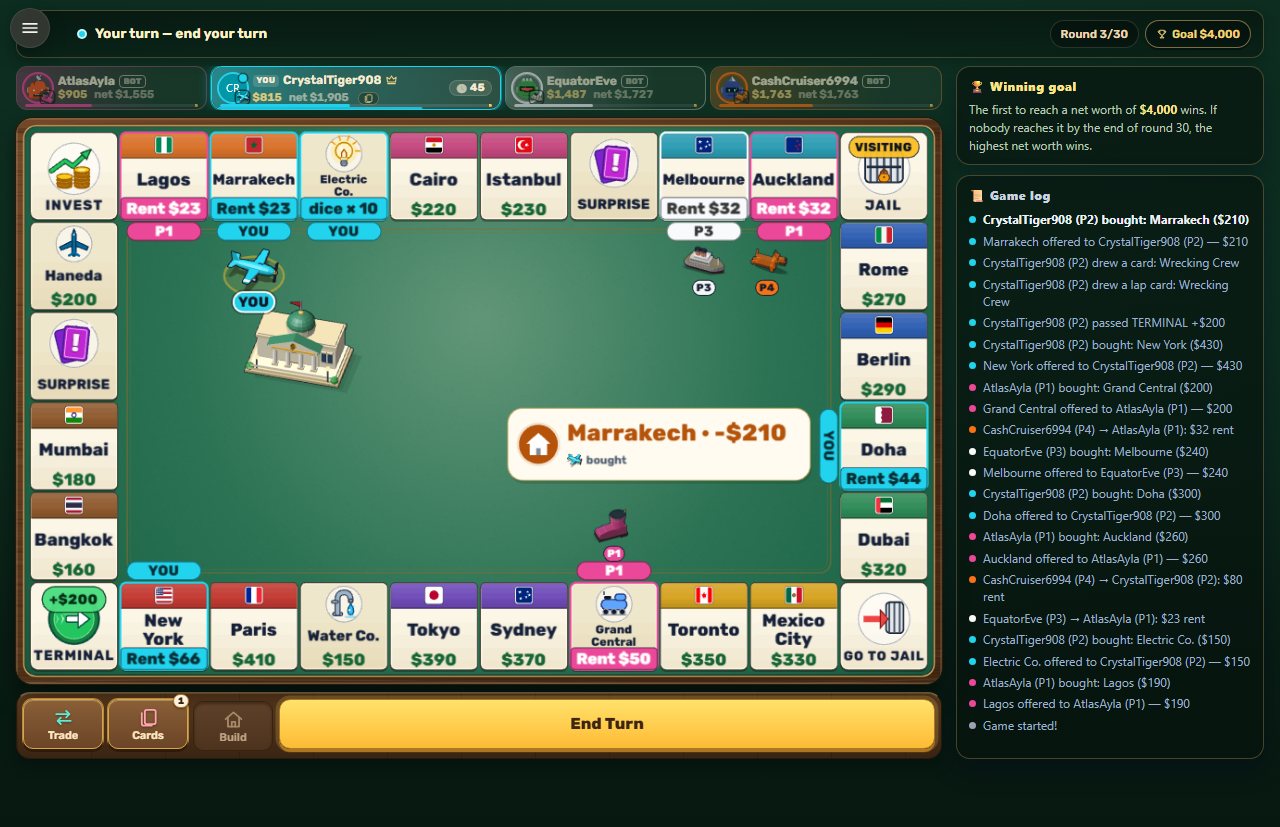
The property trading board game rules come down to one loop: roll two dice, walk the board, buy what you land on, collect rent from rivals who land on it, and build to make that rent bigger. In Estates, our version, the winner is the first player whose net worth (cash plus property plus buildings) reaches $4,000, or the richest player after 30 rounds. Press the Play button above to try it against bots while you read.
A turn, step by step
| Step | What happens |
|---|---|
| 1. Roll | Two dice, move clockwise. A double means you roll again; a third double in a row sends you straight to jail. |
| 2. Land | Unowned property: you may buy it at the printed price. A rival's property: you pay rent. Surprise tile: you draw a card. Your own tile: nothing. |
| 3. Terminal | Passing or landing on the Terminal pays $200 and gives you one Surprise card. |
| 4. Manage | Build, mortgage, trade or play a card. These are open before the roll too. |
| 5. End turn | Press End Turn. If nothing is left to do, the board passes the turn for you after about 1.5 seconds. |
If you decline a purchase, or cannot afford it, the property simply stays unowned for the next player who lands on it. There is no auction. The default move clock is 120 seconds per turn, and a doubles re-roll starts a fresh clock.
Buying, sets and rent
On the default World map there are 18 cities in 9 colour pairs, priced from $160 to $430. A set is only two cities, side by side. Rent on a city is a multiple of its base rent:
| You have | Rent multiple |
|---|---|
| One bare city | 1.5x base |
| Both cities of the pair | 3x base |
| 1 / 2 / 3 houses | 5x / 15x / 30x base |
| Hotel (fourth level) | 50x base |
So completing a pair doubles your rent before you lay a single brick. Airports and stations pay a flat rent by how many you own: $50, $150, $300 and $600 for one to four. The World map has only two of them, so $150 is the ceiling there. The two utilities charge the dice you just rolled times 10, or times 30 if one player owns both.
Building, stores and mortgages
You may add one building level per city per turn, and only once you own the whole pair with nothing mortgaged in it, so a full pair takes four turns to top out. Selling a building returns half its cost. A store is a separate upgrade that adds six times the base rent on top of whatever the city already charges, with no set needed.
Short of cash, you can mortgage a building-free property for half its price. Unmortgaging costs that amount plus 10%, and a mortgaged property collects no rent. Properties with buildings cannot be traded, but a store travels with its city.
The Surprise deck
There is one deck of 20 cards, drawn with replacement, and every card is one you keep and play later. Each type has a hand-size cap; a draw over the cap pays $50 instead.
| Card | Copies | What it does |
|---|---|---|
| Store | 6 | Open a store on any city you own. |
| Boom | 4 | One colour group you own rents double until your next turn. |
| Free Build | 3 | One free house level on a city of a completed pair. |
| Raid | 3 | A rival property earns nothing until your next turn, and you take one of its owner's cards (or $100 if the hand is empty). |
| Demolish | 2 | Knock one level off a rival city. |
| Rent Strike | 1 | Refuse one rent of any size. |
| Takeover | 1 | Force-buy a rival's bare city at 150% if you hold a city of that colour. |
Cards can be traded like cash. The best defence against Demolish and Takeover is to build: Takeover needs a city with no buildings, no store and no mortgage.
Jail and the Investment corner
Jail
You go to jail by landing on the go-to-jail corner or by rolling three doubles in a row. Landing on the jail corner by itself is just visiting. To get out, pay $100 and roll that turn, roll a double, or fail twice, in which case the second failed roll frees you and you move. The rule that surprises genre veterans: while the owner is in jail, tenants pay nothing on that owner's properties. Jail is a cost, not a hiding place.
The Investment corner
Land on the Investment corner and you get one chance to buy any empty property on the board, from anywhere, at 150% of its price. You can decline. The premium is real money, because the property then counts at its sticker price in your net worth.
Trading with bots, debt and bankruptcy
You can offer cash, building-free properties and cards in either direction, and offers expire after 60 seconds. Bots open deals too: medium and hard bots try roughly every two rounds, and a bot may answer a refused offer with one counter-offer. Nothing happens before round 2.
If you cannot pay a rent, you get a chance to raise funds: sell buildings, mortgage, trade, or use the one-tap auto-raise. Only if everything together falls short are you bankrupt, and your properties pass to the creditor with buildings razed.
How a match ends
By default the match is a $4,000 net-worth race with a cap of 30 rounds. The moment any player's net worth reaches the target, that player wins. At the cap, the highest net worth wins, and a tie goes to more cash. A host can pick $5,000, $6,000, $8,000 or last-player-standing instead. Your very first quick match is capped at 15 rounds.
What to do with this
Buy early, aim for a full pair rather than scattered cities, and build one level a turn as soon as you hold one. Keep a cash reserve for rent, and stay out of jail. Ready to try it? Play Estates, then read our online property trading game guide and which cities to buy.
Frequently Asked Questions
How do you win a property trading board game?
In Estates, the default is a race to $4,000 net worth, counting cash, property and buildings. If nobody gets there within 30 rounds, the richest player wins. A host can also choose last-player-standing.
Is there an auction when you decline to buy?
No. If you skip a purchase or cannot afford it, the property stays unowned and the next player who lands on it can buy it at the printed price.
Do I still collect rent while I am in jail?
No. While the owner is in jail, tenants who land on their properties pay nothing. Getting out costs $100, a double, or two failed rolls.
How many properties make a set?
Two. Every colour is a pair of cities, and owning both raises the rent from 1.5 times to 3 times the base before you build anything. You can then add one building level per city per turn.
Can I trade with the computer players?
Yes. You can offer cash, properties without buildings and held cards. Bots also open their own deals every few rounds, and may counter a refused offer once.