RTS vs Turn-Based Strategy: What Is the Difference?
In RTS vs turn-based strategy, the difference is the clock: a real-time strategy game (RTS) has every player acting at once and the clock never waits, while a turn-based game stops and lets one player act at a time. Both are strategy. They test different skills. Warfront is turn-based, and this article uses it as the example, so you know what to expect before you open a game.
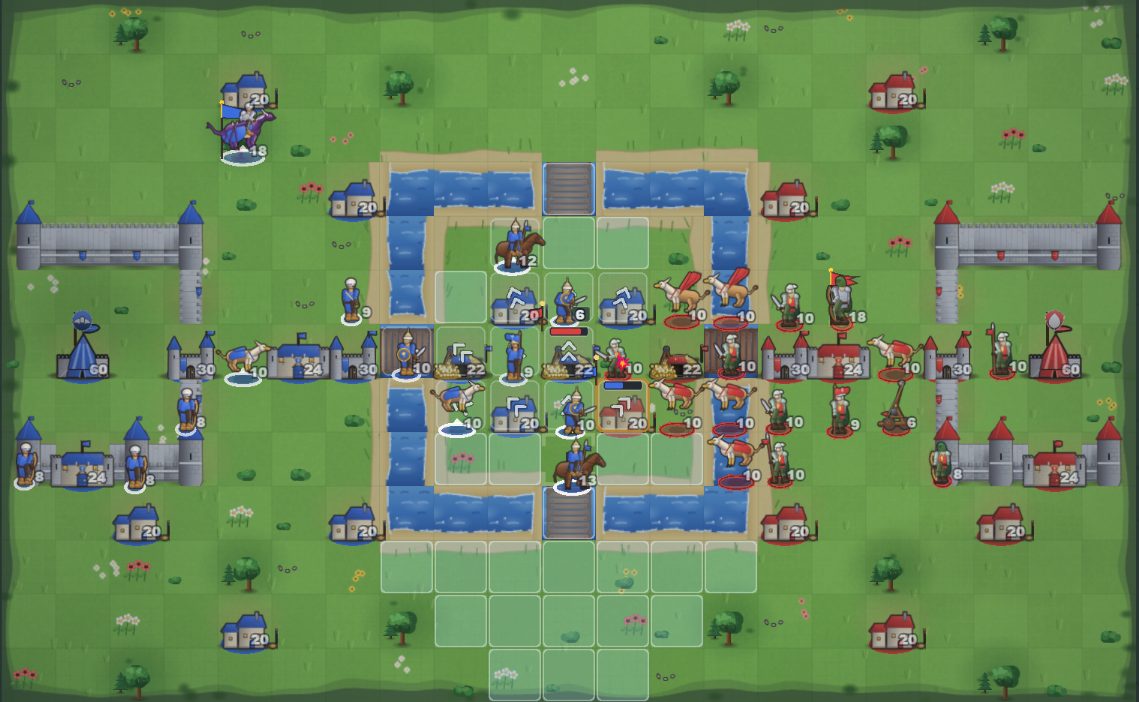
What an RTS asks of you
An RTS asks you to do many things in parallel. You gather resources, place buildings, train units and steer armies, all while the opponent does the same. Speed and attention count as much as plans. A good player manages a base and a battle in the same minute, often with many actions per minute. The game never pauses, so a distracted moment is a lost one.
What turn-based asks of you
A turn-based game asks you to think. You see the board, plan a sequence, execute it, then wait. Nothing moves until a player acts. The pressure comes from the quality of the decision, not from the speed of your hands. In Warfront you act until you end your turn: move, attack, capture and recruit in any order, then press End Turn. A move clock does exist, set at 120 seconds by default, but all it does is end a turn that runs too long.
The two styles compared
| Real-time strategy | Turn-based strategy | |
|---|---|---|
| Pace | Continuous, everyone at once | One player acts, then the next |
| What skill wins | Speed, multitasking, build order | Planning, reading the opponent, tempo |
| Session length | Often long, hard to pause | Short or long, with a natural pause every turn |
| On a phone | Hard: many fast taps | Natural: tap, think, tap |
| On a weak connection | A delay hurts everything | A delay costs a moment, not the match |
| Learning curve | Steep: mechanics first | Gentler: rules first, then depth |
One more difference is easy to miss. In an RTS the opponent is often reacting in the same second, so a plan is a guess about the next thirty seconds. In a turn-based game the whole position stands still while you decide, so a plan can be exact. That is why the same player can feel clumsy in one style and sharp in the other.
Other labels you will meet
- 4X: explore, expand, exploit, exterminate. Long games about whole empires, usually turn-based.
- Grand strategy: countries, diplomacy and economy over centuries, played slowly.
- Tactics: small battles on a grid where each unit counts. This is the family Warfront belongs to.
- Tower defence: you place defences while waves of enemies walk a path. Strategy, but against the game, not a player.
Which one to choose
Pick an RTS when you want adrenaline and are happy to practise fast hands. Pick turn-based when you want to think or play on a phone. If you only have a few minutes, turn-based is easier to fit in: on our site lately the median finished Warfront match ran about 11 minutes.
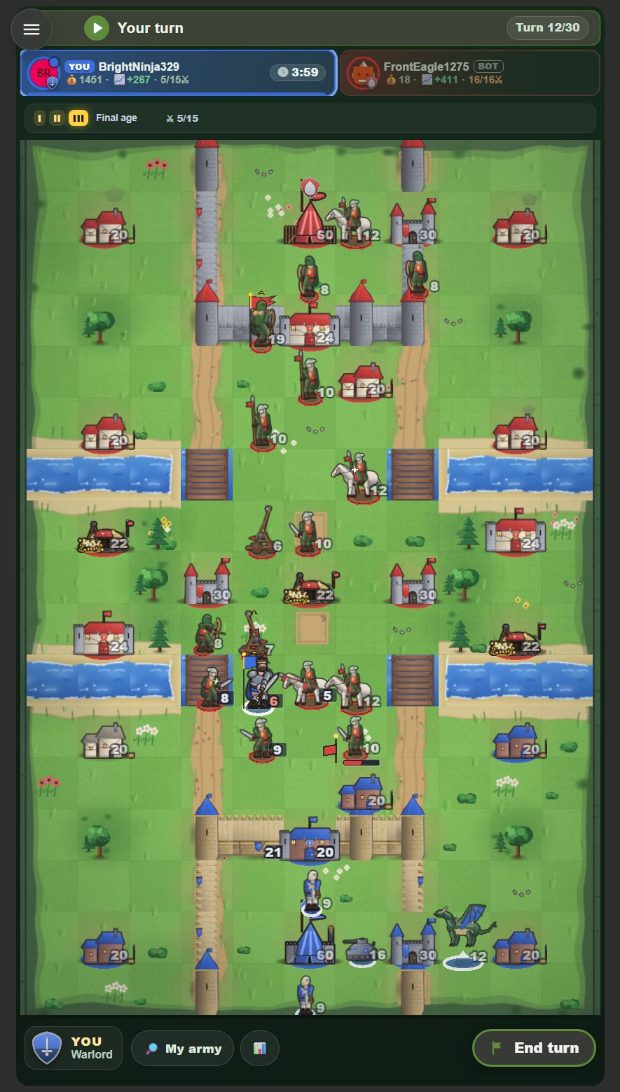
A practical test: ask whether you could put the game down for ten minutes mid-match. In an RTS you would come back to a lost base. A turn-based board at least waits for a move. Warfront still has a move clock, 120 seconds by default and adjustable from 60 to 600, so a live opponent will not wait forever. If the clock runs out, the game ends your turn for you. It does not make you forfeit.
Where Warfront sits
Warfront is turn-based, not an RTS. Nothing in it happens in real time. It is a tactical war game on a square grid for 2 to 4 players: each player leads one hero commander and a bought army, and wins by killing an enemy commander or capturing his headquarters.
What an RTS fan will find
- Armies with counters: Spearmen beat Cavalry, Archers beat flyers, siege weapons break walls.
- Three ages, from the Feudal Age through the Kingdom Age to the Gunpowder Age. Each upgrade improves the whole army and unlocks new units. Read games where you advance through ages for the full picture.
- Castles, a walled headquarters, and fantasy touches such as gryphons, dragons and meteors. More in medieval strategy games online.
What they will not find
- No gathering. Gold is the only resource and it arrives passively from the villages, mines and castles you hold.
- No base building. Bases are placed for you. The only construction is upgrading your headquarters wall.
- No workers, no build orders, no clicking race.
For a closer look at how a turn works, read turn-based war games online.
How a Warfront turn runs
At the start of your turn income arrives, upkeep is paid and your units heal. Then you act. A unit recruited this turn cannot move until the next one, and each building recruits once per turn. Cavalry that moves three or more tiles and then attacks charges for x1.3 damage. Phones are a fit too: Twin Rivers, the default map, is a portrait board that fits one screen, while wide boards need a drag to pan and a pinch to zoom.
What to do with this
If you liked the army side of an RTS but not the speed, try one 15-turn match against a bot. The game page has a Learn to Play button for a short coached match. If you miss gathering and base layout, Warfront will not give you those, and it is better to know that before you start.
Frequently Asked Questions
What is an RTS game?
RTS stands for real-time strategy. All players act at the same time and the clock never waits for anyone, so you gather resources, build, train units and command armies at once. Speed and multitasking matter as much as planning.
What is the difference between RTS and turn-based strategy?
In an RTS everyone acts continuously. In a turn-based game one player acts, ends the turn, and the next one acts. Turn-based rewards planning and reading the opponent, and it suits phones and slower connections better.
Is Warfront an RTS?
No. Warfront is turn-based and nothing moves until a player acts. The only clock is a move timer, 120 seconds by default, which ends a turn that runs long.
Do I have to gather resources or build a base in Warfront?
No. Gold is the only resource and it arrives passively from the villages, gold mines and castles you hold. Bases are pre-placed, and the only thing you build is a stronger wall on your headquarters.
Which is easier for a beginner, RTS or turn-based?
Turn-based is usually gentler. You can stop and think, so you learn the rules first and the speed never gets in the way. Warfront also offers a short coached match through its Learn to Play button.