Strategy Games Like Chess, With Armies and Gold
Strategy games like chess share four traits: no dice, nothing hidden, a loss that traces back to your own plan, and a king you cannot afford to lose. Warfront, a free turn-based war game on a square grid, keeps all four and adds an economy, an army you buy, and three ages. It is a different game, but a chess player will recognise the way of thinking.
What makes a game feel like chess
Chess feels the way it does for a few reasons that have nothing to do with the pieces.
- No luck. The same move gives the same result every time.
- Nothing hidden. Both players see the whole board.
- You lose by your own plan. There is no random event to blame.
- A king. One piece must be protected, and losing it ends the game.
What Warfront keeps
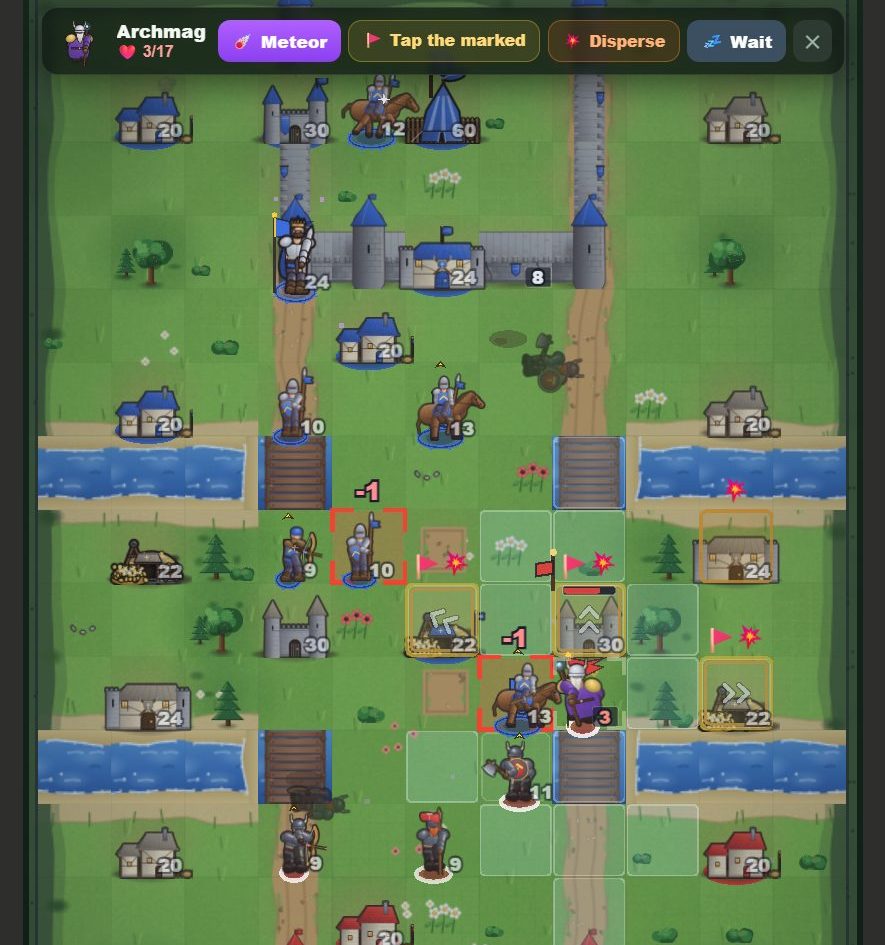
Damage is deterministic. Before you commit an attack the game shows a forecast of the result, so you choose with full information. The full board is visible at all times. Each player leads one hero commander, and killing a commander eliminates that seat. Capturing the enemy headquarters does the same.
So the king instinct carries over directly. Your Warlord, Archmage, Ranger or Sky Marshal is strong, but if he dies you lose even if your army is intact. Keeping him useful and alive is the first skill to learn.
The difference is that a chess king hides and a Warfront commander fights. The Warlord has 24 HP and the Archmage 17, so each commander has a different risk. A strong hero in front wins fights. A strong hero in front also gives the enemy a target worth ending the game for. That tension has no equivalent in chess, and it is the most interesting thing to learn.
What it adds
Gold
Gold is the only resource. You earn it passively from villages, gold mines and castles (the Keep on the board), and spend it to recruit. There are no workers and nothing to gather. A fielded unit also costs 13% of its price each turn, and your army is capped at 8 plus one per building you own, up to 16 units.
One move per unit
In chess you make one move a turn. Here you act until you end the turn: move every unit, attack, capture, recruit. A unit can usually move then attack. The Catapult and Cannon must stand still to fire.
Counters
Units are not interchangeable. A strong matchup deals x1.75 damage and a weak one x0.6. Spearmen beat Cavalry, Cavalry beats Archers, Archers beat flyers. The table is per attacker and is not a simple loop, so you learn it by playing.
Ages and heroes
You can pay to advance from the Feudal Age to the Kingdom Age and then to the Gunpowder Age. Each gives your whole army a bonus and unlocks new units. Heroes have a skill that charges over turns and then fires, such as the Archmage's Meteor.
Chess and Warfront side by side
| Chess | Warfront | |
|---|---|---|
| Dice | None | None, with a forecast before each attack |
| Hidden information | None | None |
| Moves per turn | One | As many as you have units, then End Turn |
| Pieces | 16 per side, fixed | A bought army, up to 16 units including the hero |
| Economy | None | Gold from buildings, minus 13% upkeep |
| How you win | Checkmate the king | Kill an enemy commander or capture his headquarters |
| Typical length | Set by the time control | About 11 minutes on our site lately |
Other relatives worth a look
If you like the family, four public-domain games are worth trying. Shogi is chess with captured pieces that you can drop back onto the board. Xiangqi is the Chinese relative with a river across the middle and a palace for the general. Go replaces pieces with territory and is the purest test of positional judgement. Checkers is the simplest of the five and a good first lesson in forcing moves.
Habits that transfer, and habits that do not
They transfer: look at what the opponent threatens before your own plan, protect your commander, trade only when the trade helps you, and count tempo.
They do not: in Warfront material is not fixed, so a loss can be rebuilt with gold. Waiting is also expensive, because income flows to whoever holds more buildings, and a seat with fewer than 80% of the best rival's buildings gets a 35% income boost to stay in the game. Take territory early. A chess-style quiet turn can cost you the map.
Your first game
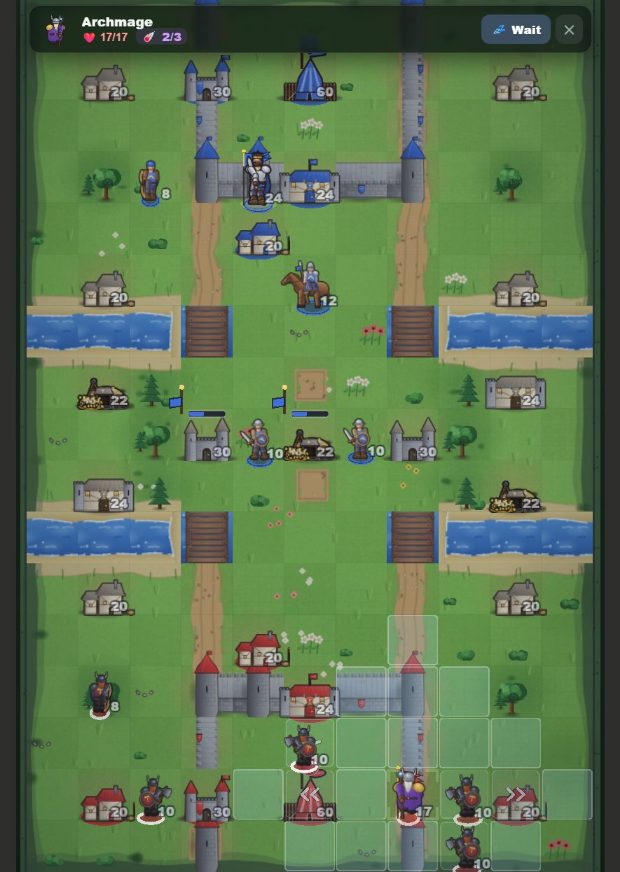
Each side starts with two Swordsmen, one Archer and the hero on a walled headquarters. The first Play Now match lasts 15 turns, and the standard limit is 30. The game page also has a Learn to Play button that starts a short match with coaching on. Play it against a bot on easy first. You will lose a few pieces to counters you did not see coming, and that is the cheapest way to learn the table.
Where to go next
Chess is the game most played on Playgridia, so the road runs both ways. If you came here for chess, play it here or read how to play chess. If chess made you curious about a game with armies, start a 15-turn Warfront match, or invite a friend with a link as described in 2 player strategy games online.
Frequently Asked Questions
What are good strategy games like chess?
Look for no dice, no hidden information and a piece whose loss ends the game. Warfront is a turn-based war game with those traits plus gold, a bought army and three ages. Shogi, xiangqi, Go and checkers are older games in the same family.
Is there luck in Warfront like in a dice game?
No. Damage is deterministic and the game shows a forecast before you commit an attack. Counter-attacks hit at 75% strength, and a strong matchup deals 1.75 times damage, but the numbers are fixed.
Does Warfront have a king like chess?
Yes, in the sense that matters. Each player leads one hero commander, and if he is killed that seat is eliminated. You also lose if the enemy captures your headquarters.
How is Warfront different from chess?
You buy your army with gold, you move every unit each turn instead of one piece, units counter each other, and you can advance through three ages. Chess has none of these, and its pieces are fixed at the start.
Can a chess player win at Warfront straight away?
The habits of reading threats, protecting your commander and counting tempo help a lot. What is new is the economy: you must capture buildings to earn gold, and an idle army falls behind. A bot on easy is a safe place to learn it.