How to Play Chess: Rules, Castling, Clock | Playgridia
How to play chess — the short answer: two players move pieces on an 8×8 board, the aim is to checkmate your opponent's king. Here, those rules never change; what changes is the board's appearance and the clock you choose.
How Pieces Move
Pawns move forward one square (two squares on their first move) and capture diagonally; rooks move horizontally or vertically any number of squares; bishops move diagonally any distance; knights move in an L-shape and can jump over pieces; the queen moves like rooks and bishops combined; the king moves one square in any direction. These moves are FIDE's own — the engine never deviates on any board.
Three special moves: castling, en passant, promotion
Castling requires all five conditions: the king is not in check, the castling right is still available, the squares between king and rook are empty, the rook remains in its corner, and the king doesn't pass through or land on an attacked square. If even one condition is missing, castling is illegal — not when the king is in check, not if either piece has moved before, and not if the king passes through an attacked square.
En passant is only legal immediately after an enemy pawn advances two squares; if not played on the next move, the right is lost forever.
Promotion occurs when a pawn reaches the last rank — the board asks which piece you want (queen, rook, bishop, or knight). If no answer arrives (a bot move, or a client with connection trouble), the server silently promotes to queen, because the board always asks a human; an unanswered promotion isn't a human move anyway.
Check, Checkmate, Stalemate, and Four Ways to Draw
Check means the king is under attack. If no legal move escapes that threat, it's checkmate and the game ends at once. If no legal moves exist but the king is not under attack, it's stalemate — not a loss, a draw.
Four separate routes lead to a draw. Threefold repetition: the same position (same pieces, same castling rights, same en passant square if any) occurs three times. Fifty-move rule: 100 half-moves pass with neither pawn moves nor captures. Insufficient material: only kings remain, or a king and a single knight, or a king and a single bishop, or both sides have only a single bishop on the same colour. Draw by agreement: one player offers, the other accepts.
One interesting detail: if your opponent's time runs out, you normally win — but if the board shows you lack the material to checkmate (say, only a knight or bishop left), this is not a victory but a draw. This is FIDE rule 6.9, and many chess resources overlook it: sufficient material is a pawn, a rook, a queen, or at least two minor pieces; without these, a flag fall doesn't give you the win.
Clock: Seven Time Controls, Default 10+0
| Control | Time + increment | Family |
|---|---|---|
| 1+0 | 1 minute, no increment | Bullet |
| 2+1 | 2 minutes + 1 second per move | Bullet |
| 3+2 | 3 minutes + 2 seconds per move | Blitz |
| 5+0 | 5 minutes, no increment | Blitz |
| 10+0 (default) | 10 minutes, no increment | Rapid |
| 15+10 | 15 minutes + 10 seconds per move | Rapid |
| 30+0 | 30 minutes, no increment | Classical |
Time works as total time + Fischer increment: each side starts with its opening balance, and increment seconds are added after each move completes — a move ending in checkmate earns no increment. There is no unlimited-time option; the longest control is 30 minutes per side. The default is deliberately rapid (10+0), not blitz: a new player starting at three minutes can lose on time before the board gets a proper look.
Four Boards, One Rule Book
Alongside the free Classic board, there are three premium boards: Emberhold, Eaglecrown, and Duskhollow. Each has its own capture animation, music, and sound set. But the rule engine never sees which board is open: move generation, check/checkmate detection, castling, en passant, promotion, and all draw calculations flow through a single function set, and none of these functions take board identity as a parameter. You play exactly the same game on Classic and on Duskhollow right to the final legal move; no board purchase grants a rules advantage.
Against a Bot: Three Real Difficulty Levels
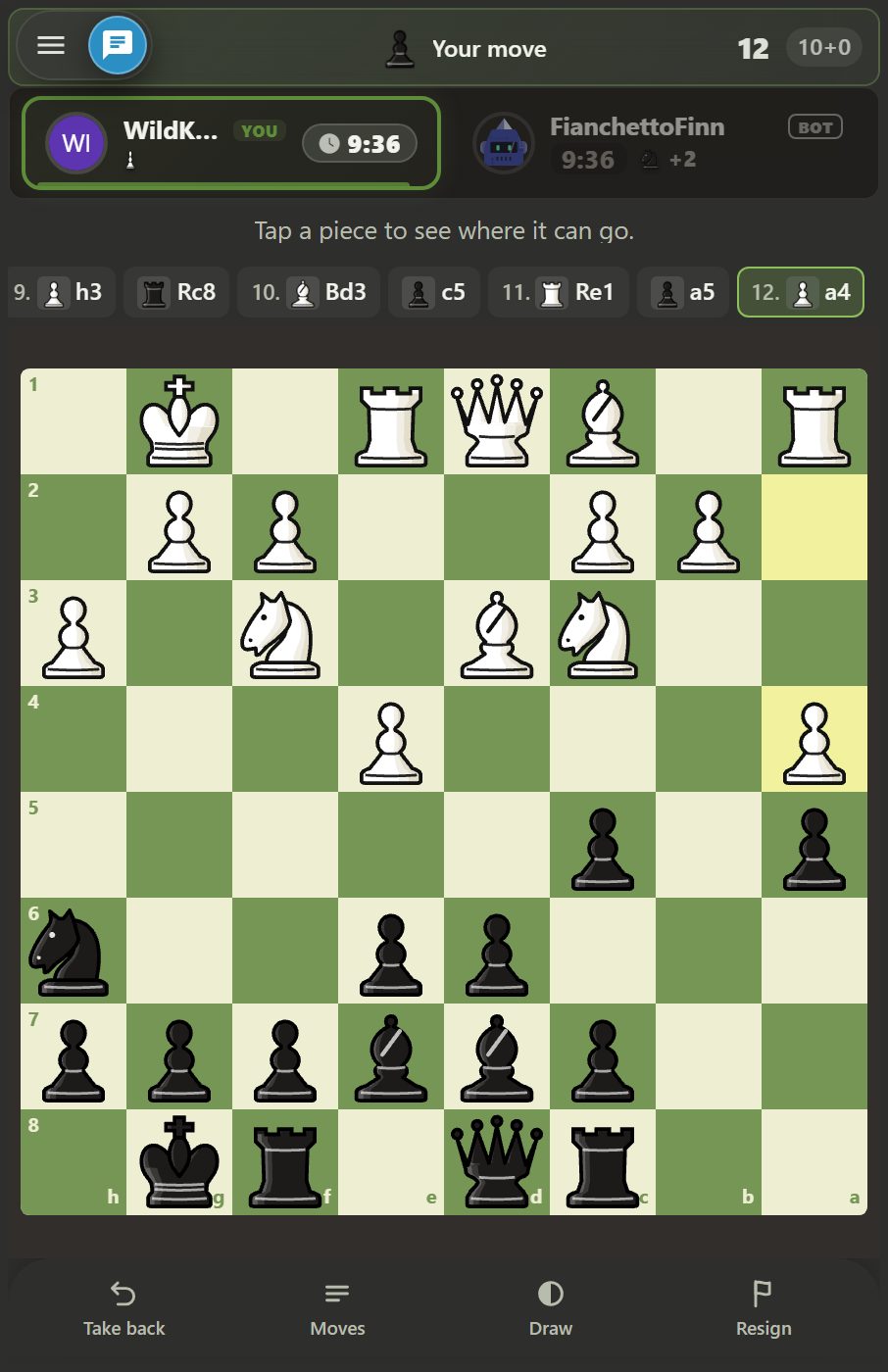
The bot plays at three levels, and the difference between them is not speed but real search depth: easy searches 2 half-moves (ply) deep, medium 5 ply, hard 7 ply. Easy level deliberately never resigns — a new player learning to finish a won position shouldn't lose that practice because the bot gives up early.
Takeback Only Against Bots; Clock Doesn't Stop on Disconnect
Takeback exists, but only in matches against bots: when it's your turn, you can take back your last move and the bot's response. The position reverts, but the time spent stays spent — the clock adjusts back by the increment those moves earned. There is no limit to how many times you can use it. The reason this is limited to bot games is simple: to be rated, a chess game requires at least two human players to have sat down; a bot game is never rated, so there's no result to protect. Between two humans, there's no takeback.
If your connection drops, your opponent doesn't automatically win: a bot temporarily takes your seat, and you can reclaim it when you return. But the clock keeps running as if you were there — it doesn't stop because you disconnected. When the game ends, the score is written in the scale chess has used for two centuries: win 1, draw ½, loss 0.
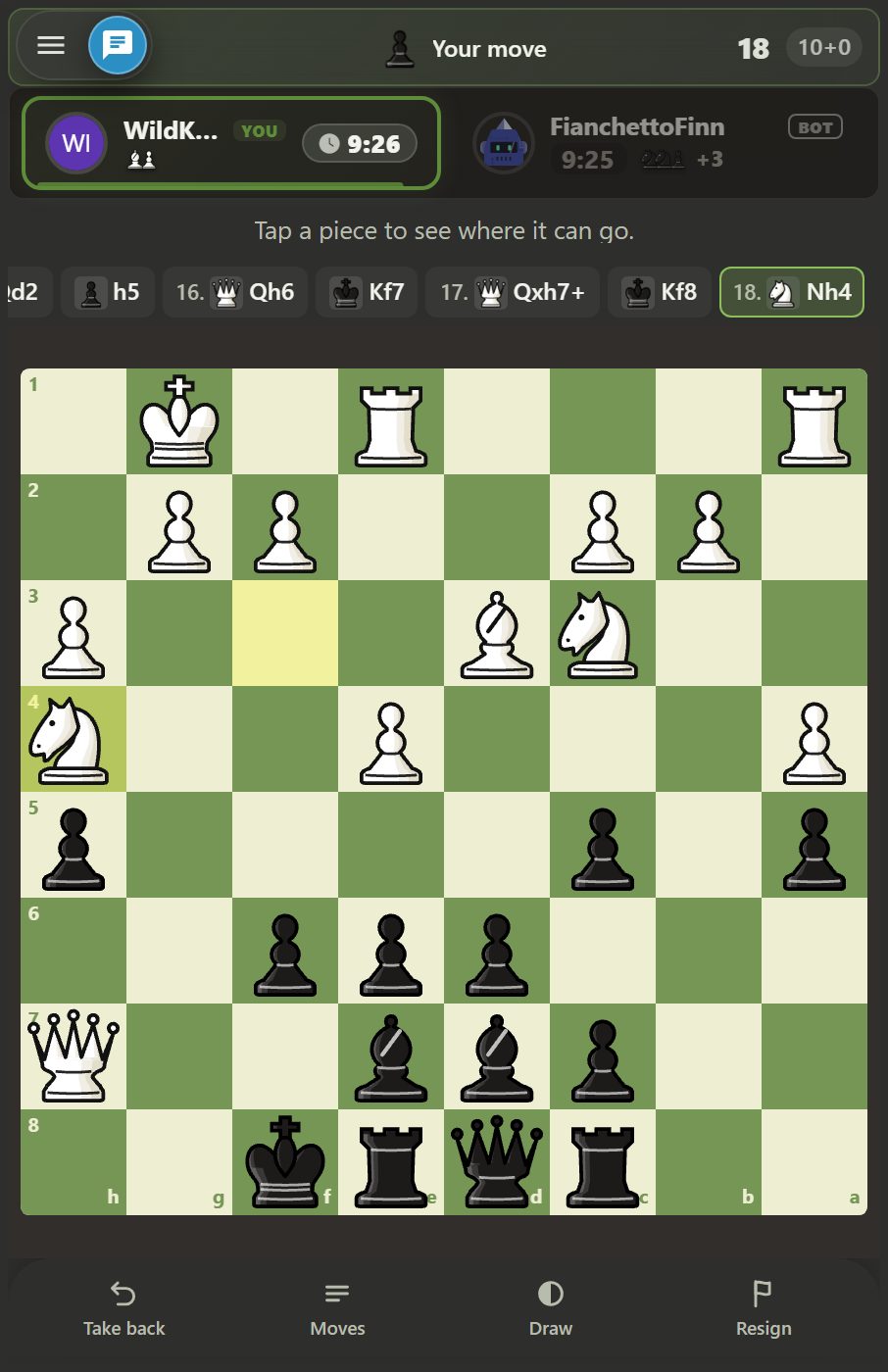
If you're playing your first match, don't change the default 10+0 rapid control, start against easy bots, and if you struggle to finish a won position, don't hesitate to use the takeback button — there's no limit. Since the rules are identical across all four boards, pick a board for looks alone. For another two-player classic, check out backgammon or browse two-player online games in general.
Frequently Asked Questions
How do you castle in chess?
Castling requires that the king and the rook on that side have never moved, the squares between them are empty, the king is not in check, and neither the square the king passes through nor the square it lands on is under attack. If any one of these five conditions fails, castling is illegal. Both kingside (short) and queenside (long) castling are possible for both colours.
What happens if I don't choose a piece for promotion?
When a pawn reaches the last rank, the board asks which piece you want: queen, rook, bishop, or knight. If no answer arrives — for instance, a bot is moving or the client has connection trouble — the system automatically promotes to a queen, because the board always asks a human player.
My opponent's time ran out but I didn't win. Why?
By FIDE rule 6.9, even if your opponent's flag falls, if your remaining material cannot deliver checkmate (for example, only a knight or bishop left), the game is a draw, not a win for you. Material sufficient for checkmate is a pawn, a rook, a queen, or at least two minor pieces.
How does the increment (increment) work on the chess clock?
Depending on the time control you choose, both players start with an opening time; increment seconds are added to that player's clock after each move is completed, never on the first move. The default control has no increment at 10 minutes (10+0); the longest control is 30 minutes, and there is no unlimited-time option.
Which chess board should I pick? Do the rules change?
No, they don't. Classic, Emberhold, Eaglecrown, and Duskhollow all play by identical rules; the rule engine doesn't even see which board is selected. Choosing a board is purely a visual and audio preference — from piece capture animations to music.
How does takeback work against bots?
In matches against bots only, when it's your turn, you can take back your last move and the bot's response; the position reverts but the time spent stays spent. There is no limit to how many times you can use it because the time you spent already pays the price. Between two human players, this feature doesn't exist, because their game is always rated.