How Draws Work in Chess: Stalemate, Repetition, 50-Move Rule
How do draws happen in chess? In six ways: stalemate, threefold repetition, fifty-move rule, insufficient material, draw by agreement, or time expires without your opponent having mating material. The engine ends some of these automatically, while others require one player to offer and the other to accept — knowing the difference keeps you from accidentally stalemating a winning position and throwing away victory.
Six ways to draw
The table below shows how each type of draw arises and when the engine ends the game automatically. The first four and the last are completely automatic — no one needs to propose anything. Draw by agreement is the only exception: one side must offer it and the other must accept.
| Method | How it happens | Engine ends when |
|---|---|---|
| Stalemate | The side to move is not in check but has no legal moves | Automatic, at the moment the move is made |
| Threefold repetition | The same board position, same player to move, and same castling rights appear three times | Automatic, when the third repetition occurs |
| Fifty-move rule | 100 half-moves pass without a piece being captured or a pawn moving | Automatic, when the counter reaches 100 |
| Insufficient material | The remaining pieces cannot allow either side to checkmate the other (e.g., bare kings) | Automatic, the moment the position arises |
| Draw by agreement | One side offers a draw and the other accepts | When accepted, after the clock is stopped |
| Time ran out, no mating material | Flag falls but opponent has no way to checkmate with their remaining pieces | Automatic — loss becomes a draw |
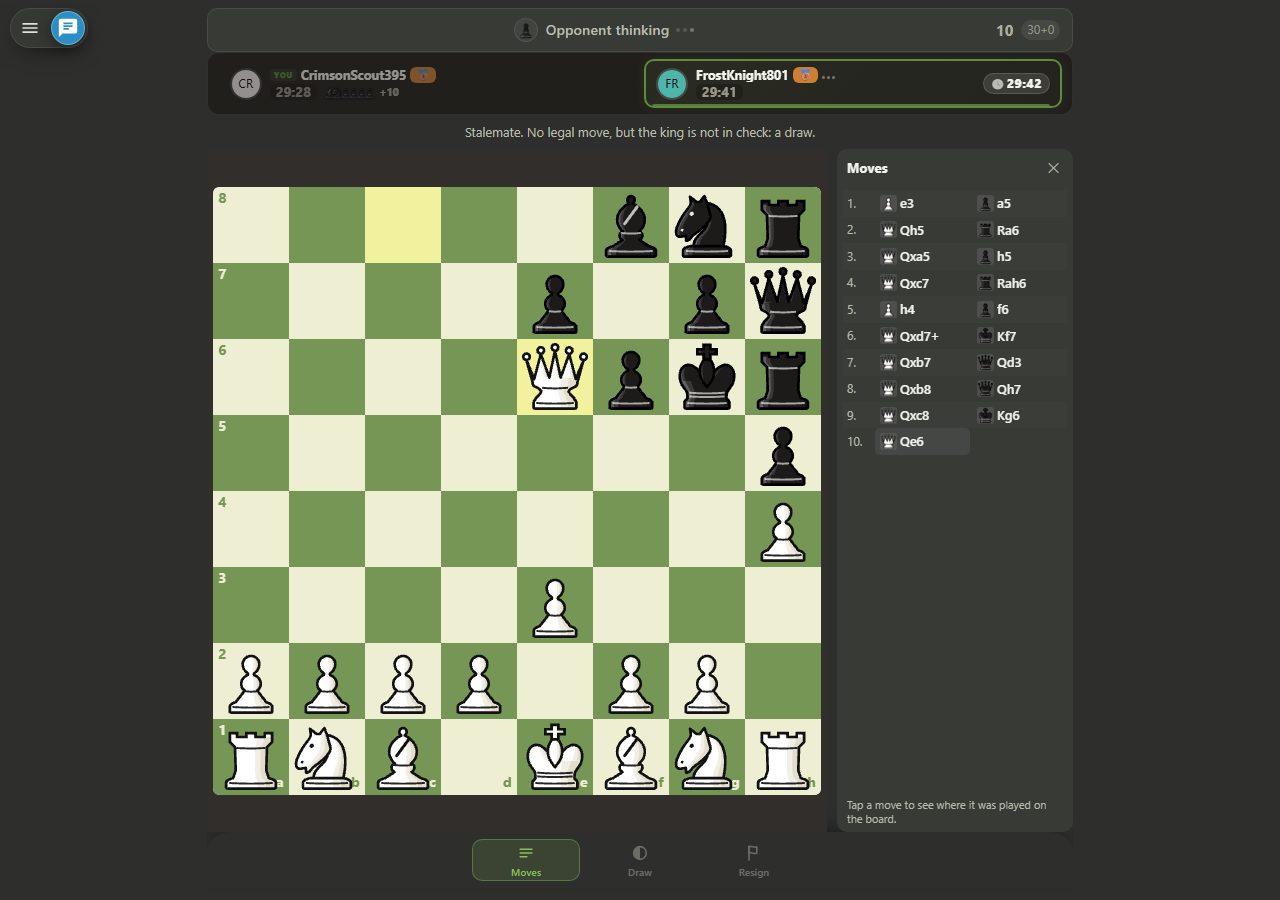
Stalemate: not in check, but no legal moves
Stalemate occurs when the side to move is not in check but has no legal moves available. This is not a loss — it counts as a draw. Beginners trip up here most: a player with huge material advantage cornering the opponent's king into a corner accidentally eliminates every square for it to move to, creates stalemate with their own hands, and watches their winning game evaporate. When hunting for mate with just a queen, the simplest way to avoid this trap is to always leave the king one escape square — and only close that final square on the very last move. No matter how large the material advantage, the moment stalemate occurs the score becomes ½–½, not 1–0.
Threefold repetition
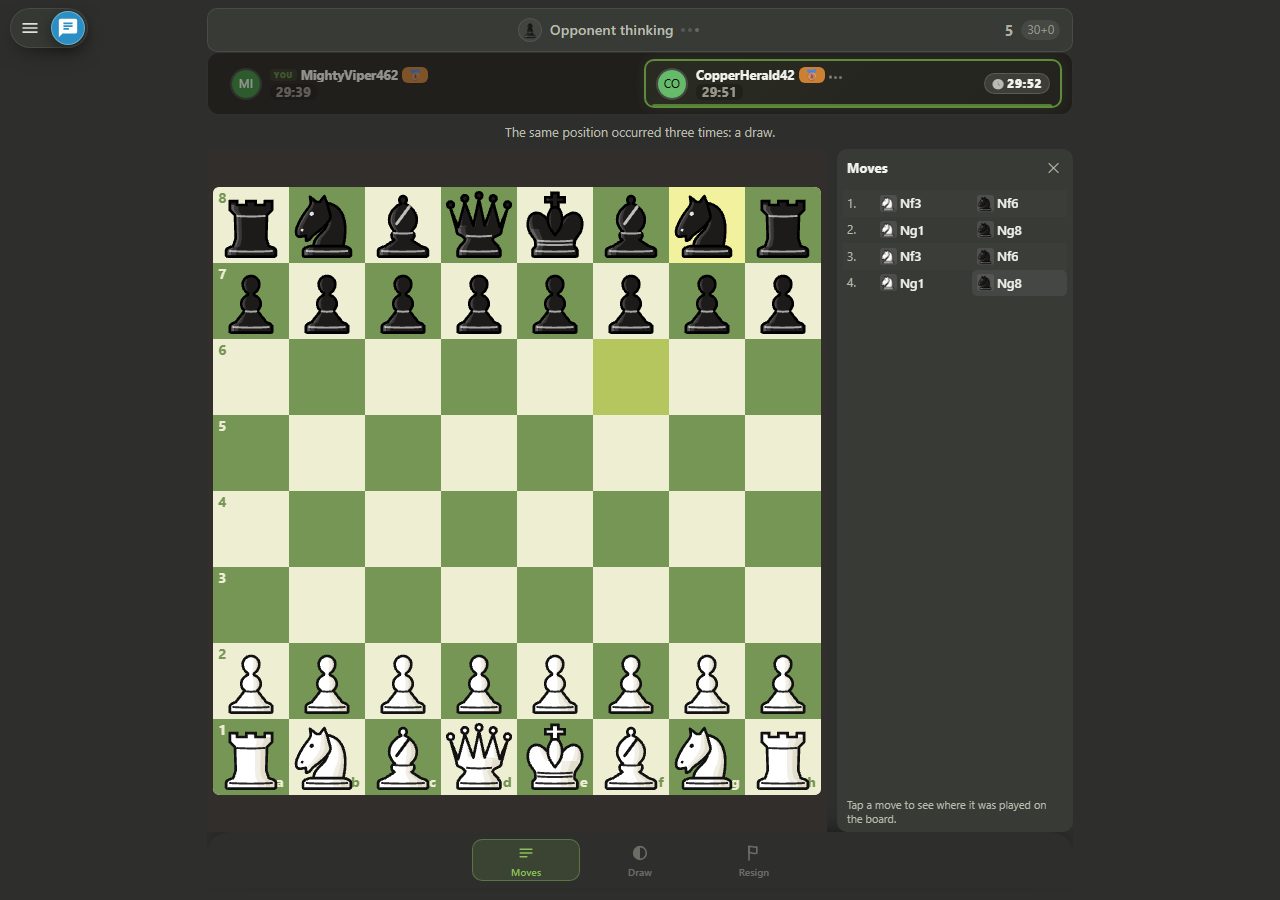
The threefold repetition rule counts POSITIONS, not moves: if the same arrangement of pieces, same player to move, and same castling rights appear three times, the game automatically becomes a draw. The simplest example is knights moving back and forth — the moment the starting position is recreated for the third time the engine ends the game automatically, no one needs to claim it. Because the engine compares positions by their piece placement, arriving at the same situation via different move orders also counts — what matters is that the board state is identical three times, not that the moves leading there are performed in exactly the same sequence.
Fifty-move rule
When the counter reaches 100 half-moves (50 full moves) and during that time neither a piece has been captured nor a pawn moved, the game automatically becomes a draw. The counter resets instantly the moment a piece is captured or a pawn moves — so during a long maneuvering phase, you can always push a pawn or capture a piece to restart the count from zero. This rule guarantees that one side cannot drag a position on forever without making progress; it acts as a practical time limit, especially for a player with material advantage who cannot seem to find checkmate.
Insufficient material
The engine recognizes four FIDE dead positions and ends the game instantly the moment one occurs — without waiting for stalemate or flag drop — because no side can possibly deliver checkmate: bare king versus bare king, king and knight versus bare king, king and bishop versus bare king, and king and bishop versus king and bishop (bishops on the same-colored squares). The instant any of these four situations arises on the board a draw is immediately declared; neither player needs to do or propose anything, because no checkmate is possible with the material left on the board.
Draw by agreement and offering to a bot
A draw offer is not an event but an open field that lasts until answered: if you make an offer and then move, your offer is automatically withdrawn; if your opponent moves without accepting, they rejected it silently. Your opponent also has a decline button. If your opponent counters your offer with their own offer — meaning they offer back against a standing offer — that counts as acceptance directly. When you offer a draw to a bot, it answers after a brief thinking pause even if it is not the bot's turn; this is the only place on the platform where a bot thinks outside its own turn, because an offer normally comes during your move and the bot is not expecting to act then — without this special pathway the offer would sit unanswered until you move (and thus withdraw it yourself).
Time ran out, but you could not win
A fallen flag does not always mean a loss: by FIDE rule 6.9, even if your flag falls, if your opponent's remaining pieces make checkmate impossible (for example only a king, or too few minor pieces), the result is not your opponent's victory but a draw — your opponent must actually have enough material to deliver mate. The site offers seven different time controls, from one-minute bullet to 30-minute classical; the default and most prominent is 10+0 (no increment). When a game ends, the score is written as 1 (win) / ½ (draw) / 0 (loss) — the scoring system chess has used for two centuries.
In summary: stalemate and repetition often stem from carelessness, fifty moves and insufficient material close a game that is dragging on, and draw by agreement is a choice in your hands. When evaluating a position, first check whether your opponent truly has a legal move to play — without it, your big material edge will not save you from a draw. For the full rules move by move, see how to play chess; for mating techniques, see how to checkmate in chess; and for special moves like castling and en passant, see special moves in chess. All these rules work live at a chess table — for most players most of them remain theory until you run into a stalemate.
Frequently Asked Questions
What is the difference between stalemate and checkmate?
Stalemate is when the side to move is not in check but has no legal moves — it counts as a draw. Checkmate is when the king is in check and cannot escape, which wins the game. For the winning side stalemate is a major blunder because the result is ½–½, not 1–0.
In threefold repetition, does the rule count moves or positions?
Positions, not moves. If the arrangement of pieces, player to move, and castling rights are the same three times, the game automatically becomes a draw; the moves leading there do not need to be played in exactly the same order.
When does the fifty-move rule counter reset?
The counter resets instantly when a piece is captured or a pawn moves. If 100 half-moves pass without either happening, the game automatically becomes a draw.
What does insufficient material mean in chess?
It is one of four situations in which neither side can possibly deliver checkmate: bare king versus bare king, king and knight versus bare king, king and bishop versus bare king, or king and bishop versus king and bishop on the same-colored squares. The moment one of these arises the game ends immediately.
How do I withdraw or decline a draw offer?
An offer remains open until answered; whichever side moves first that standing offer silently falls — if you move your offer is withdrawn, if your opponent moves it is rejected. Your opponent also has a decline button. If your opponent offers a draw in response to a standing offer — meaning they counter-offer — this counts as acceptance directly.
Do I always lose if time runs out?
No. Even if your flag falls, if your opponent lacks the material to deliver checkmate, FIDE rule 6.9 makes the result a draw, not your opponent's victory. Your opponent must have enough material to actually checkmate: a pawn, rook, queen, or at least two minor pieces.