How to Checkmate in Chess? 4-Move Mate and Patterns
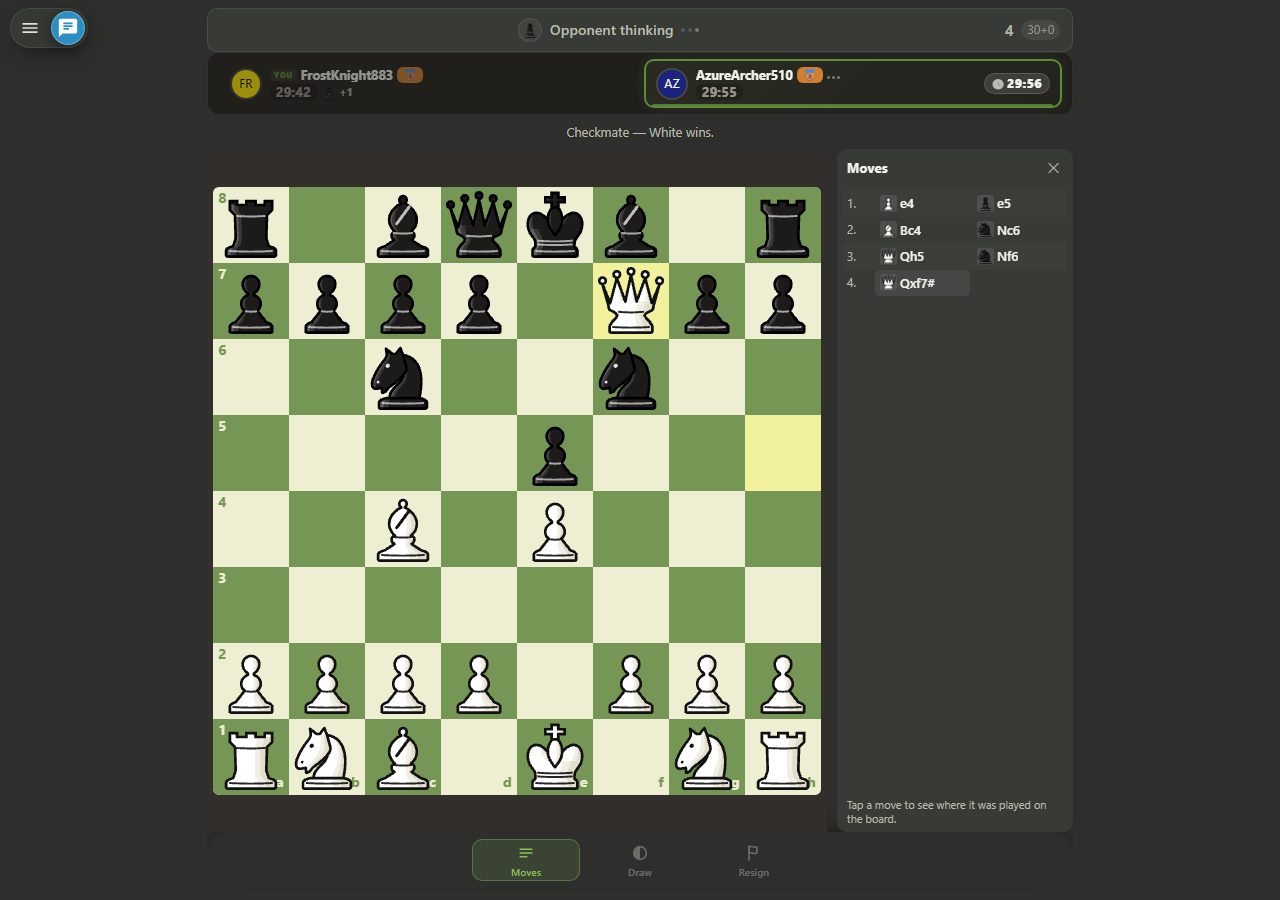
How do you checkmate in chess? The fastest way takes four moves: 1.e4 e5 2.Bc4 Nc6 3.Qh5 Nf6?? 4.Qxf7# — this exact sequence was played on this site's own chess engine, and the engine called it "checkmate, white wins." But this article isn't only here to teach you that trap — it's here so you never fall for it again either: one reader wants to set the trap, another just lost to it and wants the antidote, and both get their answer on the same page.
Check, Checkmate and Stalemate Are Not the Same Thing
Check means your king can be captured on the next move; you must remove that threat. There are three ways to do it: move the king to a square that isn't attacked, block with a piece, or capture the attacking piece.
Checkmate is when the king is under attack and none of those three escapes exist. The game ends on that move, no countdown — there's no waiting for the next move to see if the king finds a way out.
Stalemate looks like the opposite: the king isn't under attack, but there's no legal move to make at all. That's not a loss — it's a draw, the most bitter way to end a won position. The board spells out all three in writing: "Checkmate — White wins" or "Stalemate. No legal moves remain but the king isn't under attack: draw."
4-Move Mate: How to Set Up Scholar's Mate
The sequence: 1.e4 e5 2.Bc4 Nc6 3.Qh5 Nf6?? 4.Qxf7#. The engine confirmed checkmate here because f7 is defended only by the black king. White's bishop on c4 and queen on h5 both look at the same square, f7; when the queen captures there the bishop protects her from recapture, and the king has no square to flee to.
The move that actually loses the game is 3...Nf6??. The knight looks like it's attacking the queen on h5, but it doesn't defend f7 — trying to threaten instead of counting the threat against you is the most expensive habit in the opening. Three conditions stack on that one move: the king is under attack, there's no square to flee to, and no piece can block — once all three are true at once, the game ends right there.
Other Fast Mates Verified on the Engine
The five sequences below were each played out on this site's own chess engine; the result the engine gave is listed next to each one — nothing rounded, nothing extended.
| Pattern | Verified sequence | Engine result |
|---|---|---|
| Scholar's Mate (4-move mate) | 1.e4 e5 2.Bc4 Nc6 3.Qh5 Nf6?? 4.Qxf7# | checkmate, white wins |
| Scholar's Mate defence | 1.e4 e5 2.Bc4 Nc6 3.Qh5 g6 4.Qf3 Nf6 | game continues |
| Fool's Mate (2-move mate) | 1.f3 e5 2.g4 Qh4# | checkmate, black wins |
| Légal's Mate | 1.e4 e5 2.Nf3 Nc6 3.Bc4 d6 4.Nc3 Bg4 5.Nxe5 Bxd1?? 6.Bxf7+ Ke7 7.Nd5# | checkmate, white wins |
| Blackburne Trap | 1.e4 e5 2.Nf3 Nc6 3.Bc4 Nd4 4.Nxe5?? Qg5 5.Nxf7 Qxg2 6.Rf1 Qxe4+ 7.Be2 Nf3# | checkmate, black wins |
The shortest mate in the table is Fool's Mate — just two moves, and the loser is the one who played white, which is exactly why the name stuck. The other two traps work differently: in Légal's Mate White gives up the queen, while in the Blackburne Trap White's knight on f7 forks Black's queen and the h8 rook — but instead of retreating, Black counterattacks with Qxg2 and Qxe4+ and mates with the knight. The rook never leaves h8: White never gets to cash the fork in. Both need the opponent to fall for it, but when they do, the engine confirms checkmate in both.
Not Falling for the Same Trap: The One-Move Antidote
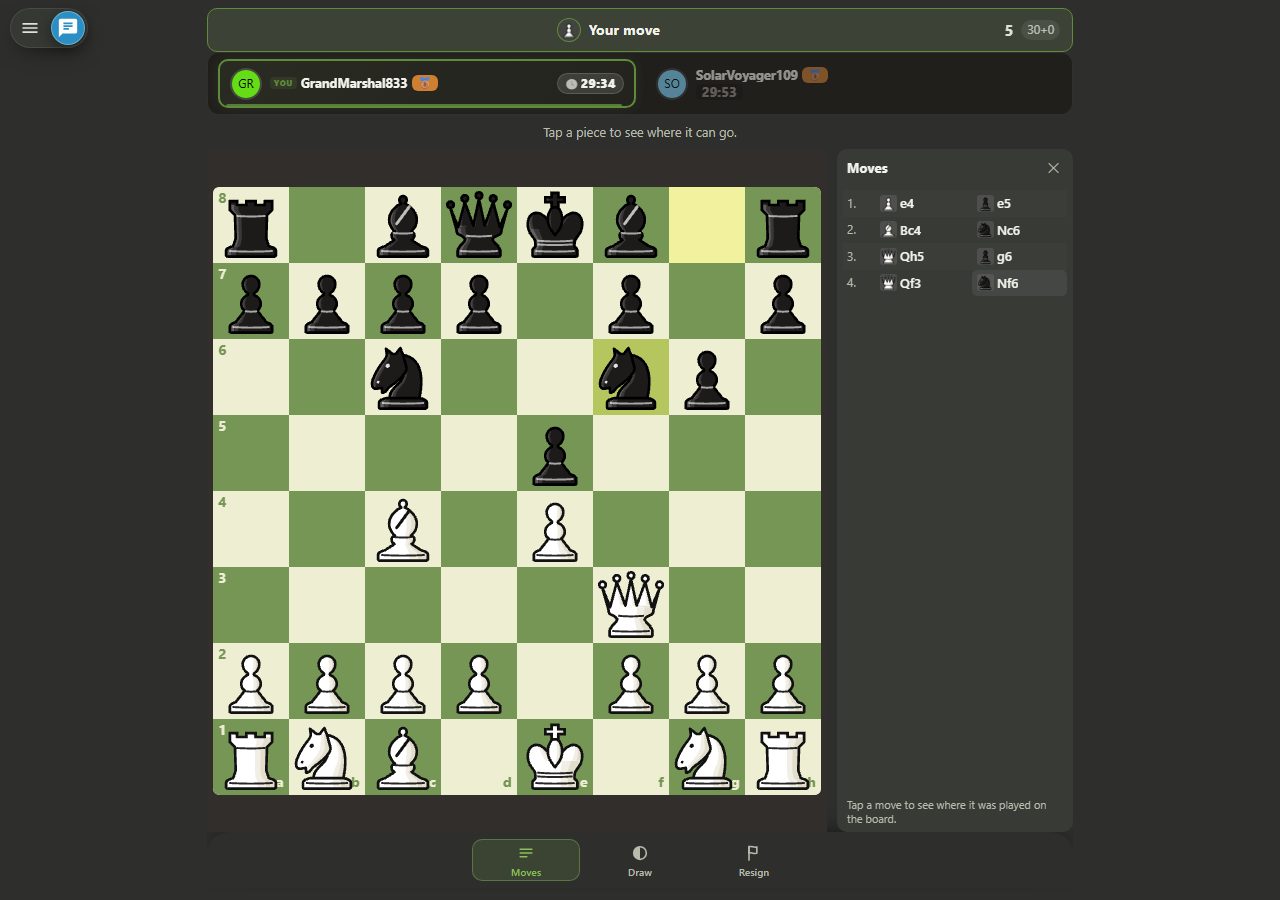
The antidote is one move: 3...g6! The pawn chases the queen away and closes off f7 at the same time. Play continues 4.Qf3 Nf6; the engine calls this position "game continues" — black is completely fine.
The general rule follows from this: when the queen comes out early, develop a piece by chasing it. If chasing the queen doesn't bring a new piece into the game, you're the one paying for the chase. This isn't specific to Scholar's Mate — it's how you play against any early queen sortie.
To be honest, Scholar's Mate works exactly once. Your opponent falls for it once, and the next time they already know g6. The rest of this article is the part that still pays off after your tenth game.
Four Checkmate Patterns Worth Actually Learning
Opening traps only work if your opponent makes a mistake; the four patterns below are the ones that will actually help you convert a won position into a real checkmate with your own hand, and they turn up again and again anywhere on the board, regardless of how much material is left.
Back-Rank Mate
If three pawns stand in front of a castled king and the king is boxed in behind them, a rook or queen landing on the back rank leaves the king with no square to run to. The antidote is one move: push one of the pawns forward one square to open an escape hatch for the king.
Ladder Mate (Two Rooks)
Two rooks take turns cutting off ranks; the king is forced back one rank each time and ends up mated at the edge of the board. This is the technique that finishes games where you've lost your queen but still have both rooks.
Queen-and-King Mate
The queen alone drives the enemy king to the edge of the board while your own king supports from across the way. This pattern carries the highest stalemate risk: if you seal off every square around the king in one go, an opponent with no threat and no move left is left in a draw instead of a loss.
Smothered Mate
A checkmate delivered by a knight against a king boxed in by its own pieces. The Blackburne Trap's final move, Nf3#, is a short example of it — the knight jumps to a square only a knight can reach, and the king's own pieces leave it nowhere to run.
When Neither Side Has Enough to Mate, the Game Is a Draw
The engine applies each of these situations separately and spells it out on the board in its own sentence. Under insufficient material, a king and a single knight, or a king and a single bishop, cannot deliver checkmate — the game ends in an automatic draw. Under threefold repetition, the same position occurring three times ends the game the same way. Under the fifty-move rule, fifty moves passing with no pawn move and no capture gives the same result.
The rule that surprises online players the most: if your opponent's time runs out but your own remaining material can't deliver checkmate — say, only a knight or a bishop is left — that's not a win, it's a draw. A draw offer, meanwhile, stays open until your opponent answers it or you make a move; the moment you move, the offer quietly disappears.
The Fastest Way to Practise Mates: Finish Them Against a Bot
The easy bot deliberately never resigns: a player learning to convert a won position into a checkmate needs to deliver that mate with their own hand, not have the opponent give up first. The medium and hard bots can resign once a few moves in a row confirm the same result.
Takeback is available against bots: take back the move that missed the mate and try again — the position comes back, the time spent doesn't, and there's no limit to how many times you can use it. There's no takeback against a human opponent. Touching a piece marks its legal squares on the board; while you're hunting for a mating pattern, those marks let the board itself answer "which square is actually open" — you learn to recognise the pattern by looking at the board, not by memorising it.
Learn these patterns first through openings, sharpen them with tactics practice, and the fastest way to try them is to sit down at a chessboard against a bot.
Frequently Asked Questions
Does the 4-move mate actually work?
Yes, but only if your opponent forgets to defend f7: the sequence 1.e4 e5 2.Bc4 Nc6 3.Qh5 Nf6?? 4.Qxf7# was verified as checkmate on this site's chess engine. An experienced opponent defends with 3...g6 in a single move and the trap is over. So it works exactly once, never a second time.
How do I defend against Scholar's Mate?
One move is enough: play 3...g6. The pawn chases the queen off h5 and closes off f7 at the same time; play continues with 4.Qf3 Nf6 and the game returns to normal. As a general rule, when the queen comes out early, develop a piece by chasing it.
What is stalemate in chess, and why does it count as a draw?
Stalemate is when the king is not under attack but there is no legal move left to play. Because the king isn't under attack it doesn't count as checkmate, and it isn't a loss either — by the rules, the game ends in a draw. Carelessly sealing off every one of your opponent's squares in a won position can drop you into exactly this draw.
Can I checkmate with a king and a single knight?
No. A king and a single knight, or a king and a single bishop, can't deliver checkmate on their own; the engine recognises this as insufficient material and ends the game in an automatic draw. The engine calls only bare kings, king plus one minor piece, and king and bishop against king and same-coloured bishop insufficient. Two knights do not end the game automatically, but they cannot force mate against correct defence either.
My opponent's time ran out but I didn't win — why?
Even if your opponent's time runs out, if your own remaining material can't deliver checkmate — say, only a knight or a bishop is left — that's a draw, not a win. The insufficient-material rule applies independently of the clock running out.
What's the shortest possible checkmate?
The shortest mate verified in this article is Fool's Mate: 1.f3 e5 2.g4 Qh4# ends the game in just two moves, and the loser is the player who had white. Scholar's Mate is the best-known trap that ends in four.