Chess Openings for Beginners: 9 Solid Choices
Chess openings aren't a list to memorize — they're different combinations of three principles: take the center, get your pieces into play quickly, and get your king to safety. This post walks through the openings you'll run into most often, move by move, and what to expect when you practice openings against the bot.
The table below lays out every move sequence used in this post at a glance; every line has been verified against this site's own chess engine, so none of them contain an illegal move.
| Opening | Verified Move Sequence |
|---|---|
| Italian Game | 1.e4 e5 2.Nf3 Nc6 3.Bc4 |
| Spanish (Ruy Lopez) | 1.e4 e5 2.Nf3 Nc6 3.Bb5 |
| Sicilian Defense (Open) | 1.e4 c5 2.Nf3 d6 3.d4 cxd4 4.Nxd4 Nf6 5.Nc3 |
| French Defense | 1.e4 e6 2.d4 d5 |
| Caro-Kann Defense | 1.e4 c6 2.d4 d5 |
| Scandinavian Defense | 1.e4 d5 2.exd5 Qxd5 3.Nc3 Qa5 |
| Queen's Gambit (Declined) | 1.d4 d5 2.c4 e6 3.Nc3 Nf6 |
| Indian Defense (King's Indian) | 1.d4 Nf6 2.c4 g6 3.Nc3 Bg7 |
| English Opening | 1.c4 e5 2.Nc3 Nf6 |
| A quiet setup leading to castling | 1.e4 e5 2.Nf3 Nc6 3.Bc4 Bc5 4.O-O Nf6 5.d3 d6 6.Bg5 |
An Opening Isn't Memorization — Three Principles
Don't let the hundreds of opening names intimidate you; behind all of them are three simple principles, and the order matters.
Take the center. The squares e4, d4, e5, and d5 are the four busiest squares on the board. A knight in the center attacks eight squares at once; a knight pushed to the edge, on the a- or h-file, only attacks four. Whoever controls the center gets pieces to either side of the board faster.
Develop your pieces, don't move the same one twice. What counts in the opening isn't the number of moves you've made, it's the number of pieces you've brought into play. Moving a knight or bishop early and then pulling it back just hands those moves to your opponent.
Get your king to safety — castle. This usually happens within the first ten moves, because a king left in the center becomes the target of every file that opens up. The line below shows what that looks like: 1.e4 e5 2.Nf3 Nc6 3.Bc4 Bc5 4.O-O Nf6 5.d3 d6 6.Bg5 — White has already castled by move four, tucking the king into the corner. You can find the five conditions castling requires in the pieces and moves post.
There's a fourth item too, and it's a forbidden one: bringing the queen out early. When the queen comes out early, the opponent chases it with simple pawn and piece moves; while you move the same piece a second time, they develop three different pieces. The three principles work together: the side that takes the center controls more squares, the pieces it develops defend those squares, and castling makes the whole setup safe.
Starting With 1.e4: The Italian and the Spanish
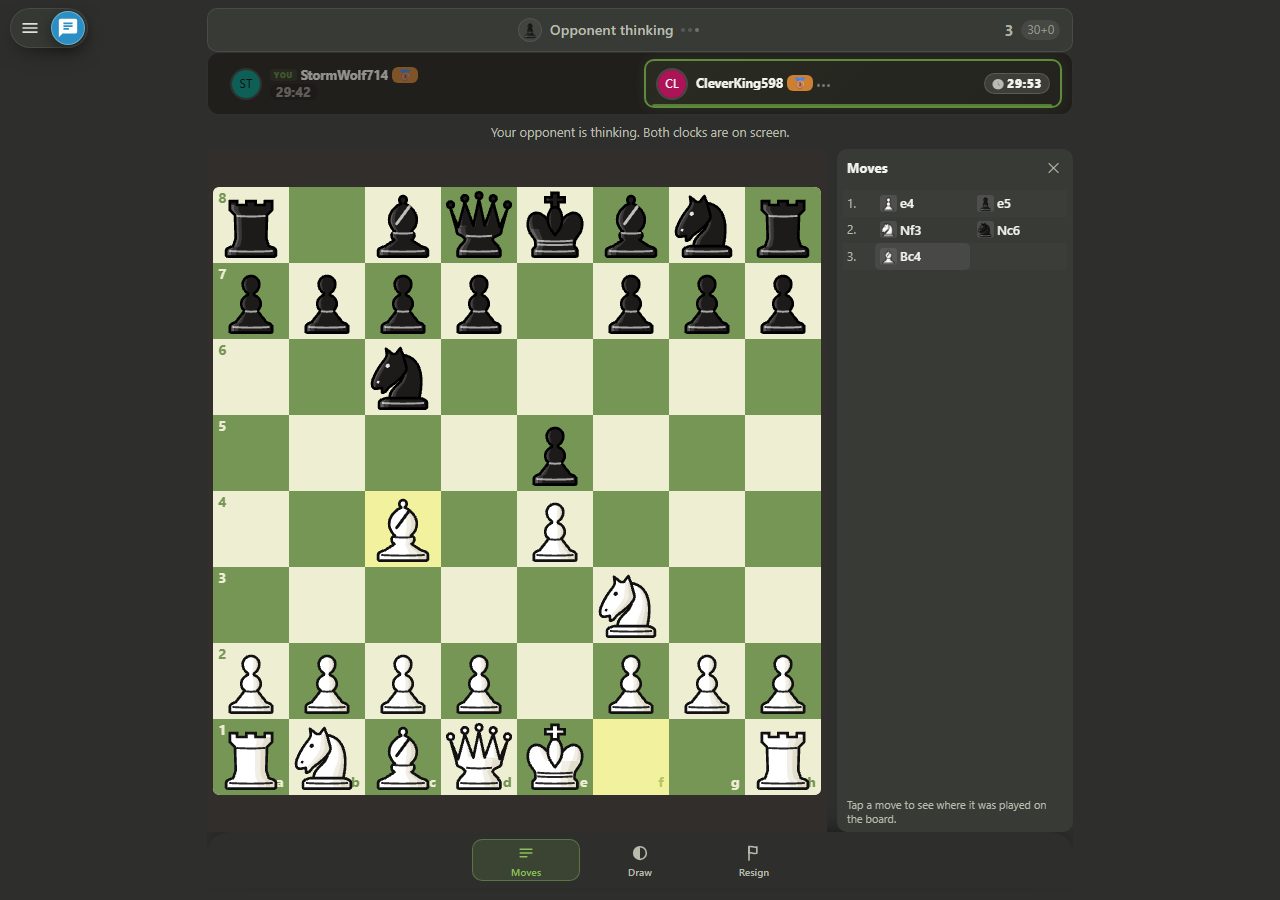
The Italian Game (1.e4 e5 2.Nf3 Nc6 3.Bc4) points the bishop straight at f7 — the only square in Black's opening position defended solely by the king, and so the weakest square on the board. This is the right first opening for a beginner: every piece's target is obvious, the plan is clear — with the bishop's target so plain, you're never confused about your next move.
The Spanish (Ruy Lopez) (1.e4 e5 2.Nf3 Nc6 3.Bb5) aims the bishop not at f7 but at the knight defending the e5 pawn. White doesn't win a piece right away; the pressure just keeps building and forces Black onto the defensive. It is slower, deeper play, and one of the most heavily analysed openings in the history of the game.
Both start with the same two moves; the choice is made on move three. That's how small a decision "learning an opening" actually is: once you've memorized two moves, everything after depends on which plan you pick.
Four Big Replies to 1.e4
The Sicilian Defense (1.e4 c5) is the sharpest and most-played defense, the one where Black answers not with a center pawn but a wing pawn. The open variation continues: 1.e4 c5 2.Nf3 d6 3.d4 cxd4 4.Nxd4 Nf6 5.Nc3 — White trades off the center pawn, and in exchange Black gets a half-open c-file.
The French Defense (1.e4 e6 2.d4 d5) gives Black a solid pawn chain; the price is that the c8 bishop stays cramped behind it. Good for players who like closed, planned games — the fighting is delayed, but the position doesn't fall apart easily.
The Caro-Kann Defense (1.e4 c6 2.d4 d5) carries the same idea as the French, but the bishop stays outside the chain. That's why it's known as "the French without the drawback" — you get the same solidity without trapping your bishop.
The Scandinavian Defense (1.e4 d5 2.exd5 Qxd5 3.Nc3 Qa5) trades immediately and brings the queen out early — it looks like it breaks the rule, but the queen is safe on a5, since nothing there can attack it with a pawn. It is the easiest of the four to learn: Black's plan is set by move three, with no long forcing lines to memorise.
1.d4 and the Flank Openings
The Queen's Gambit (1.d4 d5 2.c4 e6 3.Nc3 Nf6) is where White "offers" the c4 pawn; the pawn can't actually be kept permanently, the real goal is seizing the center. It is a classical, slow, solid game, and it is still a fixture of top-level tournament play today.
The King's Indian (Indian Defense, 1.d4 Nf6 2.c4 g6 3.Nc3 Bg7) is a defense where Black doesn't occupy the center right away; the bishop fianchettoes onto the long diagonal first, and the center gets challenged later. It calls for patience, a plan that reveals itself late.
The English Opening (1.c4 e5 2.Nc3 Nf6) plays like a color-reversed Sicilian, with White holding an extra tempo. It's a flexible choice for anyone who wants a path other than 1.e4 or 1.d4.
Practicing Openings Against the Bot
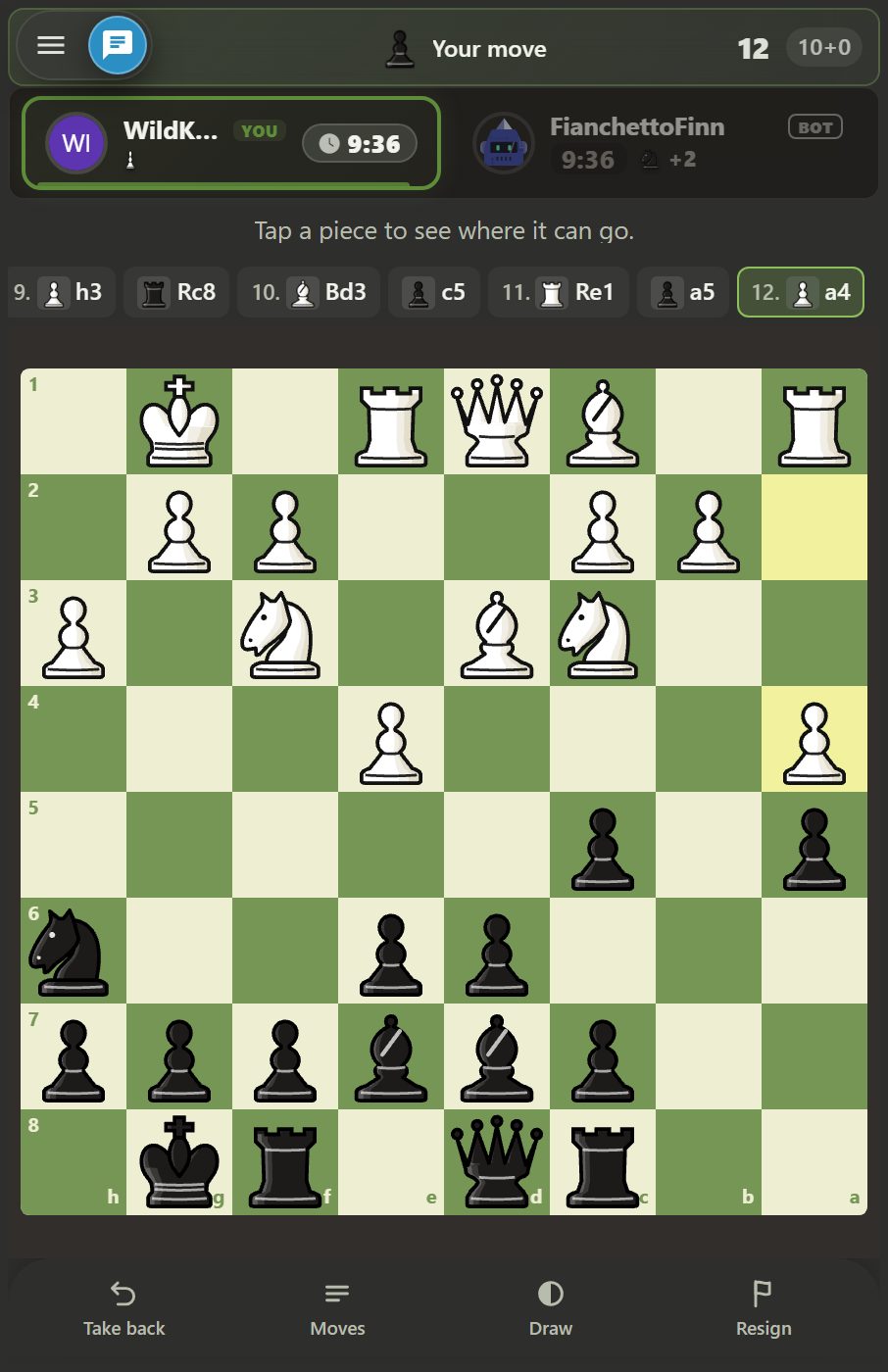
Every figure in this section is verified from Playgridia's own chess engine. The bot has an opening book: 54 positions, 140 replies. That's why your matches in a row don't all start with the same opening.
The book is used to different depths depending on difficulty: easy runs for 6 half-moves, medium for 10, hard for 14. Against the hard bot you can run into every defense listed above; the easy bot starts playing on its own after the sixth half-move.
The book exists for variety, not for strength, and every reply in it is checked against the rules before it's played — even if there were a typo in the book, an illegal move would never land on the board. The bot itself searches two half-moves deep on easy, five on medium, seven on hard; the easy bot deliberately picks the weaker move on roughly 30% of its moves and never resigns. That's exactly what you want while practicing an opening: an opponent you can make mistakes against without being punished for it.
Pick One Opening, Play Ten Games
A practical recipe: the Italian with White, the Scandinavian or Caro-Kann against 1.e4 with Black, the King's Indian against 1.d4. Three lines; don't move to a fourth until you know one well.
The default time control is 10+0 (ten minutes, no increment), and that's the right one for practicing openings too — at three minutes you won't have time to actually look at the board. There are seven time control options from 1+0 up to 30+0; there's no unlimited option.
The last step of actually learning an opening is carrying it all the way to checkmate; if you're struggling to close out a won middlegame, see chess checkmate patterns. Once you've picked a repertoire, sit down on the chess page against a bot or an opponent and start testing it.
Frequently Asked Questions
What's the best chess opening for a beginner?
The Italian Game (1.e4 e5 2.Nf3 Nc6 3.Bc4) is usually recommended as a first opening, because every piece's target is obvious: the bishop aims straight at f7, the only square in Black's opening position defended solely by the king. Because the plan is so clear, a beginner can easily see what to do.
Is the Sicilian Defense hard for beginners?
The Sicilian (1.e4 c5) is the sharpest and most-played defense, because Black answers not with a center pawn but with a wing pawn. Its open variation (1.e4 c5 2.Nf3 d6 3.d4 cxd4 4.Nxd4 Nf6 5.Nc3) contains a large number of main lines; if you want a calmer start, the Caro-Kann or the Scandinavian is easier to begin with.
Why is bringing the queen out early in the opening bad?
When the queen comes out early, the opponent chases it with simple pieces and develops a piece with every chase; while you're moving the same piece a second time, they've brought out three different pieces. What counts in the opening is the number of pieces in play, not the number of moves made, so rushing the queen out delays your development.
How many openings do I need to memorize?
Three is enough: one opening to play with White (the Italian, for example), one defense against 1.e4 (the Scandinavian or Caro-Kann), and one defense against 1.d4 (the King's Indian). Not moving to a fourth line until you truly know one is more useful than a wide but shallow repertoire.
Does the bot always play the same opening against me?
No. The bot has an opening book of 54 positions and 140 replies, so matches you play back to back don't start with the same opening. The book is used to different depths by difficulty: 6 half-moves on easy, 10 on medium, 14 on hard.
If I play a gambit, do I actually lose the pawn?
In the Queen's Gambit (1.d4 d5 2.c4 e6 3.Nc3 Nf6), White temporarily offers the c4 pawn, but the goal isn't to permanently lose it — it's to seize the center in return. This opening is known for classical, slow, solid play.