Chess Pieces and Moves: Setup and Values
Chess piece moves depend on which of the six pieces you're moving: the pawn moves straight and captures diagonally, the knight jumps in an "L", the bishop and rook slide without limit along their own lines, the queen combines both, the king moves one square in any direction — the table below shows all six, both how they move and how they capture.
How the Board Is Set Up
The 8×8 board has 64 squares and 32 pieces on it; each player starts with 16: 8 pawns, 2 knights, 2 bishops, 2 rooks, 1 queen, 1 king. Two rules cover the setup. First: the bottom-right square is always a light square — when you sit down, that's the h1 square on your right. Second: the queen goes on her own colour — the white queen sits on a light square (d1), the black queen on a dark square (d8). Remember "queen on her own colour" and you'll never mix up the setup again; the king takes the square right next to the queen.
From the corner inward, the back rank reads: rook, knight, bishop, queen, king, bishop, knight, rook. Pawns fill the entire row in front of them. White always moves first — on Playgridia, whoever creates the room can pick white, black, or random, but whoever sits down, the first move is always white's. This setup doesn't fill all 64 squares: the four central squares (d4, d5, e4, e5) start empty, and most opening moves try to claim that empty space.
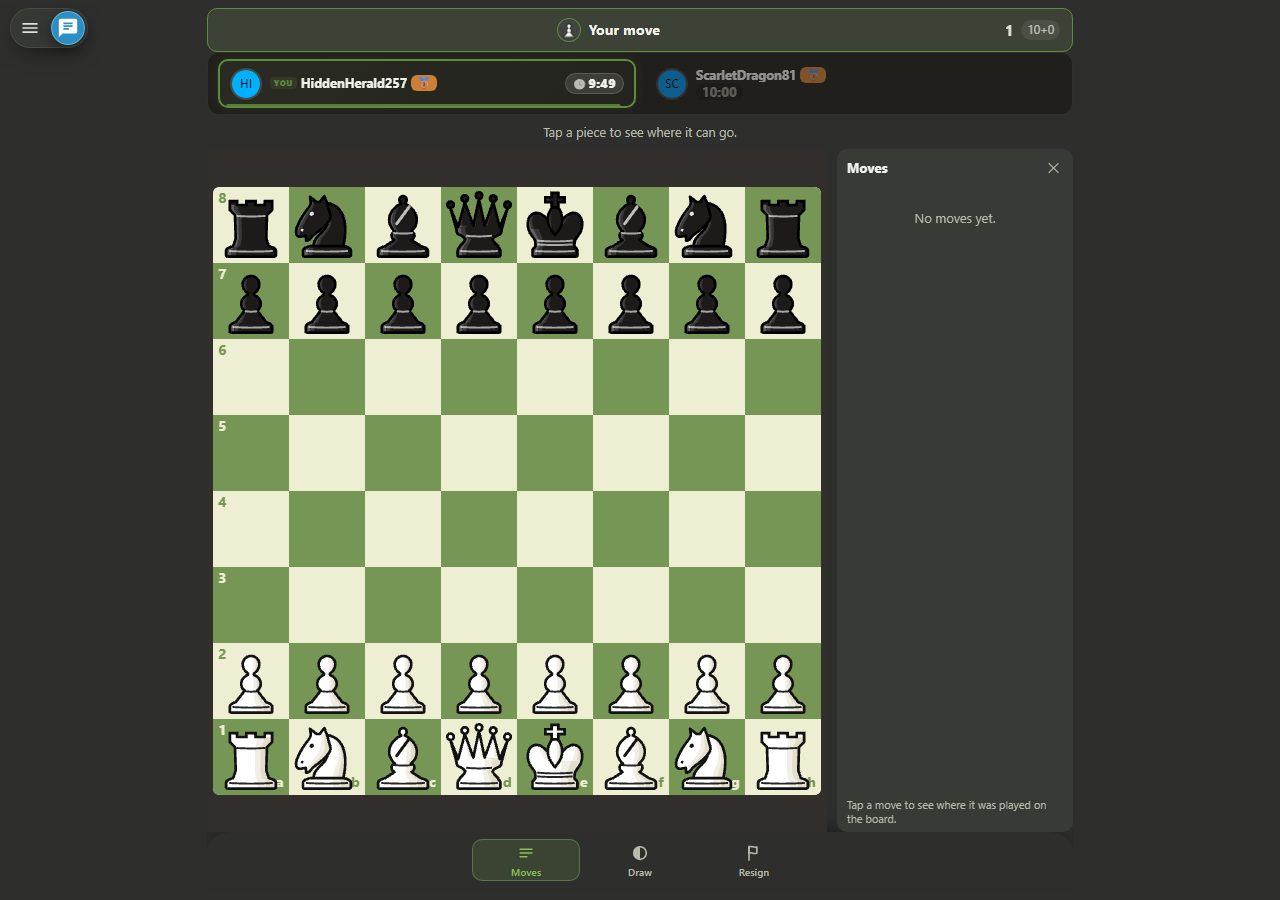
Six Pieces, Six Ways to Move
All six pieces move differently, but for five of them "moving" and "capturing" are the same thing — a piece takes whatever sits on the square it moves to. The pawn is the one exception: it advances straight and captures diagonally; it can't move onto a straight square that's occupied.
| Piece | Count | How it moves | How it captures | Value | Notation |
|---|---|---|---|---|---|
| Pawn | 8 | One square forward; two on its first move; never moves backward | One square diagonally forward only | 1 | no letter (e.g. e4) |
| Knight | 2 | An "L": two squares one way, one square perpendicular | Whatever's on the landing square | 3 | N |
| Bishop | 2 | Diagonally, unlimited as long as the path is clear | Whatever's on the landing square | 3 | B |
| Rook | 2 | Straight (horizontal/vertical), unlimited | Whatever's on the landing square | 5 | R |
| Queen | 1 | Straight and diagonal, unlimited | Whatever's on the landing square | 9 | Q |
| King | 1 | One square in any direction | Whatever's on the landing square | — (never captured, only checkmated) | K |
The knight is the only piece that jumps over other pieces in its way — the other five stop dead the moment they hit a piece and can't go past it. The bishop carries its own permanent limit: a bishop stays on one square colour for its entire life. Every player ends up with one "light-squared bishop" and one "dark-squared bishop"; whatever square one of them can never reach, the other can't either. No piece other than the pawn treats "how it captures" differently from "how it moves"; not knowing that is the single most common beginner mistake.
Playgridia's move list uses international notation: knight is N, bishop B, rook R, queen Q, king K, and the pawn carries no letter at all. Turkish chess books use At=A, Fil=F, Kale=K, Vezir=V, Şah=Ş — two different spellings of the exact same move; the move list simply prints the piece's SAN (standard algebraic notation) as-is.
Three Special Moves
Castling moves the king two squares toward a rook, and that rook jumps to the other side of the king. All five conditions must hold at once: the king must not currently be in check, neither the king nor that rook may have moved before, the squares between them must be empty, and neither the square the king passes through nor the one it lands on may be under attack. Miss even one condition and castling isn't legal. Both kingside (short) and queenside (long) castling exist for both colours — castling is the only move that tucks the king to safety and brings a corner rook into play in the very same turn, which is why nearly every player uses it within the first ten moves.
En passant kicks in when an enemy pawn advances two squares and lands beside your pawn: you can capture it diagonally as if it had only moved one square. But it's only legal on the very next move — wait one turn and the right is gone. A verified example from our own engine, move by move: 1.e4 Nf6 2.e5 d5 3.exd6 — the white pawn moves to d6 and captures the pawn on d5.
Promotion happens when a pawn reaches the eighth rank: it turns into a queen, rook, bishop, or knight. The board asks you which; if no choice ever arrives, the server silently promotes to queen. Already having a queen on the board is no obstacle — you can have two queens at once.
What Piece Values Are Actually For
The values aren't a rule, they're a trading compass: 1/3/3/5/9. The king has no value because it can't be traded — it's checkmated, never exchanged.
The bishop and knight both count as 3 points but aren't equal: the bishop works better in open positions, the knight in closed ones. Holding onto both bishops — "the bishop pair" — is a small but real advantage. A rook is worth 5; giving up a knight to win a rook ("winning the exchange") is a good trade. A queen is worth 9, but that's not the same as two rooks (10) — two rooks outperform a lone queen in most positions.
There's one rule above all of this: material never outranks the chance of checkmate. Being up 9 points means nothing the moment you get mated — which is why king safety always comes first.
Where to Send Your Pieces in the First Ten Moves
Three steps, in order: hold the centre (claim one of e4/d4/e5/d5 early), develop your knights and bishops before your queen, then castle and tuck your king into the corner. A piece in the centre sees more squares, so the side holding the centre opens up more room for its other pieces too. Rushing the queen out early is the most commonly punished opening mistake: your opponent chases it around while developing their own pieces for free — a few moves later you're still playing with one piece while your opponent has developed four. For the detail behind these three steps, see our first ten moves guide.
Try It on the Board: Touch a Piece, See Its Legal Squares Light Up
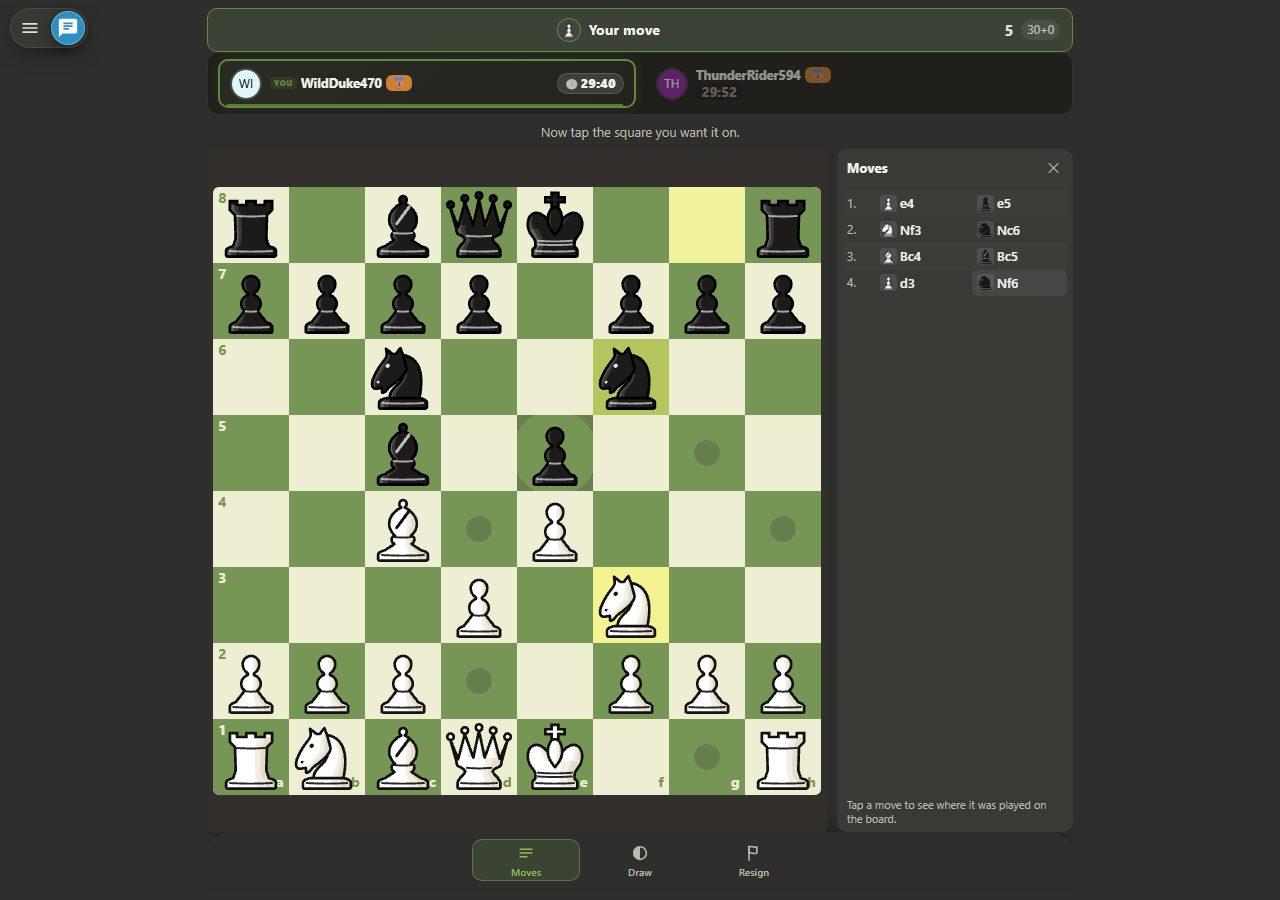
On Playgridia, touching a piece marks every square it can legally reach right on the board — it's the fastest way to learn the rules without memorizing them first. The board simply won't accept a move that breaks a rule, so tapping the wrong square doesn't move anything.
There are three bot levels: easy (looks two moves ahead and deliberately picks the weaker move about a third of the time, and never resigns), medium (looks five moves ahead), hard (looks seven moves ahead, no margin for error). The difference is real strength, not speed.
Takeback exists against bots: the position comes back, the time spent doesn't. There's no takeback against a human opponent. There are four board themes — Classic is free, alongside Emberhold, Eaglecrown, and Duskhollow. On themed boards the pieces' names change — on Emberhold the knight becomes the "Stag Rider", the rook the "Forge Tower" — but their movement is identical, letter for letter. The rule engine can't even see which board is open.
If you want the rules from the top, read our complete rules guide; otherwise just sit down at the board and learn by touching the pieces — it's the fastest way in.
Frequently Asked Questions
How does the knight move in chess?
The knight moves in an "L" shape: two squares in one direction, then one square perpendicular to that. It can jump over any piece sitting in between — it's the only piece on the board that can do this. If an enemy piece sits on the landing square it's captured; if your own piece is there, the move isn't legal.
Can a pawn move backward?
No. A pawn only ever moves forward: one square normally, or two squares on its very first move. It captures by moving one square diagonally forward, never by moving straight ahead. Once it has advanced, it never returns to that file.
Which square does the queen start on, and which does the king start on?
The queen sits on her own colour: the white queen on the light d1 square, the black queen on the dark d8 square. The king takes the square right beside the queen — e1 for white, e8 for black. "Queen on her own colour" is the easiest way to remember this setup rule.
Why does a bishop always stay on the same colour square?
A bishop only moves diagonally, and a diagonal move never takes a piece off the colour of square it started on. That's why a bishop spends its whole life on only 32 of the board's 64 squares — the ones matching the colour it began on. This is why every player ends up with one light-squared bishop and one dark-squared bishop.
What do the letters N, B, R, Q, K mean in the move list?
In international chess notation, N stands for knight, B for bishop, R for rook, Q for queen, and K for king; the pawn gets no letter at all, just the square it moves to (e.g. e4). Playgridia's move list uses these international abbreviations.
Can I promote a pawn to something other than a queen?
Yes. When a pawn reaches the last rank, the board lets you choose between queen, rook, bishop, or knight, and it turns into whichever you pick. If no choice ever arrives — for instance on a bot's move — the server automatically promotes it to a queen.