Chess Opening Traps: Legal's Mate and the Englund Gambit
Chess opening traps are checkmate combinations that end in a few moves, waiting for an opponent to grab a piece that looks "free" — and the following three traps are not fiction. They were played in real games on this site's own engine, verified by the server with a genuine checkmate.
What is an opening trap
An opening trap does not set two threats in a single move; it offers a single piece that looks "free" to the opponent, and the moment that piece is taken, the checkmate net closes. All three below are real move sequences played on the engine, listed with the move count where they end and the single rescue move. In every screenshot, the Moves panel on the right shows the full list — this panel comes from the server's own move history, and the last line in all three sequences ends with a # symbol, and the banner at the top plainly states the winner; the screenshot is not cut and pasted, it is genuinely played and verified by the server.
| Trap | Arises from | Ends in | The one rescue move |
|---|---|---|---|
| Legal's Mate | Italian Game (1.e4 e5 2.Nf3 Nc6 3.Bc4) | Checkmate on move 8 | 6...Nxe5 — take the Knight, not the Queen |
| Blackburne–Shilling | Italian Game, 3...Nd4 | Checkmate on move 7 | 4.Nxd4 — take the Knight, not the pawn |
| Englund Gambit Trap | 1.d4 e5 (Englund Gambit) | Checkmate on move 8 | 6.Nc3 — defend with the Knight, not the Bishop |
Legal's Mate: taking the Queen comes at a cost
In the Italian Game, when Black moves the Bishop to h5 and threatens the Queen, White advances the Knight to e5 without defending the Queen. If Black truly takes the Queen with the Bishop, it is checkmate in eight moves:
1.e4 e5 2.Nf3 Nc6 3.Bc4 d6 4.Nc3 Bg4 5.h3 Bh5 6.Nxe5 Bxd1 7.Bxf7+ Ke7 8.Nd5#
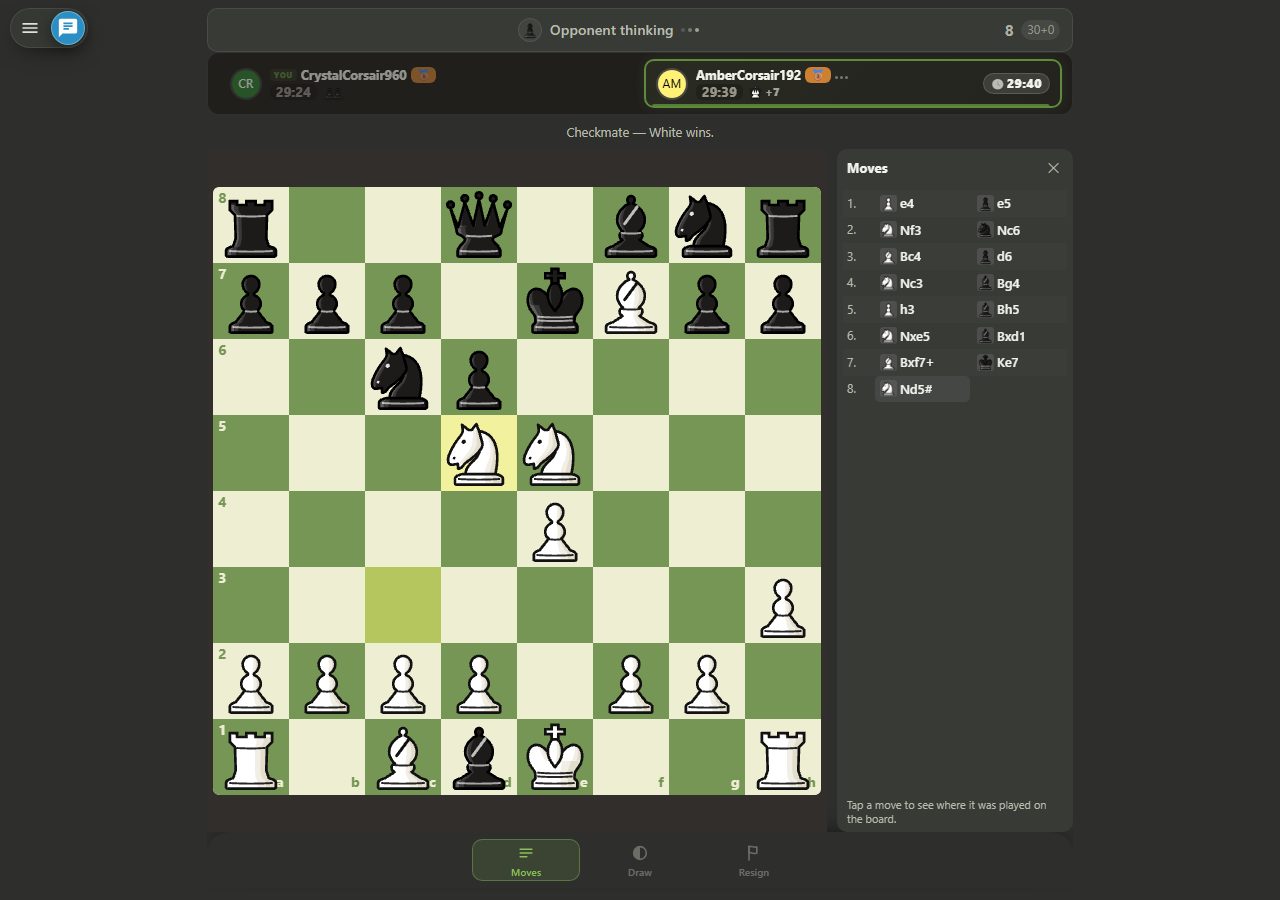
The escape is 6...Bxd1 should become 6...Nxe5 — take the Knight, not the Queen. After 7.Qxh5 Nxc4, Black is safe; this line has also been played and verified on the engine. The trap's appeal lies right here: the Queen appears visibly undefended, and looks like it wins material for two pieces — but in exchange, the King's escape square opens up and the two Knights lock f7 and e7 from d5 and e5.
Blackburne–Shilling Trap: the price of a free pawn
It also arises from the Italian Game, but with Black's Knight jumping to d4. If White takes two pawns in a row (e5 and f7), Black delivers checkmate in seven moves:
1.e4 e5 2.Nf3 Nc6 3.Bc4 Nd4 4.Nxe5 Qg5 5.Nxf7 Qxg2 6.Rf1 Qxe4+ 7.Be2 Nf3#
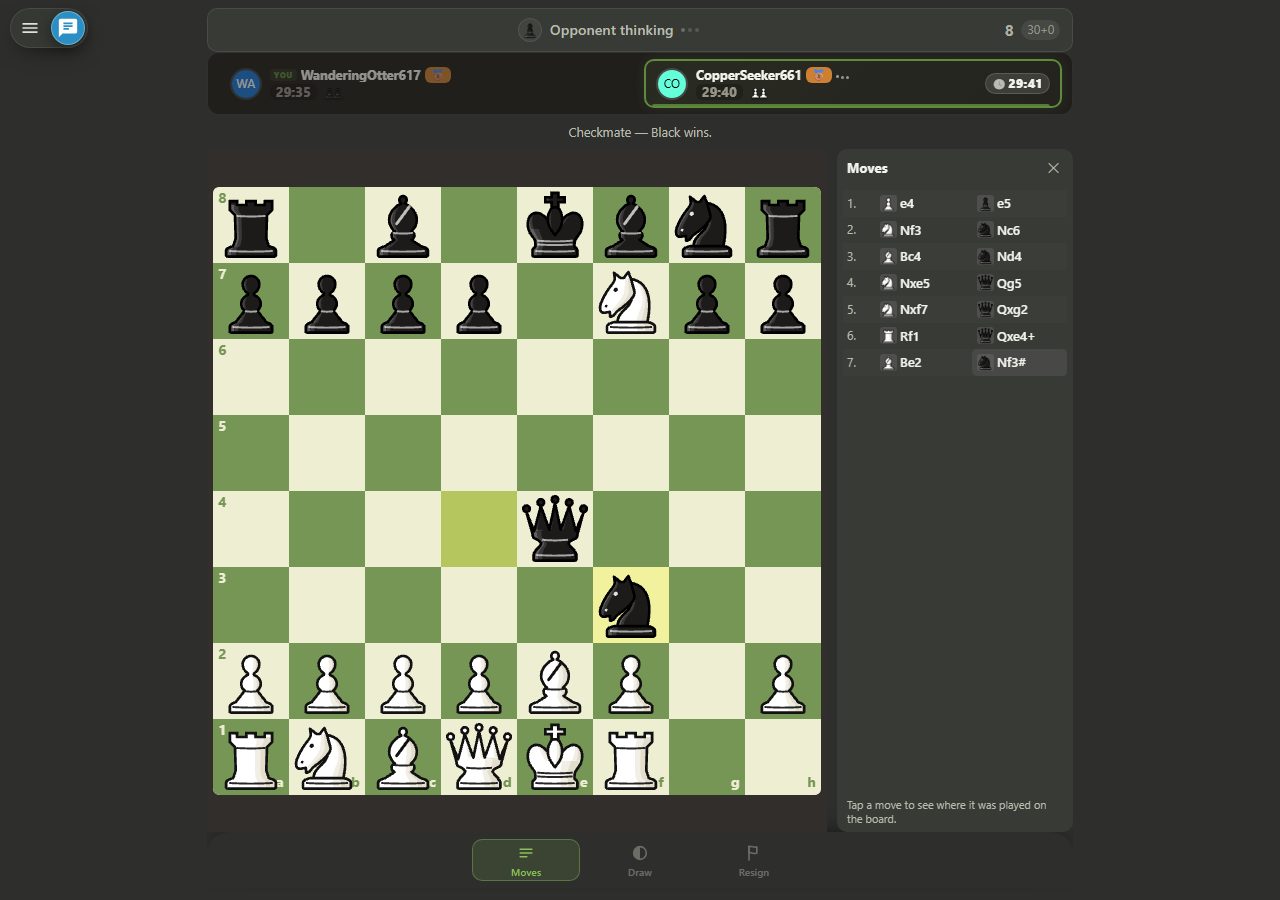
The escape is 4.Nxe5 should become 4.Nxd4 — take the Knight, not the pawn. After 4...exd4, White has an easy position; this has been verified. The mistake here is moving the Knight away from e5 to grab the second pawn on f7: the Knight falls to the g-file ahead of the pawn, the Queen enters on g2, and White's Rook and King are threatened simultaneously.
Englund Gambit Trap: checkmate while ahead a pawn
The Englund Gambit begins with 1.d4 e5, and White plays with an extra pawn — and despite that material advantage, White can be checkmated in eight moves:
1.d4 e5 2.dxe5 Nc6 3.Nf3 Qe7 4.Bf4 Qb4+ 5.Bd2 Qxb2 6.Bc3 Bb4 7.Qd2 Bxc3 8.Qxc3 Qc1#
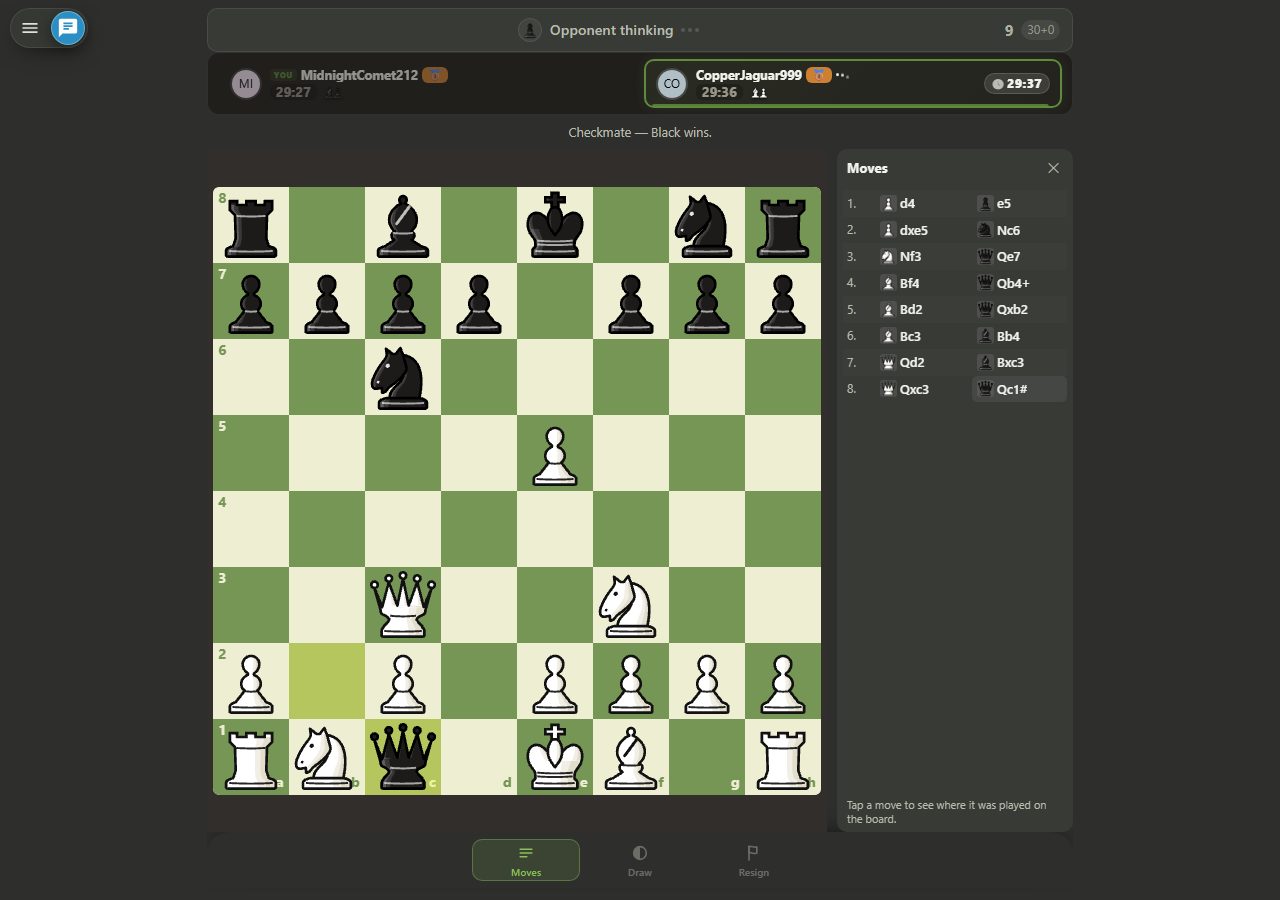
The escape is 6.Bc3 should become 6.Nc3 — defend with the Knight, not the Bishop. This has been verified. The flaw in defending with the Bishop is this: Black's 6...Bb4 move hides the Queen that took b2 behind the Bishop, and as White tries to pursue this Bishop with the Queen (7.Qd2 Bxc3 8.Qxc3), White traps its own King on the c1 square; if the Knight were defending that square instead, this link would never form.
Why these traps don't always work
The site's bot opponent does not choose moves from memory; it plays from a real opening book containing 54 positions with a total of 140 weighted responses, and it consults this book to depths of 6, 10, or 14 half-moves depending on difficulty. Each response in the book is verified before it is played to be legal against the engine's own move generator — so the bot rarely plays the "natural but losing" move the trap is waiting for.
All three traps primarily target the easy-level bot, because at easy level the bot deliberately plays a weaker move in roughly 30% of its moves — always selected from the engine's own search list, never at random. At medium level this percentage drops to 3%; at hard level it reaches zero. The same trap almost never works against a hard-level bot. The book covers not just the Italian Game and Englund Gambit where these traps appear, but also the Spanish, Sicilian, French and Caro-Kann branches of 1.e4, the Queen's Gambit and King's Indian structures of 1.d4, and the flanking openings starting with 1.Nf3 and 1.c4 — so the bot has a general tendency to play "natural" moves in the opening's early phases, not just against these three traps.
Three rules to avoid traps
Question every piece that looks free: if your opponent has left a piece undefended, first ask "why", then take it. Pause at every capture — "why is this piece here?" — because in Legal's Mate the Queen truly is undefended, but the taker's King is not safe on the next move. Put development and King safety before the trap: all three traps' victims are the side that captures material in haste and leaves the King in the center or exposed. While playing on the board, you have a helper too: every capturable piece is marked with a ring, every empty but legal square is marked with a dot, and if the King is in check the square turns red — the engine will not accept any move that leaves the King exposed, but this protects you only from illegal moves, not from legal but losing ones.
These three sequences are not a trick list to memorize; after seeing which error leads to checkmate, they are a checklist to avoid repeating the same error in your own games. Learning a trap by losing to it once is more durable than learning it by winning ten times — this is why all three sequences are given here as "here's how your opponent wins, here's how you defend", not as "here's how you win". If you want to try a trap against a bot, choose easy level — medium and hard levels know the opening book and avoid the weak move. To see checkmate patterns in more detail, consult the how to checkmate guide; for middlegame tools like forks and pins, see the chess tactics article, learn to read move lists in the chess notation guide, and you can try all three traps against a bot on the chess page.
Frequently Asked Questions
What is Legal's Mate and how do you avoid it?
Legal's Mate is an eight-move checkmate trap arising from the Italian Game, where Black's Bishop captures White's Queen. If Black takes with 6...Bxd1, then 7.Bxf7+ Ke7 8.Nd5# is checkmate. To avoid it, play 6...Nxe5 instead of 6...Bxd1; take the Knight, do not sacrifice the Queen.
When does the Blackburne–Shilling Trap work?
It works if White overlooks Black's Knight on d4 in the Italian Game and greedily takes two pawns in a row (e5 and f7); then Black delivers checkmate with 7.Nf3#. If White plays 4.Nxd4 instead of 4.Nxe5 — taking the Knight instead of the pawn — the trap ends there.
Why is the Englund Gambit considered a trap?
In the Englund Gambit (1.d4 e5), White plays with an extra pawn, and despite that advantage, if White defends incorrectly with the Bishop, Black can deliver checkmate with 8.Qc1#. The saving move is 6.Nc3 instead of 6.Bc3; defend with the Knight, not the Bishop.
Do these traps work against a hard-level bot?
Almost never. At hard level the bot never deliberately plays a weaker move, and it consults the opening book to a depth of 14 half-moves, so it will not play the weak move the trap is waiting for. These three traps work best against easy level, where the bot deliberately plays a weaker move in roughly 30% of its moves.
How comprehensive is the chess engine's opening book?
It contains 54 distinct positions with a total of 140 weighted responses, and is consulted to depths of 6 (easy), 10 (medium), or 14 (hard) half-moves depending on difficulty. Each response is verified to be legal against the engine's own move generator before it is played.
How do I know I have fallen into a trap?
When your opponent plays a move that lures you toward a piece that looks free (a Queen, pawn, or Knight), and after you capture it your King becomes exposed, you are probably in a trap. The safest response is to wait one move and check what your opponent's real threat is, rather than capturing immediately.