Chess Tactics: Fork, Pin, Skewer | Playgridia
Chess tactics are the five patterns that explain why you keep losing material even though you know the rules: the fork, the pin, the skewer, the discovered attack, and the back-rank mate — each one comes from your opponent being unable to answer two threats with a single move. None of them take memorization or deep calculation, only pattern recognition; every example below can be set up on a board in thirty seconds and tried out.
What Is a Tactic: Two Threats, One Move
Every tactic rests on one idea: your opponent cannot meet two threats with a single move. Most material loss doesn't come from a calculation error — it comes from not recognizing these patterns. The five patterns below explain most of the piece losses in amateur games; you can set up each one on an empty board in thirty seconds. All five trace back to the same root: one piece doing two jobs at once, or a piece that legally cannot move at all.
No matter how good your calculation is, you can't find a pattern you don't already know to look for — so training tactics isn't really about memorizing moves, it's about training your eye on these six shapes. The table below gives each pattern's idea and one example move; each one is then walked through with its full setup below.
| Tactic | Idea | Example move |
|---|---|---|
| Knight fork | One piece attacks two targets at once | Nc7+ |
| Queen fork | In an opening trap, the queen eyes two targets at once | 4...Qg5 |
| Absolute pin | The piece in front of the king cannot legally move | 5.Nc3 |
| Relative pin | If the piece moves, the more valuable piece behind it falls | 4.Bg5 |
| Skewer | The valuable piece stands in front; when it moves, the piece behind is captured | Rd1+ → Rxd8 |
| Back-rank mate | The king is trapped behind its own pawns | Ra8# |
Fork: One Piece, Two Targets
The knight fork is the most dangerous, because the knight is the only piece that jumps: the two pieces caught in a fork usually can't defend each other or strike back at the knight. Set up: white knight on d5, black king on e8, rooks on a8 and h8. Nc7+ attacks the king and the a8 rook at once; the king must move, and the knight takes the rook. When the same knight hits the king and the queen together it is a "royal fork", and when a rook joins them it is the "family fork".
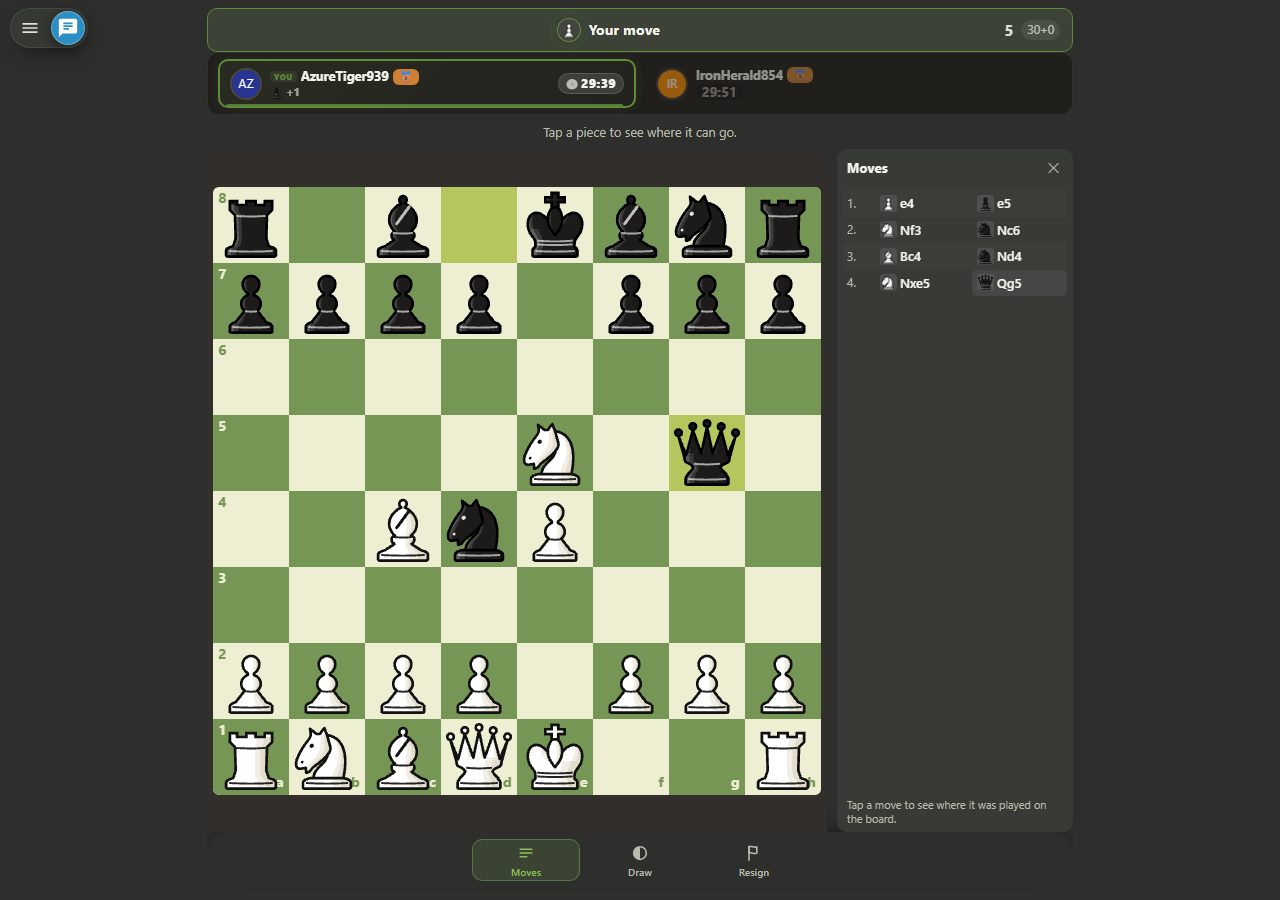
The queen fork comes out of an opening trap: 1.e4 e5 2.Nf3 Nc6 3.Bc4 Nd4 4.Nxe5?? Qg5 — the queen looks at the g2 pawn and the knight on e5 at the same time.
The pawn fork is the cheapest of all: an advancing pawn attacks two pieces diagonally at once, and it only costs you a pawn.
The defense fits in one sentence: before you get forked, don't put two of your pieces on the same colour square or the same knight-jump distance from each other. If your king and queen sit on the same diagonal, or the same knight distance apart, the danger is already set up.
Make this a habit before every move: pause for one second and check whether your opponent's next move could reach your king and another piece at the same time. Most forks happen because the victim skipped this one glance.
Pin: The Piece That Can't Move
In an absolute pin, the piece standing in front of the king cannot legally move at all. Example: 1.e4 e5 2.Nf3 Nc6 3.d4 exd4 4.Nxd4 Bb4+ 5.Nc3 — in this position the knight on c3 has zero legal moves. The pinned piece looking like it's "defending" something is an illusion: it can't capture the enemy piece heading to the square it's supposedly defending.
In a relative pin, it's not the king behind the piece but a more valuable piece. Example: 1.d4 d5 2.c4 e6 3.Nc3 Nf6 4.Bg5 — the knight on f6 is pinned against the queen. The knight can technically move, but if it does, the queen falls.
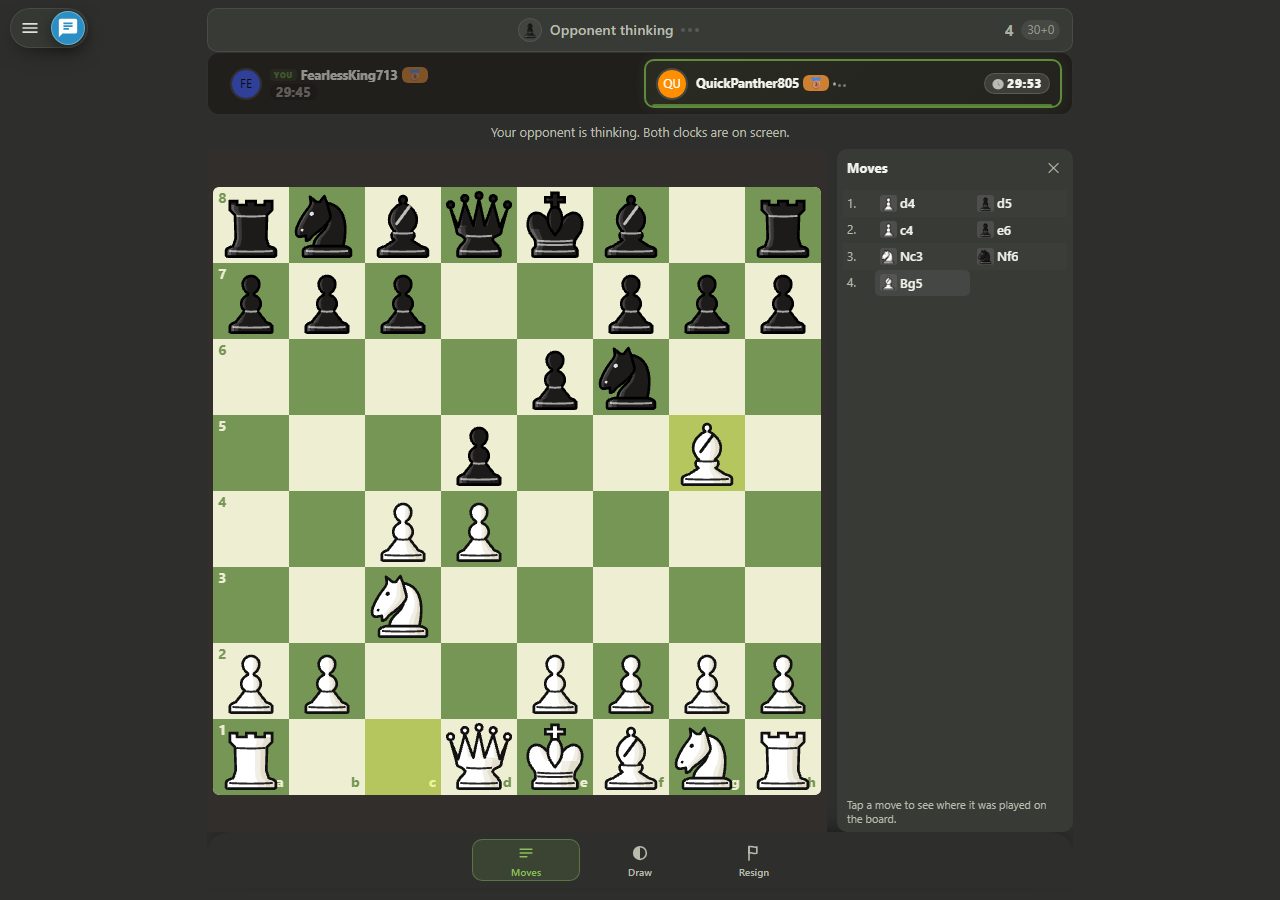
The classic way to play against a pin is to attack the pinned piece one more time.
A relative pin is pressure, not a rule — and it can sometimes be broken: 1.e4 e5 2.Nf3 Nc6 3.Bc4 d6 4.Nc3 Bg4 5.Nxe5. If black takes the queen with 5...Bxd1??, 6.Bxf7+ Ke7 7.Nd5# is checkmate. A pin doesn't mean "untouchable."
The practical way to tell the two apart over the board is to ask: "Is the king behind this piece, or is it something more valuable?" If the answer is the king, the piece truly cannot move. If it's another piece, it can move — but look at the cost first.
Skewer and Discovered Attack
A skewer is the fork's mirror image: the valuable piece stands in front, and when it moves out of danger, the piece behind it is captured. Set up: black king on d5, queen on d8, white rook on a1. Play Rd1+ — in this position, black has exactly six legal replies, all of them check responses, and in all six white follows up with Rxd8 and wins the queen. It's an inescapable tactic.
A discovered attack happens when a moving piece opens the line for a long-range piece behind it. The real threat doesn't come from the piece that moves — it comes from the line that opens, which is why it's the hardest tactic to spot. Its sharpest form is discovered check: even if the piece in front moves to a square where it can itself be captured, the opponent still has to answer the check first.
A double check is the extreme case of discovered check: two pieces give check at once, so blocking is impossible and capturing is impossible — the king has to move.
The way to spot a discovered attack is to look not at the piece that's moving, but at the empty line left behind it: a rook or bishop can suddenly be staring straight at a king or queen the moment the piece in front steps aside — check that line before you play the move.
Back-Rank Mate: One Pawn's Difference
Three pawns stand in front of a castled king, and the king ends up trapped behind its own pawns. Set up: black king on g8, pawns on f7-g7-h7 in front of it, white rook on a1. Ra8# — checkmate.
Now set up the same position with one difference: black has already played h6. The same move, Ra8+, is now only check; the king steps out to h7.
Players who castle and then never move a pawn in front of their king fall into this trap most often, because the danger builds quietly: a rook or queen can walk all the way to the back rank untouched, since nothing is standing in the way.
The lesson fits one sentence: at some quiet point in the game, push a pawn to give your king an escape square. You spend one tempo and save a game from falling into a back-rank mate.
How to Train Tactics (On the Board)
Tactics are learned by recognition, not memorization. Before every move, ask one question: "What two things could my opponent do to me right now?" For that, you first need to know how the pieces move — tactics build on rule knowledge, they don't replace it.
On Playgridia, when you tap a piece, its legal squares light up on the board — it's the fastest way to see what's looking at what. Before you play a move, tap it and look at the squares it lights up, and check whether one of them sets up a fork or a skewer.
Train against bots: the easy bot searches two moves deep and deliberately plays the weaker option about 30% of the time, which hands you material for tactics. Medium searches five moves deep, hard searches seven, and the hard bot has no margin for error — it sees the trap you set.
Takeback is available against bots: take back the move where you missed the tactic and replay the same position. The position comes back, the time spent doesn't. There's no takeback against a human opponent, which is why the most comfortable place to train tactics is a match against a bot.
Time control options run from 1+0 to 30+0, seven in total, with 10+0 as the default. Pick a longer control while you're training tactics: the most common reason to miss one isn't lack of knowledge — it's the clock. Start with the easy bot until you can spot all five patterns, then move up to medium and hard to test yourself. When you're ready, sit down at the chess board.
Frequently Asked Questions
What is a fork in chess?
A fork is when a single piece attacks two (or more) enemy pieces at the same time. The knight fork is the most dangerous, because the knight is the only piece that jumps, and the two pieces it forks usually can't defend each other. For example, with a white knight on d5, black king on e8, and rooks on a8 and h8, Nc7+ attacks both the king and the a8 rook at once; the king has to move, and the knight takes the rook.
Can a pinned piece really not move at all?
That depends on the type of pin. In an absolute pin, if the king is behind the piece, it cannot legally move at all — for example, after Bb4+ and 5.Nc3, the knight on c3 has zero legal moves. In a relative pin, a more valuable piece sits behind it instead of the king; the piece can technically move, but doing so loses the piece behind it, so in practice it stays put.
What's the difference between a skewer and a pin?
In a pin, the valuable piece sits behind; if the piece in front moves, the valuable piece is exposed. In a skewer, it's the other way around: the valuable piece is in front, and when it's forced to move, the piece behind it is captured. For example, with black's king on d5 and queen on d8, Rd1+ gives black six legal replies — all of them check responses — and in every one white follows with Rxd8 to win the queen.
How do I protect myself from a back-rank mate?
The three pawns in front of a castled king can trap the king behind its own line, so a rook or queen landing on the back rank can be mate. The fix is simple: at some quiet moment in the game, push one pawn (say, h6) forward to give your king an escape square. The same rook move that used to be mate becomes just a check, because the king now has a square to run to.
What do you do against a double check?
In a double check, two pieces give check at the same time; you can't block it or capture your way out, because the second piece is still giving check either way. The only option is to move the king. That's why a double check is considered the sharpest form of a discovered attack.
Which bot level should I play to practice tactics?
The easy bot only searches two moves deep and deliberately plays the weaker move about 30% of the time, which leaves tactical chances on the board. The medium bot searches five moves deep, the hard bot seven, and the hard bot has no margin for error. If you're just starting, begin with easy, and don't hesitate to use takeback against the bot if you miss a tactic — there's no limit.