Chess Endgames: Mating with Queen and Rook Against a Lone King
In chess, delivering checkmate against a lone king is not a job for the queen or rook alone: the winning side first brings its own king directly opposite the opponent's king (taking the opposition), and only then does the queen or rook deliver the checkmate.
Why endgame is a separate skill
Capturing your opponent's pieces is not enough—converting a winning position into an actual checkmate is a separate skill. This site's chess engine is a complete FIDE rules engine from top to bottom: it generates every move, never allows an illegal move, and only ends the game when a true checkmate, stalemate, or draw condition occurs. The two positions described below are not made up; they are the final squares from two real games played on this site—and both teach the same lesson: the king delivers the checkmate, and the queen or rook merely makes the final blow. These rules are independent of which board theme you choose: on the classic board or any of the fancy themes, the engine produces the same moves—the board is only appearance; the rules never change.
Queen checkmate: box the king in, then bring your own king
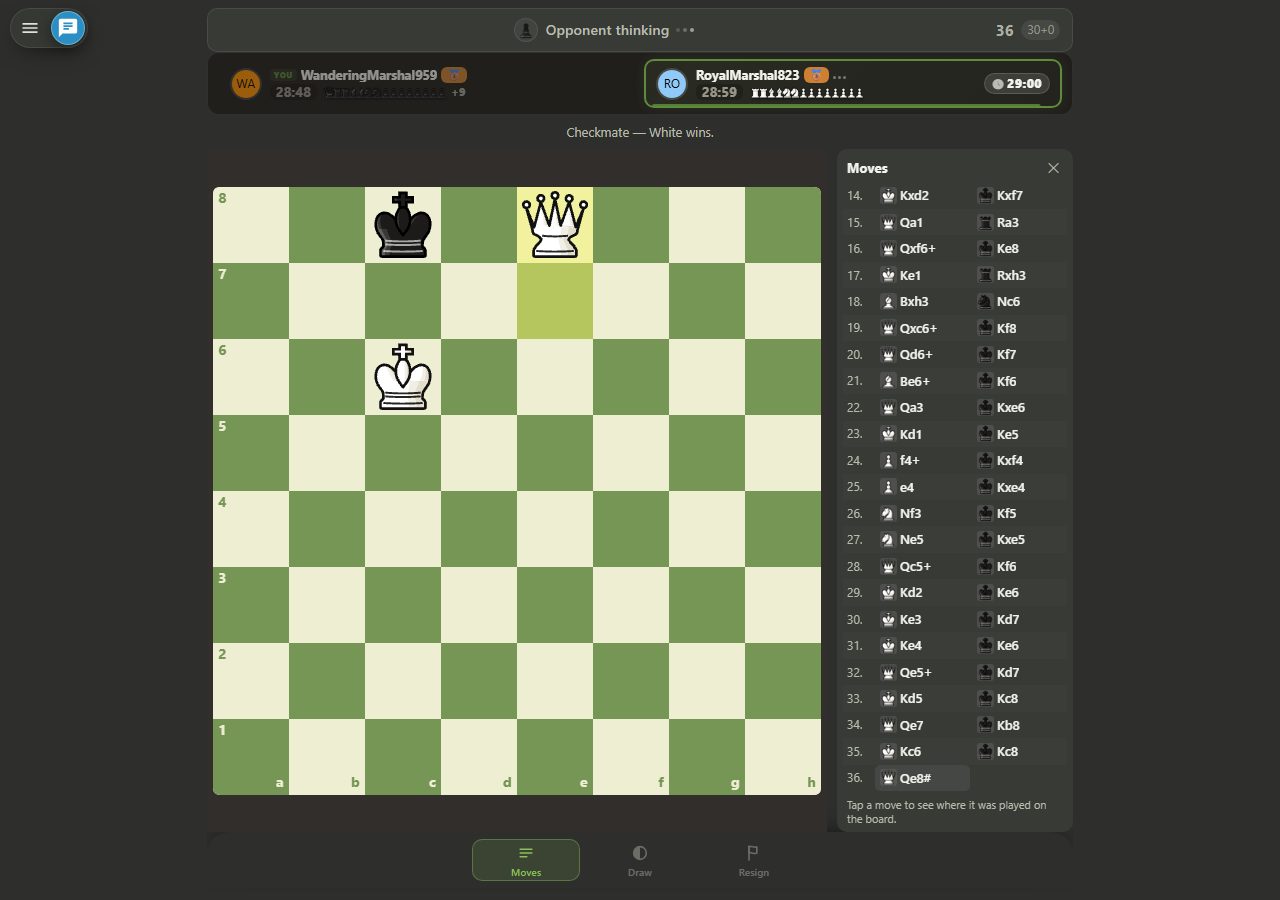
Checkmate with a single queen unfolds in three steps. First, the queen gradually forces the opponent's king to the edge of the board—always leaving one square of distance, because if the queen stands next to the opponent's king, when the turn passes to the other side it creates a stalemate risk. Once the opponent's king is cornered, it is time to bring your own king: the winning side moves its king directly opposite the opponent's king. When they stand face to face (opposition), the queen delivers the checkmate. The final moves from a real game played on this site demonstrate this exactly: 33.Kd5 Kc8 34.Qe7 Kb8 35.Kc6 Kc8 36.Qe8#—the white king moved from d5 to c6, standing directly opposite the black king at c8, and then the queen delivered checkmate at e8.
The only trap here is stalemate: the queen gets too close to the opponent's king, the other side has no legal moves, and if the queen is not giving check, the engine automatically declares it a draw—the most classic way to turn a winning position into a draw in a single move. For the complete rule on this and other draw conditions, see the article on draw rules.
Rook checkmate: cut off, push in, and take the opposition
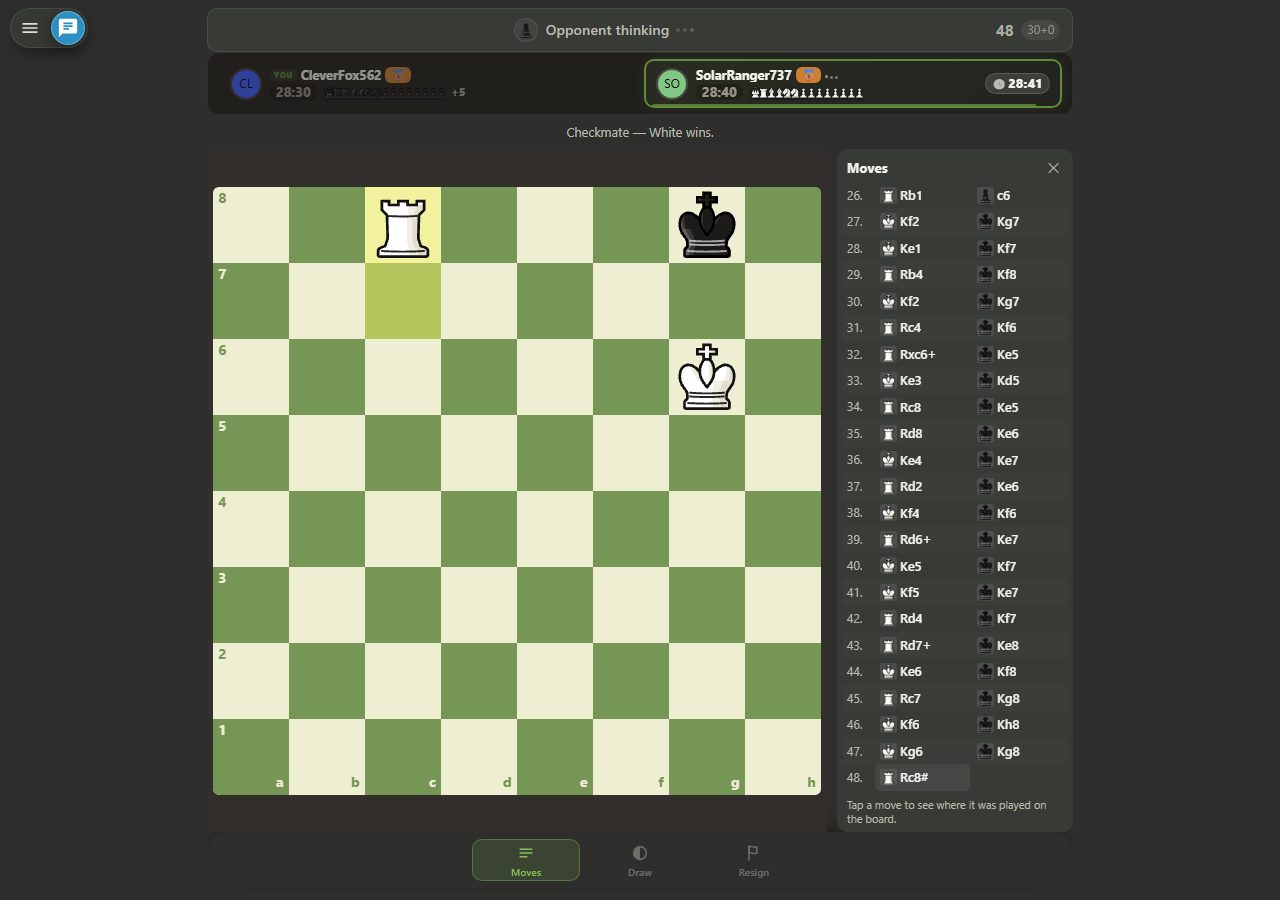
Checkmate with a rook works on a different principle: the rook cuts off the opponent's king along a rank or file, while your own king advances step by step. As the opponent's king is pushed along the line cut by the rook, the winning side brings its king to the opposite side and takes the opposition; the rook then delivers checkmate along that final rank or file where the opponent's king stands. The final moves from another real game played on this site: 45.Rc7 Kg8 46.Kf6 Kh8 47.Kg6 Kg8 48.Rc8#—the white king moved to g6, standing directly opposite the black king at g8, while the rook was cutting off the black king on the seventh rank and moved up to c8 to deliver checkmate on the eighth rank.
What is opposition?
Opposition is when two kings stand on the same file, rank, or diagonal with exactly one square between them, directly facing each other. Both examples above show the same pattern: c6-c8 and g6-g8, with exactly one square between the kings in each case. The side that holds the opposition forces the opponent's king to retreat, because the rules never allow the two kings to stand adjacent—this is why the queen or rook can safely move to the checkmate square. Much of the "I don't know how to proceed" feeling in endgames actually comes from losing the opposition.
Pieces that cannot deliver checkmate
Certain combinations of pieces cannot deliver checkmate mathematically, and the engine detects this and ends the game in a draw as soon as the position arises—without waiting for stalemate or the flag to fall. Four cases are recognized: bare king versus bare king, king and single knight versus king, king and single bishop versus king, and king and bishop versus king and bishop on the same colored squares. In other words, there is no checkmate with a single knight or a single bishop alone; if one of these pieces is all you have left, your material was not sufficient to trap the opponent's king in the corner by itself, and the engine counts the position as automatically drawn the moment it arises.
The fifty-move rule limits your time in the endgame
The fifty-move rule means you cannot postpone converting a winning position indefinitely: when the counter reaches 100 half-moves (50 full moves), the game automatically ends in a draw. This counter resets on any pawn move or any capture—so converting to checkmate with queen or rook generally stays far below this limit, but if you shuffle your queen or rook around without making progress, the counter silently ticks forward. A winning endgame can turn into a draw this way if you never convert it. The result still creates a point difference: in chess, a win is 1 point and a draw is 0.5 points—an unconverted advantage is cut in half.
Practicing against a bot
You can practice this technique most comfortably at the easy bot level, because the easy bot never resigns—this is an intentional choice of the engine: to prevent a beginner who is learning to convert from missing the finale because the bot resigned early. The medium and hard levels can resign from a lost position. Moreover, this practice is risk-free: games against a bot never count toward your rating, because for a game to be rated at least two human players must have taken a seat.
| Difficulty | Search Depth | Does It Resign? | Good For |
|---|---|---|---|
| Easy | 2 | No—never resigns | You can practice queen/rook checkmate all the way to the end |
| Medium | 5 | Can resign from a lost position | May resign early; you won't always see the full finish |
| Hard | 7 | Can resign from a lost position, sometimes earlier | May resign early; you won't always see the full finish |
When playing against a bot, you also have the right to take back moves: you can undo your last move and the bot's response, and the position returns but the elapsed time does not—the clock also deducts the time that the taken-back moves would have cost. There is no limit to how many times you can take back in a single game, but only if your opponent is a bot: between two human players, there are no takebacks at all.
In short: find the opposition, move your king first, and then strike with queen or rook. Practice this three-step sequence against a bot a few times, study different checkmate patterns from the checkmate patterns article, and sharpen your tactical eye from the tactics article; keep track of the fifty-move counter and never try to find checkmate with a single knight or bishop—the engine will already count that position as a draw.
Frequently Asked Questions
How do you deliver checkmate with a queen against a lone king?
The queen first forces the opponent's king to the edge of the board, always leaving one square of distance to avoid stalemate. Then you move your own king directly opposite the opponent's king (taking the opposition); once this position is set, the queen delivers the checkmate blow, just as in the example 33.Kd5 Kc8 34.Qe7 Kb8 35.Kc6 Kc8 36.Qe8#.
How is checkmate built with a rook?
The rook cuts off the opponent's king along a rank or file, and you gradually advance your own king to take the opposition. When the kings stand face to face, the rook delivers checkmate along that rank or file where the opponent's king stands—45.Rc7 Kg8 46.Kf6 Kh8 47.Kg6 Kg8 48.Rc8# is a real example of this technique from an actual game.
What is opposition?
Opposition is when two kings stand on the same file, rank, or diagonal with exactly one square between them, facing each other. Because the rules never allow two kings to stand adjacent, the side holding the opposition forces the opponent to retreat, allowing the queen or rook to safely advance to the checkmate square.
Which pieces cannot deliver checkmate in chess?
There is no checkmate with a single knight or a single bishop alone. The engine recognizes four cases and draws immediately: bare king versus bare king, king and single knight versus king, king and single bishop versus king, and king and bishop versus king and bishop on the same colored squares.
How does the fifty-move rule work?
When the counter reaches 100 half-moves (50 full moves), the game automatically ends in a draw. The counter resets on any pawn move or capture, so an unconverted winning position can silently turn into a draw if you never make progress.
Can you take back moves against a bot?
Yes, but only against a bot opponent: you can undo your last move and the bot's response, the position returns but the elapsed time does not. Between two human players, there are no takebacks, and games against bots do not count toward your rating anyway.