What Is Chess Notation? How Moves Are Written
Chess notation is the standard way to write a chess move in a single line that everyone reads the same way: it describes which piece moved to which square and how in three or four characters — e4, Nf3, O-O, and so on. This guide walks you through how to read this notation step by step using moves from a real game; by the end, you'll be able to read your own game move by move the same way.
What notation is and why it matters
The board is an 8×8 grid: the columns (vertical files) are lettered a through h from white's perspective left to right, and the rows (ranks) are numbered 1 through 8 from bottom to top. Where they meet, each square gets a single, unique name — e4 always means the same square, no matter which game you're looking at. On all four boards on this site, the file letters and rank numbers are printed inside the corner squares, not floating in a frame; you don't have to look away from the board to read a square's name. These abbreviations speak the same language as the coordinates in the corners, because both come from the same file-rank pair. The real payoff of learning to read notation is this: you can follow a game from start to finish without a board in front of you, just by looking at the move list, and you can discuss a move with an opponent or yourself.
Piece letters and square names
When a move is written, the piece's letter comes first, then the name of the square it goes to; pawns have no letter, only the destination square is written. The Queen is Q, the Rook is R, the Bishop is B; the Knight is written N, because K is reserved for the King.
| Piece | Letter | Comes from | Example |
|---|---|---|---|
| King | K | King | Kb8 |
| Queen | Q | Queen | Qxg4+ |
| Rook | R | Rook | Rae1 |
| Bishop | B | Bishop | Bxc6 |
| Knight | N | Knight (K is taken by the king) | Nf3 |
| Pawn | (none) | — | e4 |
The letters come straight from the English names, which is why the Knight is N and not K. The move list on this site uses algebraic notation with the international letters: K/Q/R/B/N, shown next to a small piece icon at the start of each line, so you can verify that a move starting with Q is a Queen by looking at the icon. We cover the movement rules of each piece separately in chess pieces and how they move.
Capture, check, and checkmate symbols
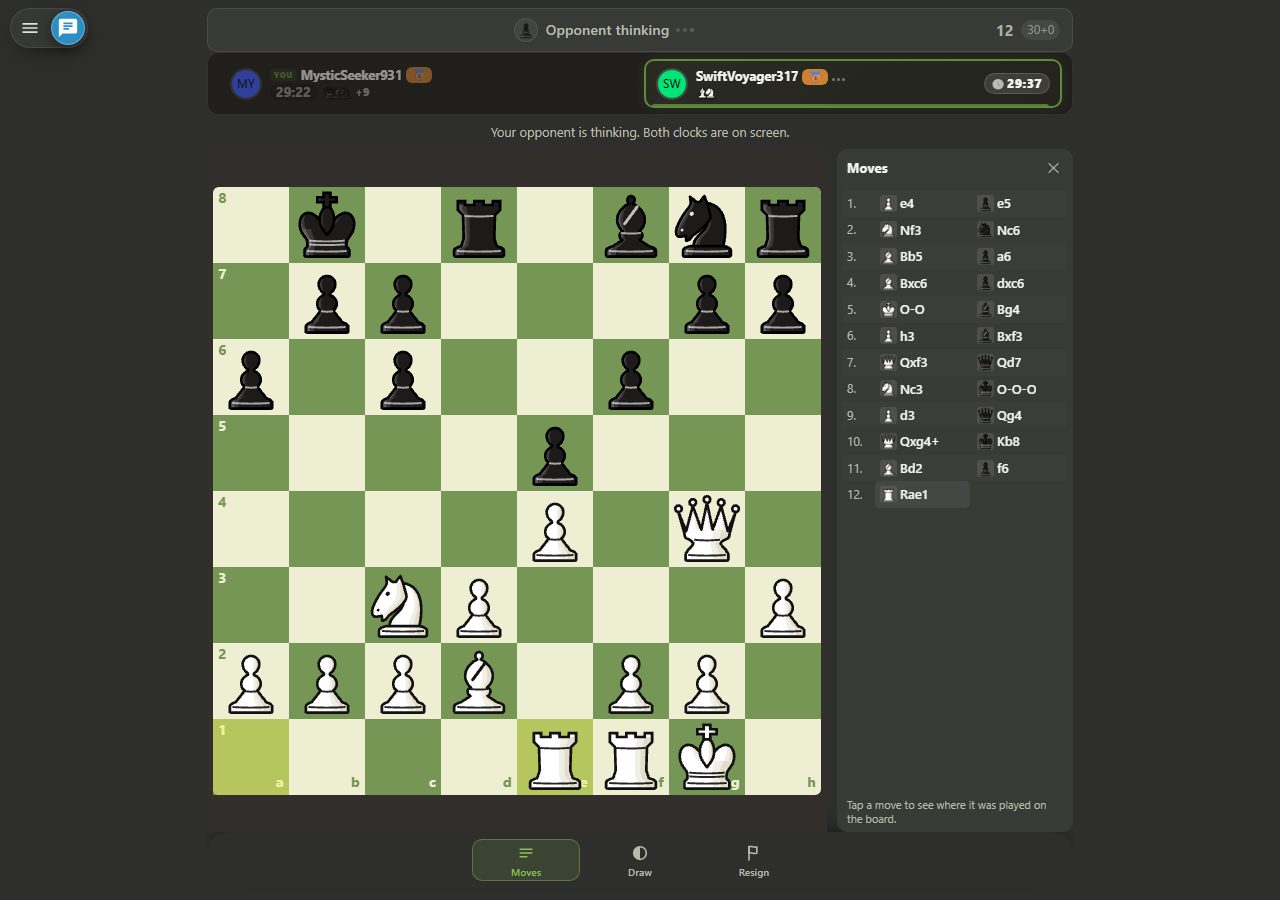
The real power of notation is carrying a lot of information with short symbols. Real examples from this game: the x symbol means a capture (Bxc6, dxc6, Bxf3, Qxf3 — all in this list); the + symbol shows check (Qxg4+ on move 10); O-O is castling kingside, O-O-O is castling queenside — white played O-O on move 5, black played O-O-O on move 8, both in the same game. In pawn captures, the file letter of the capturing pawn is also shown to clarify where it came from: in the move dxc6, the d tells you the pawn came from the d-file, because the destination square alone wouldn't tell you which pawn moved. The engine adds every move to the move history in this SAN notation along with check and checkmate flags; since this game didn't end in checkmate, you won't see # on the screen, but the same system adds # after a move that delivers checkmate, and when a pawn reaches the last rank and promotes, it adds which piece it becomes, like =Q. We explain other special moves like en passant in special moves in chess.
When two pieces can move to the same square: resolving ambiguity
Sometimes two pieces of the same kind can move to the same square — then a plain Re1 doesn't tell you which Rook moved. Move 12 of the game above shows exactly this situation: white's Rook on a1 and Rook on f1 could both go to e1, so the move was written Rae1 — the file letter where the piece started was added to the move. If two pieces were on the same file but different ranks, you'd add the rank number instead (for example, N1d2 shows the Knight moved from the 1st rank). These ambiguities usually come up when you have more than one piece of the same kind — like two Rooks, two Knights, or a second Queen from a promotion. The rule is simple: try to disambiguate with the file letter first, and if that's not enough, add the rank number.
Reading a game from start to finish
Reading the complete panel above line by line works like this: 1.e4 e5 2.Nf3 Nc6 3.Bb5 a6 develops the opening. On move 4, white plays Bxc6 taking the Knight, black recaptures with dxc6. On move 5, white castles kingside with O-O, black plays Bg4. On move 6, white plays h3, black takes with Bxf3; on move 7, white recaptures with Qxf3 and black plays Qd7. On move 8, white plays Nc3 and black castles queenside with O-O-O to get the King to safety. On move 9, white plays d3 and black brings the Queen to Qg4; on move 10, white plays Qxg4+, both capturing and giving check, and black's King escapes to Kb8. Move 11 sees Bd2 and f6 played, and on move 12, white plays the Rae1 we described earlier — it's black's turn, and the opponent thinking message on screen shows it. The tag at the top says 30+0, meaning this game was played with a time control of 30 minutes for each player with no increment per move; both players' clocks stay on screen the whole time. When you follow the notation line by line like this, the game reads as a story of moves, not of pieces.
Try it on your own game
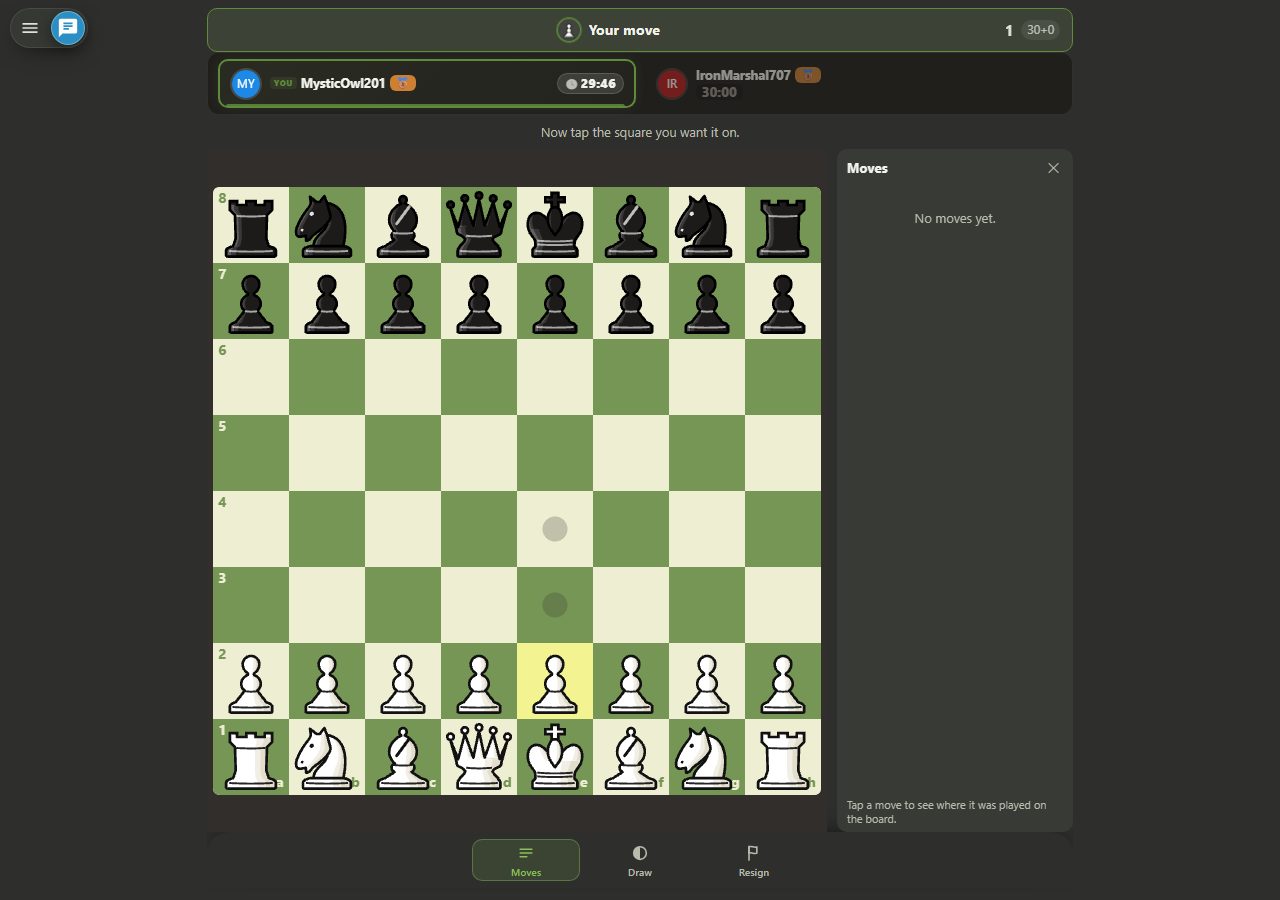
You don't need to do anything special to see notation in your own game: you can play each move either by dragging or by tapping, and both have the same result. On a wide screen, the move list stays as a fixed panel next to the board; on a narrow screen, the same list is called up as a separate panel by a button. When you tap a move in the list, it shows you where that move was played on the board — you don't just read the notation, you can verify it on the board too. The move sounds also come from the same record: the engine compares the move history and sounds any new moves that haven't been voiced yet, and a rejected move stays silent. If you want to explore openings in more depth, check out chess openings; if you want to start playing right away, visit the chess page.
In short: on your next game, don't close the move list—leave it open. Taking a look at it after each move turns reading three or four characters to understand both your own moves and your opponent's plan into a habit within a few games.
Frequently Asked Questions
What does e4 mean?
e4 is the name of a square on the chess board and shows that a pawn moved there. In pawn moves, the piece letter is not written — only the file and rank number of the destination square. In the games on this site, the opening move is usually exactly this way, starting with 1.e4.
What do O-O and O-O-O mean?
O-O is castling kingside, and O-O-O is castling queenside; both are special moves that move the King and a Rook to safety in the same move. You can see both white's kingside castling (O-O) and black's queenside castling (O-O-O) in a single game, written with different symbols.
What do the + and # symbols mean in chess?
The + symbol shows that the move gives check to the opponent's King, and the # symbol shows that the move ends in checkmate. The move list adds these flags right after the move itself; for example, Qxg4+ is both a capture and a check.
How is a move written when two Rooks can move to the same square?
In this case, the file letter where the piece started is added to the move, or if that's not enough, the rank number is added, so it's clear which piece moved. For example, if two Rooks can both move to e1 and the one on a1 is moving, the move is written Rae1.
What letters are chess pieces written with?
In international notation, the King is K, the Queen is Q, the Rook is R, the Bishop is B, and the Knight is N; pawns have no letter. The letters come directly from the English names. This site's move list shows the international letters with a small piece icon at the start of each line.
How do I use the move list?
On a wide screen, the move list appears as a fixed panel next to the board; on a narrow screen, it's a separate list that opens with a button. When you tap a move in the list, you can see where it was played on the board; you can also play moves by dragging or tapping.