Chess Middlegame: Open Files and Outposts
Chess middlegame is where the opening book ends and no forced mate is yet in sight—where you must build your own plan with the pieces left on the board. The opening carries you to a safe, developed position; the endgame converts your advantage into material; the middlegame is the space between, after memorization ends and the question "what do I play now?" has no textbook answer—it is the volume that the opening trilogy rarely writes. This article fills that gap: from the moment you step outside the book, you will hold two concrete tools in your hand—the open file and the outpost—and know how to spot them in a real game.
What is middlegame: the book ends, planning begins
The moment you step out of the opening book, you stop memorizing moves and start reading position. In the middlegame, the winning side is rarely the one calculating the most moves—it is the side that spots the lasting advantages on the board first—an open file, an outpost, an opponent's weak pawn—and points its pieces toward that advantage. A lasting advantage differs from a tactical shot: a tactic can vanish in two moves, but an open file or a permanent outpost will sit on the board until you exploit it. The two positions below come from real games played on this site's own engine; both show the same idea in two different ways: something sitting idle on the board becomes a home for the right piece.
Open file: put your rook there
In this game, which went 1.d4 d5 2.c4 dxc4 3.e3 e5 4.Bxc4 exd4 5.exd4 Nf6 6.Nf3 Be7 7.O-O O-O 8.Nc3 Nc6 9.Re1 Bg4 10.Be3 Re8, both sides' e-pawns left the board on moves 4 and 5. As a result, no pawn remained on the e-file—White's rook settled on e1, Black's rook on e8, and they share control of the file.
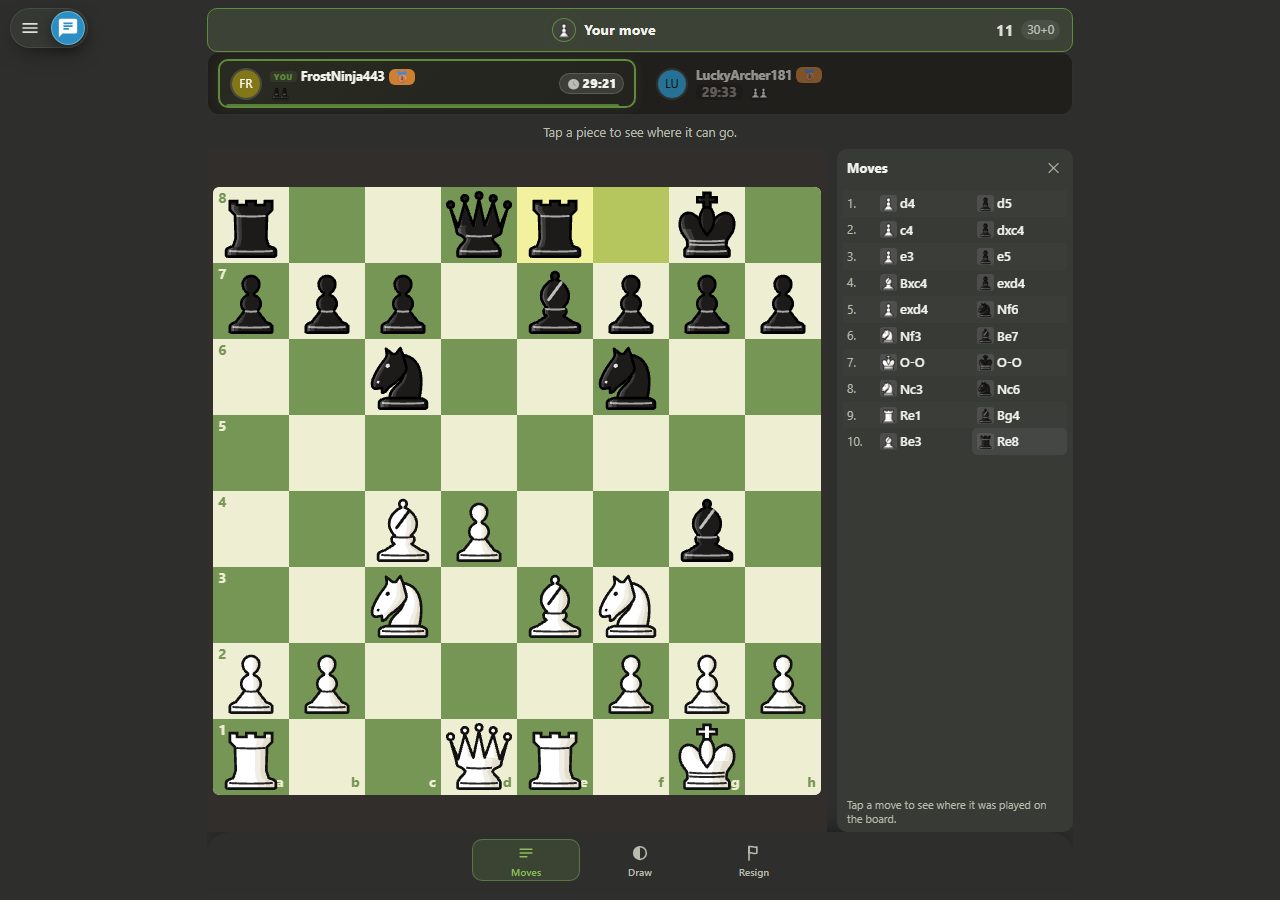
The rule for an open file is simple: if no pawns remain on a file, the rook that enters it first controls it. The method is standard: first open the file (by exchanging pawns), then place your rook there, and if possible, bring your second rook to the same file to double rooks, targeting the seventh rank (the second rank for your opponent)—from there you threaten both pawns and the enemy king at once. The file does not have to be completely empty; other pieces can stand on it too, but no pawn from either side can ever close it again.
The outpost: the knight's permanent home
The second game: 1.e4 c5 2.Nf3 d6 3.d4 cxd4 4.Nxd4 Nf6 5.Nc3 a6 6.Be2 e5 7.Nb3 Be7 8.O-O O-O 9.Bg5 b5 10.Bxf6 Bxf6 11.Nd5. Black's c-pawn left the board on move 3, and the e-pawn advanced to e5 on move 6—the two pawns that could have threatened the d5 square are now out of the picture. When White plays 11.Nd5, no Black pawn can chase it away; moreover, the knight sits directly in front of Black's backward d6 pawn.
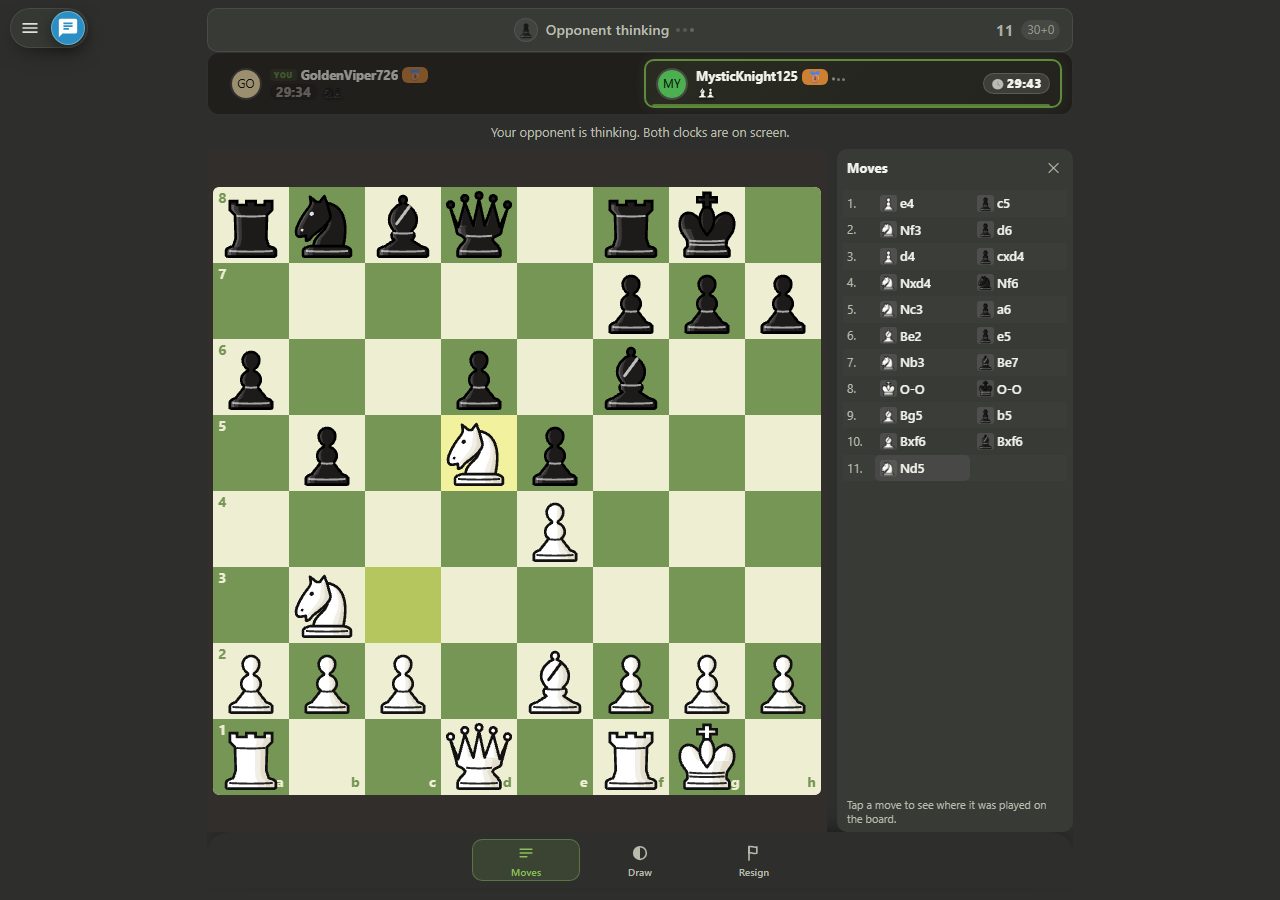
A square is an outpost if no enemy pawn can ever threaten it again. A knight planted on an outpost is not just a three-point piece—it is an unchased permanent problem, usually blockading an opponent's weak pawn; in many positions it becomes worth more than a bishop, because the opponent can only silence it by trading a bishop for it. In this game, Black's early loss of the c-pawn also left an open c-file—open files and outposts are born together from the same pawn exchange, as a rule.
Weak pawns: backward, isolated, and doubled
A pawn weakens in three ways. A backward pawn is one whose neighbors have advanced; it has no pawn to defend it anymore—like Black's d6 pawn in the second game above. An isolated pawn has no neighbors in adjacent files, so no pawn can ever protect it. Doubled pawns are two pawns stacked on the same file, unable to protect each other. All three create the same consequence: the square in front of the weak pawn also weakens, because you can no longer chase off a piece planted there with a pawn—and there is your outpost. That is why in the middlegame, the question "which pawn is weak?" and "which square is weak?" are really the same question.
Piece activity and king safety
In the middlegame, material count matters less than two other things: how active your pieces are and how safe your king is. A bishop cornered in a trap or a rook still on its starting square means part of your material is literally out of play—an extra pawn means little if the rest of your pieces are passive. Similarly, a king that has not castled or one with a broken pawn shelter turns the rest of the middlegame into an emergency before any material calculation—it is a priority to solve first. This is why the first test of any plan is simple: does it leave my king safer or more exposed?
Three questions for building a plan
When it is your turn and you see no tactical blow, ask yourself three questions: Which is my worst piece, and how do I get it into play next move? Where is my opponent's weakest square—which square can no pawn defend again? And which wing should I play on—where does the pawn structure give me more ground? The table below sums up the kinds of lasting advantage you will meet in the middlegame and how to play against each one.
| Advantage type | How to spot it | What to do |
|---|---|---|
| Open file | No pawns remain on the file | Place your rook there, double rooks if possible, aim to reach the seventh rank |
| Outpost | No enemy pawn can threaten this square again | Plant your knight (or bishop) there and do not let it be traded |
| Passed pawn | No enemy pawns ahead or on either side | Support it with your pieces and advance; your opponent will waste material to stop it |
| Bishop pair | You have two bishops, your opponent has a bishop and knight or two knights | Open the position, simplify with pawn trades |
| Space advantage | Your pawns control more squares than your opponent's | Constrain the enemy pieces, secure the center before opening the flank |
Practice middlegame on the board
If you want to set up these games and try them yourself, the move list sits in a panel on the board: on a wide screen, fixed to the side; on a narrow screen, a panel you open to see—for both games, you can step through all the moves above in order. Dragging a piece or tapping its square and marking the target both play the same move—no difference. The bot's three difficulty levels are good sparring partners for testing this kind of plan: easy level searches shallowly and blunders often; medium searches deeper and rarely errs; hard searches the deepest and has zero margin for intentional blunder—so it will truly punish a plan you build in the middlegame. For tactical lessons, see our tactical article; to clear up how moves are read, check our notation guide.
Now when you spot an open file, an outpost, or an opponent's backward pawn, you know what to do: place your rook on the file, plant your knight on the unreachable square, and ask yourself the three targeting questions every turn. Sit down at the chess board and try these two ideas in your own games.
Frequently Asked Questions
What should you do in the chess middlegame?
The middlegame is where opening memorization ends and no forced mate is yet in sight. Here the job is not to memorize moves but to spot lasting advantages on the board (an open file, an outpost, a weak pawn) and aim your pieces toward them. Finding how to activate your worst piece and locating your opponent's weakest square are good starting points.
What is an open file?
An open file is one with no pawns for either side. The rook that enters it first controls it, as a rule. If possible, bring a second rook to double rooks; if the file stays open to the end, the rook tries to reach the opponent's second rank.
What is an outpost?
An outpost is a square no enemy pawn can threaten again. It usually forms right in front of an opponent's backward pawn. A knight planted on an outpost, being unchased, rises above its three-point value and is usually kept rather than traded for a bishop.
Why is a backward pawn weak?
A backward pawn is one whose neighbors have advanced, so no pawn can protect it anymore. The real problem is not the pawn itself but the square in front of it, which also loses pawn protection—an opponent can plant a knight or bishop there as an outpost.
How do you build a plan in chess?
When it is your turn and you see no tactic, ask three questions: which is your worst piece and how do you activate it, where is your opponent's weakest square, and which wing should you play based on the pawn structure. If an open file, an outpost, or a weak pawn is in sight, the plan usually builds around magnifying that advantage.
How can you practice middlegame plans on this site?
The move list appears as a fixed panel beside the board on wide screens or as an open page on narrow ones, so you can step through a game move by move from start to finish. Dragging a piece and tapping its square play the same move; the bot's easy, medium, and hard levels search at different depths, so you can truly test the plans you build.