How Chess Elo Ratings Work | Playgridia
Elo rating is the worldwide standard ranking system that measures the skill gap between two chess players in a single number and updates that number after each game — but chess rating on this site is not Elo at all. It is a flat counter that runs +20 for a win, and this article explains both separately, from start to finish.
What Is Elo?
Elo is the ranking system developed by physicist Arpad Elo and now used by FIDE and virtually every official chess federation in the world. The logic is straightforward: each player's strength is represented by a single number, and every game result updates that number. If you beat an opponent rated higher than you, your rating jumps; if you score the expected win as the favorite, your rating barely moves. The entire value of the system sits here — it converts a rating gap into a concrete win probability. From tournament pairings to broadcast labels of "the favorite," nearly every number you see in chess traces back through this formula.
How Is Elo Calculated?
The formula has two steps. First, the "expected score" (Se) against your opponent is computed:
Se = 1 / (1 + 10^((Ropponent − Ryou) / 400))
Here Ryou is your rating and Ropponent is your opponent's. When the game ends, the actual result (Sa) is 1 for a win, 0.5 for a draw, or 0 for a loss. The rating change (ΔR) is the difference between the actual result and expected score, multiplied by the K-factor:
ΔR = K × (Sa − Se)
The K-factor varies with your experience and strength; the three tiers FIDE uses are:
| K-factor | For whom |
|---|---|
| 40 | New players and under-18 players below 2300 |
| 20 | Established players below 2400 |
| 10 | Players rated 2400 and above |
The logic is this: a new player's rating is still a rough guess, so each game pulls it toward the true skill level quickly (K=40). A player rated 2400 and above has a rating cemented by thousands of games, a reliable measure; a single bad day should not break it, so K=10 keeps it moving slowly.
Let's work through an example: a 1500-rated player in the K=20 tier plays a 1700-rated opponent. First, the expected score: Ropponent − Ryou = 200, 10^(200/400) = 10^0.5 ≈ 3.16, so Se = 1 / (1 + 3.16) ≈ 0.24 — this player's "expected" win rate is about 24%. Now two scenarios: if they win (Sa=1), ΔR = 20 × (1 − 0.24) ≈ +15; if they lose (Sa=0), ΔR = 20 × (0 − 0.24) ≈ −5. An upset over the favorite shoots the rating up fast, while an expected loss barely dents it.
What Does a Rating Gap Mean?
Run the same formula across different ranges and the pattern emerges. A 100-point gap gives the stronger player an expected win rate of about 64% (the weaker side has Se ≈ 0.36). A 200-point gap pushes this to about 76% (Se ≈ 0.24 — the example above). A 400-point gap means the weaker side has an expected score of just 1/11 ≈ 9%, so the favorite should expect to win about 10 out of 11 games. This is what Elo does: it turns a rating gap into a concrete probability. That is why upsets against much higher-rated opponents are rare in top tournaments — the favorite is already statistically doing what it should.
How Does Rating Work on Playgridia?
Here is the critical distinction: the chess rating on Playgridia is not Elo. There is no expected score calculation, no K-factor, no tiered system — a simple, predictable counter runs instead. Everyone starts at 800. Win a game and your rating goes up a fixed +20; lose and it goes down a fixed −20; draw and it stays the same (change is 0). If you abandon a game by handing your seat to a bot, there is an extra penalty: a flat −15 stacked on top of the normal −20. Rating never falls below 0.
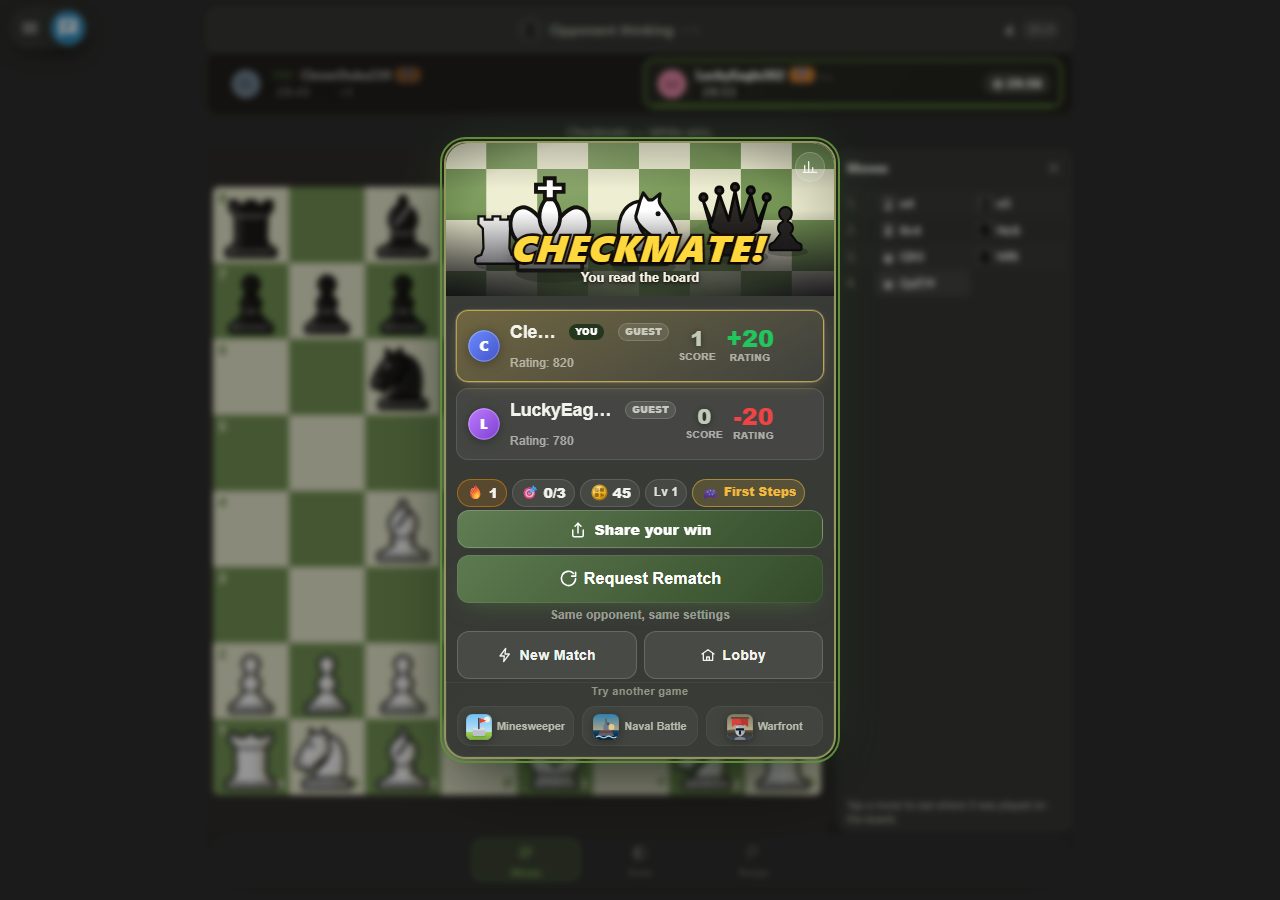
This design is an intentional choice: there is nothing hidden to calculate, no mysterious K-factor, practice against a bot cannot inflate your rating, and walking away from a game costs more than losing it.
Which Games Count?
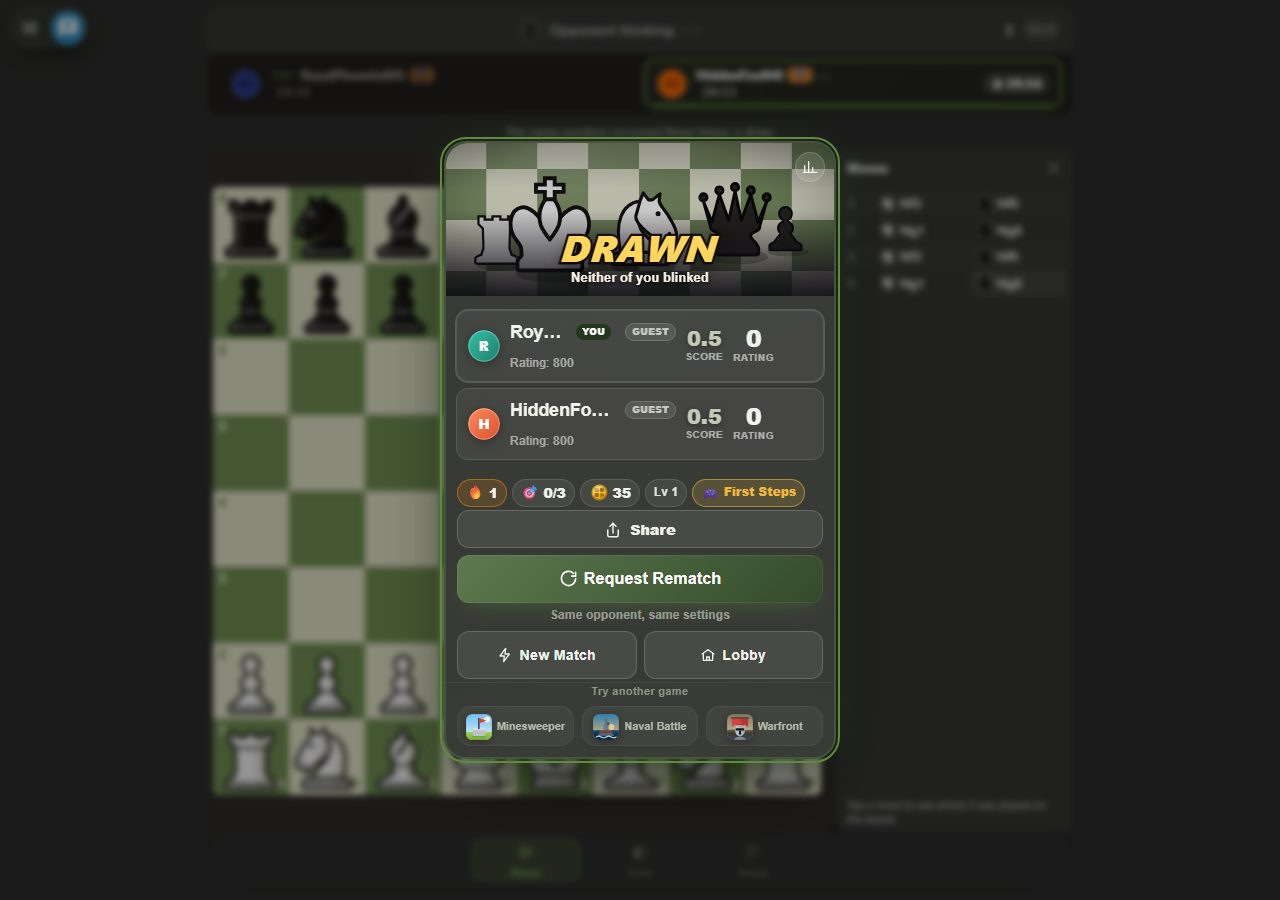
Rating only moves when two real humans sit down at the same table. A game you play against a bot — no matter how long it goes or how well you play — never touches your rating; this is why practicing against bots is completely risk-free. If a game ends with neither side making a move, it is voided: no rating, no score. If a game ends while a seat's timer has run out and the bot has taken over, that game does not count toward either player's rating — a half-finished result changes no one's points. A game ending in a draw counts, but the rating change for both sides is zero.
Two Ratings: Overall and Game-Specific
The point most players miss is this: there is not one rating here, there are two. One is the overall rating — it pools every rated game you have played across all games into a single number. The other is chess-specific — it moves only on chess games and starts from its own base of 800. The leaderboards are separate too: the overall leaderboard ranks by overall rating, and the chess leaderboard ranks by chess rating. The reason there is not a single "your rank" line on your profile page is exactly this — rating branches by game, and a single number is not enough. In practice this means: if you only play chess, both ratings move at the same speed, but if you play multiple games, your overall rating feeds from rated matches outside chess — reading a single change in overall rating as "my chess performance" would be misleading.
How Do You Raise Your Rating?
The practical path is simple. First, warm up against a bot — it costs you nothing, does not raise or lower your rating, and lets you test your moves safely. Then enter rated games against humans: find an opponent in the chess room, pick a time control (see chess time controls) and play. The most expensive mistake is not losing — it is abandoning a game you are losing, because this adds an extra −15 on top of the normal −20. It helps to know how draws form and how games end (draw rules, endgame), and if you are new to the rules, the how to play chess article walks through everything from the start.
Frequently Asked Questions
What is chess Elo rating?
Elo is the ranking system developed by Arpad Elo and used by FIDE and official chess federations worldwide. After each game, your rating updates by the formula ΔR = K × (Sa − Se), where Sa is your actual result and Se is your expected score based on the rating gap with your opponent.
Is my Playgridia chess rating Elo?
No. The site does not use expected score or K-factor in its calculation; it runs a simple flat counter: +20 for a win, −20 for a loss, 0 for a draw. Everyone starts at 800 and rating never goes below 0.
If I play against a bot, does my rating change?
No, never. Rating only moves when two real humans play the same game; against a bot, no matter how much you play or how well you play, your rating does not budge. This is why practice against bots is completely risk-free.
What happens to my rating in a drawn game?
The score to each player records as 0.5, but the rating change for both sides is 0 — the RATING column on the end screen stays the same for both. A draw does not raise or lower your rating.
How much does my rating drop if I abandon a game?
Abandoning a game by handing your seat to a bot costs an extra −15 penalty on top of the normal −20 loss. This is the most expensive move on the platform; your rating will not fall below 0 even so.
Why are my overall rating and chess rating different numbers?
Because they are two separate counters: overall rating pools all your rated games across every game you play, while chess rating moves only on chess games and starts from its own base of 800. There are also two separate leaderboards — one ranked by overall rating and one by chess rating.