Chess Duskhollow Board: Rules Unchanged
The Duskhollow Board in Chess is one of four visual themes: atop obsidian and bone, beneath a slow violet shimmer, the pale coven sits opposite the brood that rises from the abyss, with a spinning rune circle beneath the board—and none of this touches the rules engine by so much as a single line.
What This Board Changes
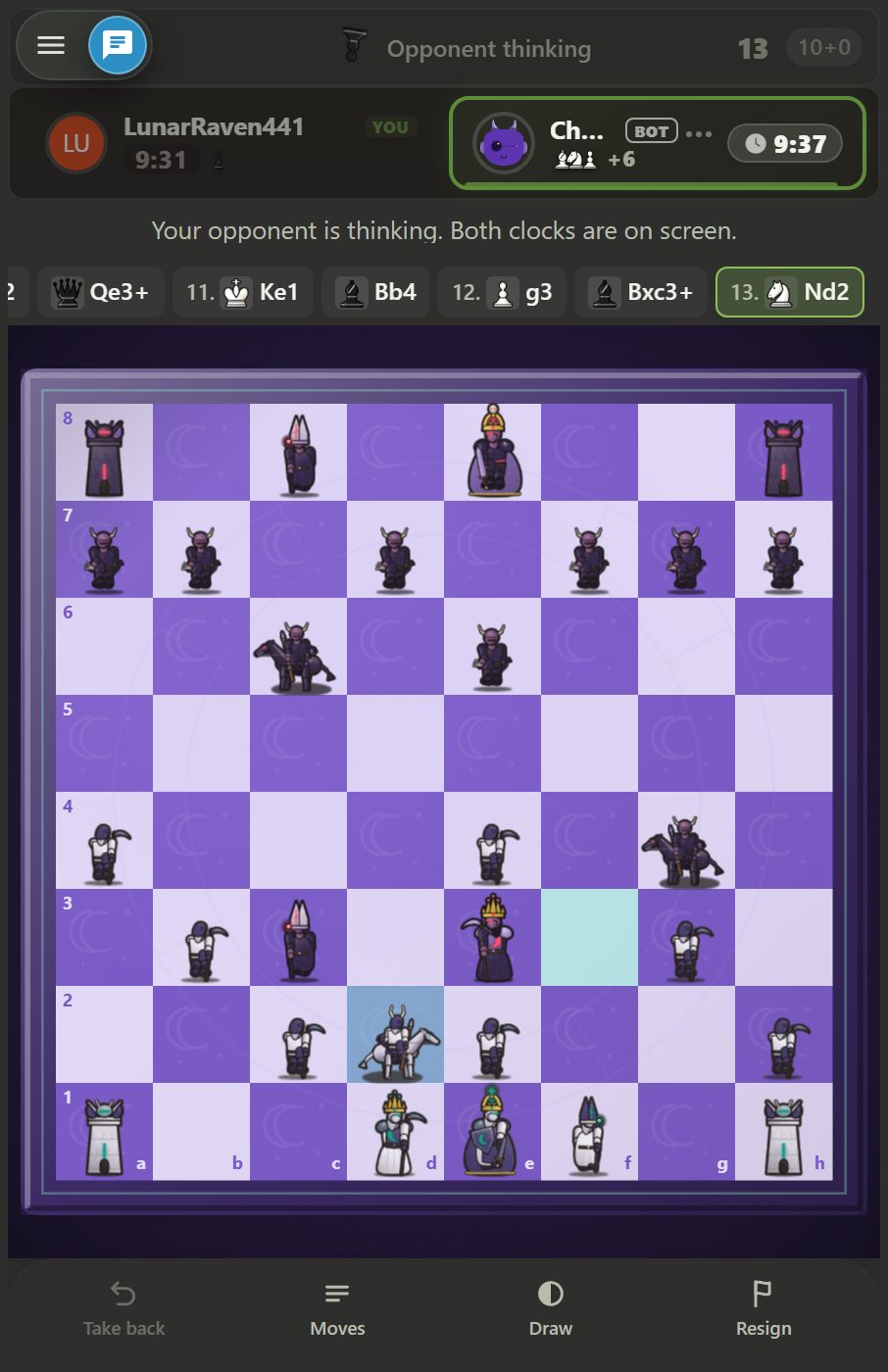
Two armies change: on one side the pale coven, on the other the abyssal brood. The palette is deliberately built to convey "moonlight, not cave"—light squares are pale lilac, dark squares a violet close to true purple. The board features a moon inlay on top and a spinning rune circle below. The color choice draws an intentional boundary: the design team has built this as a scene under moonlight, not in a cave—meaning dark, not the dungeon-black the name "chasm" might suggest, but the pale purple light of midnight sky. We don't retell the rules here; the Chess How to Play article covers moves, checkmate, and castling from scratch.
On all four boards, file and rank coordinates are painted INSIDE the corner squares, not on the frame—this prevents the coordinates from drifting away from the board's actual position. The frame itself exists only on three premium boards; the free Classic board has no frame, and the other three—including Duskhollow—are surrounded by a frame of the same thin weight. So what sets this board apart from the other two premium themes (Emberhold, Eaglecrown) is not the presence of a frame, but the light and texture on top of it.
Capturing Pieces: The Grammar of Devouring
In Duskhollow, when a piece is taken, the scene is staged as "devour": the target piece breaks apart into motes and is drawn into the capturing piece; the square carries a mark for a single breath. On the sound side, the same weight: a wet crack, a subsonic drop, and an ascent-bell layer over; this board's sound bank is tuned deeper and with longer tails than the other three boards. For contrast: in Emberhold, capturing is an assault (dispersing into leaves or cracking into splinters), in Eaglecrown a salvo (gunshot, smoke, descent)—all three boards work toward different feelings, but all three follow the same rule, the same piece leaves the board.
The Last-Move Mark: The Only Cold Color in the Set
On every theme, the last-played square is emphasized with a color; on all three other themes this emphasis is in a warm tone—Duskhollow is the exception. Here the last-move square burns with a cold witchlight mint tone; among the four boards, this is the only place where the mark is not warm. In the screenshot below, while waiting for the bot's turn, this mint color is clearly visible on the last-move square.
Music: The Slowest, Deepest Piece of the Set
This board's music theme is called "abyss": Phrygian mode, 61.74 Hz root pitch, 52 BPM, and an untuned choir—the slowest and lowest of the three musical themes (Emberhold, Eaglecrown, Duskhollow). For contrast: Emberhold's "forge" theme carries a livelier tempo at 73.42 Hz root with 66 BPM, while Eaglecrown's "martial" theme is the liveliest of the three at 82.41 Hz root with 84 BPM—Duskhollow's 52 BPM falls noticeably below both. By contrast, the free Classic board has no music at all; its silence is its own design choice.
What This Board Doesn't Change: The Rules
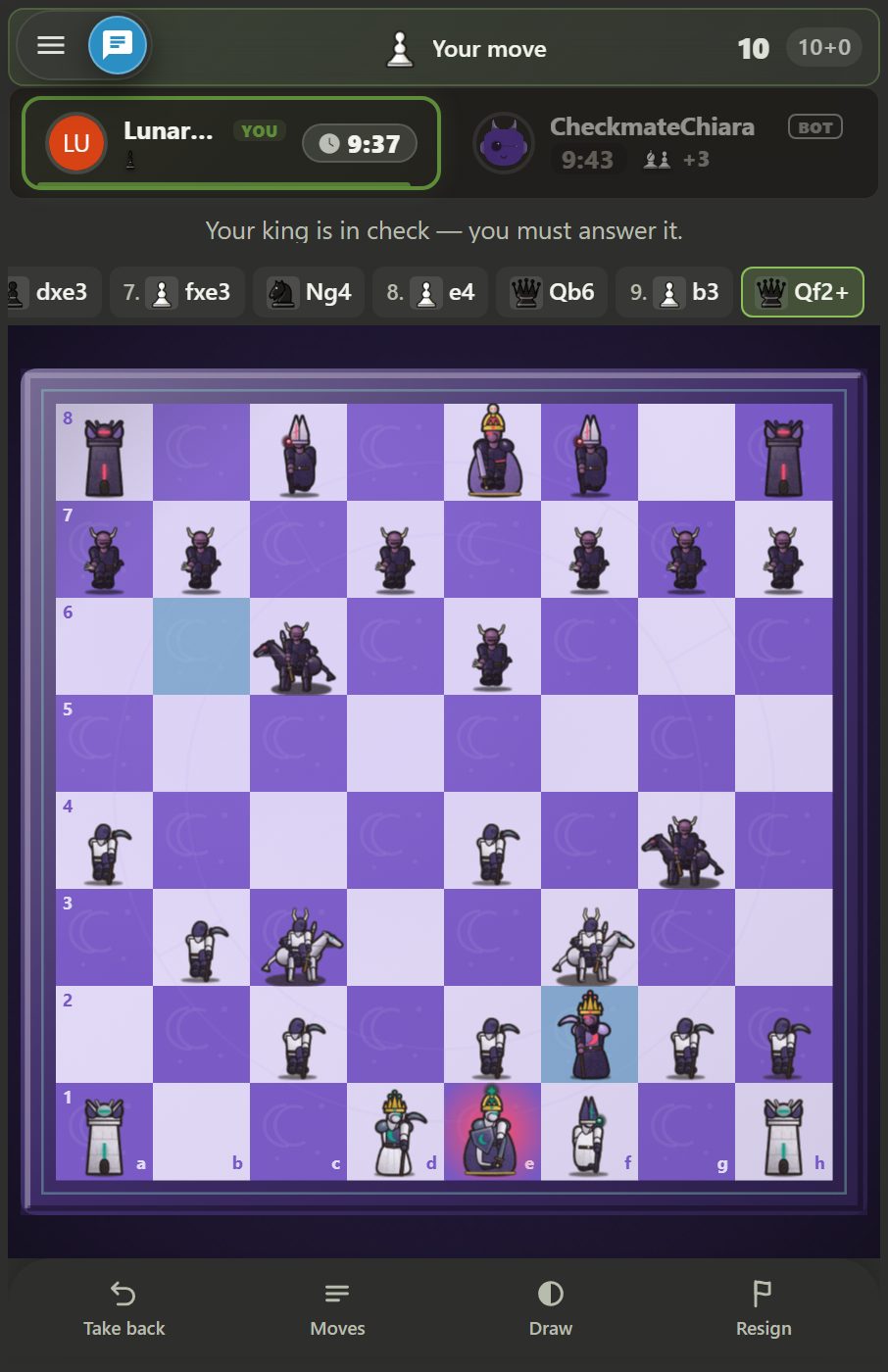
The engine's rules file doesn't even know which board is selected in any move, castling, en passant, draw-check function, or pawn-promotion function—the code's own note says this plainly: the rules engine "cannot see which board is open," and Classic and Duskhollow play the identical game up to the last legal move. This concretizes in the midgame square below: White's king is in danger, a warning appears in the header strip, and the king's square is marked in red—exactly the warning and mark you'd see on a Classic board. Check is not a theme matter, it's a rules surface; all four boards show it identically. On the server side the same distinction holds: the game engine reads which board is selected only in presentation fields; this information never passes to the rules functions that generate moves. Squares you can land on are marked with a ring, empty legal squares with a dot, and the engine accepts no move that leaves the king in danger—this behavior is identical across all four boards, because the marks on screen are read from the same legal-move map coming from the server, not from the board's theme.
Four Boards Side by Side
| Board | Two Sides | Capturing Grammar | Music |
|---|---|---|---|
| Classic | white / black | plain—a tick on the board | none (silent) |
| Emberhold | woodland folk / ironforge | assault—dispersing into leaves or cracking into splinters | forge—73.42 Hz, 66 BPM |
| Eaglecrown | crowned island army / continental empire | salvo—gunshot, smoke, descent | martial—82.41 Hz, 84 BPM |
| Duskhollow | pale coven / abyssal brood | devouring—breaking apart and drawn in | abyss—61.74 Hz, 52 BPM |
If you want to read the same comparison for the other two musical boards separately, check the Emberhold Board and Eaglecrown Board articles.
Freedom and Price
Classic is the only board that is both default and free; Emberhold, Eaglecrown, and Duskhollow are not free. We don't explain pricing or the purchase flow here—the only thing you need to know is that whichever board you choose, the game you play stays the same. This is where themes diverge from one another: for your opponent, not you—a choice for yourself. Choosing Duskhollow gives your opponent nothing and takes nothing from them; the only thing that changes is how the screen looks and sounds to you.
Conclusion: When You Should Choose This Board
If you want to bring a different atmosphere to your matches but don't want to compromise on opening preparation, tactics, or time control, Duskhollow is made for exactly that: look and sound change completely, the rulebook doesn't move. If you still need to brush up on the rules, start with the Chess How to Play article first, then pick your board.
Frequently Asked Questions
Does the Duskhollow Board change chess rules?
No. The engine's rules file doesn't even know which board is selected, and no move, castling, en passant, or draw-check passes board information into it. Classic and Duskhollow play the identical game up to the last legal move.
Is the Duskhollow Board free?
No; the only default free board is Classic. Emberhold, Eaglecrown, and Duskhollow are not free; this article does not cover pricing or the purchase flow.
How does capturing look on this board?
A captured piece breaks apart into motes and is drawn into the capturing piece, and the square carries a mark for a single breath. On the sound side, a wet crack, a subsonic drop, and an ascent-bell blend together; this board's sound bank is the deepest and longest-tailed in the set.
Why is the last-move mark a different color on this board?
While the other three themes highlight the last-move square in a warm tone, Duskhollow uses a cold witchlight mint tone. Among the four boards, this is the only place where the mark is not warm.
What feeling does the music on this board give?
The music theme uses Phrygian mode, 61.74 Hz root pitch, 52 BPM, and an untuned choir; it's the slowest and lowest of the three musical themes. The free Classic board has no music at all, which is its own design choice.
How do I know when my king is in check?
The king's square is marked in red and a warning appears in the header strip above; this looks identical across all four boards no matter which you choose. Because this is a rules surface, not a theme.