What Is the Chess Emberhold Board? Rules Unchanged
Emberhold (internally emberhold), is one of four chess boards: it pits a sylvan elf army against deep-hall dwarves over moss stone and rune-inlaid squares — yet it does not touch a single line of the rules engine that drives the game.
Why No Rules Change
Chess on this platform is one of the games whose rules are never touched; a player's expectation IS the rule itself, which is why no board variant can change play. Move generation, check/checkmate, castling, en passant, promotion, the fifty-move rule, threefold repetition, and insufficient material draws all live in a single module, and none of that module's functions accepts a board or theme parameter — the module's own comment states this directly: the rules engine 'can't even see which board is open.' The same document proves this guarantee another way: 'Classic and Duskhollow play the exact same game up to the last legal move.' As a result, Classic and Emberhold too play exactly the same game up to the last legal move. To learn the rules, see the how to play chess article — we won't repeat them here.
The server-side module that holds the game state maintains the same distinction: it reads which board you're playing on only to choose what effects and music to send to the screen, and never passes this information to the functions that execute move rules. So choosing a board is never buying an advantage, because there is no advantage for sale.
The interface is the same too: dragging pieces and tapping squares on all four boards produces exactly the same move, the move list opens on the same panel, the promotion selector appears only when needed, and both players' clocks always show at the same time. The only thing that changes is the board itself, the pieces' silhouettes, and the sounds.
What Changes: Two Armies, Piece by Piece
In Emberhold, instead of white and black, there are two peoples: sylvan elves on one side, deep-hall dwarves on the other. The ground splits accordingly — moss stone on the elf side, hammered iron on the dwarf side — and on the light squares rests a rune inlay that awakens (glows) on the last move. The overall palette is warm and bright: terracotta over pale sand, deliberately repainted from the previous dark olive-almost-black version. The rank and file letters at the corners of each square sit in the same place on all four boards, positioned inside the square itself to shield them from frame shift. Classic has no frame, but Emberhold has a fine one.
For comparison: the Classic board still stands as a Staunton set in fine wood, on a walnut-maple ground, with felt table and a plain coordinate ring — no character, no flourish; when a piece is captured, it's simply lifted and reset with a wooden click. In Emberhold, the board is a scene, and the pieces are characters.
Looking close, the difference is clear: on the elf side, rooks become stone towers with tree crowns, pawns become cowled green-robed figures, knights become white-mounted cavalry; the queen and king wear golden crowns and green robes. On the dwarf side, rooks sit on glowing-coal bases, pawns wear horned helms and orange mail, knights ride compact shield-bearing mounts, and the queen and king sport horned helms and shields.
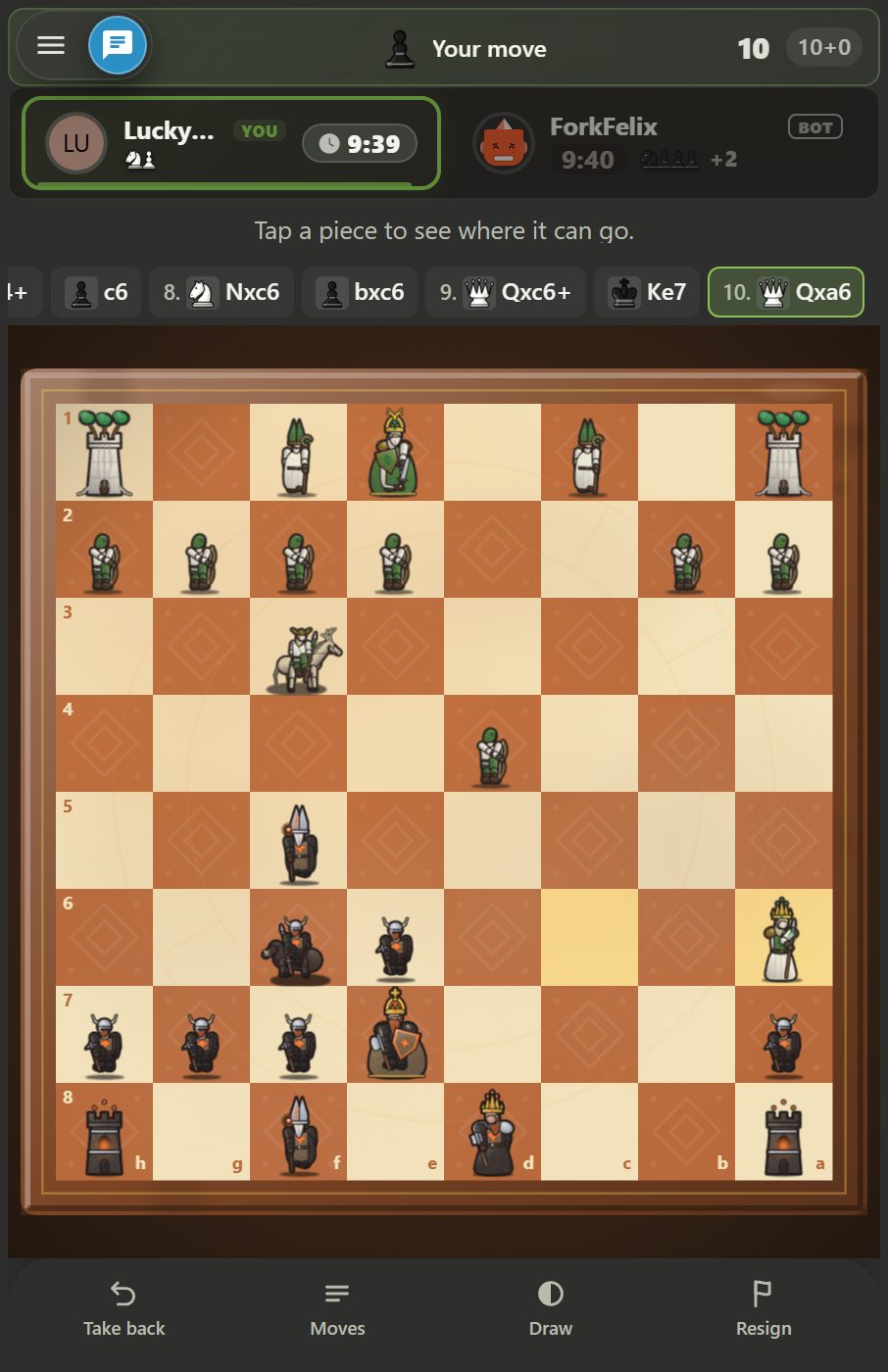
The Capture: 'Clash'
Each of the three other themed boards has its own capture sequence; Emberhold's is called 'clash.' When an elf captures a piece, it fires a rain of arrows and the target transforms into leaves that scatter; when a dwarf captures, it swings a weapon and the target shatters into coal and ash. So the two armies don't just look different — they truly fight differently. Classic has no equivalent: a piece is simply lifted and reset with a wooden click.
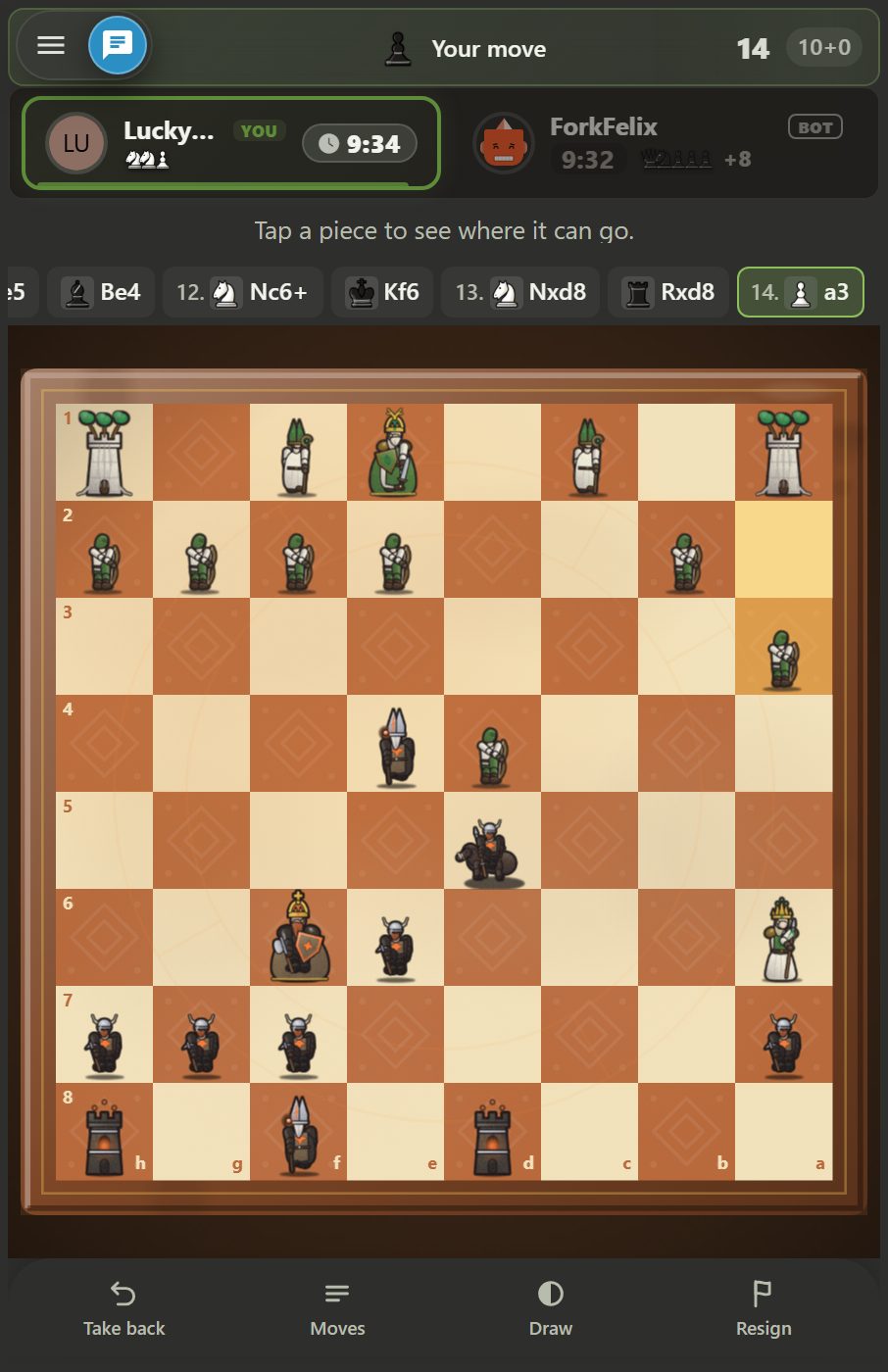
Sound and Music: The Forge Theme
Emberhold has its own sound bank: the release of a bowstring, the strike of a hammer, and the scatter of ash, layered over the classic wooden click. Sound design named this layer 'steel and stone': the strike hardness is raised slightly, while the body and tail sounds are left the same as Classic. On Classic, all six piece types share a single sound: the same wooden click for moves, captures, and castling. Moreover, Emberhold is accompanied by generative music — 'forge': in Dorian mode, with a root frequency of 73.42 Hz and a tempo of 66 BPM. By contrast, Classic has no music — it is silent. This is not a lack; it's a deliberate choice: Classic is a spare board, imitating a real wooden Staunton set, carrying no character or flourish; Emberhold tells a story, and so it has its own sound identity. The same difference holds for the two other themed boards: Eaglecrown's 'martial' theme and Duskhollow's 'abyss' theme are both the opposite of Classic's silence.
All Four Boards Together
In Eaglecrown, capture is a cannon blast; in Duskhollow, the piece crumbles into dust and vanishes; see all four side by side in the table below.
| Board | Two Armies | Capture Sequence | Music |
|---|---|---|---|
| Classic | White / Black | Plain — piece lifted and reset | None — silent |
| Emberhold | Sylvan elves / Deep-hall dwarves | Clash — leaves or coal-ash | Forge — Dorian, 73.42 Hz, 66 BPM |
| Eaglecrown | Crowned island army / Continental empire | Volley fire — cannon shells | Martial — minor, 82.41 Hz, 84 BPM |
| Duskhollow | Pale coven / Abyssal brood | Dissolution — piece crumbles to dust | Abyss — Phrygian, 61.74 Hz, 52 BPM |
Of these four boards, only Classic is free; Emberhold and the two others are not.
What You Should Do
If you've learned the rules, choosing Emberhold changes your chess not at all — only the board, pieces, and scene. Testing it in a bot match and watching elf captures turn to leaves while dwarf captures shatter into coal and ash is, for someone who knows the rules, purely a visual decision. The Undo button in the dock in these screenshots is part of the same logic: it appears only against a bot, because a match between two humans is never touched. If you're curious about the two other themed boards, see Eaglecrown and Duskhollow; if you haven't learned the rules yet, read how to play chess first.
Frequently Asked Questions
Does Emberhold change the rules of chess?
No. The rules engine—move generation, castling, en passant, promotion, and draw rules—takes no board or theme information. Classic and Emberhold play exactly the same game up to the last legal move. Choosing a board is about visuals and sound, not advantage.
Is Emberhold free?
No. The only free default board on the platform is Classic; Emberhold, Eaglecrown, and Duskhollow are not free.
What do the pieces look like in Emberhold?
One side has a sylvan elf army: rooks are stone towers with tree crowns, pawns are green-robed figures, knights are white-mounted cavalry. The other side has deep-hall dwarves: rooks rest on glowing-coal bases, pawns wear horned helms, knights are shield-bearing cavalry.
How do captures look in Emberhold?
When an elf captures, it fires a rain of arrows and the target transforms into leaves that scatter; when a dwarf captures, it swings a weapon and the target shatters into coal and ash. The two armies fight visually in completely different ways.
Does Emberhold have music?
Yes—a generative theme called 'forge,' in Dorian mode, with a root frequency of 73.42 Hz and a tempo of 66 BPM. Classic has no music at all; this is a deliberate silence, imitating the real quiet of a wooden board.
What are the other themed chess boards?
Eaglecrown pits the crowned island army against the continental empire. Duskhollow pits the pale coven against the abyssal brood. Classic is the fourth and the only free board.