What Is the Chess Eaglecrown Board? | Playgridia
Eaglecrown is one of Chess's four themed boards: squares are read like a campaign map between a crowned island army and a continental empire, yet it touches no rule—not how far a bishop moves or when castling is legal.
What is Eaglecrown?
This board, whose engine ID is eaglecrown, transforms both sides of the chess board into a campaign map between a crowned island army and a continental empire. Squares are painted as parchment with contour lines and slate stone; the frame resembles a planning table. Learning its rules is not where this essay starts—go to How to Play Chess for that; all this text covers is what this board adds to the game in sight and sound. In the engine's own data these two sides are named 'crown' (the crowned side) and 'empire' (the empire); in screenshots you see the stones of the white-and-crimson crowned-island army at the top, and the stones of the dark-blue-caped continental empire army at the bottom.
Campaign map: icy blue palette and meander inlay
Eaglecrown is painted in a mix of ice blue and royal blue—light squares in cold ice tone (#e8f0fa), dark squares in royal-blue tone (#5a86bf). Gold is used in only three places: the frame, the coordinate letters, and the last-move marker. A portion of the dark squares bears a meander (labyrinth) inlay at roughly 10% contrast; in the screenshot below you can see this spiral motif in the lower corners of the board. Coordinate letters are painted INSIDE the corner squares, not on the frame—the same rule holds on all four boards, because the frame's position is locked to the grid and the letters are deliberately moved here to prevent drift. The frame appears on only three premium boards; Eaglecrown's frame thickness is calibrated to the exact same ratio as Emberhold and Duskhollow, while Classic has no frame at all.
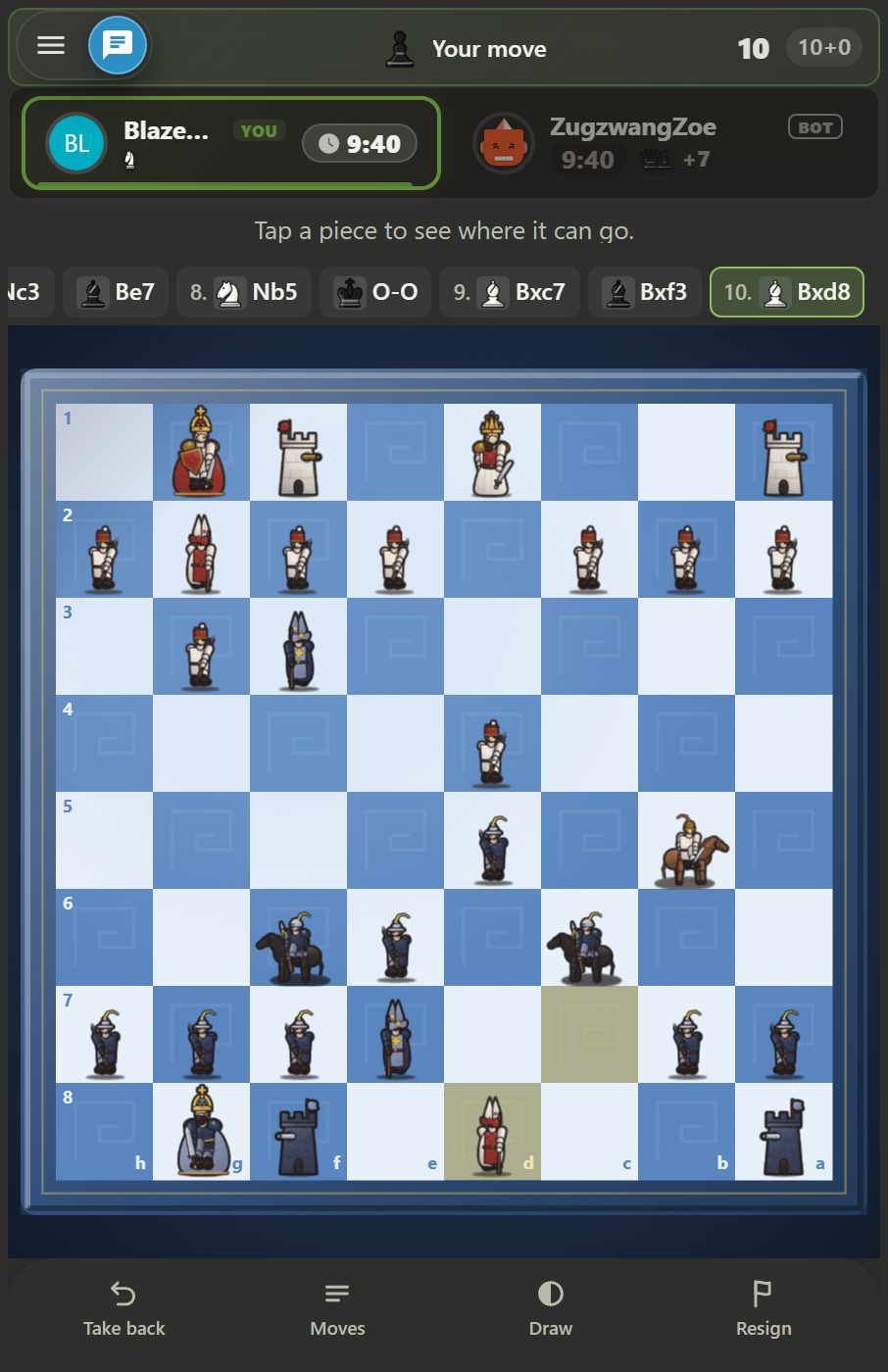
Volley: what happens when a piece is taken
On Eaglecrown, a piece capture is staged as a volley: a line of fire opens, smoke spreads across the board, and the target piece falls. A rook launches a cannonball; the cannonball arcs and explodes at the target. The sound bank layers a sharp crack, a rolling cannonball sound, and smoke crackle; when castling is performed, a separate drumstick click is heard. This is part of a larger design where each of the four boards carries its own capture scene and sound bank—on Emberhold a charge unfolds between forest elves and iron dwarves (see Emberhold Board), and on Duskhollow a piece is scattered to shards and consumed (see Duskhollow Board). The design notes describe this sound mix as 'gunpowder, drier': the crack layer stands out distinctly compared to other boards while the body and tail sounds are slightly dimmed.
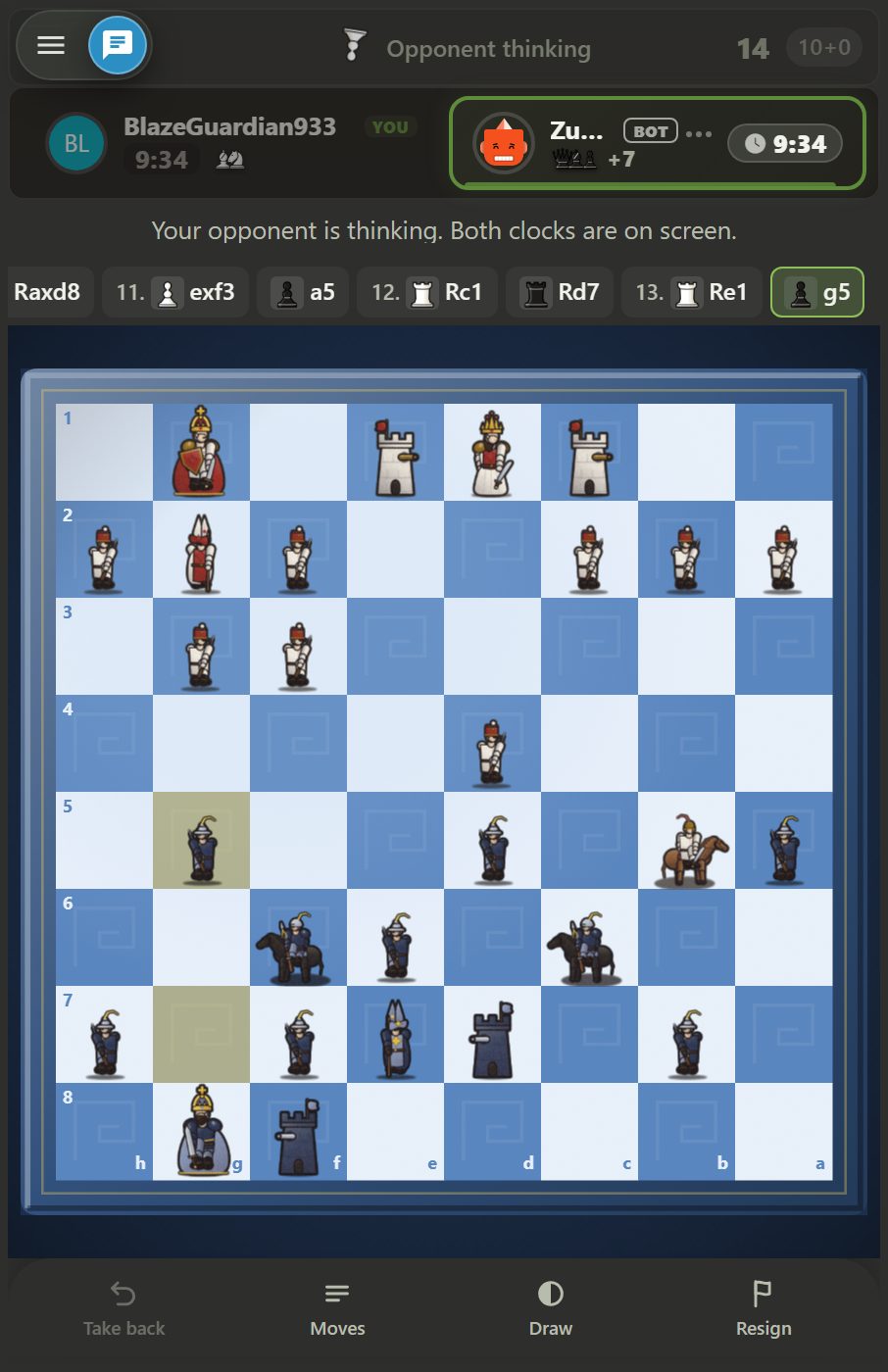
The bottom dock row in the screenshots is identical on each board: Undo, Moves, Draw, and Resign buttons. Undo is available only when playing against a bot and rewinds only your last move and the single response your opponent gave to it; the position returns but time spent does not. Both players' clocks stay on screen at all times—this is a consequence of Chess being the only game on the platform with dual clocks.
Silent Classic against a campaign score
Classic, the free default board, has no music at all by design—complete silence. Eaglecrown's own generative music theme is built on a minor key, root note 82.41 Hz, tempo 84 BPM, and carries a trumpet-like pulse. This is part of a system where each of the four boards has its own character: Emberhold's theme plays in Dorian mode at 66 BPM, while Duskhollow's is much slower and darker in Phrygian mode at 52 BPM. Root notes also shift from board to board: Emberhold starts at 73.42 Hz, Eaglecrown at 82.41 Hz, and Duskhollow drops to 61.74 Hz—each board has its own timbre.
Four boards, one rulebook
Chess's four boards differ only in appearance, capture scene, and music—how the bishop, knight, rook, queen, and pawn move never changes across any of them. The table below lays all four side by side:
| Board | Sides | Capture Scene | Music |
|---|---|---|---|
| Classic (free default) | White / Black | Clean—piece is lifted and replaced with a wooden "tak" sound | None (silent) |
| Emberhold | Sylvan elves / Deep-hall dwarves | Charge—arrow volley or hammer blow | Forge—Dorian mode, 66 BPM |
| Eaglecrown | Crowned island army / Continental empire | Volley—line of fire opens, rook launches a cannonball | Martial—minor key, 84 BPM |
| Duskhollow | The pale coven / The abyssal brood | Consumption—target scatters to shards | Abyss—Phrygian mode, 52 BPM |
None of these four boards change the rules. Chess's rules engine takes no board or theme parameter; a comment in the engine's own code states it directly—the rules engine cannot even see which board is open. Classic and Eaglecrown play identical games right down to the last legal move: castling, en passant, insufficient material, the fifty-move rule, and threefold repetition are exactly the same across all four boards. So no board carries a purchasable advantage, because nothing purchasable has an edge.
When should you choose Eaglecrown?
Eaglecrown is not for someone who wants to change the rules, but for someone who wants to stage the game: a campaign-map feel, a gold frame, volley captures, and its own music theme turn the board into a war table. Classic is free and opens by default; Eaglecrown, like Emberhold and Duskhollow, is not free. The game in the screenshots is also played against a bot—which is why an Undo button appears in the dock: that button shows only against a bot opponent and never appears on screen against another person. Whichever you choose, you play the same game: the same bishop, the same knight, the same castling rule awaits you. For the complete rules, see the How to Play Chess guide.
Frequently Asked Questions
Does the Eaglecrown board change chess rules?
No. Chess's rules engine takes no board parameter, so it cannot even see which board is chosen. Classic and Eaglecrown play identical games down to the last legal move; castling, en passant, promotion, and draw rules are the same across all four boards.
Is Eaglecrown free?
No. The free default board is Classic; Eaglecrown, like Emberhold and Duskhollow, is not free.
How does a piece get taken on Eaglecrown, and what does it look like?
A capture is staged as a volley: a line of fire opens, smoke spreads across the board, and the target piece falls. A rook launches a cannonball that arcs and explodes at the target. When castling is performed, you also hear a separate drumstick click.
Is there music on Eaglecrown?
Yes. Its generative music theme is built on a minor key, root note 82.41 Hz, tempo 84 BPM, and carries a trumpet-like pulse. Classic, the free default board, has no music at all by design and is completely silent.
Who are the two sides on Eaglecrown?
A crowned island army plays against a continental empire. These are fictional sides designed for this board and have no connection to any real country or historical war.
Can I undo my move on Eaglecrown?
Undo is available only when playing against a bot; you can rewind your last move and the single response your opponent gave to it. The position returns but time spent does not—the minutes that ran off the clock stay off. There is no undo between two human players.