How to Play Backgammon: Rules and the Doubling Cube
Looking for how to play backgammon? First, understand this: what is played here is international backgammon, not Turkish tavla — this is a deliberate design choice. Two differences set them apart, so we spell them out upfront: here there is a doubling cube that multiplies the stake from 1 to 64, and when a player fails to bear off a single checker before the game ends, it sometimes counts as a backgammon (triple loss) instead of a gammon — Turkish tavla has neither. We explain all the rules in order so you don't hit doubling play unprepared and conclude the game is broken.
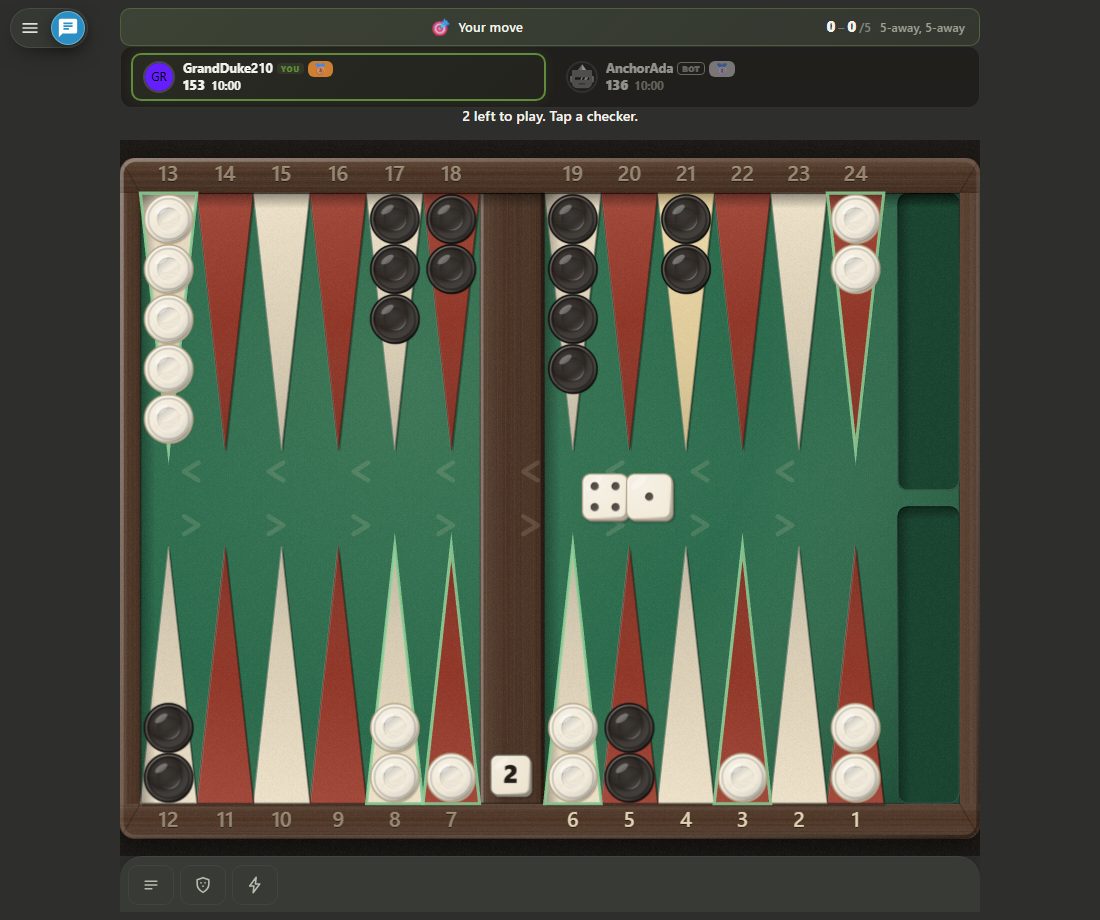
The board, checkers, and bearing off
The board has 24 points; each player begins with 15 checkers that advance toward their home quadrant. The standard opening uses the classic layout. Two alternative openings are also available: nackgammon gives each side 4 checkers in the back (instead of 2), shortening the opening phase and extending contact play; hypergammon starts each player with only 3 checkers on points 22-23-24 and 1-2-3, and games conclude in under 10 moves.
Once all your checkers are in your home quadrant and none remain on the bar, bearing off begins. The crucial rule: if a die shows a number matching that point, you remove the checker; if the die is larger than any occupied point, you remove only from the highest occupied point. Amateur backgammon engines most often get this rule wrong; here it works correctly.
Hitting, the bar, and dice rules
A point with a single checker is a blot; if your opponent lands on it, that checker goes to the bar. A point with two or more checkers cannot be entered. A checker on the bar must be re-entered before any other move.
Dice are rolled in a verifiably fair way. Rolling doubles (for example, 4–4) gives you four moves. The fine point: if you can play both dice, you must play both—evaluated across the entire turn, not move by move; if only one number is playable, you must play the larger one. Sometimes you cannot make a legal move with the roll you drew — this is called dancing, a real and recorded outcome; the turn does not pass silently.
Scoring: single, gammon, backgammon
When a game ends, one of three scores is recorded: if your opponent has borne off at least one checker, a single (1×); if your opponent has not borne off any, a gammon (2×); if your opponent has borne off none AND still has a checker on the bar or in your home quadrant, a backgammon (3×). This multiplier is then multiplied by the current value of the doubling cube (explained below) and added to the match score.
The doubling cube
The doubling cube begins at 1 and can escalate to 2, 4, 8, 16, 32, and 64. It sits in the center; both players start with the right to double. You may double only on your turn, before rolling the dice, and only if you own the cube (or no one has doubled yet). Your opponent then has two choices: take the double—the cube passes to them, and play continues at double value—or pass (drop)—you win immediately at the cube's current (undoubled) value. Rejecting an offer costs you that value; the gammon or backgammon multiplier does not apply, and you cannot win a gammon from a player who passes.
When one player reaches one point away from winning the match, the next game is a Crawford game, and doubling is forbidden in that game only; doubling resumes in any games after. In a 1-point match, doubling is not live—there is no value to doubling in a sequence where doubling cannot end the match.
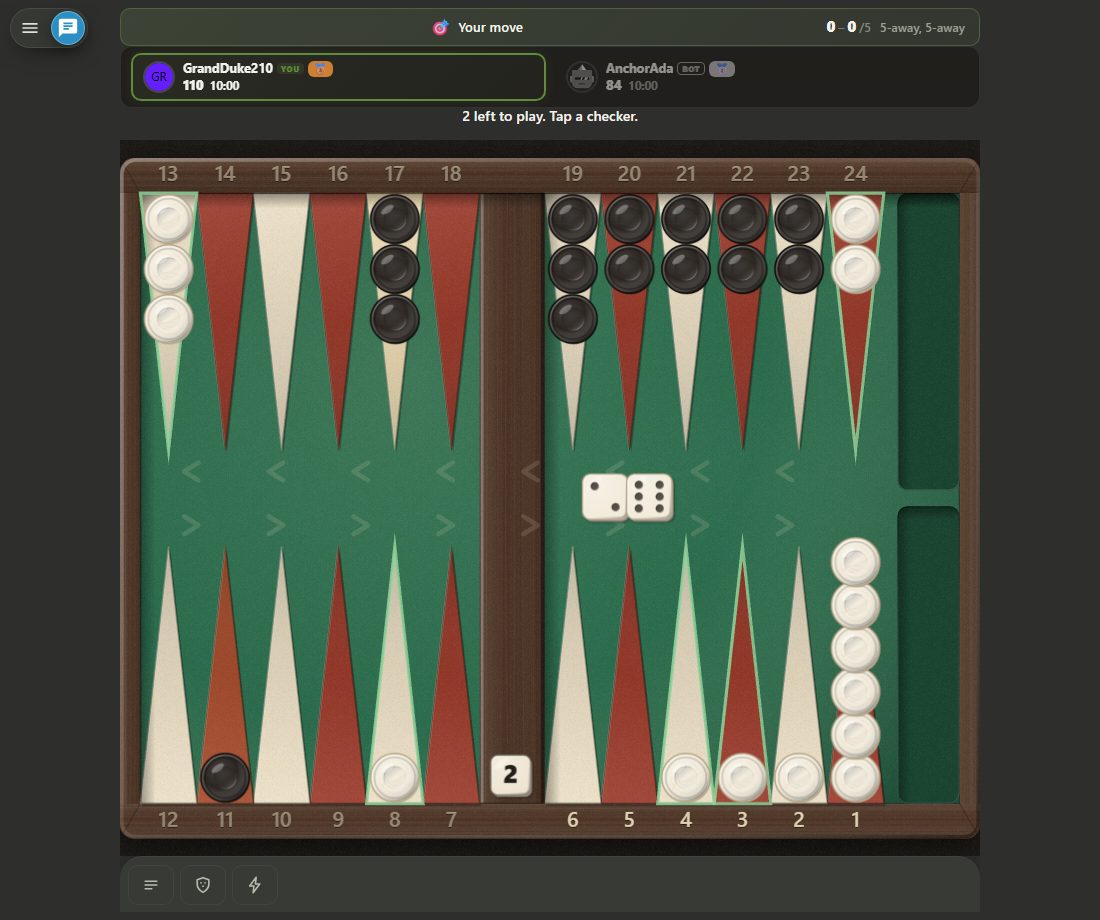
Match format and time controls
A backgammon "game" on this platform is not a single hand but an entire match: played to 1, 3, 5, 7, or 11 points, with 5 as the default. A 1-point match is called "double match point" and has no doubling at all—the simplest format for a beginner; 7 points is the tournament standard.
Time controls are scaled to the match: each turn begins with a free delay window; time spent within that window does not draw from your reserve—this is not a Fischer increment. Your reserve is a bank allocated for the entire match, scaled by match length (reserve per point × total points). Five choices exist:
| Time control | Delay (free per turn) | Reserve (per point) |
|---|---|---|
| Bullet | 3s | 30s |
| Blitz | 8s | 60s |
| Standard (default) | 12s | 120s (2 min) |
| Comfortable | 20s | 180s |
| Relaxed | 30s | 240s |
For example, in a 5-point standard match, each player has 120 s × 5 = 600 seconds (10 minutes) in reserve. Run out and you lose the match immediately—not just the game in progress.
Computer opponent and match analysis
You may choose one of three difficulty levels against the bot. The two stronger levels (medium and hard) use a neural network trained on 400,000 self-play games; easy uses a hand-coded feature model. The levels differ not just in error rate but in which evaluator they use—easy does not miss moves randomly; it picks from the 2nd or 3rd best move in rank, like a human who did not see the best one.
Every match concludes with an analysis report: an error rate (PR) measured as equity loss per move, a luck metric showing how fortunate or unlucky each roll was relative to the position's baseline, and separately noted doubling decisions (double / take / pass). Forced rolls with only one legal move do not count toward this total—no one inflates their PR by drawing boring rolls.
How to play on the board
Checkers are not dragged—they are tapped: click the checker you want to move, legal destinations light up, and if there is only one option it goes there automatically. You cannot send a move before the turn is complete—the engine rejects any incomplete move that leaves a playable die still in the turn. Before submitting, use ↶ to undo; if you prefer, click ⚡ "auto" mode and your turn will be sent the instant you finish it.
In short: do not assume Turkish tavla rules carry over. Play your first match at 1 point, learn the point-by-point rules without worrying about doubles; then read backgammon strategy tips to sharpen your doubling timing and opening choices. To try another classic two-player game, see how to play chess; or if you want to explore beyond backgammon alone, check the 2-player online games guide.
Frequently Asked Questions
Is tavla the same as backgammon?
Not exactly. This platform plays international backgammon; it includes a doubling cube and a backgammon (triple loss) rule, neither of which exist in Turkish tavla. Apart from the board, checkers, and dice logic, these two differences are why we explain them upfront.
How does the doubling cube work?
It starts at 1 and can scale to 2, 4, 8, 16, 32, and 64, sitting in the center. You may double only on your turn, before rolling; your opponent either takes (the cube passes to them and play continues at doubled value) or passes (you win immediately at the cube's current undoubled value).
When bearing off, what if my die is larger than my highest checker?
Then you may use it to remove the checker from your highest occupied point; an exact match is not required. This is the rule most amateur backgammon engines get wrong, and it is implemented correctly here.
Must I play both dice?
Yes, if both are playable, you must play both; this is judged across the entire turn, not move by move. If only one number is playable, you must play the larger one. If no legal move exists, the turn is recorded as a dance and ends.
What match lengths are available?
Matches are played to 1, 3, 5, 7, or 11 points, with 5 as the default. In a 1-point match doubling is not live, because a double can never end the match.
What is the difference between bot difficulty levels?
Medium and hard use a neural network trained on 400,000 self-play games; easy uses a hand-coded model. A weaker level does not miss moves randomly; it picks the 2nd or 3rd best move from the ranking.