Backgammon Opening Moves: Best Play for All 15 Rolls
Backgammon opening moves — the short answer: roll your dice, find that roll in the table below, and play it. Every one of the 15 different opening rolls has a best move, and three simple ideas sit behind that table.
First, Who Starts Gets Decided
The opening move in backgammon isn't a coin flip: both sides roll one die each, the higher roll starts, and that player plays both dice as their first move. That's why doubles never appear as an opening roll — a tie forces a re-roll. As a result there are 15 playable opening rolls, not 21.
On Playgridia, the opening roll comes from the same commit–reveal system as the rest of the game: who starts is data you can verify yourself after the match, not a roll made behind a closed door.
Every Opening Move
Before the table, you need to know how points are numbered, because this is where most new players get stuck: each player counts from their own direction of travel — the farthest point is 24, the last point in their home is 1. So "13/7" means six steps from point 13 to point 7. The 24-13-8-6 line is the four starting stacks: two checkers on 24, five on 13, three on 8, five on 6. That's 15 checkers total, and both sides start with a pip count of 167.
Every move below was generated by this site's own backgammon move generator from the standard starting position, and came back in the engine's own notation — play it exactly as written.
| Roll | Name | Move played | What it does |
|---|---|---|---|
| 3-1 | se yek | 8/5 6/5 | Makes point 5. The undisputed best opening roll. |
| 6-1 | şeş yek | 13/7 8/7 | Makes point 7 (the bar point). |
| 4-2 | cihar dü | 8/4 6/4 | Makes point 4. |
| 5-3 | penç se | 8/3 6/3 | Makes point 3. |
| 6-5 | şeşibeş | 24/13 | Runs the back checker to a safe stack in one move. |
| 6-4 | şeş cihar | 24/18 13/9 | Advances two checkers at once. Alternative: 8/2 6/2. |
| 6-3 | şeş se | 24/18 13/10 | Brings a back checker forward, setting up a future point. |
| 6-2 | şeş dü | 24/18 13/11 | Alternative: 13/5 — slots a lone checker on point 5. |
| 5-4 | penç cihar | 24/20 13/8 | Point 20 is the most valuable back point to make later. |
| 5-2 | penç dü | 13/8 13/11 | Both checkers come down from 13. |
| 5-1 | penç yek | 24/23 13/8 | Pulls one back checker up beside the other. |
| 4-3 | cihar se | 24/20 13/10 | Brings a back checker forward, gaining pips. |
| 4-1 | cihar yek | 24/23 13/9 | Brings a back checker forward, gaining pips. |
| 3-2 | se dü | 24/21 13/11 | Brings a back checker forward, gaining pips. |
| 2-1 | dü yek | 24/23 13/11 (safe) or 13/11 6/5 (slots point 5) | Two choices: safe advance or a slot. |
This table isn't a list to memorize — it's the result of three ideas. The three sections below walk through them one at a time.
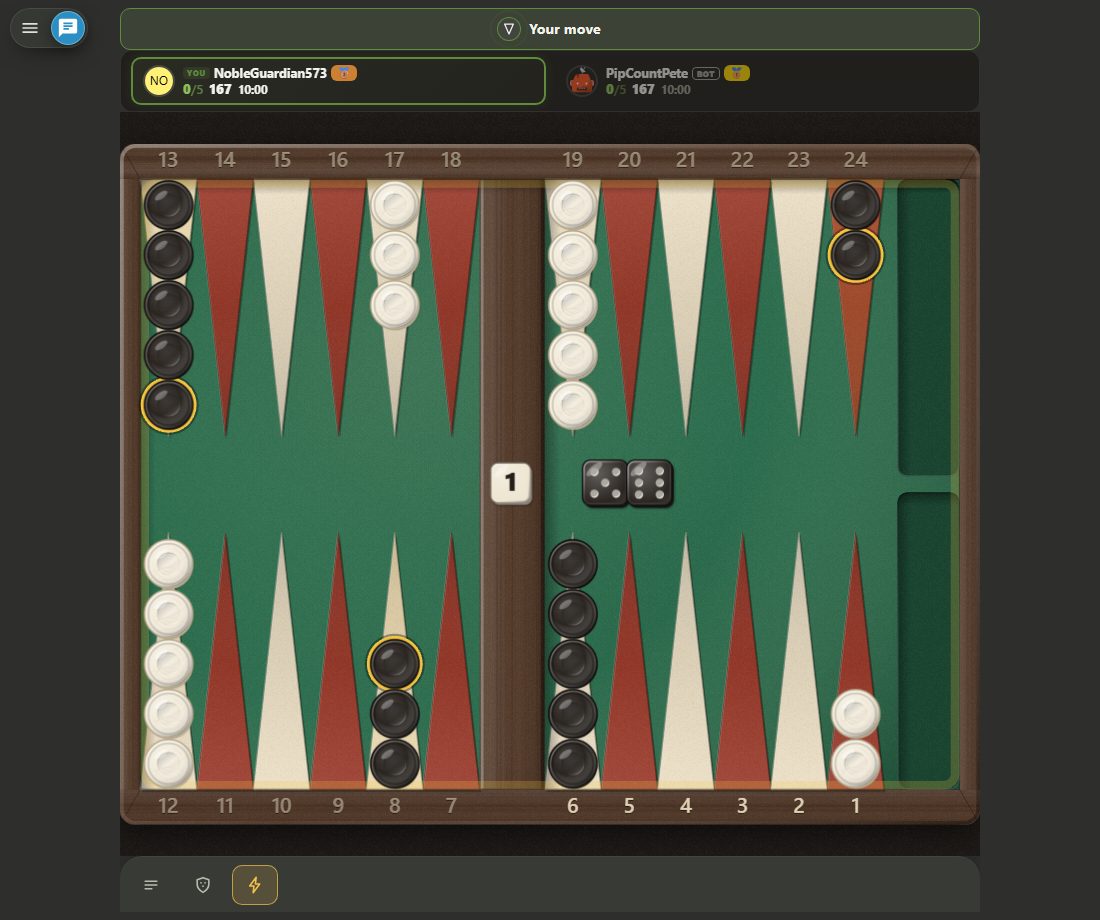
Idea 1: Make a Point When You Can
3-1, 6-1, 4-2, and 5-3 all make a point directly on the opening roll; these four are undisputed, and we haven't shown an alternative for them.
Point 5 (the "golden point") is the most valuable: it sits right in front of your opponent's back checkers and is the door to your home board. Point 7 (the bar point) comes second, because 5, 6, and 7 together are the start of a wall.
A point means two checkers, and it can't be hit. Every point made on the opening roll makes some of your opponent's dice useless for the rest of the game.
Idea 2: No Point? Save Your Back Checkers or Slot
6-5 runs the back checker to point 13 in a single move — the most comfortable opening roll in backgammon, leaving only one checker back.
On rolls like 6-4, 6-3, 5-4, 4-3, 3-2, one of your back checkers comes forward: you gain pips, and that checker becomes a candidate to make a point later.
Slotting is a deliberate risk: on 2-1, playing 13/11 6/5 puts a lone checker on point 5. Get hit, and you lose a turn; don't get hit, and you make that point next turn. Playing safe means 24/23 13/11 instead. Both are correct — both are a choice.
Idea 3: Count the Hit Risk, Don't Guess It
The question to ask when you slot isn't "will I get hit" — it's "how many ways can I get hit." A checker six steps away is hit by 17 of 36 outcomes; the same checker seven steps away is hit by only 6. The distances and numbers are laid out as a table in backgammon dice probabilities.
That's why the slot on 2-1 goes to point 5, not point 6 — and why, on the opening roll, a far slot is cheaper than a close one.
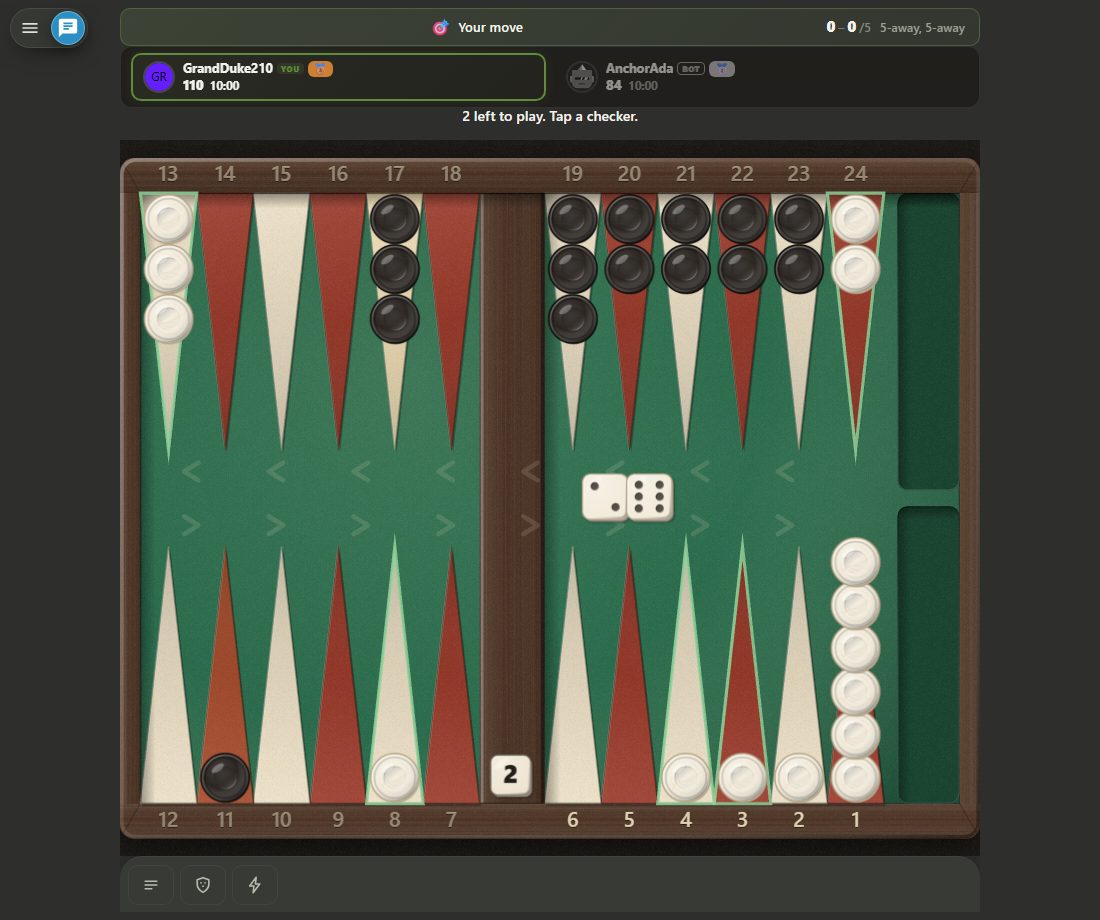
Nackgammon: A Setup That Shrinks the Opening Roll's Luck
On Playgridia, the starting layout is a room option, and there are three setups: Classic, Nackgammon (four checkers back instead of two), and Hypergammon (only three checkers per side).
Nackgammon plays by the same rules; only the layout differs. Having four checkers back narrows the gap between a "good" opening roll and a "bad" one, and stretches out contact — which lowers how decisive the table above actually is. More detail in backgammon variants.
Match length is a room option too: 1, 3, 5, 7, 11 points, default 5. While you're still learning openings, pick a longer match — a single good roll matters less.
You don't need to memorize the table for your first match — just keep it open and check your roll. If you don't know backgammon's basic rules yet, start with how to play backgammon, then sit down at a table from the backgammon page.
Frequently Asked Questions
Who makes the first move in backgammon?
Who starts isn't a coin flip: both sides roll one die each, the higher roll starts, and that player plays both dice together as the opening move. On Playgridia this roll comes from the same commit-reveal system as the rest of the game, so who started is verifiable data.
Can the opening roll be a double?
No. Both sides roll separately, and a tie forces a re-roll, so a double can never appear as the opening roll. That's why there are 15 playable opening rolls, not 21.
What do you play if you roll 3-1?
3-1 is the undisputed best opening roll, played as 8/5 6/5. That move makes point 5 (the golden point) and builds an unhittable structure right in front of your opponent's back checkers.
Why is point 5 so important in backgammon?
Point 5 is known as the "golden point" because it sits right in front of your opponent's back checkers and is the door to your home board. Closing it early makes some of your opponent's dice useless for the rest of the game.
Is slotting on the opening roll a good idea?
On a roll that can't make a point, slotting is a deliberate risk with no single right answer. On 2-1, for example, playing 13/11 6/5 puts one checker on point 5; get hit and you lose a turn, don't get hit and you make that point next turn. Playing safe means 24/23 13/11 on the same roll instead.
What does Nackgammon change about the opening?
Nackgammon plays by the same rules; only the layout differs, with four checkers back instead of two. That narrows the gap between a good and a bad opening roll and stretches out contact, so the opening table above becomes less decisive.