Backgammon Variants: Classic, Mahbusan, Gülbahar, Nackgammon
Backgammon variants means, alongside classic backgammon, regional games like Mahbusan, Gülbahar and Tapa, plus standard opening variations like Nackgammon and Hypergammon — all of them use the same board, the same dice and the same fifteen checkers; what changes is either a single rule or the starting layout.
Why Are There So Many Backgammon Variants?
Backgammon is one of the world's oldest board games, and for centuries it spread without a written rulebook. Today the only standard is the international tournament rules — that is, the classic game plus the doubling cube and gammon/backgammon scoring. Everything else is a local rule: the same name can mean two different things in two different coffeehouses. This article shows exactly where those differences lie.
A rule you learned at one coffeehouse might not hold at a table in the next town over — even if both are simply called "backgammon." That doesn't make backgammon a poorly defined game; if anything, it shows how independently it took shape across regions for centuries. The "official" rules you'll run into elsewhere are really just a standard written later, on top of that same local tradition, for tournaments.
Variants Played in Turkey
Mahbusan, Gülbahar and Tapa have no single written rulebook; the details vary from region to region, even from table to table. The standardized rulebook belongs to the classic game, and international tournament rules descend from it. Still, all four share a common core — read the four descriptions below in order and you'll see each one is really just a single change layered onto the same game.
Classic backgammon (portes). This is the game Turkish players simply call "tavla." A single checker standing alone is hit and sent to the bar, and no other move is possible until that checker re-enters the board. This one rule — a hit checker going to the bar — creates backgammon's most familiar moment: when you hit your opponent's checker, it doesn't leave the game, it's just sent back. The measurable part of this article, and everything below, is built on this game.
Mahbusan. The name means "imprisoned," and that's its one and only difference: a hit checker doesn't go to the bar — the hitting checker sits on top of it, and the checker underneath stays imprisoned until the checker on top leaves that point. An imprisoned checker doesn't leave the game; it just can't move. That makes Mahbusan a slower, more stubborn game than classic backgammon: once you've claimed a point, you play knowing your opponent won't easily free that checker.
Gülbahar. In this variant, checkers are never hit. With no hitting, the game becomes a pure race and the only question is who is moving faster. Details like how many checkers it takes to hold a point vary from table to table; the core that does not vary is that nothing is hit. Luck plays a bigger role here, because the one mechanism that can reverse the game — the hit — doesn't exist, which makes Gülbahar a game where an experienced player's edge counts for less than in classic backgammon.
Tapa. Another name for the same "sit on top" idea as Mahbusan, common along the Aegean-Mediterranean coast. In practice it asks the same question: holding your opponent's checker in place instead of sending it away. At some tables Tapa and Mahbusan are simply two names for the same game; at others, small local details differ — but the core idea is identical.
What these four share: they all use the same board, the same dice, and the same fifteen checkers. What changes is a single rule — and that one rule changes the whole tempo of the game. Knowing which one you're playing is the only way to be sure you and your opponent share the same rules — especially with two variants as close as Mahbusan and Tapa.
What Does That One Rule Actually Change?
Learning a variant really means learning the answer to three questions. Where does a hit checker go? In classic, to the bar; in Mahbusan, it stays where it was; in Gülbahar, it's never hit at all. How many checkers does it take to make a point? And can you reverse the game? Apply those three questions to the four variants above and the difference snaps into focus: in classic, a hit checker has to re-enter from the start; in Mahbusan, it stays imprisoned on the same point; in Gülbahar, hitting never happens at all — and as a result, all three feel like a completely different game on the same board. In a backgammon with no hitting, coming back from behind is nearly impossible; in one where hitting gets harsher, no lead is ever safe.
The Three Openings Playable on Playgridia
These are a room option (the option is called "Opening"), they're free, and none of them changes the rules — only the starting layout. Same hitting, same bar, same bearing off, same gammon and backgammon, same doubling cube.
| Variant | Layout | Checkers | What Changes |
|---|---|---|---|
| Classic | 2 on point 24, 5 on 13, 3 on 8, 5 on 6 | 15 | The standard game. Opening pip count is 167 for both sides. |
| Nackgammon | 2 on 24, 2 on 23, 4 on 13, 4 on 8, 4 on 6 | 15 | Four checkers back instead of two. The opening roll matters less, and the contact phase lasts longer. |
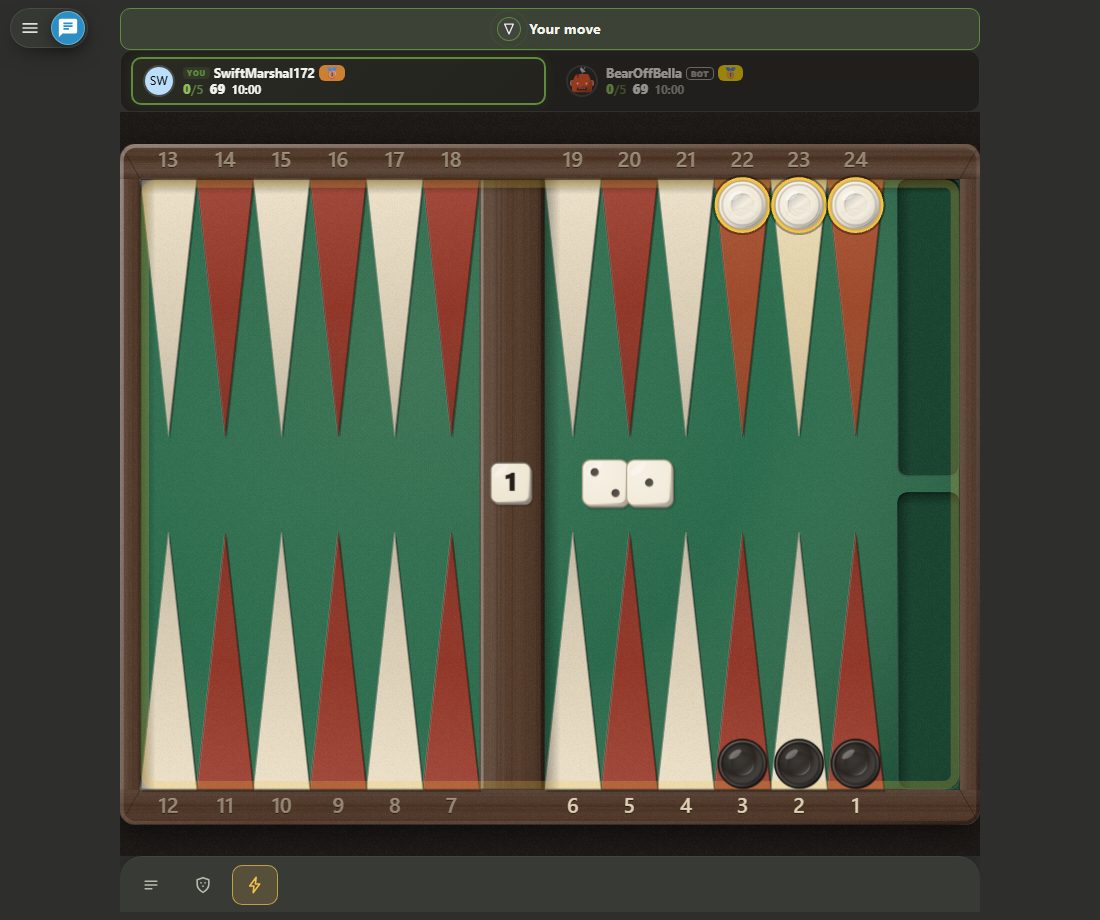
| Hypergammon | One checker each on 24, 23 and 22 | 3 | A game finishes far faster than classic backgammon. Built to learn the race and the doubling cube in one sitting. |
All three play by identical rules; you pick one from the "Opening" option when setting up a room, and it's free. "Pip count" is the total number of squares all your checkers still need to travel to reach home; a lower pip count means you're currently ahead in the race. Nackgammon is designed to shrink the opening-roll lottery: the four checkers in the back reduce the gap between rolling well and rolling badly, and especially in a match between two new players, it stops the first few moves alone from deciding the outcome.
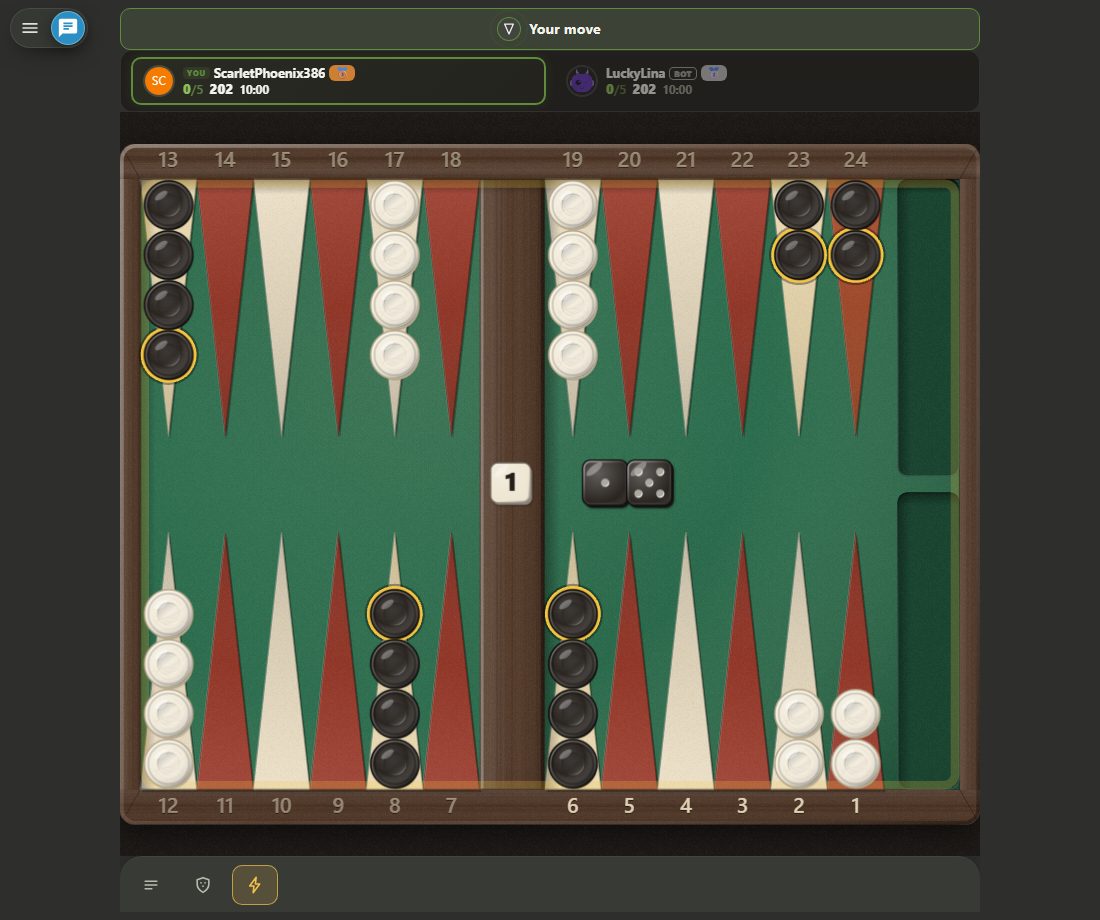
Hypergammon is played with three checkers; it's a learning board. The race math and the doubling-cube decision become visible inside a game short enough to hold in your head in a single sitting. Small counting mistakes that would get lost in a fifteen-checker game show up immediately with only three — which is exactly what makes it ideal for learning.
A board theme is not a game variant. A theme is only how the board looks; the dice are generated before the board is drawn, and the rules never see the theme.
Match Length Is a Variant Too
A single game and a match are not the same thing. Match lengths are 1, 3, 5, 7 and 11 points; the default is 5 points.
A 1-point match has no doubling cube — there's nothing left to double, which makes it the simplest format to start with. From 3 points on, the doubling cube becomes a real decision. The longer the match, the smaller luck's share: the same skill gap wins far more often over an 11-point match. The reason is simple: in a short match, a single bad roll can decide the outcome; in a long one, that bad roll's effect gets balanced out over the following games.
The Crawford rule: in the single game played right after one side reaches one point short of winning the match, the doubling cube isn't used.
Which One Should You Start With?
If you don't know the rules: classic plus a 1-point match — with no doubling cube, you can focus on just one thing at a time: hitting, the bar, bearing off. If you already know them: classic plus a 5-point match, which brings the doubling cube's extra layer of decisions into play. If you're tired of how much the opening roll decides: Nackgammon, which makes you rethink the same rules from a different starting point. If you only have ten minutes: Hypergammon, which plays out the whole game — from race math to the doubling-cube call — in one short sitting. All of them can be played without creating an account, against one of three bot levels or against a real opponent.
If this is your first time sitting down, check out how to play backgammon; if you're curious about opening moves, the opening moves guide helps, and if terms like "pip" and "gammon" are unfamiliar, the backgammon terms glossary will help. You can start playing from the backgammon page.
Frequently Asked Questions
How many backgammon variants are there?
There's no single exact count, because the local rules of Mahbusan, Gülbahar and Tapa vary from region to region. The well-known ones are local variants like Classic (portes), Mahbusan, Gülbahar and Tapa, plus standard opening variations like Nackgammon and Hypergammon.
How do you play Mahbusan backgammon?
Mahbusan uses exactly the same rules as classic backgammon; the only difference is that a hit checker doesn't go to the bar — it stays imprisoned on that point, under the checker that hit it, until the checker on top leaves. The checker underneath can't move but doesn't leave the game either. That makes Mahbusan slower and more stubborn than classic backgammon.
Are checkers hit in Gülbahar?
No, checkers are never hit in Gülbahar. With no hitting, the game turns into a pure race, and luck's share is higher than in classic backgammon, because the mechanism that can reverse the game — the hit — doesn't exist here.
What is Nackgammon, and how is it different from classic backgammon?
Nackgammon uses the same rules as classic backgammon but starts from a different layout: each player begins with two checkers each on points 24 and 23, four checkers back in total; classic has only two checkers on point 24. This reduces how much the opening roll decides and lengthens the contact phase.
How many checkers does Hypergammon use?
Hypergammon is played with three checkers: each player places one checker each on points 24, 23 and 22. With only three checkers on the board the game runs far shorter than classic backgammon; the race is settled in a handful of turns.
Can I play Mahbusan or Gülbahar on Playgridia?
No. The three openings playable on Playgridia are Classic, Nackgammon and Hypergammon; all three apply classic backgammon's rules.