Backgammon Terms & Dice Names: Full Glossary
The backgammon terms a Turkish table uses can be confusing at first, because most of the words entered Turkish together with the game itself: düşeş, dubara, and mars aren't everyday words. This page defines every one of them, starting with the dice names, then the board's own vocabulary, and finally the language of scoring.
Where the Dice Names Come From
All six dice names come from Persian number words that entered Turkish along with the game: yek 1, dü 2, se 3, cihar 4, penç 5, şeş 6. Once you know these six words, the table below reads itself — every non-double name is just the Persian word for one number followed by the other. Doubles are the exception, because they each carry their own shortened name.
| Roll | Turkish name (reading) | Checkers played |
|---|---|---|
| 1-1 | hep yek (all ones) | 1 four times |
| 2-2 | dubara (dü bara — double two) | 2 four times |
| 3-3 | düse (dü se — double three) | 3 four times |
| 4-4 | dörtcihar (double four) | 4 four times |
| 5-5 | dübeş (dü beş — double five) | 5 four times |
| 6-6 | düşeş (dü şeş — double six) | 6 four times |
Non-double rolls are just the two numbers named side by side:
| Roll | Turkish name | Roll | Turkish name |
|---|---|---|---|
| 6-5 | şeşibeş | 4-3 | cihar se |
| 6-4 | şeş cihar | 4-2 | cihar dü |
| 6-3 | şeş se | 4-1 | cihar yek |
| 6-2 | şeş dü | 3-2 | se dü |
| 6-1 | şeş yek | 3-1 | se yek |
| 5-4 | penç cihar | 2-1 | dü yek |
| 5-3 | penç se | ||
| 5-2 | penç dü | ||
| 5-1 | penç yek |
One rule sits under all these names: rolling a double means four moves. The engine applies exactly this — a player who rolls 3-3 (düse) plays three four separate times, not just twice. Six of the thirty-six possible dice outcomes are doubles, so the chance your next roll is a double is 16.7%.
The Board's Own Language: Point, Home, Blot, Bar
Once the dice names click, the board's own terms come next. These are the words that steer every single move.
| Term | What it means |
|---|---|
| Point (hane) | One of the triangles on the board. There are 24 points on the board. |
| Checker (pul) | Each player has 15 checkers (3 in a hypergammon opening). |
| Home board (ev) | Your own last six points. Once all your checkers are there, you can start bearing off. |
| Point / made point (kapı) | A point held by two or more of your checkers. Your opponent cannot land there. |
| Blot (açık pul) | A checker standing alone on a point. It can be hit. |
| Hit (vurmak) | Landing on a point where the opponent has a single checker. That checker goes to the bar. |
| Bar | The strip in the middle of the board. A hit checker is placed there. |
| Checker on the bar | While you have a checker on the bar, you cannot play any other move; you must re-enter it first. |
| Prime (duvar) | Made points built side by side. A checker trapped behind six consecutive points cannot escape with any roll. |
| Bearing off (toplama) | Removing checkers from the board. It only starts once every checker is in your home board and none is on the bar. |
| Gammon (mars) | If your opponent loses without bearing off a single checker: the score is double. |
| Backgammon (çifte mars) | On top of a gammon, if the opponent still has a checker on the bar or in your home board: the score is triple. |
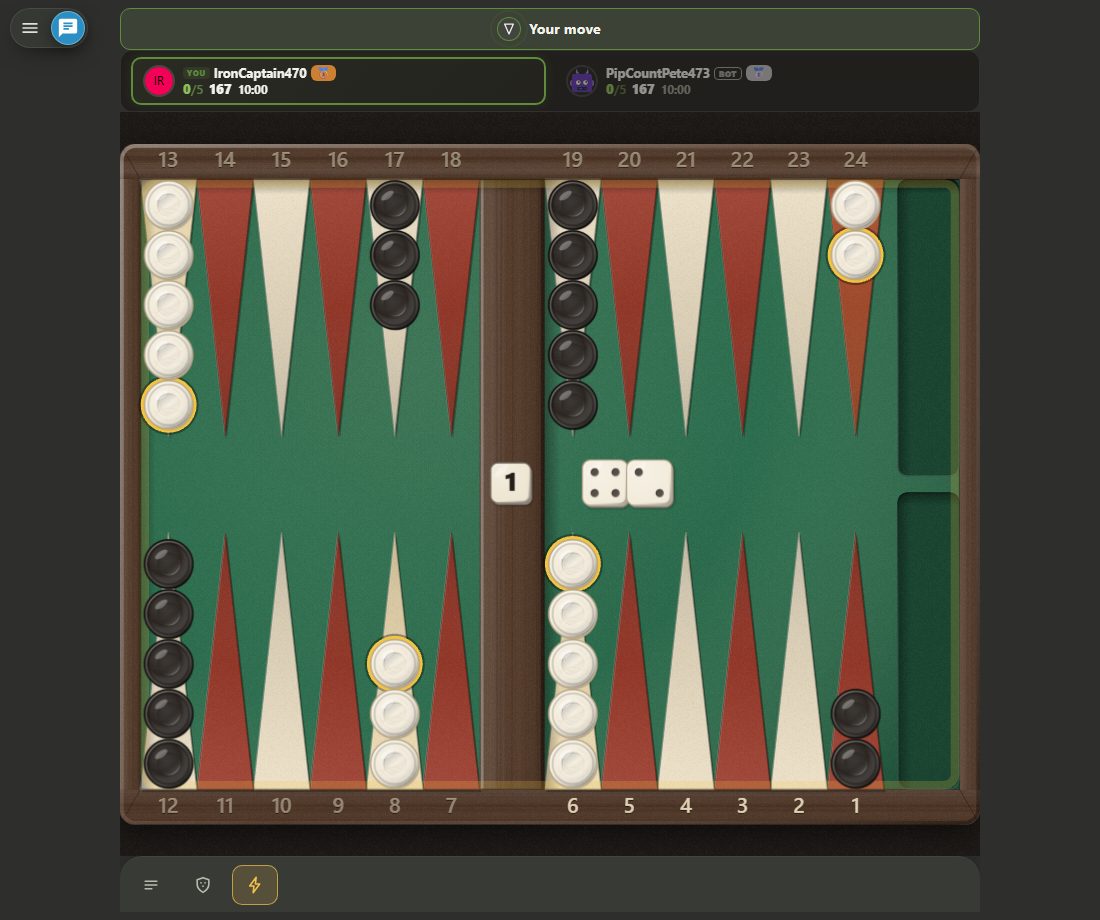
| Pip count (pip) | The total dice-step distance needed to bear off all your checkers. It is 167 for both sides at the start. |
| Doubling cube | An offer to double the stake. It starts at 1 and can rise to 2, 4, 8, 16, 32, and at most 64. |
| Crawford rule | In the single game right after one side reaches one point away from match victory, the doubling cube cannot be used. |
| Beaver | A "redouble and keep the cube" rule some tables allow. Playgridia does not have it — the player who accepts a double becomes the cube's owner and cannot redouble it back immediately. |
The Language of Scoring: Gammon, Backgammon, Doubling Cube
A game's value is calculated as points × the doubling cube's current value. A single game is worth 1, a gammon 2, a backgammon 3; a gammon won while the cube reads 4 is worth 8 points. The number looks large, but the logic is simple: however many times the cube has been doubled, the game's base value is multiplied by that many times.
If a doubling offer is declined, the game ends immediately at its undoubled value — the player who declines loses the current stake (often 1 point) and the game stops there. In other words, no gammon or backgammon is ever scored against someone who declined: those multipliers only apply when a game is actually played out to the end.
Match length is chosen from 1, 3, 5, 7, or 11 points; the default is 5 points. A 1-point match never uses the doubling cube at all — there is no remaining match value left to double.
Three Pairs That Get Mixed Up
Gammon ≠ backgammon. Both start the same way — your opponent loses without bearing off a single checker — but the difference is whether the opponent still has a checker on the bar or in your home board at that moment. If they do, it's a backgammon; if not, it's a plain gammon.
Point ≠ prime. A point is a single triangle; two checkers are enough to hold it. A prime is several made points built side by side — six consecutive points in a row leave the checker trapped behind them with no legal roll to escape.
Turkish tavla ≠ international backgammon. The rules are largely identical; the real difference is that the doubling cube and gammon/backgammon scoring are formally part of the international game's rule set. Playgridia's backgammon applies the international rules, so every term on this page applies directly.
The One Real Fact About Dice Language: Naming Doesn't Change the Game
The dice names are folklore; the only thing that changes the game is the number you roll. How the dice are actually generated, on the other hand, genuinely matters: on Playgridia, dice are rolled using a commit-reveal method, meaning the result is locked in before either side acts and can be verified afterward, roll by roll. The opening roll that decides who starts comes from the same system. Full explanation: is backgammon dice fair.
Board theme doesn't change the dice either — the dice are generated before the board is even drawn, so the look you chose has no relationship to the numbers the dice produce.
See the Terms on the Board
Once you sit down to play, these terms click into place on their own: while you have a checker on the bar, the board simply won't accept any other move, a counter appears once bearing off begins, and gammon and backgammon are scored separately at the end of the match.
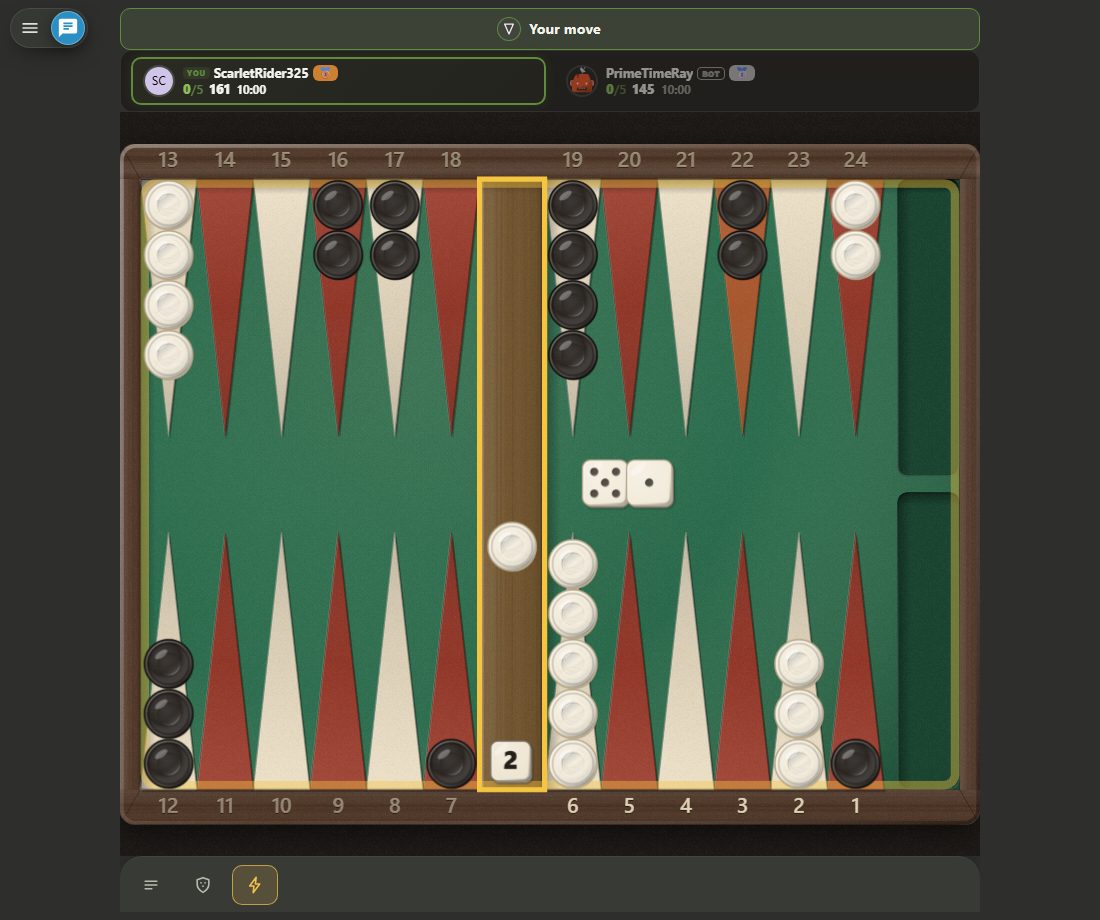
You can pick one of three bot levels or a real opponent; you can sit down as a guest and start without an account. If you want the rules from the start, read how to play backgammon, or go play at backgammon.
Frequently Asked Questions
What does düşeş mean?
Düşeş is the name for rolling 6-6, from the Persian words "dü" (two) and "şeş" (six). Because it's a double, you play four separate sixes, moving a total of 24 points. Out of thirty-six possible dice outcomes, exactly one is düşeş.
What does dubara mean, and how many moves does it play?
Dubara is the name for rolling 2-2; the Persian "dü bara" means two twice. Like any double, it plays four moves, so you advance by two four separate times, 8 points in total. The chance of rolling any double is 16.7% on each roll.
What does mars mean in backgammon, and how many points is it worth?
Mars (gammon) is when your opponent loses without bearing off a single checker, and it's worth double a normal game. If the opponent still has a checker on the bar or in your home board, it becomes a backgammon (çifte mars) and is worth triple. Both multiply whatever the doubling cube's current value is.
What is a point (kapı) in backgammon, and how many checkers does it take?
A point is held once at least two of your checkers sit on it, and your opponent cannot land there. Points built side by side form a prime; six consecutive points leave a trapped checker with no legal roll to escape.
Can I make any other move while I have a checker on the bar?
No. While you have a checker waiting on the bar, you must re-enter it through your opponent's home board before playing anything else. If there's no open point to enter on, your turn passes straight to your opponent.
What is pip count, and what is it at the start of the game?
Pip count is the total number of dice steps needed to bear off all your checkers. At the start of the game it's equal for both sides — exactly 167 — and it drops as the game progresses.