Classic Minesweeper Online: The Old Grey Board in a Browser
You can play classic Minesweeper online with the old grey look on Playgridia: raised grey tiles, pixel digits, a red LED counter and a smiley that reacts. It is not the solo game from the old office PCs. It is a 2-player race on one shared field, against a bot or a friend, and the Classic field is free for everyone, with no download and no sign-up.
Is this the original Minesweeper?
No. Playgridia is an independent game. It borrows the look you remember and the way a number is read, and it changes the rules around them. If you want the quiet solo game with a timer, this is not that, and it is better to know before you tap play. If you want the same grey board with a second person fighting over the same mines, read on.
The old details and where they are on the Classic field
The Classic field is the default table. Here is what you will recognise:
| Detail you remember | On the Classic field |
|---|---|
| Grey raised tiles | Every covered cell is a grey raised tile. An opened cell is flat grey. |
| Pixel digits | Numbers use the classic colours: 1 blue, 2 green, 3 red, 4 dark blue, 5 maroon, 6 teal, 7 black, 8 grey. |
| Red LED counter | It shows the mines still buried. It starts at 25 and drops by one for every flag, so with 4 flags down it reads 021. |
| The smiley | It sits between the two seat chips and reacts as the match goes. |
| A flag on a mine | Flags stand on the tile in the colour of the seat that found them: blue for you, red for your rival in the screenshots on this page. |
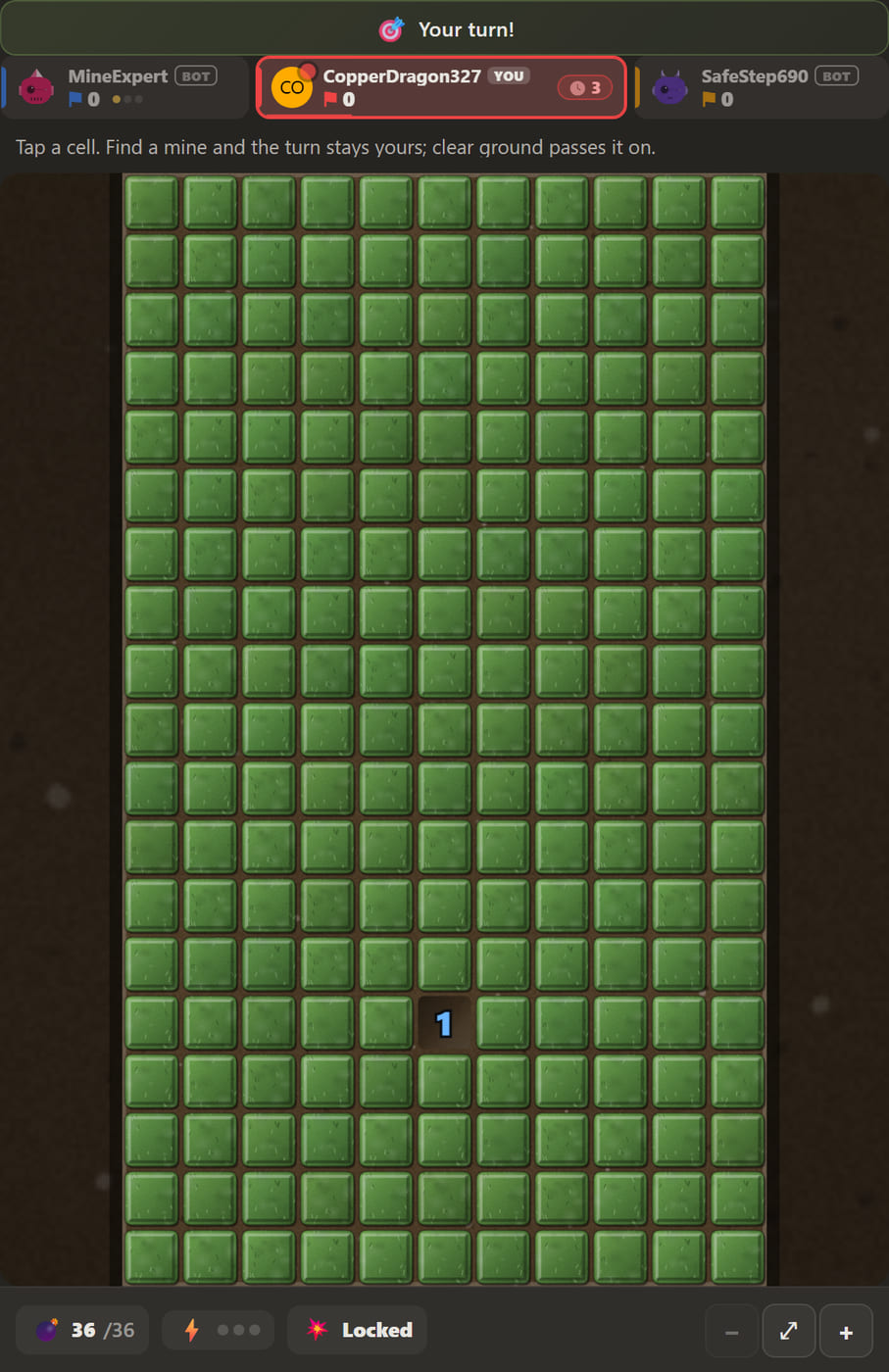
What stayed exactly the same
A number counts the mines in the 8 cells around it, diagonals included. Cells on an edge or a corner have fewer neighbours, so the number reads lower there. A cell showing 0 has no mine around it, so it opens all connected empty cells and the numbered border in one go, as a cascade.
That means everything you learned about reading numbers still works. The guide to how to play Minesweeper explains the numbers, and the page on patterns such as 1-2-1 covers the shapes that give a certain answer.
What changed
- Two players, one field. You and your rival take turns on the same cells.
- Mines score. Tap a cell that hides a mine: a flag is planted for you, you get +1 and the turn stays yours. Tap clear ground: it opens and the turn passes. The player with more flags wins, and equal scores are a draw.
- No game over. Hitting a mine is the good result. The cost of a bad guess is a clear cell and a lost turn.
- No manual flags and no timer race. A flag appears only when you find a real mine. Each move has a clock instead, 60 seconds by default.
- A tall board. The Classic field is 9 wide and 16 tall: 144 cells and 25 mines, a density of 17.4%.
- No first-click protection. Mines are laid before the first tap and nothing moves them. In a test of 2000 random first taps on this field, 18.05% hit a mine. Here that just means a flag and another turn.
Two extras exist for close matches. Three misses in a row give your rival one extra turn. The Square Bomb, a 3x3 blast usable once per player, unlocks when the best rival leads you by 5 or more. Tap the Bomb button to see whether it is Locked or Ready.
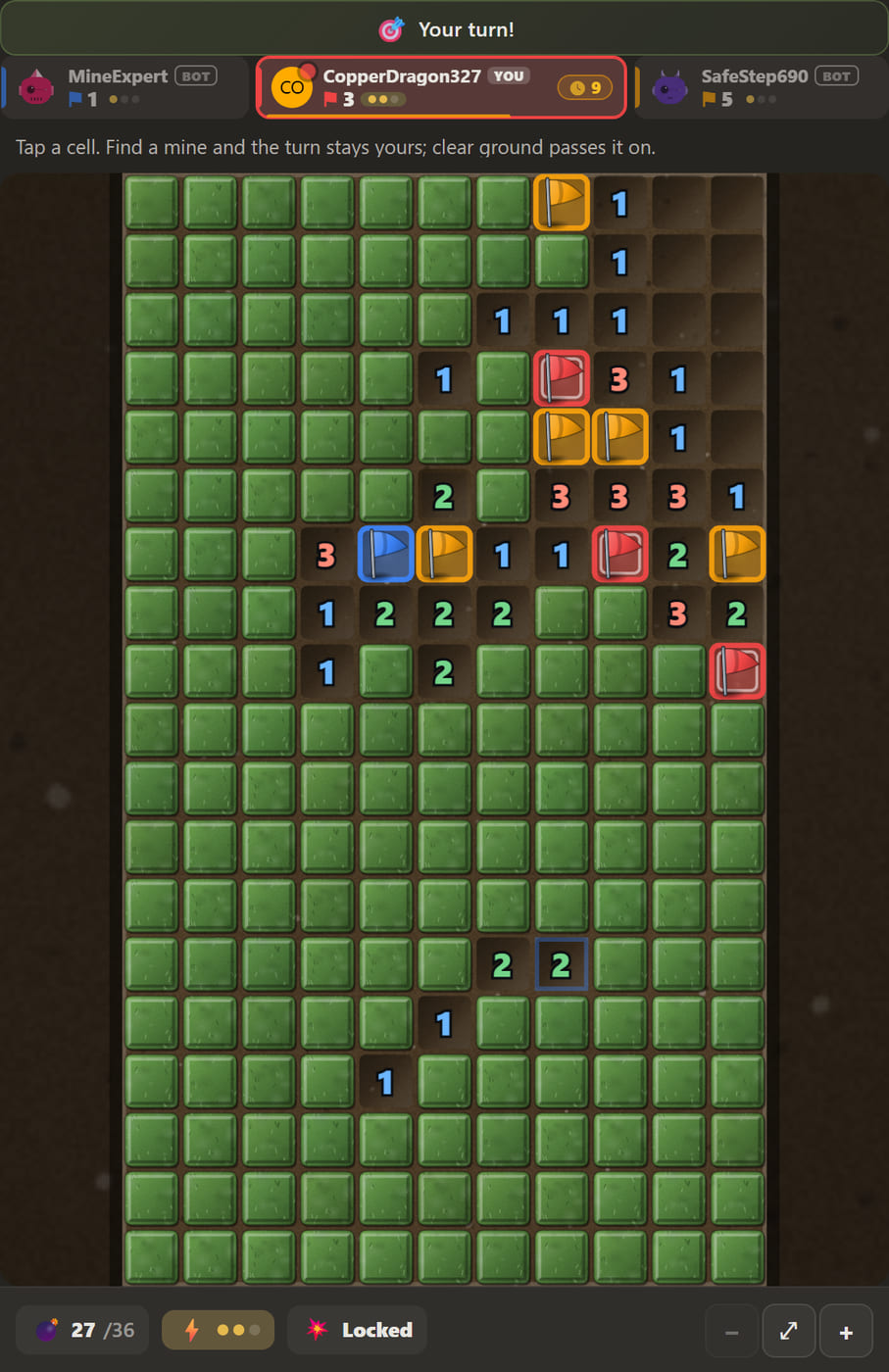
The bar above the field has a two-coloured score bar. Its centre line means a win: get past it and you hold more flags than your rival. See the 2-player duel guide for how a match plays out.
Where the old game came from
The history is disputed. Eurogamer names Mined-Out (1983) by Ian Andrew as the first game of this kind, while other sources credit the 1990 Microsoft version. That version first appeared in 1990, written by Robert Donner and Curt Johnson, and came with the Windows Entertainment Pack.
It was included by default in Windows until Windows 8 in 2012, when a free-to-play version from the Microsoft Store replaced it. That is why many people no longer find it on a new PC. A 2001 campaign objected to the landmine theme, and a later version found in Windows Vista offered a tileset with flowers instead of mines.
The old game had three usual levels. Beginner is usually 8x8 or 9x9 with 10 mines, intermediate is 16x16 with 40, and expert is 30x16 with 99. Our Classic field has no preset level; it is one fixed 9x16 board. For the bigger boards see expert level and board sizes.
How to start
Open the game page and tap Play Now. You are seated against a bot on the Classic field in one tap. The bots come in Easy, Medium and Hard, and none of them can see the mines. A finished match takes about 3 minutes (median from our own match log, November 2026).
To play a friend, open a room and send the room link. The room option Link only hides the room from the lists, so only people with the link can join. There are no passwords. Only Classic is open to everyone; the other four fields need a one-match board ticket paid with in-game coins, and anyone can sit at a table whose host has it. There is also an Android app.
Ready to see the grey board again? Play Minesweeper now, tap one cell, and read the number the way you always did.
Windows and Microsoft are trademarks of Microsoft Corporation. Playgridia is an independent game and is not affiliated with or endorsed by Microsoft.
Frequently Asked Questions
Can I play the classic grey Minesweeper online?
You can play a game with the classic grey look on Playgridia: raised tiles, pixel digits, a red LED counter and a reacting smiley. It is an independent 2-player game, not a copy of the old solo one. The Classic field is free and needs no download or sign-up.
Is this the original Minesweeper?
No. Numbers and cascades work as you remember, but you race another player on one shared field. Mines you find score points and there is no game over.
Who made Minesweeper?
Sources disagree. Eurogamer names Mined-Out (1983) by Ian Andrew as the first game of this kind, while other sources credit the 1990 version written by Robert Donner and Curt Johnson.
Why is Minesweeper missing from new PCs?
It was included by default until Windows 8 in 2012. A free-to-play version from the Microsoft Store replaced it at that point.
Is the first click safe on the Classic field?
No. Mines are laid before the first tap and never moved. In a test of 2000 random first taps, 18.05% hit a mine, which here only gives you a flag and another turn.
How big is the Classic board?
It is 9 cells wide and 16 tall: 144 cells with 25 mines. A finished match takes about 3 minutes.