Minesweeper Patterns Cheat Sheet: 1-2-1, 1-2-2-1 and More
The minesweeper patterns worth memorising are 1-2-1 (mines under the two 1s), 1-2-2-1 (mines under the two 2s), 2-1-2 (mines at both ends and the middle), 1-1 and 1-2 against a wall, and 1-1-1-1. Guides disagree about some of these, so we checked each one by enumerating every possible mine layout. Every result below holds in all of them.
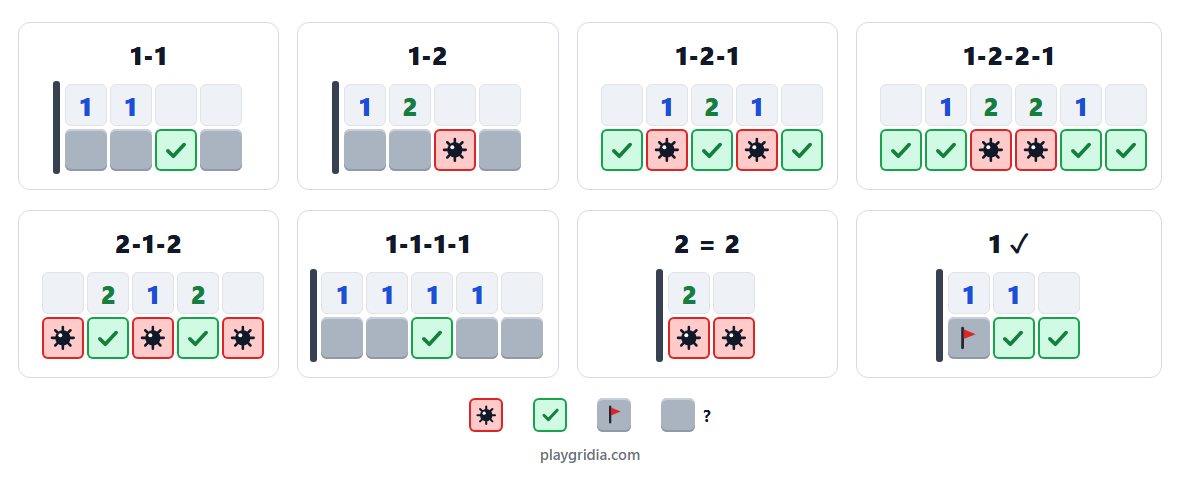
How to read the sheet
A number counts the mines among its 8 neighbours, diagonals included. A cell on an edge has fewer neighbours, and that is what makes every pattern below work. On our boards the rock cells in some fields act like an edge too: rock never holds a mine, and it is not counted as a neighbour.
In the diagrams the numbers sit in the top row and the unknown cells sit below them. The thick bar on the left of some panels is a wall. Letters a, b, c, d, e run left to right along the unknown row.
The patterns, with the answer
| Pattern | Setup | Mines | Safe |
|---|---|---|---|
| 1-2-1 | Flat edge of unknowns | Under the two 1s | Under the 2 and beside the 1s |
| 1-2-2-1 | Flat edge of unknowns | Under the two 2s | Under the 1s and beyond them |
| 2-1-2 | Numbers over b, c, d | a, c, e | b, d |
| 1-1 | Starting at a wall | None forced | The third cell along |
| 1-2 | Starting at a wall | The third cell along | None forced |
| 1-1-1-1 | Starting at a wall | None forced | The third cell; the rest stay open |
| 2 = 2 | A 2 with exactly two unknown neighbours | Both of them | None |
| 1 with a flag | A number already satisfied by a known mine | None | Every other unknown neighbour |
Why 1-2-1 works
Put the numbers over b, c, d with unknowns a to e below. The left 1 sees a, b, c and the right 1 sees c, d, e. The 2 sees b, c, d. Suppose c is a mine. Then the left 1 is full, so b is clear, and the right 1 is full, so d is clear. The 2 would then see only one mine. That breaks the rule, so c is safe. The 2 now needs two mines among b and d, so both are mines, and each 1 is then full, which clears a and e.
1-2-2-1 and 2-1-2
1-2-2-1 is the same logic stretched one cell: the two mines sit under the two 2s, and the cells under both 1s and the cells beyond them are safe. 2-1-2 looks like it should be messy but it is not. Mines at a, c and e, safe at b and d, and no other layout fits.
Against a wall
Starting from a wall, 1-1 means the third cell along is safe. 1-2 means the third cell along is a mine. In 1-1-1-1 the third cell is safe, and the other cells stay open until more numbers arrive. Do not push past what the pattern proves.
Mines are the scoring taps here
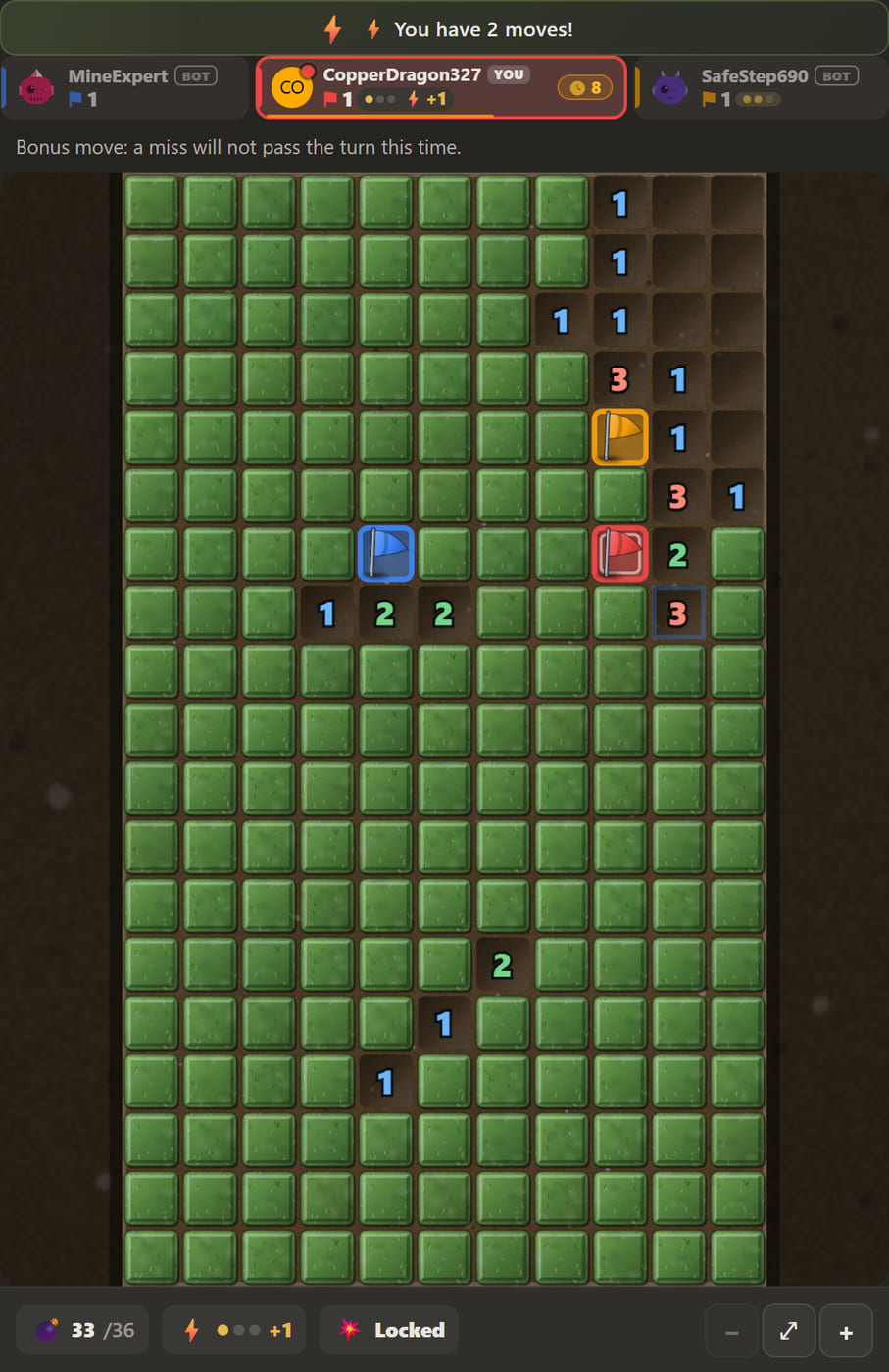
Our Minesweeper is a 2-player race on one shared field. Tap a cell that hides a mine and a flag is planted for you, you score 1 point and the turn stays yours. Tap clear ground and it opens, and the turn passes. There are no manual flags: the only flag is a mine you found.
That flips the usual advice. A deduced mine is a free point that lets you keep going, so 1-2-1, 1-2-2-1, 1-2 and 2 = 2 are all scoring chains. A deduced safe cell scores nothing and costs you the turn if it opens ground. Tap it when you want to hand the turn back or open a region, not before you have taken every mine you can prove.
Guessing and the first tap
The first tap is not safe. Mines are laid when the match starts and nothing moves them. On Classic, 25 mines in 144 cells is 17.4%, and a random first tap hit a mine 18.05% of the time over 2000 boards in an engine run. Here that is a good result: you get a flag and move again.
Nothing in the engine removes forced guesses either. There is no solver and no solvability check, so a 50/50 can appear on any field. In a model of Classic, 12.9% of boards needed no forced guess at all and the average board needed 3.07 (how we measured it). A wrong guess costs you a clear cell and the turn, never the match. Solo apps differ on this: first-tap safety and flag handling depend on the app, so check before you carry habits over.
Which field makes patterns easiest
On the Quarry field no two mines touch, which we confirmed over 500 generated boards with zero touching pairs. A number there never counts adjacent mines, so 1-1 and 1-2 read strictly. Classic is the plainest field if you want to practise on uniform random mines.
The Square Bomb as a catch-up
When your rival leads you by 5 or more, you unlock a 3x3 bomb, once per match. Mines in the square are flagged and scored for you, and clear cells open. If it banked at least one mine the turn stays yours. Patterns still decide where to aim it: drop it where your proven mines cluster.
What to do with this
Print the sheet and scan each opening for 1-2-1 and the wall patterns before you tap anything uncertain. Take every proven mine first, then spend a safe tap only when you need the turn to pass or the ground to open. Practise against a bot in the free Minesweeper game. For the basics see how to play Minesweeper, for habits tips and tricks, and for the head-to-head rules 2-player Minesweeper online.
Frequently Asked Questions
What is the 1-2-1 pattern in minesweeper?
Three numbers in a row on a flat edge of unknown cells: a 1, a 2 and a 1. The mines are under the two 1s, and the cells under the 2 and beside the 1s are safe. Checking every possible layout gives the same answer each time.
Where are the mines in a 1-2-2-1 pattern?
Under the two 2s. The cells under both 1s and the cells beyond them are safe.
How do I read 2-1-2?
Take columns a to e with the numbers over b, c and d. The mines are at a, c and e, and b and d are safe. Only that layout fits all three numbers.
Can you win minesweeper without guessing?
Often, but not always. The engine has no solvability check, so a forced 50/50 can appear on any field. Here a wrong guess opens a clear cell and passes the turn rather than ending the match, and the first tap is not protected: on Classic it hits a mine about 17.4% of the time.
Do I need to place flags in your Minesweeper?
No. There is no manual flag mode. Tapping a cell that hides a mine plants a flag for you, scores 1 point and keeps your turn, while tapping clear ground opens it and passes the turn.
Is the first click safe?
Not in our game. Mines are placed when the match starts and nothing relocates them, so on Classic about 1 in 6 first taps finds a mine. That is a point for you and another turn. Solo apps may protect the first click, so it depends on the app.