Is Minesweeper Luck? When You Really Have to Guess
Is Minesweeper luck? Minesweeper is mostly logic with a measurable share of luck, and that share grows with mine density. In our model, with a guaranteed opening, 89.9% of beginner boards, 68.7% of intermediate boards and 14.1% of expert boards could be finished without a single forced guess. The model is a solver that uses every local constraint on random boards. These are simulated boards, not real players.
How often does a board force a guess?
We generated random boards and let the solver play until it had no proven cell left. If it had to pick a cell without proof, we counted one forced guess and carried on. Each row used 4000 boards. We ran the three standard levels twice: once with a protected first click (never a mine), and once with a guaranteed opening (the first click opens an area).
| Level | Start | No guess needed | Forced guesses per board |
|---|---|---|---|
| Beginner 9x9, 10 mines | Protected first click | 36.0% | 1.38 |
| Beginner 9x9, 10 mines | Guaranteed opening | 89.9% | 0.15 |
| Intermediate 16x16, 40 mines | Protected first click | 20.4% | 2.39 |
| Intermediate 16x16, 40 mines | Guaranteed opening | 68.7% | 0.58 |
| Expert 30x16, 99 mines | Protected first click | 2.5% | 6.34 |
| Expert 30x16, 99 mines | Guaranteed opening | 14.1% | 3.67 |
Two things stand out. A good opening matters a lot: on beginner boards it lifts the no-guess share from 36.0% to 89.9%. And density wins in the end: expert boards carry 20.6% mines against 12.3% on beginner, and even with an opening only 14.1% of them are fully solvable by logic.
Why can a board force a guess?
The board is filled with mines at random, and nothing checks whether logic can solve it. The smallest forced guess is a 50/50: two covered cells, exactly one mine between them, and no number anywhere that touches one cell but not the other. Every number sees both cells or neither, so no clue separates them. Larger cases exist too, but the idea is the same: the numbers fit more than one layout.
This is also why people call Minesweeper hard. It is not only about speed. Some boards simply do not contain enough information. In 2000 Sadie Kaye published a proof that deciding whether a Minesweeper position is possible at all is NP-complete, which is a formal way of saying it is a hard problem for computers too. For the rules and what the numbers mean, see how to play Minesweeper.
What is the best first click?
In the standard game the first click is never a mine. The table shows, on 40000 simulated boards per spot, how often it lands on a zero (and so opens an area), and how many cells it opens when it does.
| Level | Spot | Lands on a zero | Cells opened when it does |
|---|---|---|---|
| Beginner 9x9 | Corner | 66.5% | 28.0 |
| Beginner 9x9 | Edge | 49.9% | 35.6 |
| Beginner 9x9 | Centre | 32.6% | 46.0 |
| Intermediate 16x16 | Corner | 59.9% | 26.9 |
| Intermediate 16x16 | Edge | 42.6% | 41.8 |
| Intermediate 16x16 | Centre | 25.4% | 64.6 |
| Expert 30x16 | Corner | 49.7% | 16.1 |
| Expert 30x16 | Edge | 30.9% | 26.4 |
| Expert 30x16 | Centre | 15.4% | 40.7 |
A corner opens an area most often, but a small one. The centre opens an area least often, but the biggest one when it works. If you want an opening most of the time, take the corner. If you would rather gamble on a large opening, take the centre. More on the layouts in expert level and board sizes.
What should you do when you must guess?
- First take every proven cell. Guess only when none is left. Many guesses come from a missed deduction, and the patterns guide covers the common ones.
- Count the risk. A 1 that touches 3 covered cells puts 1 mine among 3, so each cell carries 33%.
- For a cell far from any number, divide the mines still unfound by the covered cells left. That is its chance of being a mine.
- Compare the two numbers and take the lower.
More habits are in Minesweeper tips and tricks.
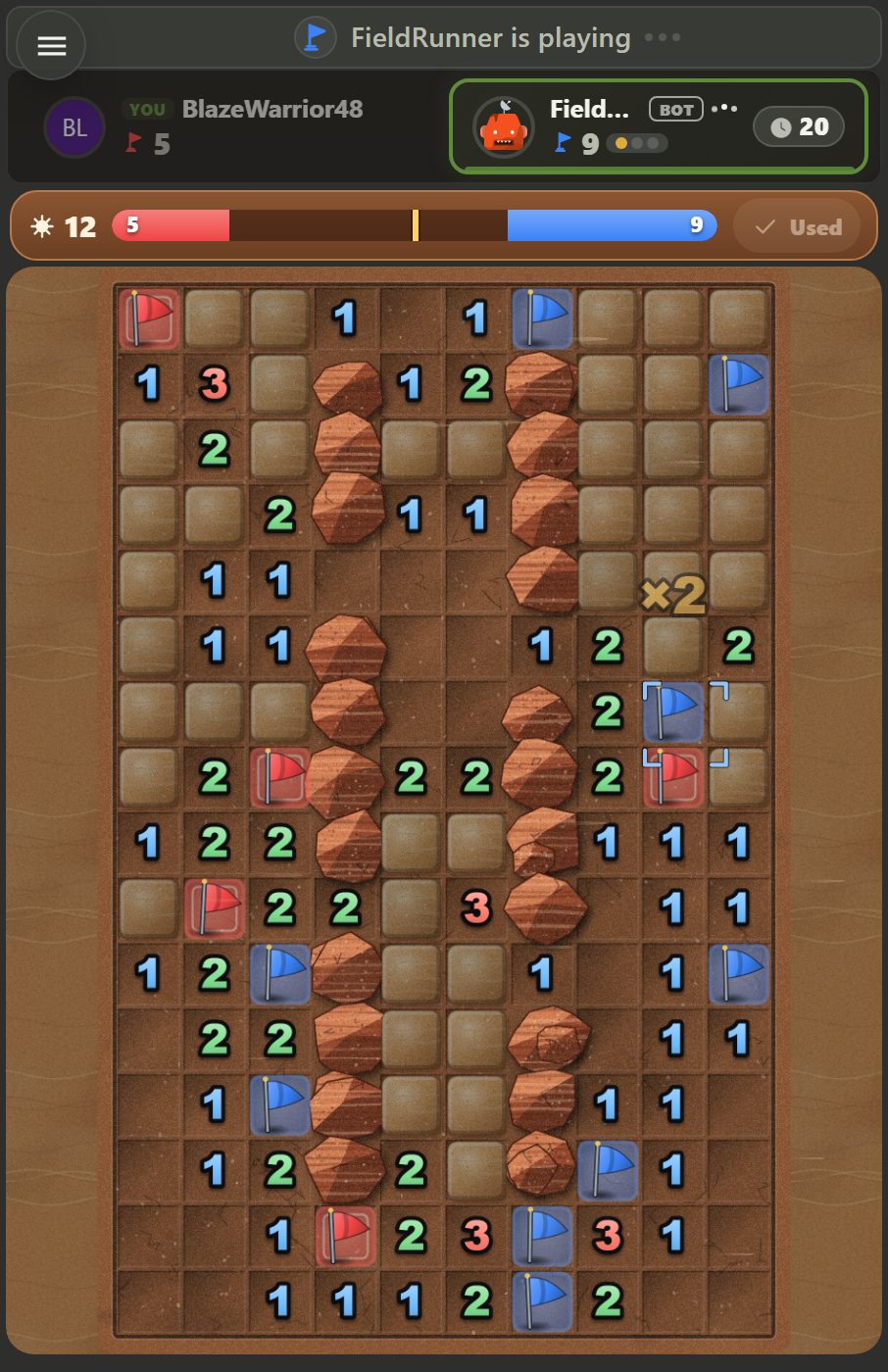
How does luck work in our two-player duel?
Our game is not solo. It is a race for mines on one shared field, against a bot or a friend (see the 2-player duel). Tapping a mine plants your flag, scores 1 point and keeps the turn. Tapping a clear cell opens it and passes the turn. So a bad guess costs a turn, not the match.
- The first tap is not protected. On Classic, 25 mines sit among 144 cells, so a first tap hits a mine 17.4% of the time, and that is a point for you.
- Three misses in a row give your opponent one extra turn.
- If you trail by 5 points, the Square Bomb unlocks. It resolves a 3x3 area, and each player can use it once.
The risk logic flips here: a cell that is probably a mine is the good tap, and a cell that is probably clear only passes the turn.
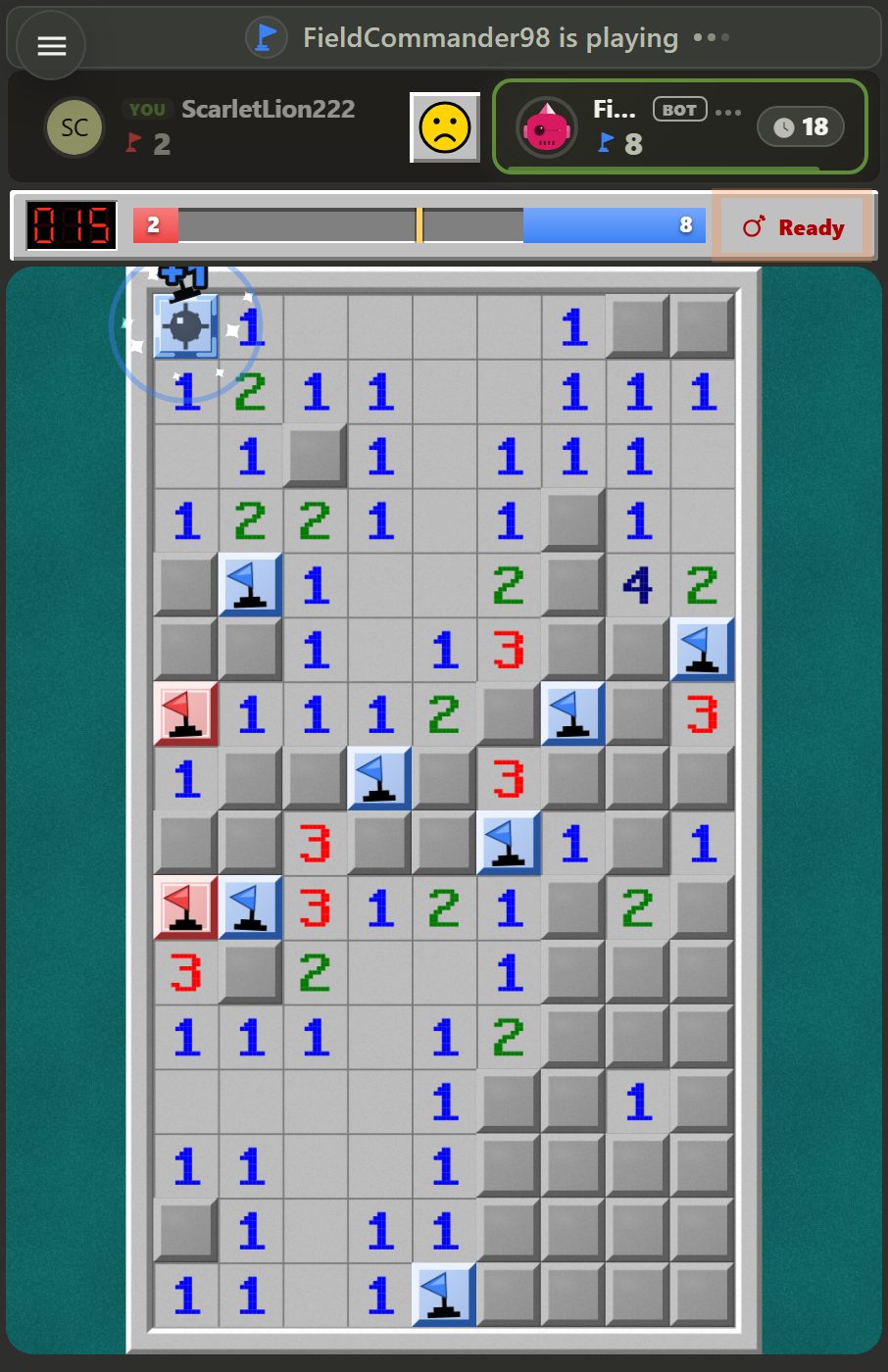
Which field is the most logical?
The same solver played our five fields. Here it starts from a random clear cell, so these rows are not comparable with the standard rows above.
| Field | No guess needed | Forced guesses per board |
|---|---|---|
| Classic | 12.9% | 3.07 |
| Canyon | 0.0% | 11.01 |
| Quarry | 0.5% | 7.92 |
| Crossroads | 7.9% | 7.41 |
| Hot Zone | 10.1% | 3.48 |
Classic is the most logical. Canyon is the least, because its rock walls stop cascades. Only Classic is open to everyone; the other four need a one-match board ticket paid with in-game coins.
So what do you do with this?
Treat Minesweeper as logic first and risk second: take every proven cell, then compare the arithmetic. When a guess is forced, that is the board, not you. Play a match on Minesweeper and see how your reading holds up when a guess costs only a turn.
Frequently Asked Questions
Is Minesweeper luck based?
It is mostly logic with a share of luck. In our model, with a guaranteed opening, 89.9% of beginner boards, 68.7% of intermediate boards and 14.1% of expert boards needed no forced guess. The denser the board, the more luck matters. These are simulated boards, not real players.
Why is Minesweeper so hard?
Mines are placed at random, and nothing checks that the numbers are enough to solve the board. Some positions contain a 50/50, where two covered cells hold one mine and no number tells them apart. On expert boards our model needed 3.67 forced guesses per board even with a guaranteed opening.
Can Minesweeper always be solved without guessing?
No. Even on beginner boards with a guaranteed opening, 10.1% needed at least one forced guess in our model, and on expert boards only 14.1% needed none. A board can leave two cells that every number sees in the same way.
What should I do when I have to guess?
First take every proven cell. Then compare risks: a 1 touching 3 covered cells gives 33% per cell, and for a cell far from any number you divide the mines left by the covered cells left. Take the lower chance.
What is the best first click in Minesweeper?
In the standard game a corner opens an area most often, for example 66.5% on beginner boards, but the area is small, 28.0 cells. The centre opens an area least often, 32.6% on beginner, but the biggest one, 46.0 cells. In our duel the first tap is not protected, and on Classic it hits a mine 17.4% of the time.