Estates Jail Guide: Pay $700 or Wait It Out?
Waiting in jail is free in Estates — after two failed doubles rolls you are simply released with no charge, and that single rule flips the standard advice for this whole genre: a jailed owner earns nothing while they sit, so the $700 fine is not for everyone, it is for the player whose board is already built.
A Board Hazard, Not a Dice Hazard
You only land in jail two ways: rolling onto the GO TO JAIL corner, or rolling a third consecutive double, which discards that roll and ends your turn on the spot. Landing on the jail tile itself during an ordinary move is harmless — you are "just visiting" and play continues as normal. Measured over 400 simulated matches, 90.4% of jail trips came from landing on the GO TO JAIL corner and only 9.6% from three doubles — so almost every trip to jail is a corner you can see coming two or three tiles out, not a freak run of triples.
Four Ways Out — Only Three Are a Real Choice
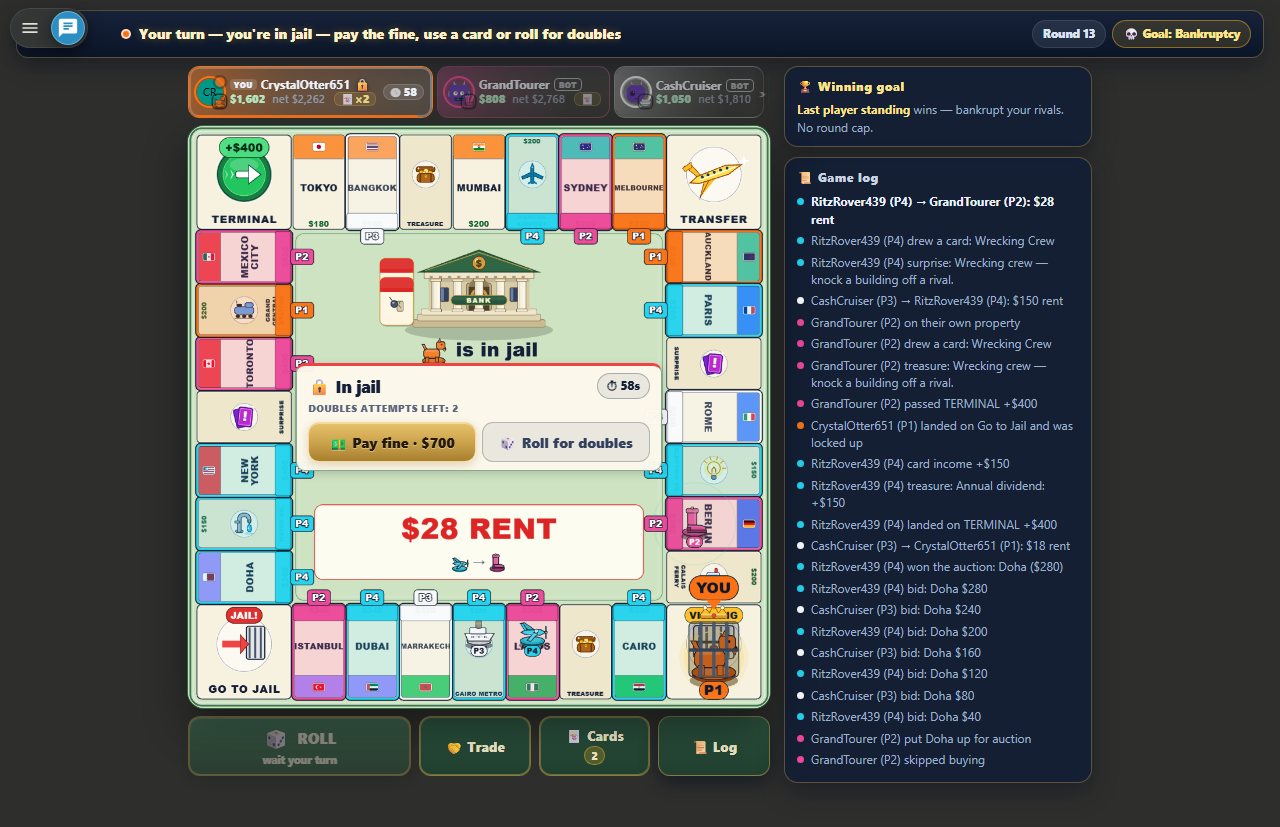
Once you are sitting on the jail tile, your next turn opens in a special jail phase instead of an ordinary roll. From there you have three genuine choices, and one outcome that is not a choice at all — it simply happens if you fail twice in a row.
| Way out | What it costs | When it is right |
|---|---|---|
| Pay the $700 fine | $700 cash, then a normal roll the same turn | Your board is built and every turn spent sitting is rent you are not collecting |
| Roll for doubles | Free, but you might fail — a successful roll moves you that many tiles at once with no bonus re-roll | Your default move on almost every turn |
| Play a Get-Out-of-Jail card | The card itself, if you happen to be holding one | Whenever you have one and want to move now, no arithmetic needed |
| Wait it out | Free, after two failed doubles attempts | Your board is empty or unbuilt — you have little or no rent income to lose |
Why Waiting Is Not Automatically Right
While an owner sits in jail, nobody pays them rent. Any seat that lands on a property owned by a jailed player pays nothing at all — not the owner, not the bank — the landing resolves exactly as if the tile were mortgaged. That rule covers cities, transport hubs and utilities alike, and it is measured at 2.99 waived rents per match across 400 simulated matches. Most advice for this genre says the safest move late in a match is to sit in jail and let opponents walk into your properties while you are untouchable. In Estates that advice is backwards: a jailed owner is untouchable, but they are also unpaid, so the richer your board, the more each turn in jail actually costs you.
What $700 Actually Costs You
$700 is 47% of the $1,500 you start the match with, and it is more than the $600 a fully built transport network charges per landing — the single best return on investment on the board. For the same money you could buy three of the four transport hubs ($200 each) and still have $100 in hand, or take both utilities at $150 each and put two houses on a mid-tier city, where a single house runs $150–$190. If your board is still empty, none of that math matters — there is no rent to protect, so free is still free, and paying only buys you a lap you may not need.
There is an early-game version of the same logic: in the opening rounds most tiles are still unowned and cheap, and the board moves fast — 96.2% of buy prompts in the same 400-match sample were taken, meaning property gets snapped up quickly. If jail interrupts an early lap while good tiles are still on the table, paying to keep moving can be worth the $700 simply to not miss out, even with no rent income at stake yet. See our Estates game guide for how the opening rounds usually play out, or the best properties in Estates for what to prioritise while tiles are still up for grabs.
Late Game: Pay If You Have Income to Protect
City rent climbs a fixed ladder as a colour set gets built: ×1 with no set, ×2 once you own all three cities in a group, then ×5, ×15 and ×30 for one, two and three houses, and ×50 for a hotel. On the most expensive colour group, a hotel charges $2,100 rent — three times the $700 fine. A player sitting on that kind of board loses real money for every turn they spend in jail collecting nothing, so paying to get back out and keep the rent flowing can be the correct trade. A player with an empty or half-built board has nothing to protect, so for them the free release is still the right default. The decision now turns on your own holdings, not just the calendar.
What 400 Simulated Matches Show Players Actually Do
Across 400 simulated bot matches, players who reached jail left it by serving the two turns and walking out free 47.7% of the time, rolling doubles 22.6%, paying the $700 fine 16.7%, and playing a Get-Out-of-Jail card 12.9%. These are bot games, not human ones, and the bots are not weighing their own rent income turn by turn the way a careful human player can — so treat the fine share (16.7%) as a floor, not a target. For more on reading a match's pace, see our Estates strategy tips.
The Get-Out-of-Jail Card Is a Trade Chip, Not a Shortcut
A Get-Out-of-Jail card can be traded to another player or put up at a live auction exactly like property, and it is the rarest of the three held cards in the game. In the Treasure deck there is exactly one Get-Out-of-Jail entry against nine demolish entries — you will draw a demolish card far more often than a free jail exit. If your own board is thin, the card is often worth more sitting in your hand as something a rival with a built-out board will overpay for than spent on yourself, since you were never losing income by waiting anyway. Our Estates trading guide covers how to read a desperate opponent's offer.
The rule of thumb: check your own board before you check your dice. If you own little or nothing built up, roll or wait every time — waiting is free and there is no rent to lose. If you own a colour group with houses or a hotel on it, the $700 fine is a real question, because every turn in jail is rent you are not collecting. Open a match at Estates and watch how the right call changes as your own board fills in.
Any third-party brand or game names mentioned are trademarks of their respective owners. Playgridia is an independent platform and is not affiliated with or endorsed by them.
Frequently Asked Questions
Do you have to pay the jail fine in Estates?
No. After two failed doubles rolls in jail you are released for free, with no fine ever forced on you. Paying the $700 fine is always optional and mainly worth it when you have rent income on the board that you do not want to miss.
How do you end up in jail in Estates?
You get sent to jail by landing on the GO TO JAIL corner, or by rolling a third double in a row, which discards that roll and ends your turn immediately. Landing on the jail tile during a normal move is harmless, you are just visiting. Measured over 400 simulated matches, 90.4% of jail trips came from the corner and only 9.6% from three doubles.
Do you still collect rent while sitting in jail?
No, and this is the rule most players get wrong. While you are jailed, any opponent who lands on a property you own pays nothing at all, not you and not the bank, the same as if the tile were mortgaged. That is measured at about 2.99 waived rents per match across 400 simulated matches.
Is it worth paying $700 to get out of jail?
It depends on your own board. If you own little or nothing built up, waiting is free and costs you nothing, so there is no reason to pay. If you own a colour group with houses or a hotel on it, every turn in jail is rent you are not collecting, so paying to get back into play can be worth it.
How long can you stay in jail?
A maximum of two turns. If you fail to roll doubles on both attempts, you are automatically released with no fine charged, and play continues as normal.
What is the best use for a Get-Out-of-Jail card?
If your own board is thin, the card is often more valuable held onto and offered in a trade than spent on yourself, since you were not losing any rent by waiting anyway. It is the rarest of the three held cards, the Treasure deck carries only one Get-Out-of-Jail entry against nine demolish entries.