Estates Trading Guide: 60-Second Offers & Debt
Trading in Estates runs on a hard 60-second clock: only the player whose turn it is may open an offer, any seat can answer one at any moment, and every open offer dies outright the instant the offering player's own turn ends — with one deliberate exception that lets the whole table bid for a drowning player's estate out of turn. If you're new to the genre, this property-trading board game is the one that wrote that exception down as an actual rule instead of leaving it to table manners.
What a trade can actually carry
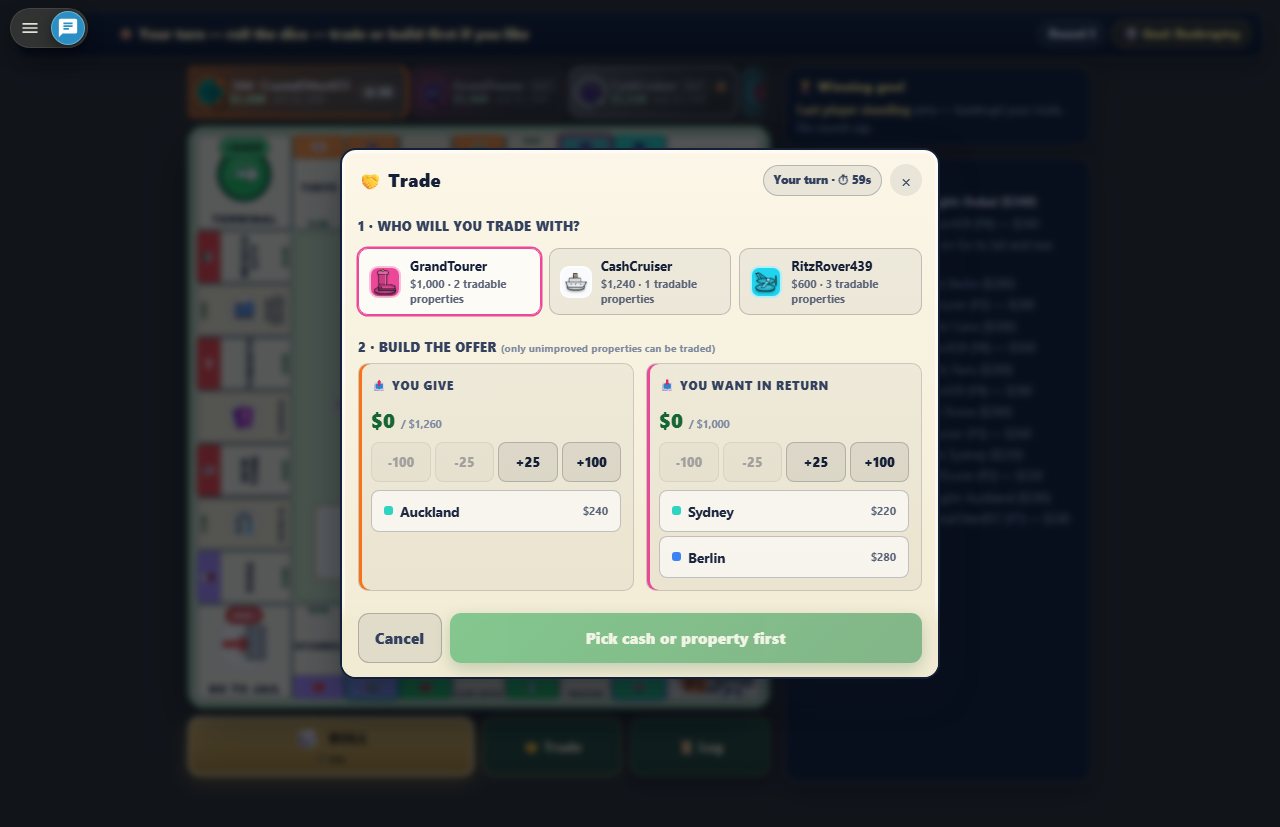
A trade bundle moves in both directions and can hold three things: cash, unbuilt property (its mortgage status travels with the tile, whichever way it moves), and held cards. The one thing you cannot put on the table is a city with houses or a hotel already standing on it — sell the buildings back first, which refunds half of what you paid to put them up, and only then is the tile tradeable. The same tiles, ranked by what they're actually worth to hold, are covered in which properties are worth building on.
The clock: when you can offer, and when it just dies
Only the current player may open an offer, but any other seat can accept or reject one at any point in the match — there's no waiting for your own turn to answer. Every open offer expires after 60 seconds on its own, and the moment the offering player's turn ends, every offer they had open is cancelled outright, answered or not. The practical upshot: an offer made near the end of your turn is mostly theatre, because it dies before anyone has time to think it over. Open it at the start of your turn instead, while there's a full turn's worth of time for a rival to actually consider it.
The one exception: bidding on a drowning table-mate
Normally a seat that isn't on its own turn can only answer, never open. The single deliberate carve-out is forced fund-raising: while a seat is stuck unable to cover a payment, any other active seat may pitch that player an offer out of turn, with no waiting for their turn to come around. It cuts both ways. You can throw a lifeline to a neighbor so a bigger rival doesn't inherit their almost-complete colour set by bankruptcy — or you can be that rival, and use the exact same window to buy the set out from under them while they're still deciding whether they can survive.
What actually happens when you can't pay
Being unable to cover rent, a card's cash penalty, a wealth tax or the jail fine does not end your game on the spot — it opens a forced fund-raising window with five ways out.
| Exit | What it costs you | What it costs the table |
|---|---|---|
| Pay | The cash, once you actually have it | Nothing — the debt just closes |
| Auto-raise | Buildings sold back at half cost, then property mortgaged | Nothing — it refuses up front if it still can't cover the debt, and it never declares bankruptcy for you |
| Sell at live auction | A property or a held card, sold to the highest bidder (see the auction guide for how that clock works) | A rival gets the lot, sometimes cheap |
| Accept an incoming trade | Whatever you agree to give up | The rescuer spends cash or property to save you |
| Declare bankruptcy | Everything — land, buildings, held cards, all pass to the creditor | The creditor inherits your whole estate for free |
Measured over 400 simulated matches, a table raises 1.44 forced debts per match and pays off 1.24 of them — about six debts in seven are survived. Bankruptcy is the rare outcome here, not the default one.
The mortgage arithmetic
Mortgaging an unbuilt property pays you half its list price immediately, and it stops collecting rent while it's mortgaged. Buying it back out costs the mortgage value plus 10% interest. That makes a mortgage a fine way to survive one bad roll — but a slow bleed if you leave a property parked that way for turns on end, since it's earning you nothing while a rival's board keeps paying them.
What a set-completing tile is actually worth
List price is the wrong number to negotiate from. Measured over the same 400 matches, a fully built transport network — all four hubs, $800 total — returns $93.80 of rent for every dollar invested per 1,000 landings — twelve times what a single lone hub returns, which is $7.80 per dollar. The fourth hub is what makes that jump: rent doubles from $300 to $600 the moment it's bought, while total outlay only rises from $600 to $800 — about a third more. So the tile that completes a rival's network or colour set is worth far more to them than its list price suggests, while it's worth nothing extra to you — that gap between what it's worth to them and what it costs you is the entire negotiation. The same logic covers a held card: the Get-Out-of-Jail card is the rarest of the three kinds in play, and it is worth the most to whoever is stuck in jail without one.
Trading is common, and it gets taken
None of this is theoretical. Measured over 400 simulated matches, the table makes 7.83 trade offers per match and 45% of them are accepted. This is not a table where nobody deals — offers land often enough that reading the board for who needs what is a real skill, not a nice-to-have. For the rest of a turn's mechanics, see the full rules guide or the strategy tips.
Why the bankrupt seat's creditor matters
When a player goes bankrupt, their land and its mortgage status pass straight to whoever they owed money to, buildings already on that land are razed with no refund to anyone, and any held cards pass to the creditor too. So being the seat a struggling neighbor owes money to is itself a position worth engineering — the out-of-turn trade window means you can put yourself there before they fall, not just profit after.
So what do you do with this? Open your trade offers at the start of your turn so they have a full turn to actually be answered, watch every other seat's cash for the moment they can't cover a payment, and decide in advance whether a drowning neighbor is worth rescuing or worth letting fall — because either way, the window to act is measured in seconds, not turns. Sit down at an Estates table and the clock starts on your very first offer.
Any third-party brand or game names mentioned are trademarks of their respective owners. Playgridia is an independent platform and is not affiliated with or endorsed by them.
Frequently Asked Questions
How long does a trade offer last in Estates?
An open offer expires automatically after 60 seconds, and if the player who made it ends their turn before anyone answers, it is cancelled outright regardless of the timer. Answering can happen at any time from any seat, but the offer itself only lives as long as the offering player's own turn plus that 60-second window.
Can I trade with someone when it's not my turn?
You can always answer an existing offer, at any point in the match. Opening a brand new offer is normally restricted to the player whose turn it is, with one exception: a seat that owes money it cannot pay can be approached with an offer by any other seat, out of turn.
What can I actually offer in a trade?
Cash, unbuilt property, and any held cards you're carrying, in either direction. A property's mortgage status moves with it if it changes hands, but a city that already has houses or a hotel on it cannot be traded until those buildings are sold back.
What happens if I can't pay a debt in Estates?
The game opens a forced fund-raising window instead of ending your turn outright. You can pay once you have the cash, use one-tap auto-raise (which sells buildings back and mortgages property, but refuses if that still can't cover the debt), sell something at a live auction, accept an incoming trade, or declare bankruptcy.
Is it worth rescuing another player from bankruptcy?
Measured across simulated matches, about six debts in seven are survived without anyone going bankrupt, so the out-of-turn trade window does get used. Whether it's worth using depends on who inherits the drowning player's colour set if you don't step in - sometimes the better play is to let a struggling neighbor fall to a weaker rival rather than hand them a lifeline yourself.
What happens to my properties if I go bankrupt?
Everything passes to whoever you owed the debt to: your land and its mortgage status, plus any held cards you were carrying. Buildings already standing on your land are razed with no refund to anyone.