Which Estates Properties Pay Off Fastest?
The properties that pay for themselves fastest in Estates are the four transport hubs: $800 to own the whole network, and $600 in rent every time a rival lands on one—a higher return per dollar than any colour group on the board, measured over 400 simulated matches. You do not need a colour set, a house, or a single dollar of build cost to collect it.
The board is close to flat, so price is what separates the tiles
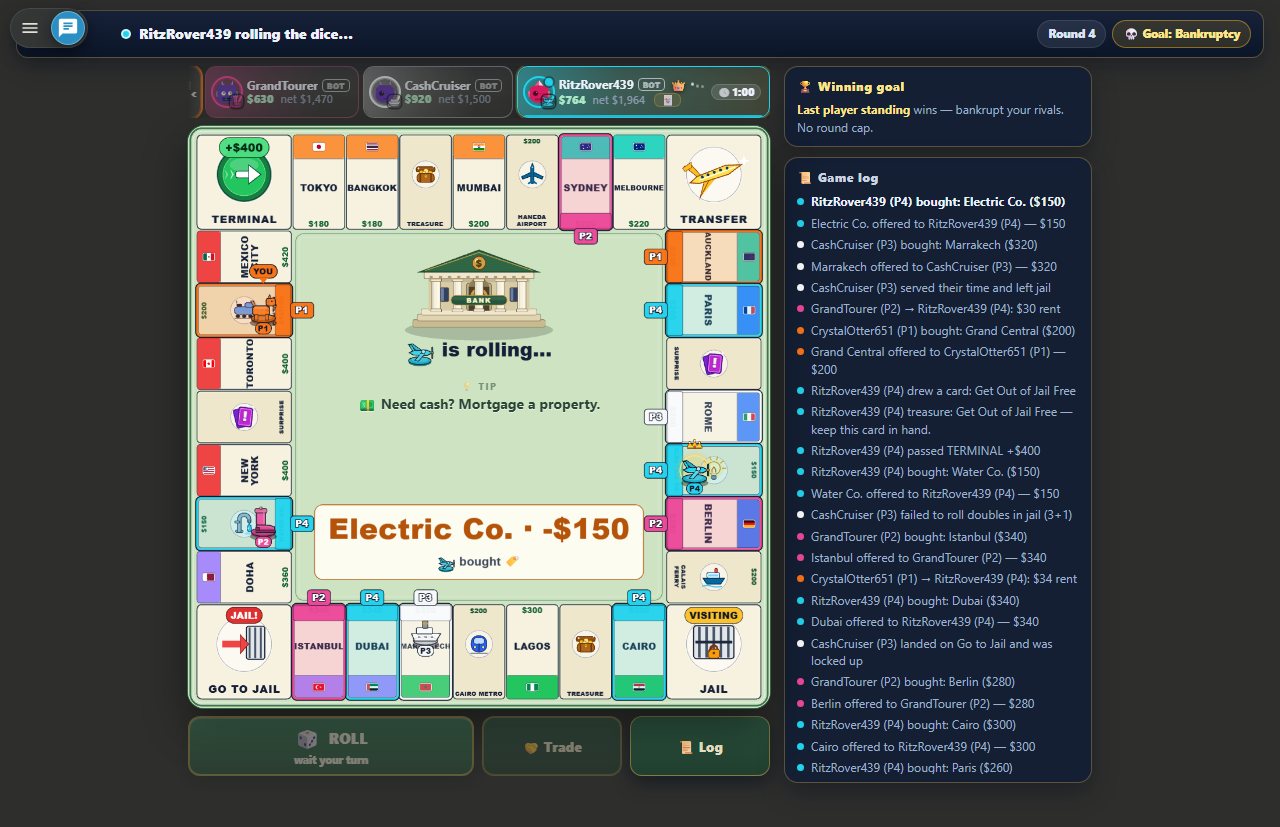
Estates plays out on a 32-tile ring, and the traffic on it is nearly even: across 400 simulated bot matches (4 seats, all five boards, a 25-round cap), every individual tile took between 2.7% and 4.0% of all landings, against a perfectly flat baseline of 3.13%. That is a narrow band. Nobody is getting rich because a tile sits in a lucky spot—the tiles that make money do it on price, not position. See the full turn-by-turn rules for how a token actually moves around that ring before you start pricing tiles against each other.
The transport network: the safest money on the board
Four hubs—one air, one ferry, one metro, one rail—sit on the ring, and however different they look, they are priced identically at $200 each and share a single rent network. Owning one pays $50 whenever a rival lands there; two pays $150; three pays $300; all four pays $600. The curve is super-linear: the fourth hub exactly doubles the network's rent, from $300 to $600, while its own $200 price tag is only a quarter of the full $800 network.
| Hubs owned | Cost so far | Rent per landing | Return per $1 |
|---|---|---|---|
| 1 | $200 | $50 | 7.8 |
| 2 | $400 | $150 | 23.5 |
| 3 | $600 | $300 | 46.9 |
| 4 (full network) | $800 | $600 | 93.8 |
Nothing else on the board is this safe. There is no colour set to assemble, no build cost to front, and the demolish card cannot touch a hub at all—that card only ever knocks a level off a city's building. Buy a hub whenever one is up, in an auction or off the roll — the fourth is worth chasing at a premium.
The two utilities: a tenth of the outlay, a mid-tier return
Electric and Water cost $150 each, $300 for the pair. Own one and the roll that lands on it is charged ×10; own both and it is charged ×30—an average roll of 7 pays $70 or $210. Measured against 400 matches, that works out to 41.5 return per dollar spent, ahead of two of the six colour tiers below—for a tenth of what most colour groups cost to finish.
The six colour tiers, priced out
Rent on a city climbs ×1 (owned, but without the full colour set) to ×2 (full set, no buildings) to ×5 / ×15 / ×30 for one, two or three houses to ×50 at the hotel. Building needs the full three-city set and no mortgaged tile anywhere in that group.
| Tier | 3 cities cost | Base rent | Build cost / house | Rent, 1 house | Rent, 3 houses | Rent, hotel |
|---|---|---|---|---|---|---|
| Tier 0 (cheapest) | $560 | $14 | $100 | $70 | $420 | $700 |
| Tier 1 | $680 | $18 | $120 | $90 | $540 | $900 |
| Tier 2 | $800 | $22 | $150 | $110 | $660 | $1,100 |
| Tier 3 | $920 | $28 | $170 | $140 | $840 | $1,400 |
| Tier 4 | $1,040 | $34 | $190 | $170 | $1,020 | $1,700 |
| Tier 5 (priciest) | $1,220 | $42 | $200 | $210 | $1,260 | $2,100 |
Prices and rents are identical on every one of the five boards—World, Europe, USA, Türkiye and Asia only swap the city names and the palette, never a number. Read the full breakdown of the colour-group strategy if you want the set-building side of the game rather than the toll-collecting side this post is about.
Return per dollar, ranked
Put every fully-built holding on one ladder and the picture is stark: the transport network is not just first, it is not close.
| Holding | Total cost | Rent per landing | Return per $1 |
|---|---|---|---|
| All 4 transport hubs | $800 | $600 | 93.8 |
| Tier 5 at hotels | $3,620 | $2,100 | 56.7 |
| Tier 4 at hotels | $3,320 | $1,700 | 54.9 |
| Tier 1 at hotels | $2,120 | $900 | 43.1 |
| Tier 3 at hotels | $2,960 | $1,400 | 41.9 |
| Both utilities | $300 | dice ×30 (avg $210) | 41.5 |
| Tier 2 at hotels | $2,600 | $1,100 | 38.9 |
| Tier 0 at hotels | $1,760 | $700 | 36.1 |
Tier 5 is genuinely the best colour group per dollar once it is fully built—rents scale faster than prices as you go up the tiers—but "fully built" is doing a lot of work in that sentence. Finishing it costs $3,620 all in — the three cities at $1,220 plus $2,400 of houses and hotels — against $1,760 to take the cheapest tier all the way to a hotel. A new game starts every player with $1,500 total. The transport network at $800, and the two utilities at $300, are the only holdings on this list you can plausibly own outright before anybody else finishes a set.
Why so few colour sets ever get finished
That cash gap shows up in the matches themselves: measured across 400 simulated games, only 1.66 full colour sets are formed per match, and 0.43 of those are lost again along the way. Most matches are decided with one set on the table, or none—which is the strongest argument for building your early game around the hubs and the utilities rather than banking on a set you may never complete. Owning a tile that pays the moment it is bought beats owning two-thirds of a group that never gets there.
The demolish card is a tax on every hotel, and hubs are immune to it
Both card decks draw a demolish card three times as often as a free-build card—it is the single most common effect either deck grants. Demolish knocks exactly one building level off a rival's city (a hotel drops back to houses) with no refund to them, and it can only ever target a city. A hub or a utility cannot be demolished, mortgaged out of a network, or downgraded by a card at all—the money you collect from them is not just fast, it is not exposed to the one card that specifically punishes a finished build.
When the colour set is still the right call
None of this makes the colour tiers wrong to buy—it makes them a bigger bet. A set you can actually afford to finish and build up wins outright: the rent ladder from ×1 to ×2 to ×5, ×15, ×30 and finally ×50 at the hotel is brutal once it is live, and a hotel on the priciest tier charges $2,100 in a single hit—more than triple what the entire transport network charges. The honest read: a colour set is the higher ceiling, the hubs and utilities are the higher floor. Grab the cheap, safe money early, and commit to a colour tier only once you can see the cash to finish it. For the game's other lever on getting properties cheap in the first place, see how bidding at a live auction actually plays out, and for turning a half-finished set into a full one, trading with the table.
So: on your first lap of the board, prioritise a transport hub over almost anything else you can afford, pick up a utility if the price is right, and only pour money into a colour tier once you can see the cash to build it all the way to a hotel—a completed set with no houses on it still only charges ×2 while the board's real money keeps moving past you. Compare the full mechanics against the rest of the genre in what makes Estates different, or just go see the current board at Estates.
Any third-party brand or game names mentioned are trademarks of their respective owners. Playgridia is an independent platform and is not affiliated with or endorsed by them.
Frequently Asked Questions
What's the best property to buy first in Estates?
The four transport hubs are the safest early buy: together they cost $800 and pay $600 in rent whenever a rival lands on one, a higher return per dollar than any colour group, measured over 400 simulated matches. You don't need a colour set or a single house to collect it, and the demolish card can't touch a hub.
Are the transport hubs worth it in Estates?
Yes. Owning all four returns 93.8 per dollar spent, measured across 400 simulated matches, well ahead of every fully-built colour tier. The curve is super-linear too: the fourth hub exactly doubles the network's rent, from $300 to $600, and its own $200 price is only a quarter of the full $800 network.
How much does it cost to build a full colour set to hotels in Estates?
It ranges from $1,760 for the cheapest tier to $3,620 for the priciest tier, including the price of the three cities themselves. A new game starts every player with $1,500, so finishing even the cheapest tier to hotels takes more than your entire starting cash.
How common is the demolish card in Estates?
Demolish is drawn three times as often as the free-build card in both decks, making it the single most common card effect in the game. It knocks exactly one building level off a rival's city, dropping a hotel back to houses with no refund, and it can only ever target a city, never a transport hub or a utility.
Are the utilities worth buying in Estates?
Yes, for the price. Both utilities together cost $300 and return 41.5 per dollar measured over 400 simulated matches, on par with a mid-tier colour group that costs several times more to finish. Own one and the roll that lands there is charged times 10; own both and it's charged times 30.
How many colour sets actually get completed in an Estates match?
Measured across 400 simulated matches, only 1.66 full colour sets are formed per match on average, and 0.43 of those are lost again before the game ends. Most matches are decided with one set on the board or none at all, which is part of why the transport network and the utilities are such reliable money.