What Makes Estates Different? | Playgridia
Estates is Playgridia's take on the classic property-trading board game, and the short version is: the roll-buy-build loop is untouched, but almost everything around it got rebuilt — a live 12-second auction fires the moment nobody buys a tile, 2 to 6 players can sit at one table instead of the usual four, and you pick how the match actually ends before the dice even roll.
What's exactly the same
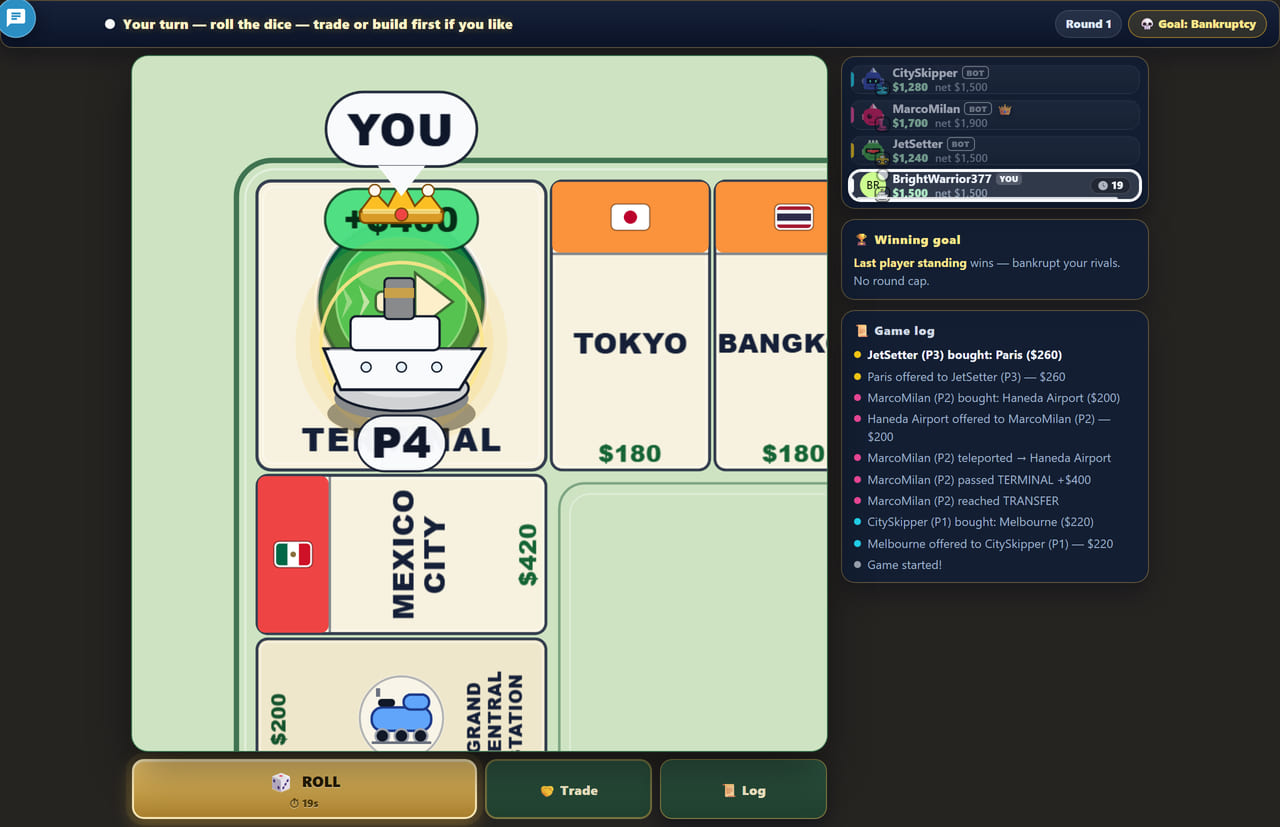
If you've already played a property-trading board game, Estates plays like home from turn one: roll two dice, move clockwise around a loop of tiles, and either buy the one you land on or pay rent to whoever already owns it. Roll doubles and you go again — three doubles in a row sends you straight to jail instead, the same as landing on the Go to Jail corner. Cross or land on the Terminal corner and you collect a bonus, and Treasure and Surprise cards can hand you cash, a card you keep for later, or move your token somewhere else on the board entirely. None of that needed reinventing.
Estates by the numbers
| What | Estates |
|---|---|
| Players | 2–6 (new rooms default to 4) |
| Starting cash | $1,500 |
| Board | One 32-tile loop, five real-world map skins |
| Pass or land on Terminal | +$400 |
| Jail fine / max wait | $700, or released free after 2 failed turns |
| City rent ladder | ×1 → ×2 (monopoly) → ×5 / ×15 / ×30 (houses) → ×50 (hotel) |
| Building cost by tier | $100 to $200 |
| Mortgage / buy-back | Half price to mortgage, +10% to reverse it |
| Transport hub rent | $50 / $150 / $300 / $600 for 1–4 owned |
| Utility rent | Dice × 10 (one owned), dice × 30 (both) |
| Live auction | 12s window, +7s per bid, $10 minimum raise |
| Move clock | 120s default (60, 90, 120 or 150s) |
Five world maps, one rulebook
Every board — world (the default), Europe, the USA, Türkiye and Asia — is compiled from the exact same 32-slot layout, so the rules never change between them, only the geography does. The six tiers of colour groups keep the same rent ladder, build costs and colours on every map; what changes is which 18 cities fill them, what they're called, and which flags show up. On the world map that means landmarks like Haneda Airport, Calais Ferry, Cairo Metro and Grand Central sitting on the board as the four transport tiles — all four cost $200 and pay rent from one shared network, so it never matters which one you pick up first.
The auction nobody gets to skip
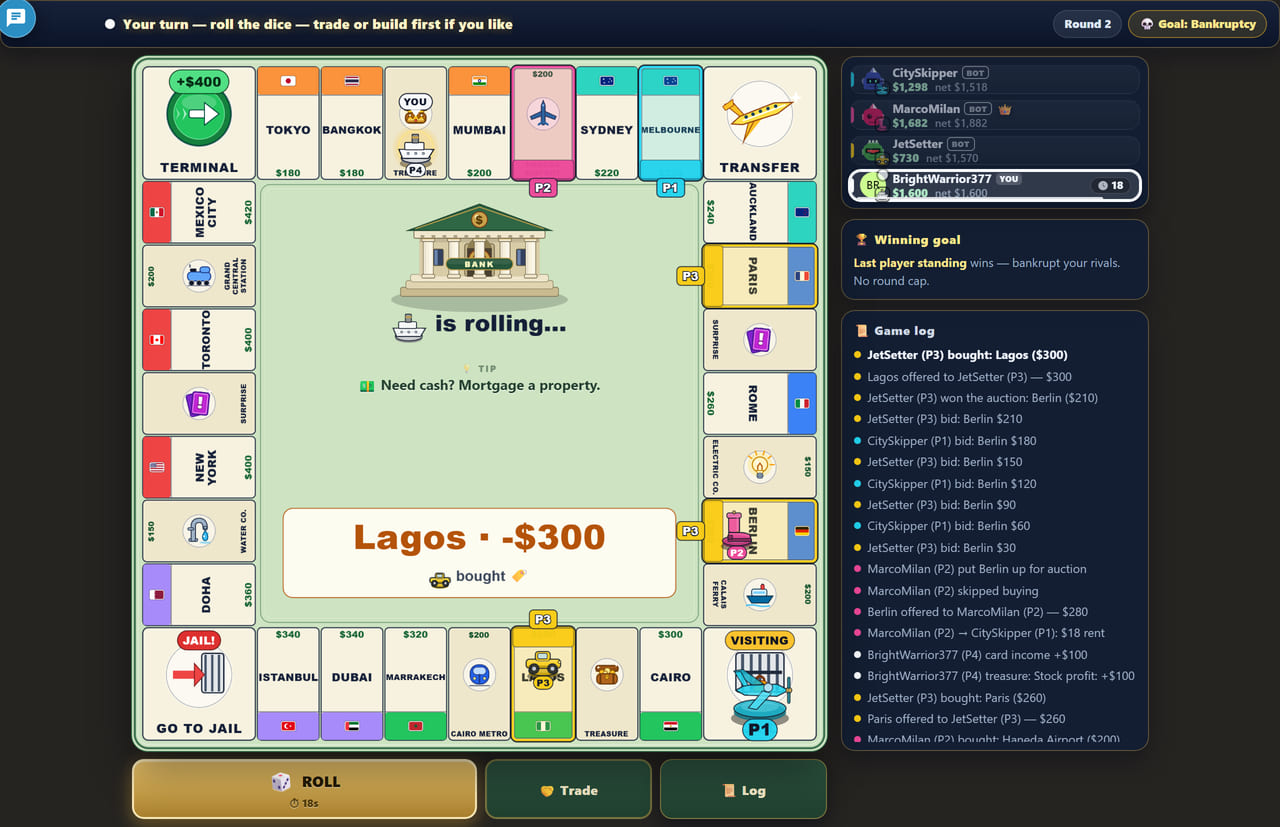
Decline to buy a tile, or you can't afford it, and it goes to a live, ascending auction open to every other seat. The window opens for 12 seconds, every accepted bid pushes the deadline out by another 7, and a bid still counts if it lands within half a second of the clock hitting zero. There's a $10 minimum raise, and the one seat that can never bid on the lot is the player who just turned it down. You can also open your own auction voluntarily, on any unbuilt, unmortgaged property you own or on a card in your hand — the proceeds go straight to you, not the bank.
Trading, mortgages and a safety net before bankruptcy
You can offer a trade — cash, unbuilt properties, held cards, any mix — on your own turn, and anyone else can accept or decline it whenever they like. The one exception runs the other way: if a debt you can't cover forces you into raising funds, any other seat can pitch you a trade out of turn, so a rival can rescue your full colour-group monopoly, or buy the pieces of it, right as it's about to break apart. Before that debt turns into a bankruptcy, the game shows you exactly how much you could still raise by mortgaging property or selling houses back at half price, and the one-tap "raise funds" option refuses to fire if it can see you genuinely can't cover the debt — it will never bankrupt you by mistake.
Choosing how the match actually ends
The room has two separate dials for this, and by default both are switched off: no net-worth target and no round cap, so the match runs until only one player hasn't gone bankrupt. Turn the target dial to 6,000, 8,000 or 10,000 and the first player whose net worth reaches it wins immediately, rivals' bankruptcies or not. Turn the round dial to 15, 20, 25, 30, 35 or 40 rounds — or leave it unlimited — and whoever holds the highest net worth when the last round ends wins, ties broken by cash on hand. Set both, and whichever finish line gets crossed first ends the match.
What to do with this
If you already know the classic property-trading loop, you already know how to play Estates — the differences are all in the parts that used to be friction: the sale that used to get waved through instead of auctioned, the endgame that used to grind on for hours with no way to shorten it, and the four-player ceiling that used to leave a fifth friend just watching. Pick a net-worth target if you want a shorter match, or leave it on bankruptcy for the full grind. See the complete ruleset in the Estates game guide, sharpen your opening buys with the Estates strategy tips, or just open a table and try it: play Estates for free against bots or friends.
Any third-party brand or game names mentioned are trademarks of their respective owners. Playgridia is an independent platform and is not affiliated with or endorsed by them.
Frequently Asked Questions
How many players can play Estates?
Estates seats 2 to 6 players, and a new room defaults to 4. The 5th and 6th seats need a registered account to host — a guest-hosted room caps at 4 no matter what the room is set to.
How do you win a game of Estates?
It depends on the room's settings. By default there is no net-worth target or round limit, and the match ends the moment only one player hasn't gone bankrupt. You can instead set a net-worth target of 6,000, 8,000 or 10,000 for an instant win, or cap the match at a set number of rounds and let the highest net worth decide it when time runs out.
What happens if you land on a property nobody has bought?
You get first chance to buy it at its listed price. If you skip it, or can't afford it, it goes to a live auction open to every other player — bidding runs for 12 seconds and extends by 7 more seconds every time somebody raises. The one player who is not allowed to bid is the one who just turned the property down.
How do you get out of jail?
Pay a $700 fine and roll normally that same turn, roll doubles to move immediately, or play a jail-free card if you're holding one. Fail to roll doubles for two turns in a row and you're released for free on your next attempt. The catch is that you collect no rent at all while you sit there, so waiting out the sentence is never actually free.
Can you trade with other players in Estates?
Yes — you can offer cash, unbuilt properties or held cards in any combination, and any other player can accept or decline whenever they like. There is one exception: if you're forced into raising funds to cover a debt, any other player can send you a trade offer out of turn, which is often how a full colour-group monopoly gets rescued, or bought out, at the last second.
Is Estates the same as the classic property-trading board game?
The core loop is the same — roll, buy, build, collect rent — so if you know that game, you already know how to play Estates. The differences sit around it: a live timed auction instead of a skipped sale, up to 6 players instead of the usual 4, and a choice between three different ways to end a match instead of one fixed rule.