Estates Live Auction: Rules, Timing and Tactics
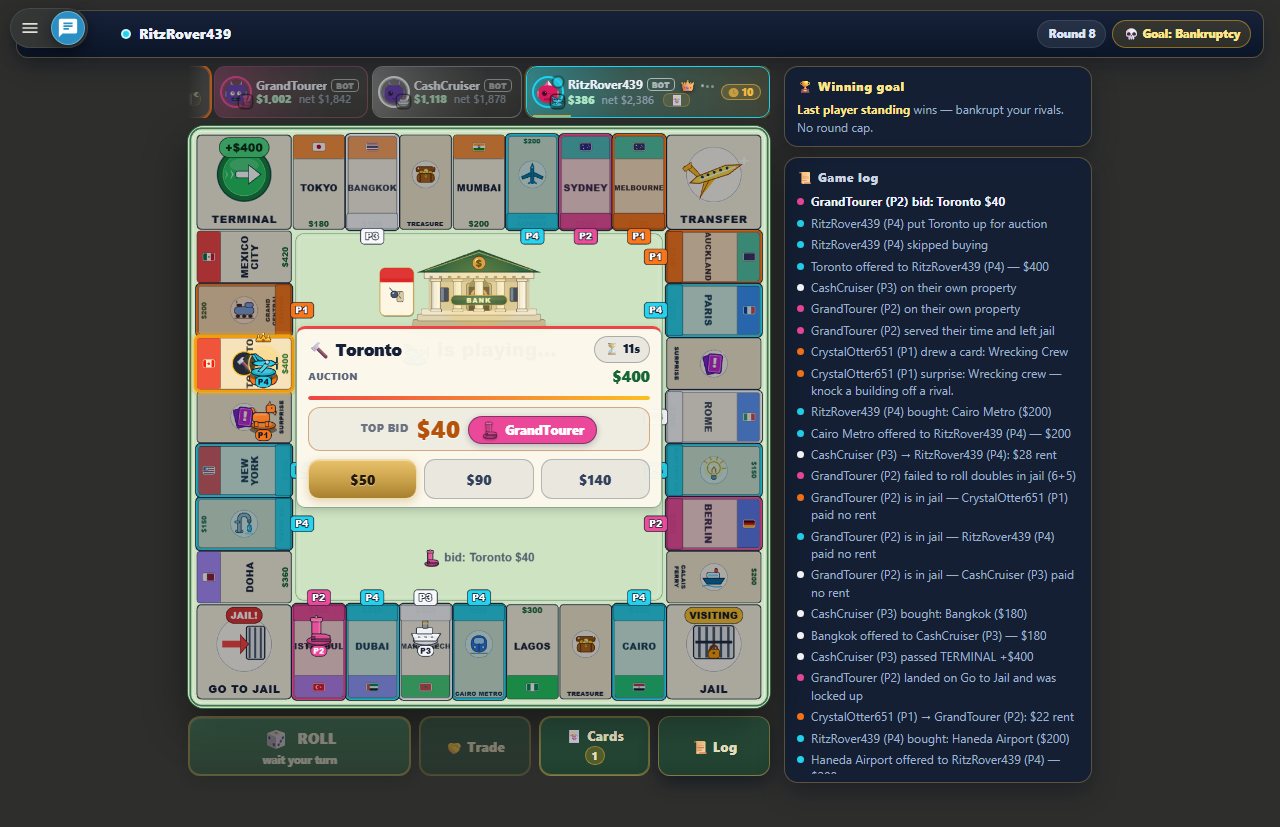
Decline to buy a tile in Estates — or land on one you can't afford — and it does not simply sit there unowned: the game throws it straight into a live auction, a timed bidding window open to every other seat at the table, with one exception: the player who just said no is barred from bidding.
What Actually Triggers an Auction
Two things send a tile to auction, and both are automatic. Land on an unowned city, transport hub or utility and skip the buy prompt, or run out of cash to cover the price, and the tile goes up for bid the instant your decision (or your timeout) resolves. There is a third, voluntary route: on your own turn you can put any property you own outright — unbuilt and unmortgaged — or a held card up for auction yourself, and pocket whatever it sells for. See the full turn-by-turn rules for where auctions sit inside the roll-buy-build loop; it is one of the biggest departures from the classic property-trading board game, covered in more depth in what makes Estates different.
The Clock: 12 Seconds, Then Faster
Every auction opens with the same window, and every accepted bid buys the room more time rather than less:
| Rule | Value |
|---|---|
| Opening window | 12 seconds |
| Reset on every accepted bid | +7 seconds |
| Minimum raise | $10 over the standing bid |
| Late-bid grace | 500ms |
That reset is the whole shape of the mechanic. A bid at 11.9 seconds is not a snipe — it still resets the clock to 7 more seconds, so the table always gets a chance to answer it. The 500ms grace exists purely so a bid thrown right at zero on a laggy connection still counts instead of vanishing.
Who Can Bid — and Who Can Not
Every seat with cash may bid, with two exceptions written directly into the rules: the seller can never bid on their own lot (a self-bid is refused outright), and on a declined-buy auction specifically, the player who skipped or could not afford the tile is locked out of the bidding entirely. You triggered the sale; you do not get a say in where it lands.
Selling Your Own Property — and What Happens If Nobody Bids
The voluntary auction works differently from a declined-buy one in one important way: proceeds go to you, the seller, not the bank. You can even auction a property that is mortgaged — it transfers to the winning bidder with the mortgage still attached, debt and all. And nothing forces a sale to happen: if no one bids, the lot stays exactly where it was — with the seller if you put it up yourself, or unowned if it was a declined buy.
| Trigger | Who can not bid | If nobody bids |
|---|---|---|
| Declined or unaffordable buy | the decliner | stays unowned |
| You auction your own property | you (the seller) | stays with you |
| You auction a held card | you (the seller) | stays with you |
One more thing to plan around: an auction reports its own clock instead of your turn's, which is why the whole table can watch it play out without anyone getting force-substituted for a bot mid-bid. But your own turn budget is still draining underneath the whole time, and it resumes at whatever is left the moment the lot sells — often close to zero if the bidding war ran long.
A Real Auction, Bid by Bid
Here is one from a match played while writing this guide: World board, four seats, one human and three bots. The human landed on Paris, listed at $260, and skipped it. The auction opened at $30 and climbed — $60, $90, and on up through $180, $210 and $230 to $260 — where a rival took it, paying exactly the price the human had just refused to pay. The interface's own note to the decliner says it plainly: "You passed — you can't bid on this one, watching." Only 0.89 tiles per match reach an auction at all — 96.2% of buy prompts get taken on the spot — but of the lots that do go up, 98% sell. Rare, and almost never a dud.
How to Actually Win One
The 7-second reset kills sniping outright: there is no last-second bid that ends an auction, because any accepted bid — however late — buys the table another 7 seconds to answer it. Bid to win, not to run out the clock.
A cheap tile is not always a cheap decision. If a rival needs a city to complete their third colour in a set, denying it to them is worth paying well above the base price for, even if you never build on it — a completed set doubles rent before a single house goes up. The same logic runs in reverse: a property you have no use for is still worth pushing up, in $10 steps, right to the edge of what actually costs you something, because every extra dollar a rival pays for it is a dollar they do not have for the next lot.
Watch the transport hubs specifically. All four share one rent network and cost $200 each no matter which one it is, but a completed four-hub network returns more per dollar than anything else in the game — $600 in rent per landing against $800 total spent owning all four, a return that only gets better as each hub you already own makes the next one worth more. A transport hub reaching auction is never "just a $200 tile" for the player one hub away from completing the network.
So what do you do with this: do not treat the buy prompt as a formality — skip it and the tile does not wait for you, it goes to market, and the market usually clears. If you are holding cash while a rival closes in on a set, an auction is the one moment you can spend money to shape someone else's board instead of just your own. And if the forced sale you are watching started with a bad stretch in jail rather than bad luck, that is covered separately in our jail guide. The fastest way to actually feel these numbers is to sit down at a live table: play Estates, our online property-trading game, and watch the next skipped tile go up for sale.
Any third-party brand or game names mentioned are trademarks of their respective owners. Playgridia is an independent platform and is not affiliated with or endorsed by them.
Frequently Asked Questions
What happens if I don't buy a property in Estates?
If you decline to buy an unowned tile, or you don't have enough cash to cover it, the tile is immediately sent to a live auction open to every other seat at the table. You are barred from bidding on it yourself, so the property almost always ends up owned by someone else. Only about one tile per match ever reaches this point, since most players take the buy prompt on the spot.
How long does an Estates auction last?
It opens with a 12-second window, and every accepted bid resets the clock to 7 more seconds, so a lively auction can run well past that opening 12 seconds. The minimum raise is $10 over the current bid, and a bid landing within 500 milliseconds of the deadline still counts. There is no fixed total length, it just ends whenever 7 seconds pass with no new bid.
Can you sell your own property at auction in Estates?
Yes. On your own turn you can put any unbuilt, unmortgaged property you own, or a held card, up for a live auction, and the winning bid pays you directly instead of the bank. You can't bid on your own sale, and if nobody else bids, the property simply stays with you.
Who is not allowed to bid in an Estates auction?
The seller can never bid on their own lot, whether that's a bank sale or one they started themselves. On a declined-buy auction specifically, the player who skipped the tile or couldn't afford it is also locked out, even though it was their decision that put the tile up for sale.
What happens if nobody bids on an auction?
The lot simply stays where it was. A tile nobody bought stays unowned and can be landed on again later, while a property a player chose to auction themselves stays in that player's hands. No forced sale happens either way.
Does a mortgaged property keep its mortgage when it's auctioned?
Yes. A mortgaged property can be put up for auction, and it transfers to the winning bidder with the mortgage still attached. The buyer inherits the debt along with the deed, exactly as they would in a trade.