How to Play a 5-Letter Word Game: Colors and Double Letters
To play a 5-letter word game, you guess one hidden 5-letter word in at most six tries, and after every guess each tile turns green (right letter, right place), yellow-amber (in the word, wrong place) or gray (not counted). In Word Duel everyone at the table guesses the same hidden word at the same time, and this guide covers the steps, the colors and the part that trips people up most: double letters.
The rules in five steps
- Every player gets a grid of six rows and five tiles. The hidden word is the same for everyone at the table, and nobody takes turns.
- Type any 5-letter word from the game's word list and press Enter.
- The row flips and every tile takes a color. Read the colors, then guess again using what they told you.
- You are done when you solve the word or use your sixth guess.
- Solve it in fewer guesses and ahead of the others to score more.
A guess has to be a real word from the list. If it is not, the row shakes, a message says it is not in the word list, and nothing is spent: no row is used and no clock penalty applies. A guess shorter than five letters is stopped before it is sent. You also cannot repeat a word you already tried in that round. There is no hard mode, so a guess does not have to reuse earlier clues.
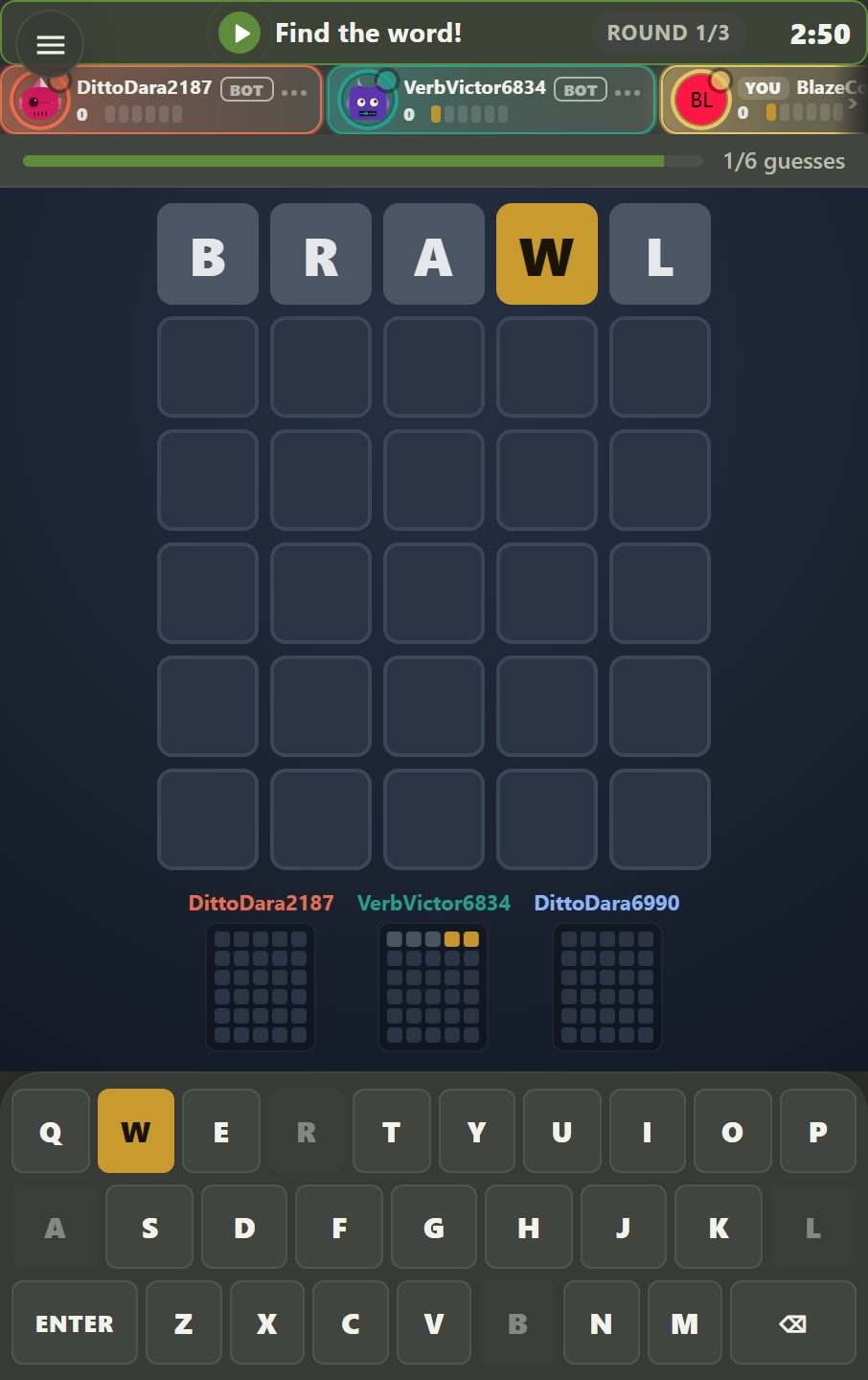
What the colors mean
| Tile color | What it tells you | What to do |
|---|---|---|
| Green | Right letter in the right place | Keep it in that position |
| Yellow-amber | The letter is in the word, but not there | Move it to another position |
| Gray | No further copy of that letter is left in the word | Drop it, unless the same letter is green or amber elsewhere in the row |
The game draws this tile as amber, and most players call it yellow. The on-screen keyboard follows the same colors. Each key shows the strongest clue that letter has earned across your revealed guesses: green beats amber, and amber beats gray. A key that turned amber once stays amber even if a later copy of that letter scored gray. Gray keys are dimmed but you can still type them.
Double letters
It is easy to read gray as "this letter is not in the word". That is not always true when a guess repeats a letter. The word may hold that letter once, or twice, and a guess with three copies can only be matched as many times as the word has them. So in Word Duel a gray tile can mean two different things, and the game marks the difference: a gray tile with a small amber dot in its corner is an extra copy. The letter is in the word, but you have already used up every copy the word holds.
The rule to remember: the word holds a letter exactly as many times as that letter is colored in the row. Count the green and amber tiles of that letter in one guess. That is the number of copies in the hidden word. Any further copy in the same row is gray. Count green and amber together, in that one row, never across rows.
The game settles the colors in two passes. First every exact match is marked green. Then the remaining letters are checked from left to right, one for one: a letter turns amber only if the word still has an unmatched copy of it, and each amber tile uses up one copy. A letter that finds none left turns gray. Because green is settled first, an exact match is never robbed by an earlier duplicate, and when the copies run short the earlier tile gets the amber and the later one goes gray.
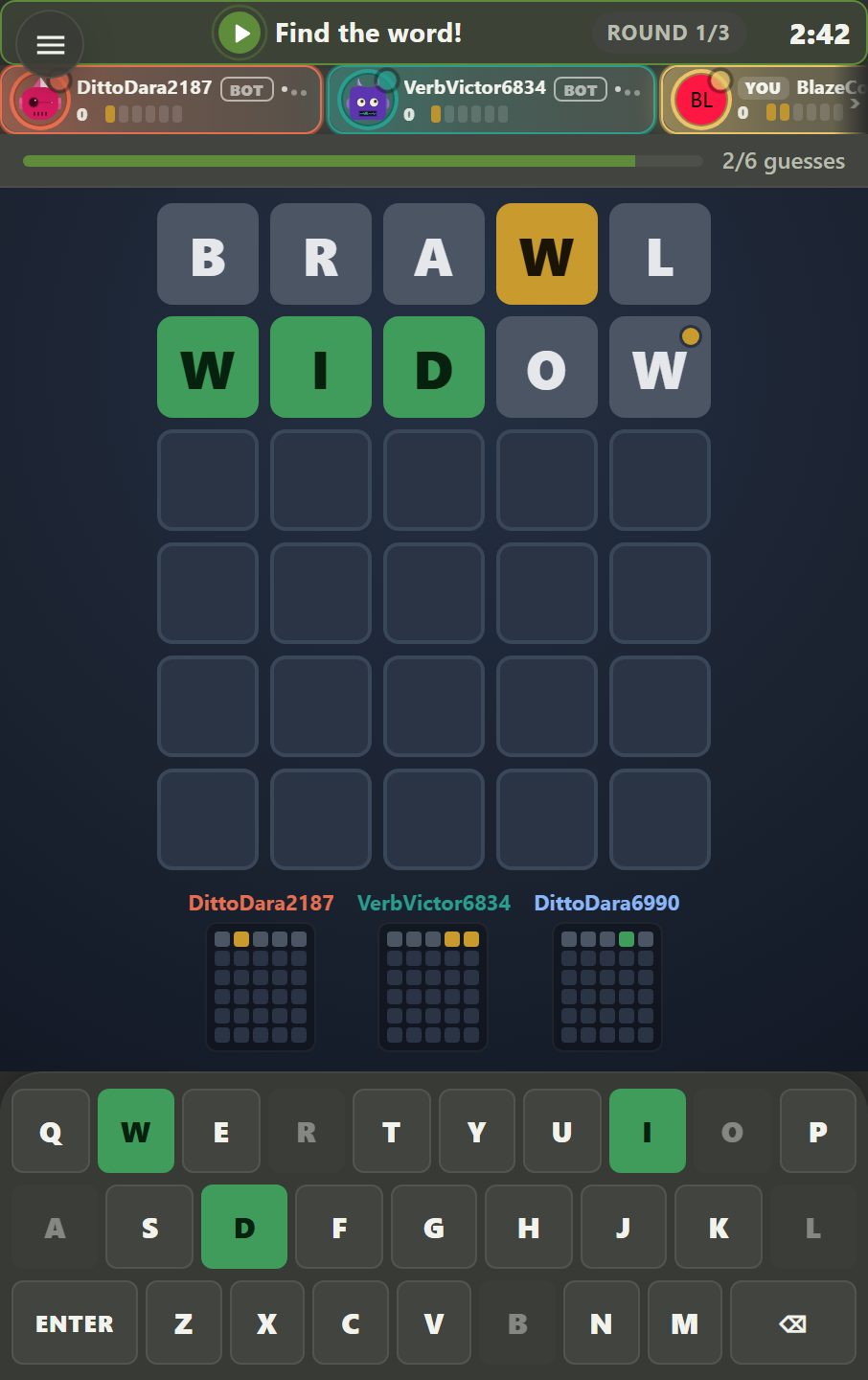
Here are real examples from the game's own word list, marked by the game. Each one shows a secret word, a guess that repeats a letter, and the colors the game gives it.
| Hidden word | Guess and result | What happened |
|---|---|---|
| CANOE | L⬛ O🟨 O⬛ S⬛ E🟩 | The word has one O: the first copy is yellow, the extra copy is gray |
| IGLOO | L🟨 O🟨 O🟨 S⬛ E⬛ | The word has two Os: both copies are colored |
| ALONE | L🟨 O⬛ O🟩 S⬛ E🟩 | The copy in the right place is settled first, so the other O is gray |
The first time an extra copy appears in a match, a short message also tells you the word has only one of that letter. After that, only the dot reminds you.
Scoring
Points are per round, and your total over all rounds decides the match.
| Solved on guess | Points |
|---|---|
| 1 | 60 |
| 2 | 50 |
| 3 | 40 |
| 4 | 30 |
| 5 | 20 |
| 6 | 10 |
| Not solved | 0 |
On top of that, the first three players to solve the word in a round get a speed bonus: +15, +10 and +5 by solve order. The order does not depend on how many guesses you used, so a sixth-guess solve that lands first still earns +15. An unsolved round scores 0 even if you used all six guesses. The best possible round is 75 points.
The round clock
Each round has a clock, set when the room is created: 1:30, 2:00, 2:30 or 3:00, with 2:00 as the default. A match runs 1, 3 or 5 rounds, with 3 as the default. The round ends early when every player has solved the word or used all six guesses. When the first player solves it, a 20-second closing window opens for everyone else; it can shorten the round but never extend it. Guesses still count during that window.
There is no daily limit: you can play as many rounds as you like. You see your rivals' color grids as they guess, but never their letters.
What counts as a letter in each language
Word Duel runs on its own word list per language, and the word language is set in the room's match settings, separately from the interface language. What counts as one letter changes with the language, so check this before you type.
| Language | What a letter is |
|---|---|
| English | The 26 letters A to Z; accents are folded to the base letter |
| French | Accents are not letters: they fold to the base letter, so you type the plain letter, and a ligature counts as two letters |
| Spanish | Ñ is its own letter; other accents fold away |
| Russian | Ё counts as Е |
| Turkish | The 29 Turkish letters; dotted İ and dotless I are two different letters |
| Korean | Five basic jamo (consonant and vowel parts), not five syllables, so most words are two syllables |
In Korean, a compound jamo splits again, so double letters are counted per jamo. The on-screen keyboard switches to the word language's layout.
What to do with this
Play one round with the colors in front of you and, whenever a guess repeats a letter, count its green and amber tiles before you read the gray one. For openers, see best starting words, and for the words that cost the most guesses, see the hardest 5-letter words. You can also play the same format with friends in a two-player game. When you are ready, open Word Duel, pick a word language and start a match; bots fill any empty seat.
Frequently Asked Questions
Why is one of my repeated letters gray when the letter is in the word?
The word holds a letter only as many times as it is colored green or amber in your row. A further copy of that letter in the same guess turns gray, and Word Duel adds a small amber dot in the tile's corner to show it is an extra copy, not a missing letter.
Does a word that is not on the list use up one of my six guesses?
No. If the word is not in the list, the row shakes, a message says it is not in the word list, and no guess is spent. You can also not repeat a word you already tried in the same round.
How are points scored in a round?
Solving on guess 1 earns 60 points, then 50, 40, 30, 20 and 10 for guesses 2 to 6. The first three players to solve also get +15, +10 and +5 by solve order. An unsolved round scores 0.
How long is a round?
The round clock is 1:30, 2:00, 2:30 or 3:00, and the default is 2:00. After the first player solves the word, everyone else has 20 seconds at most to finish, and the round also ends early once all players are done.
Do accents and special letters count in other languages?
It depends on the language. French accents fold into the plain letter, Spanish keeps Ñ as its own letter, Russian treats Ё as Е, and Turkish treats dotted and dotless I as different letters. Korean is played on five jamo, so most words are two syllables.
Is there a daily limit or a hard mode?
No. Word Duel has no daily limit and no hard mode. You can play as many rounds as you like, and a guess does not have to reuse earlier clues.