Vocabulary Game for Adults: Learn a Language in 5 Letters
A vocabulary game for adults works best when you have to recall and spell real words instead of recognizing them on a card, and Word Duel does that: 5-letter rounds where the interface stays in your own language and the hidden words come from the language you are learning, such as Spanish or French. A round lasts about two minutes, it needs no signup to try, and it does not feel like homework.
Why a 5-letter word game suits adult learners
Flashcards ask you to recognize a word you have already seen. A guessing round asks you to produce one: you think of a candidate, check that it fits the clues, type it letter by letter and read the feedback. That is closer to using a word than to looking at it, and the effort is the point.
It is also short. Everyone in the room guesses the same hidden word at the same time, you get six guesses, and the round clock defaults to two minutes. You can stop after one round.
How to set it up for language learning
- Open Word Duel and create a room.
- On the room screen, open Match settings.
- Under Word Language, pick the language you are learning.
- Leave your interface language alone. The two settings are independent, so menus, hints and error messages stay in your own language while the words change.
- Start the match. The on-screen keyboard switches to the layout of the word language.
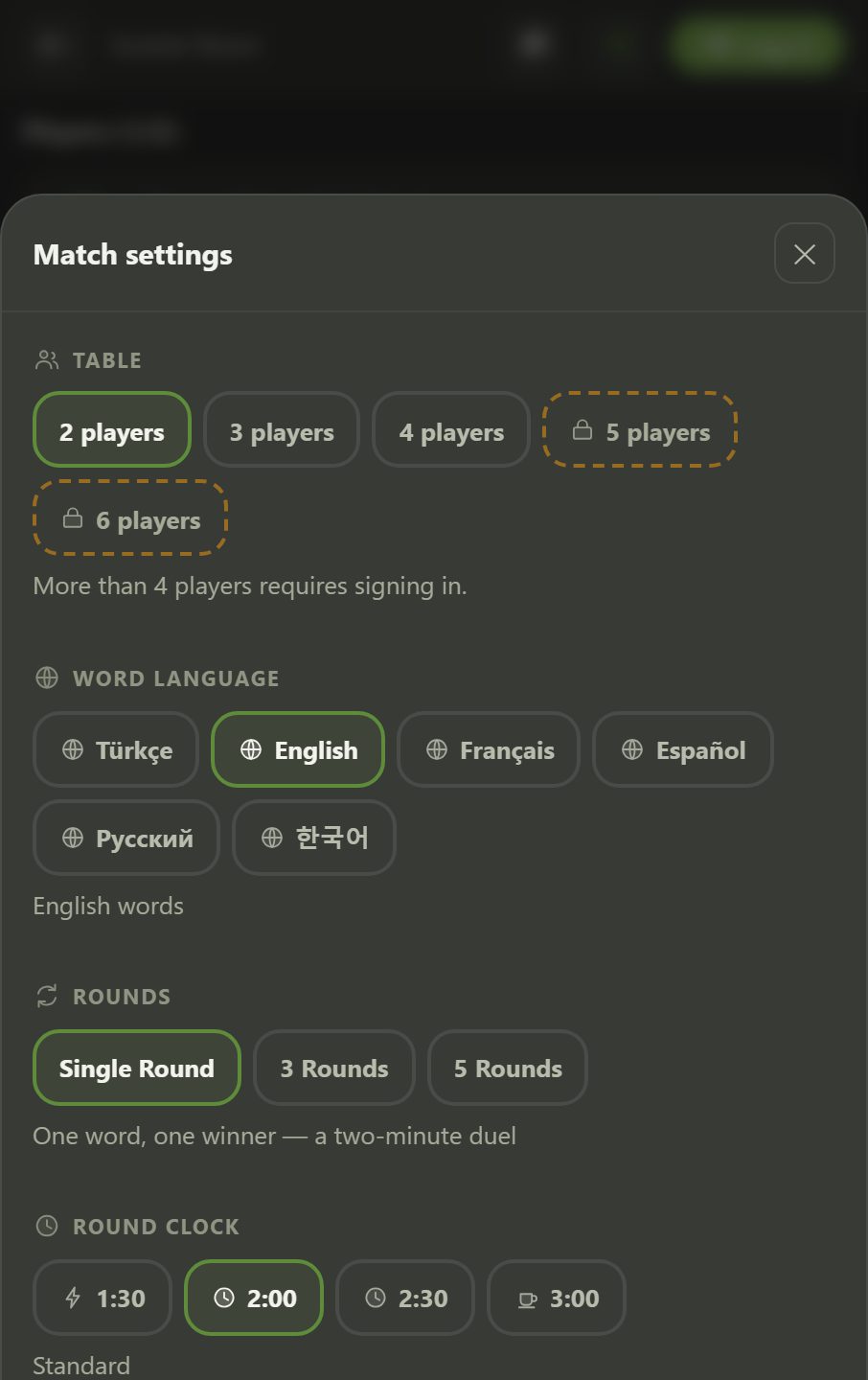
If you only want to try it, the three-round default is a good start. You can also pick a single round, or five.
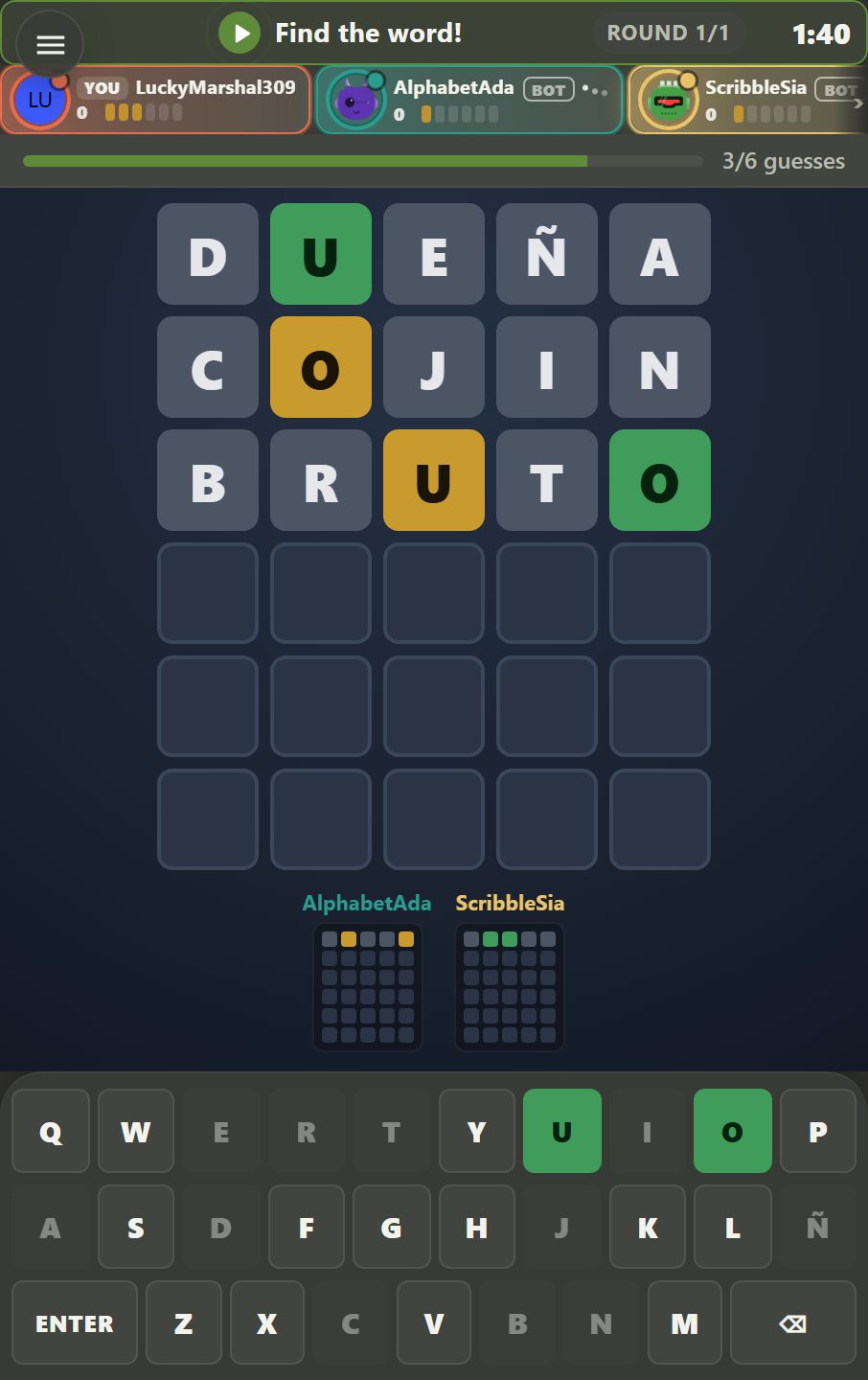
What to expect from the word list
The hidden word is always a common, base-form word, and the answer lists contain no proper nouns. That keeps rounds fair for learners: you will not be asked for a place name or an obscure inflection.
Your guesses are more flexible than the answers. The game also accepts other valid 5-letter forms of the language, such as plurals and conjugations. That is useful, because you can test a form you half remember. The hidden word itself is never one of those extra forms.
A word that is not on the list is simply refused, with a shake and a short message. It does not use up one of your six guesses and it does not cost any clock penalty, so trying a spelling you are unsure of is free.
A routine that turns rounds into retention
Playing is the easy part. The learning happens when you deal with the words you missed. Here is a simple loop for a session.
| Step | What you do Why |
|---|---|
| 1. Play | Three rounds in the language you are learning Short enough to repeat, long enough to meet several new words |
| 2. Note | When a round ends, the round card shows the hidden word for a few seconds. Write down each word you missed The card is where the word appears, so catch it then |
| 3. Look up | After the match, check meaning and usage in a dictionary or your course book The game shows no translations or definitions |
| 4. Keep a list | Keep a short running list, not a long one A list you can finish gets reviewed |
| 5. Repeat | Start the next session by trying to use those words in your guesses You meet them again, in a new round |
For the guessing itself, a good first word helps a lot; see best starting words for a 5-letter word game. In a language you are still learning, pick openers that use its most common letters.
Typing in another language: letters and accents
Each word language has its own letter rules, and they matter when you type. In French, accents fold: an accented letter counts as its base letter, so you do not need to hunt for accent keys. In Spanish, Ñ is its own letter and not a variant of N, while other accents fold. The full rules for every word language are in how to play the 5-letter word game.
Playing with a class, a partner or bots
A room can be set to link only. It then stays out of the public lists, and only people who have the link can join. That suits a class, a study group or a language exchange partner: each of you can use your own interface language while sharing the same hidden word in one target language.
A room seats up to 6 players, and a guest host can open up to 4 seats. Everyone guesses at once and sees how rivals are doing as color grids, never their letters, so a stronger player cannot give the answer away. If nobody is around, bots fill the empty seats, so you can practice alone at any hour. There is no daily limit on matches or rounds. For more ways to play with others, see multiplayer word games with friends.
The limits, stated plainly
- It does not teach grammar.
- It does not show translations or definitions.
- It uses 5-letter words only, so longer words and phrases never appear.
So treat it as a supplement to a course, not a course. It gives you spelling practice, recall under a light time limit and repeated contact with common words. Meaning and grammar still have to come from somewhere else.
What to do next
Pick the language you are studying, play one round and write down the first word you miss. Then open Word Duel whenever you want a few more minutes of practice, and keep the list short.
Frequently Asked Questions
Can I play with my interface in my own language and the words in another?
Yes. Open Match settings in the room and pick the Word Language. It is a separate setting from the interface language, so menus and messages stay in your own language while the hidden words and the keyboard follow the language you chose.
Does it work for learning Spanish or French?
Yes, both are available as word languages. Spanish treats Ñ as its own letter, and French folds accented letters to their base letters, so you can type without accent keys. The game does not teach meaning, so pair it with a dictionary or a course.
Does the game show translations or definitions?
No. After a round the card shows the hidden word and each player's result, nothing more. Write down the words you missed and look them up yourself.
Does it cost a guess if I try a word that is not on the list?
No. A word that is not on the list is refused with a short message and does not use one of your six guesses. The list also accepts other valid forms such as plurals and conjugations, though the hidden word is always a common base-form word.
Can a class or language partner play together?
Yes. Make the room link only, so only people with the link can join. A room seats up to 6 players, and a guest host can open up to 4 seats. If nobody is around, bots fill the empty seats.
Is it a replacement for a language course?
No. It only uses 5-letter words and does not teach grammar, so it works as a supplement. Use it for spelling practice and repeated contact with common words alongside a course.