2-Player Word Game Online: Race a Friend to the Same Word
A 2-player word game online works best as a duel: you and a friend get the same hidden 5-letter word at the same moment, each with six guesses and green, yellow and gray clues, and whoever solves it cleaner and faster takes the round. Word Duel is built that way. There are no turns, and a table for two takes about a minute to set up.
Set up a table for two
- Open Word Duel and create a room.
- Open "Match settings" and set the table to 2 seats. The same sheet holds the word language, the number of rounds and the round clock.
- Turn on "Link only". The room disappears from the public lists, and only people who get your link can join.
- Press "Share link" and send it by message. Your friend opens it and can join as a guest, with no signup.
- Start the match when both of you are seated.
This post is about the one-on-one case. For a bigger table of up to six, see the guide to playing with a group.
What a one-on-one round looks like
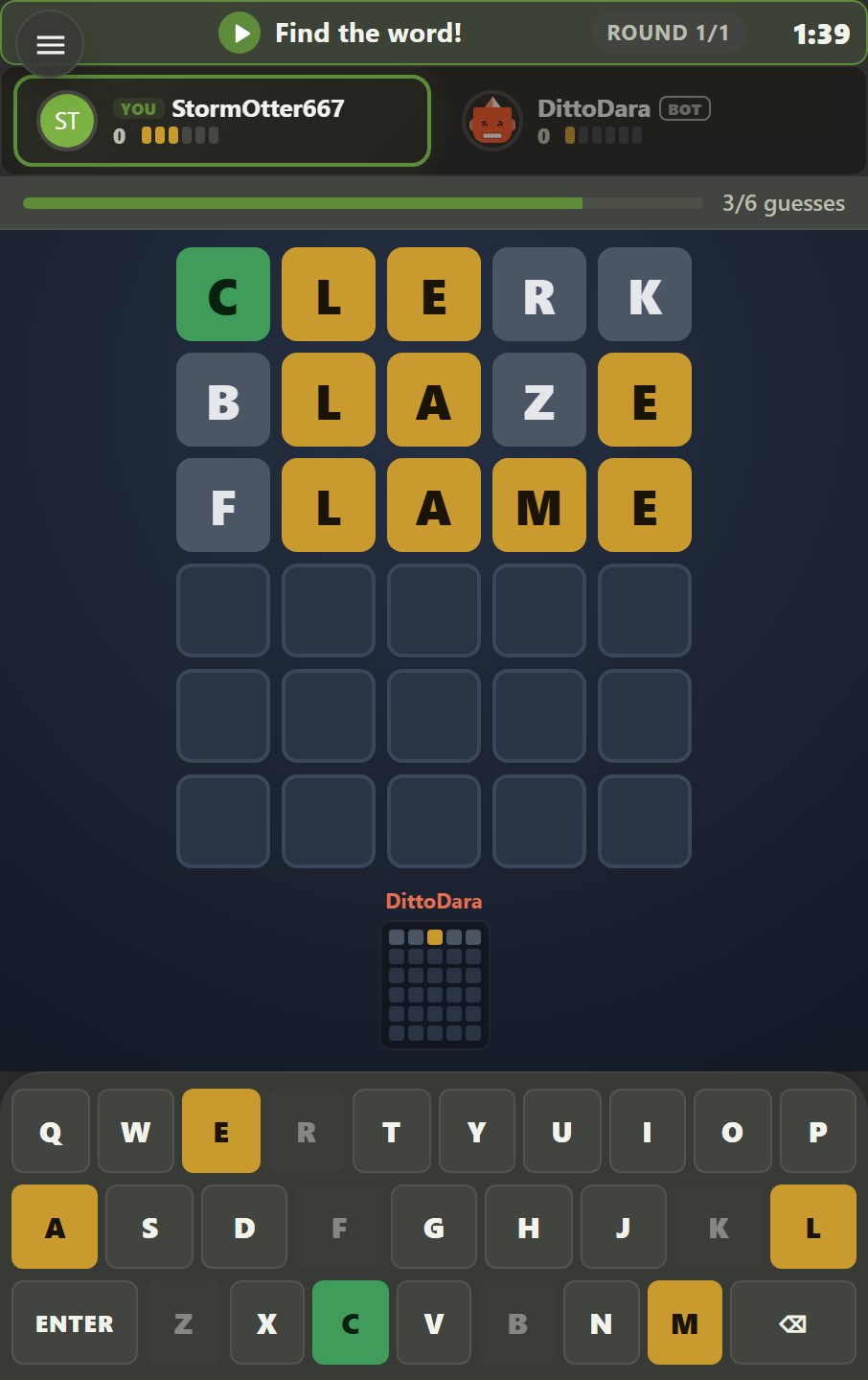
After a short round card, both of you see an empty grid of six rows and five tiles at the same instant. Nobody waits for a turn: you type and submit whenever you are ready. Each submitted row flips and shows green for the right letter in the right place, yellow for a letter that is in the word but elsewhere, and gray for a letter that is not in it.
Your friend's progress is visible too, but only as a small color grid under your own board. You see how many rows they have used and how many tiles are green, and you never see their letters. A word that is not in the word list is refused without costing you a guess, and you cannot repeat a word you already tried in that round.
How scoring works for two
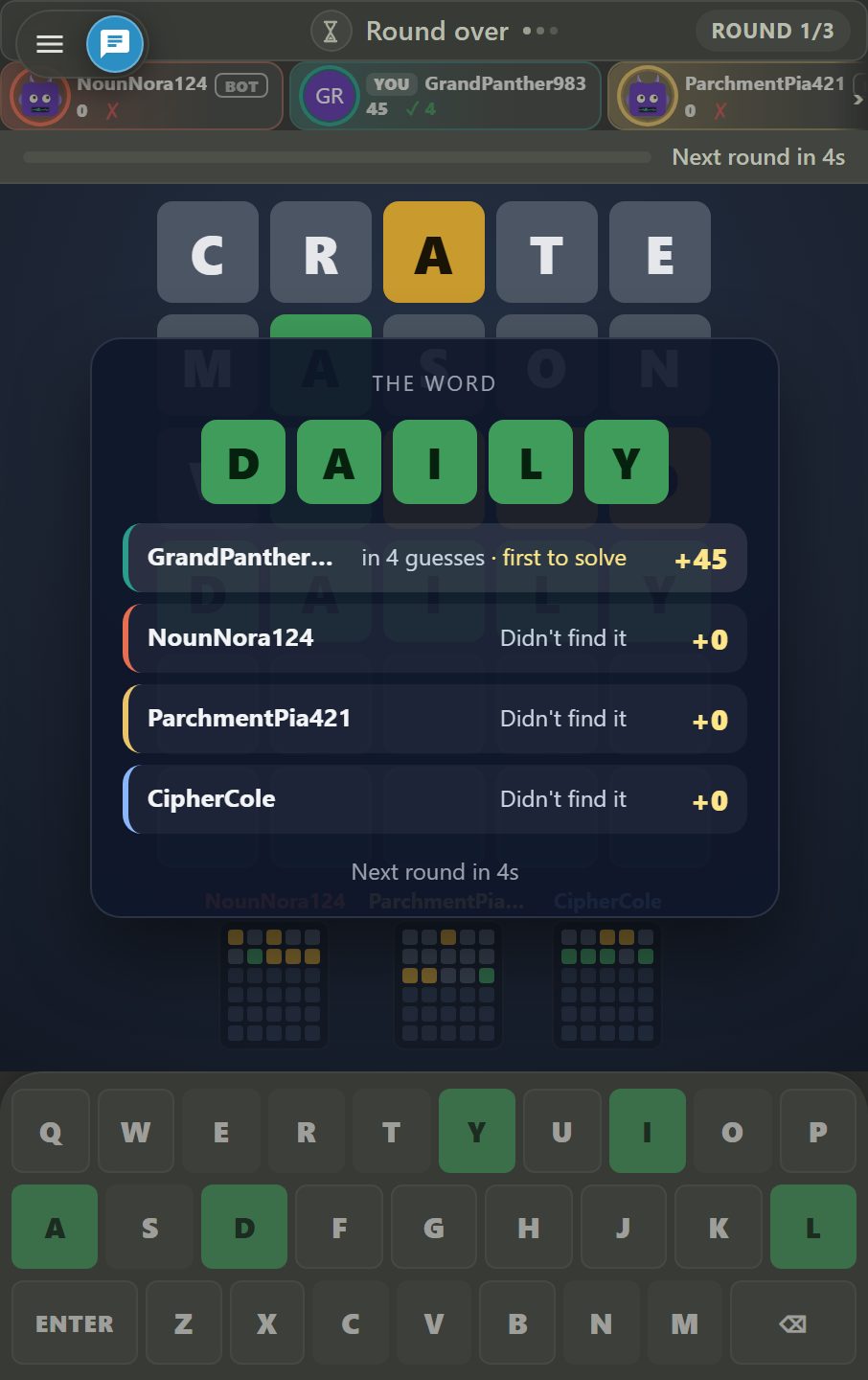
A solve is worth more the fewer guesses it takes: 60 points for one guess, then 50, 40, 30, 20 and 10 for the sixth. An unsolved round scores 0, even if you used all six guesses. On top of that, the first player to solve gets +15 and the second gets +10. Only the order of solving earns the bonus, not the guess count.
| Round | First solver | Second solver | Round winner |
|---|---|---|---|
| A | 5 guesses: 20 + 15 = 35 | 3 guesses: 40 + 10 = 50 | Second solver, 50 to 35 |
| B | 2 guesses: 50 + 15 = 65 | 6 guesses: 10 + 10 = 20 | First solver, 65 to 20 |
| C | 4 guesses: 30 + 15 = 45 | did not solve: 0 | First solver, 45 to 0 |
Row A is the lesson of the format: arriving second with a cleaner solve beats arriving first with a sloppy one. When both of you solve, arriving first instead of second is worth only 5 points (15 against 10), and one guess is worth 10.
Tactics that only matter in a duel
Read the rival's grid
The small grid tells you two things: how many guesses they have used, and how close they are. A row with several green tiles means a solve may be one or two guesses away. A rival with a mostly gray grid is still searching, which gives you time to be careful.
The 20-second window
The first solve starts a closing window of 20 seconds, or whatever is left of the round clock if that is shorter. Guessing stays open until it runs out, and the round ends early if both of you are finished. If your friend solves first and you are close, you still have time for a couple of guesses, so use them. If you solve first, your friend is on a short clock, and an unsolved round scores 0.
When a safe extra guess pays
Every extra guess costs 10 points, but a wrong rush that burns your last guess costs the whole solve. While your friend has not solved, the only pressure is the round clock, so a careful guess that sorts out the remaining possibilities is usually right. Once they have solved, the 20-second window decides: take the shot that can still win the round.
How a match ends
A match is 1, 3 or 5 rounds, and the default is 3. After the last round, the higher total wins. If the totals are equal, a two-seat match is a draw. The round clock can be set to 1:30, 2:00, 2:30 or 3:00, and the default is 2:00. When both seats are human, the match is rated. A match against bots only counts toward streaks and quests, not the rating.
If your friend is not online, or the connection drops
With nobody to invite, add a bot and the seat fills at once, though a match with bots only besides you is unrated. If a connection drops during a match, a bot takes the seat after 2 minutes and keeps playing it. You take the seat back by returning to the match.
A handicap for an uneven match
The word language is set in "Match settings" and is separate from the interface language. If one of you is much stronger in your shared language, choose a word language that neither of you speaks well, such as Spanish, French or Korean. You both start equally lost, and the clue colors do the work.
Ready for a first round? Open Word Duel, make a link-only room for two and send it. For ways to sharpen your guesses first, read the strategy guide.
Frequently Asked Questions
How do I play a 2-player word game online with a friend?
Create a room in Word Duel, set the table to 2 seats in Match settings, turn on Link only and press Share link. Your friend opens the link and joins, and you both guess the same hidden word at the same time.
Can I see my friend's letters while we play?
No. You see a small color grid for their guesses, which shows how many rows they have used and how close they are, but never the letters. Their words stay hidden during the round.
Who wins a round when both of us solve the word?
The one with more points. A solve scores 60, 50, 40, 30, 20 or 10 by guess count, plus 15 for the first solver and 10 for the second. A second solver with fewer guesses can beat a first solver who needed more.
What happens if my friend disconnects?
After 2 minutes a bot keeps the seat, and your friend can take it back by returning to the match. If a player leaves on purpose, the bot keeps the seat for good.
Does a 1v1 match count toward the rating?
Yes, when both seats are human. A match where you play only against bots is unrated, though it still counts toward your streak and quests.
What if we tie?
With two seats, equal totals after the last round make the match a draw. Playing 3 or 5 rounds makes a tie less likely than a single round.