Hardest 5-Letter Words to Guess, Measured by a Solver
The hardest 5-letter words to guess are not the rare or long-winded ones. What makes a word hard is its company: near-twins that differ from it in a single position, a repeated letter, or a letter few other words use. To find them we had a solver play every answer in Word Duel 500 times and ranked the words by how often six guesses were not enough.
How we measured it
The solver is deliberately simple and careful. It opens with one of the 20 most letter-rich answers, and after that it always guesses a random word that still fits every clue so far. It plays on the game's own answer list and scores each guess with the engine's own green, yellow and gray rules, so nothing is approximated. Every word was played 500 times.
Read the results for what they are. This is a simulation of one careful strategy, not statistics about human players, and a different solver would shuffle the middle of the ranking. The ranking says which words punish a straightforward, sensible approach. It does not say how often a person on a phone misses them.
We ran 577500 simulated games, 500 for each of the 1155 common English words: the solver opens with a letter-rich word, then always guesses a random word that still fits every clue. On average it needed 3.55 guesses and missed the six-guess limit in 0.6% of games.
The hardest words, ranked
The table lists the twelve words with the highest share of games that needed more than six guesses. To get a fair average the simulation keeps going past six until the word is found, and "average guesses" counts every one of those games.
| # | Word | Average guesses | Missed in six |
|---|---|---|---|
| 1 | WATCH | 5.0 | 26% |
| 2 | BATCH | 5.0 | 26% |
| 3 | HATCH | 4.9 | 24% |
| 4 | MATCH | 5.0 | 24% |
| 5 | CATCH | 4.8 | 23% |
| 6 | PATCH | 4.9 | 23% |
| 7 | JOKER | 5.0 | 16% |
| 8 | LATCH | 4.1 | 15% |
| 9 | BOXER | 4.8 | 13% |
| 10 | GRAPE | 4.7 | 13% |
| 11 | GRAZE | 4.8 | 12% |
| 12 | FOYER | 4.8 | 11% |
Look at how the list is built. Some entries share all but one letter with another word, and others stand out for a repeated or unusual letter. Those are the three reasons a word is hard.
Why a word is hard
1. Many neighbors that differ in one position
This is the big one. When a word fits a pattern like four fixed letters and one open slot, and a handful of other words fit the same pattern, one guess cannot separate them. Green tiles confirm the four letters you already know and tell you nothing new about the open slot.
| Pattern | Words that fit it |
|---|---|
| _IGHT | EIGHT, FIGHT, LIGHT, MIGHT, NIGHT, RIGHT, SIGHT, TIGHT |
| _ATCH | BATCH, CATCH, HATCH, LATCH, MATCH, PATCH, WATCH |
| GRA_E | GRACE, GRADE, GRAPE, GRATE, GRAVE, GRAZE |
| SHA_E | SHADE, SHAKE, SHAME, SHAPE, SHARE, SHAVE |
| _OUND | HOUND, MOUND, POUND, ROUND, SOUND, WOUND |
| STA_E | STAGE, STAKE, STALE, STARE, STATE |
Each row is a family: the pattern on the left, every answer that fits it on the right. Once you reach a pattern like that with several words alive, you are no longer deducing. You are picking one name from a hat.
2. A repeated letter
A repeated letter is easy to overlook because you rarely guess one on purpose. If you assume five different letters, you never test whether a letter appears twice, and the clues cannot show you what you did not try. In Word Duel an extra copy of a letter shows as gray like a miss, with a small amber dot in the tile corner, so it is worth reading the dots.
3. Rare letters
Words built around letters that few other words use are hard to reach by elimination. Common letters get tested early by almost any opener, but a rare letter only turns up if you happen to guess it, so these words tend to be solved late or not at all.
Why neighbors cost guesses one at a time
Suppose six words still fit and you guess one of them. If you are right, you gain a lot. If you are wrong, the clues usually eliminate only one or two of the others, because every neighbor shares the same four letters and the feedback on those four is identical. Guess the second, then the third, and you have spent three of your six guesses to shrink the family by three.
The solver in our simulation plays exactly this way. It is the right move when many words fit and the letters differ widely. It is the wrong move inside a family of near-twins, and the bigger the family, the more games run past six guesses.
How to escape a trap family
When several words still fit and they differ in only one position, stop guessing them one by one. Instead, list the letters that distinguish them and play a word that contains as many of those letters as you can, even if that word cannot be the answer.
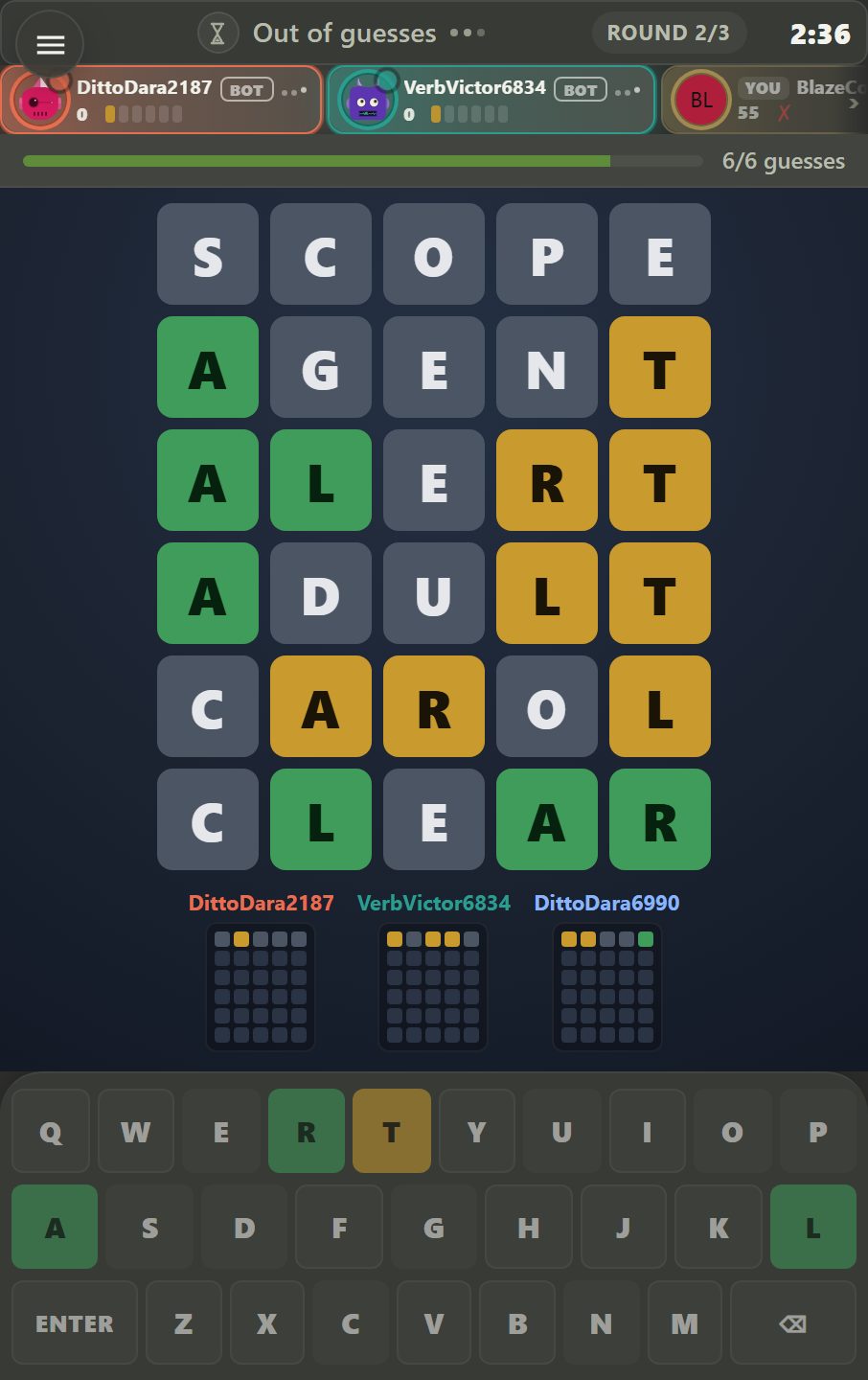
This works in Word Duel because a guess only has to be on the game's word list. It does not have to be a possible answer. A word that cannot win the round is still a legal guess, and a single such guess can mark several differing letters at once: each tile that turns yellow or green removes a group of candidates, where a plain guess would remove one or two.
A practical routine looks like this:
- Write down the open slot and the letters the remaining words put in it.
- Look for a word on the list that uses as many of those letters as possible in different positions.
- Play it, even if it feels like a wasted guess, then read the tiles and pick the one word left.
- Do this while you still have at least three guesses in hand. With only one or two left, take the best single guess instead.
What it costs in points
In Word Duel a solve is worth 60 points on the first guess, and each extra guess is worth 10 points less, down to 10 points for a solve on the sixth. A round you do not solve scores 0. The first three players to solve also get a small bonus of 15, 10 and 5 points by order. A trap that eats three guesses therefore costs you 30 points before you even count the risk of missing entirely.
How to practice
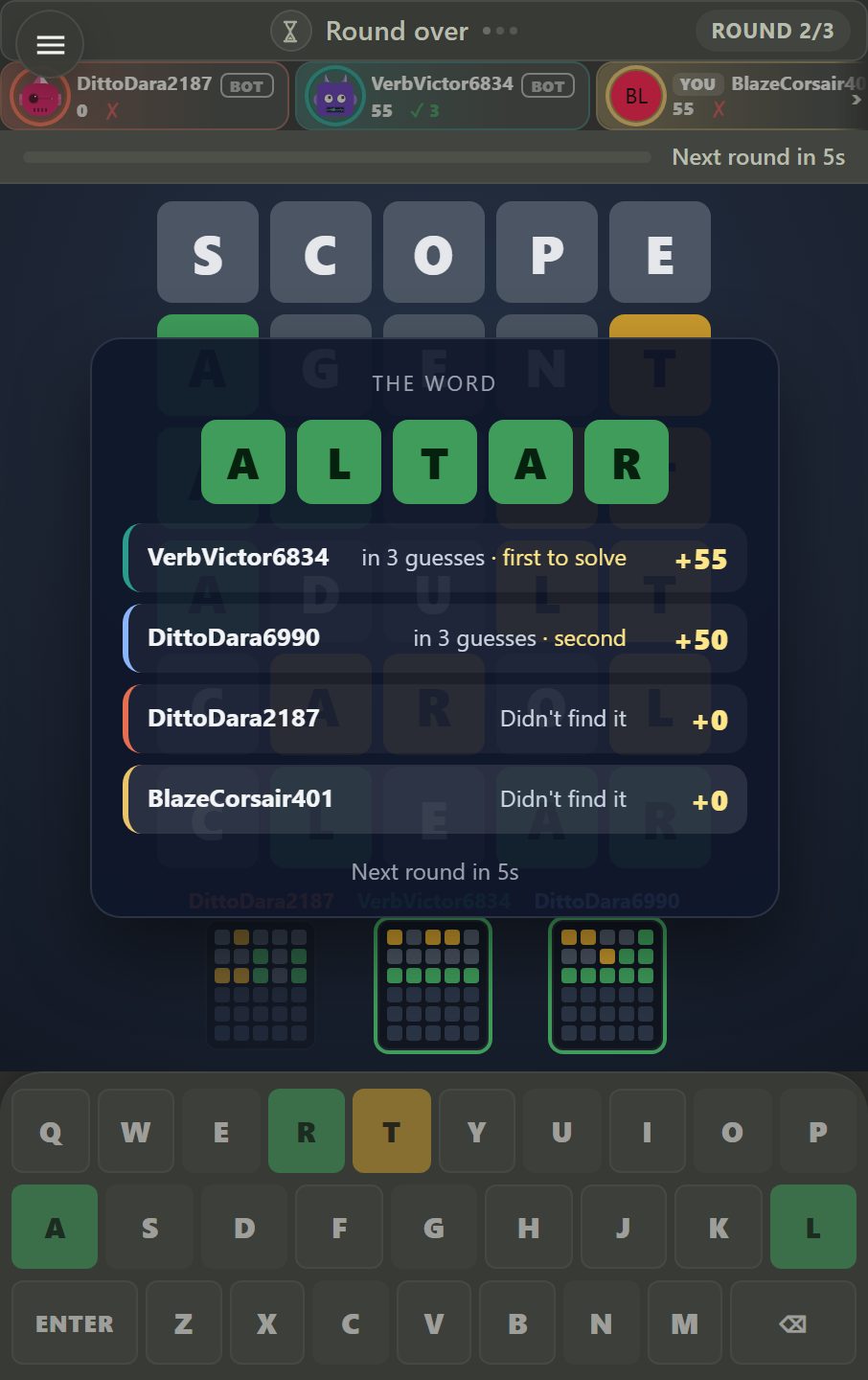
Matches have no daily limit, so you can meet trap families as often as you like. After a missed round, look at the word on the round card and ask which letters in its family you never tested. Over a few matches you start to see the patterns before they trap you. For a stronger opening, read the guide to starting words, and for the wider game plan see the word guessing strategy tips. New to the format? Start with how the 5-letter game works.
Next time two or more words fit and differ in one spot, spend a guess on a word that tests the difference rather than on a coin flip. You can try it in a Word Duel match right now.
Word Duel is an independent game with its own word lists.
Frequently Asked Questions
What makes a 5-letter word hard to guess?
Mostly neighbors: when several words differ from a word in only one position, one guess cannot separate them. A repeated letter and rare letters also make words harder. In our simulation these three patterns explain the words at the top of the list.
How did you measure which words are hardest?
A solver played every answer in Word Duel 500 times. It opens with a letter-rich word, then always guesses a random word that fits all clues so far. Words were ranked by how often six guesses were not enough.
Are these the words real players miss most?
Not necessarily. The results come from a simulated careful solver, not from player statistics. A different strategy would reorder the middle of the list, though near-identical families are hard for almost any approach.
How do I escape when several words still fit?
Stop guessing them one at a time. Play a word that tests as many of the differing letters as possible, even if it cannot be the answer. In Word Duel any word on the game's word list is a legal guess, so this costs nothing in rules.
How many points does an extra guess cost in Word Duel?
Each extra guess is worth 10 points less. A first-guess solve earns 60 and a sixth-guess solve earns 10, while an unsolved round earns 0. The first three players to solve also get 15, 10 and 5 bonus points.