Gin Rummy Against the Computer: Free Bot Levels
 Play Gin Rummy
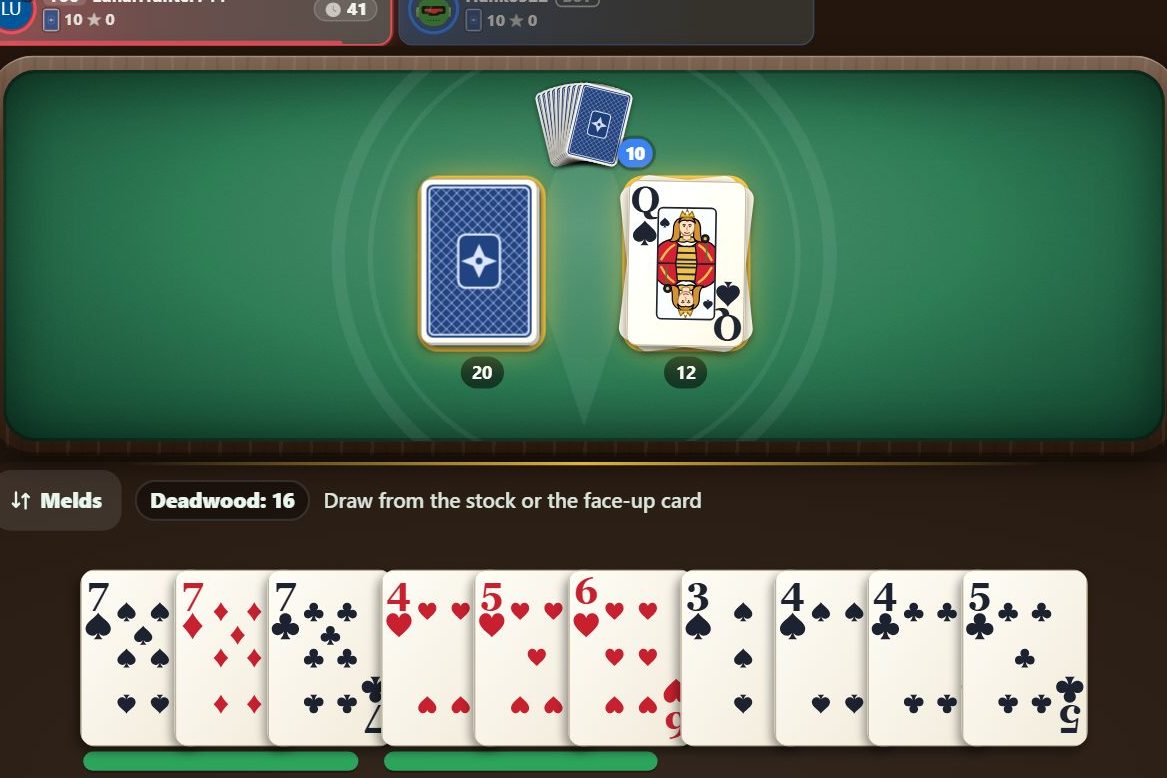
To play gin rummy against the computer, press the Play button at the top of this page (or Play Now on the Gin Rummy page): you get a two-player game against a bot at the Medium level, ten cards each, and you can knock as soon as your loose cards add up to 10 or less. This guide covers the numbers that decide a deal and how each bot level behaves.
What you are playing
The game uses one 52-card deck with no jokers, and each player gets 10 cards. A set is three or four cards of one rank in different suits, and a run is three or more cards in one suit. The ace is low only, so A-2-3 is a run and Q-K-A is not. Cards outside your melds are deadwood: ace 1, twos to nines at face value, and 10, J, Q and K at 10 each.
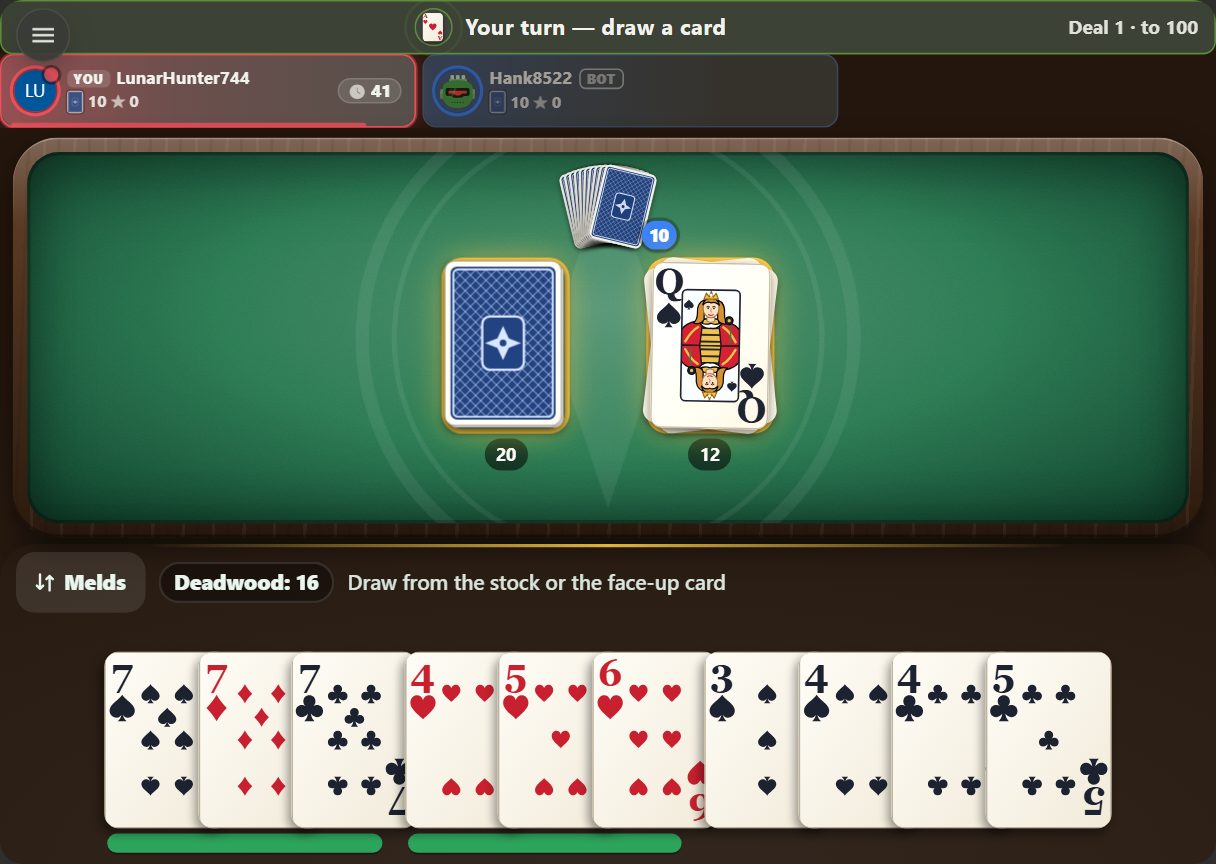
On your turn you draw from the stock or take the face-up card, then discard one. The card you just took from the discard pile cannot be thrown straight back that turn. You never have to arrange melds yourself: the server finds the best arrangement, and the Deadwood badge under the table shows your count live.
Knock, gin and undercut
| Term | Condition | What it scores |
|---|---|---|
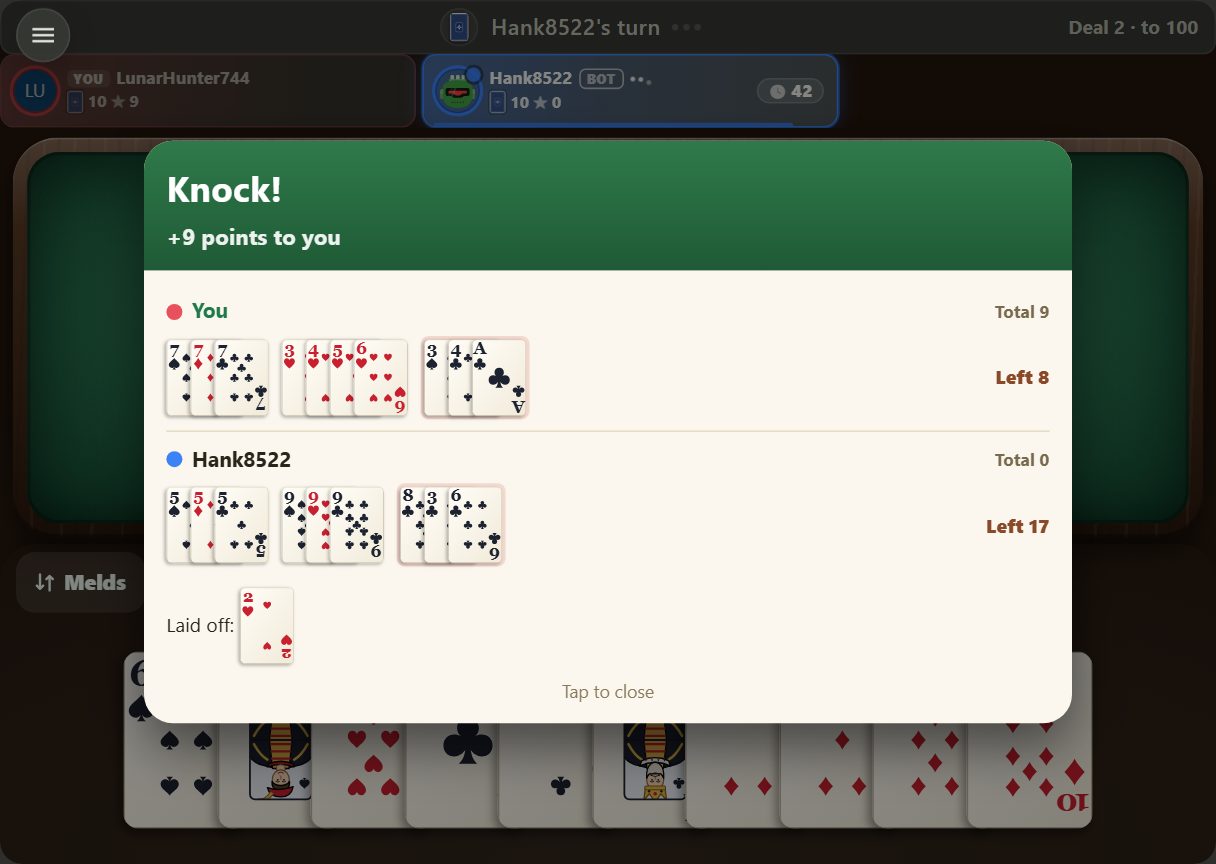
| Knock | After discarding, your deadwood is 10 or less | You score the difference between the two deadwoods. The rival first lays off cards onto your melds. |
| Gin | You knock with deadwood 0 | You score 25 plus the rival's deadwood, and the rival may not lay off. |
| Undercut | The rival's deadwood is equal to or lower than the knocker's | The rival scores the difference plus 25 instead of the knocker. |
| Dead hand | A discard leaves 2 or fewer cards in the stock and nobody has knocked | No score; the cards are redealt with the same dealer. |
Scoring in depth is in gin rummy scoring, and the basics in how to play gin rummy.
Match length
The default is one deal: the deal decides the match. In the room options you can switch to a match played to 100, and the top bar then shows Deal 1 to 100, as in the screenshots. Ties at the target go to the leader.
The three bot levels, and how to beat each
Easy, Medium and Hard map to three styles: casual, steady and sharp. The default is Medium. In Create Room you can add a bot at any of the three levels.
| Level | When it knocks | How to play against it |
|---|---|---|
| Easy (casual) | Only at deadwood 5 or less | It rarely ends a deal early, and half the time it picks at random among its best four discards. Build steadily and knock when you are at 10 or less with a lead; its hand is often far from ready. |
| Medium (steady) | At 6 or less while the stock is above 22, at 8 or less while it is above 14, then at 10 or less | Early knocks from it are low, so do not knock at 10 into an early steady bot: its deadwood may be equal or lower, which is an undercut. Later in the deal its threshold relaxes, so keep your count down. |
| Hard (sharp) | At 10 or less, but with deadwood 1 to 4 and the stock above 18 it plays for gin instead | It tracks what you have picked up and refuses to feed you. When it holds back with 1 to 4 deadwood it is close to gin, so knock first only with a count genuinely below its likely one, since a knock at 8 into a near-gin hand gets undercut. Do not take the face-up card unless it really helps. |
For the take-or-pass decision on the face-up card: casual takes it only if it forms a meld and cuts at least 5 points; steady and sharp need only 1 point. Expect Easy to pass on useful cards.
Does the bot see your hand?
The bot reads its own hand, the face-up card, the melds on the table and the public record of which cards each side picked up. Your hand and the order of the stock are not part of its reading.
Clock and timeouts
The clock is per turn, 45 seconds by default (30, 45, 60 or 90 can be chosen), and drawing, melding and discarding all share it. If it runs out, you get the honest minimum: the game draws from the stock and throws that same card back, and your hand is never rearranged for you. Do not rely on it; a drawn-and-discarded turn gives up a chance to improve.
A match with one human and a bot is never rated, but it still counts toward your total games, daily streak, quests and achievements.
So what do you do with this?
Start on Medium on the Gin Rummy page, play single deals, and watch the Deadwood badge: knock when you are at 10 or less and the bot's thresholds suggest it cannot be lower. Step up to Hard once Medium rarely undercuts you. For plans after the first few games, read gin rummy strategy tips, and compare with table rummy in rummy vs gin rummy. Other two-player card options are listed in card games for 2 players.
Frequently Asked Questions
How do I play gin rummy against the computer?
Press the Play button at the top of this page, or Play Now on the Gin Rummy page. A two-player game starts against one bot at the Medium level, with ten cards each from one 52-card deck with no jokers. By default one deal decides the match.
When can I knock in gin rummy?
After you discard, your deadwood must be 10 or less. Deadwood is the cards outside your melds: ace 1, number cards face value, and 10, J, Q and K at 10 each. The server arranges your melds in the best way automatically.
What is an undercut and can a bot do it?
An undercut happens when the rival has equal or lower deadwood than the player who knocked. The rival then scores the difference plus 25 points. Bots can undercut you, so avoid knocking at a high count against a bot that may be close to gin.
How do the bot levels differ when knocking?
Easy knocks only at deadwood 5 or less. Medium starts at 6, rises to 8, then to 10 as the stock shrinks. Hard can knock at 10 but plays for gin instead when it has 1 to 4 deadwood and plenty of stock left.
Can I play to 100 instead of one deal?
Yes. One deal is the default, but the room options let you play first to 100 points. The top bar shows the deal number and the target.
What happens if I run out of time?
The game does the honest minimum for you: it draws from the stock and throws that same card back. It never rearranges your hand or knocks for you.