Catan Cheat Sheet: Costs, Points, Trades, Dice on One Page
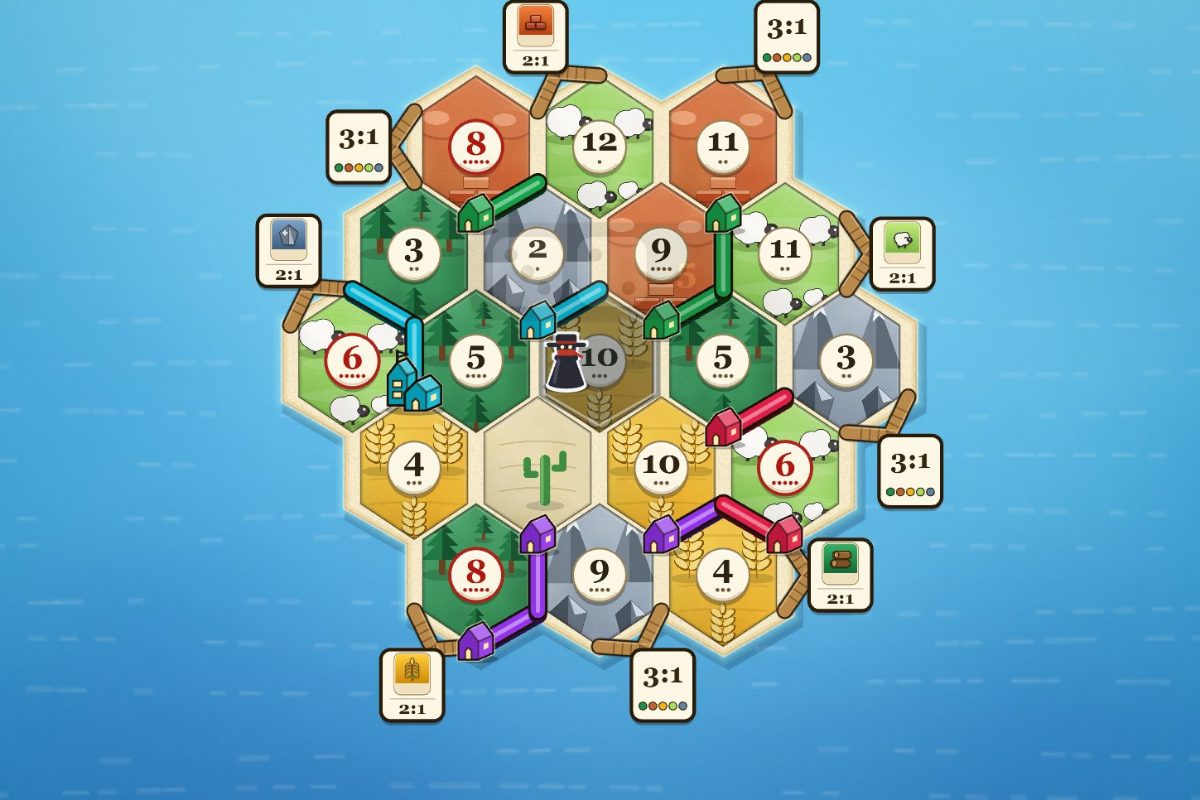 Play Claimridge
A Catan cheat sheet fits on one page: what each piece costs, where victory points come from, the trade ratios, what a 7 does and which dice numbers pay most. The four tables below are that page, filled in with the numbers of Claimridge, an independent browser game of the same genre with its own names and rules. If you play a boxed Catan-style set, check each line against your own rulebook before you trust it.
The tables are also available as a printable cheat sheet (PDF): one page, tables only, made to sit next to the board.
Building costs
You can only build after you have rolled. Goods are timber, brick, grain, wool and ore.
| Piece | Cost | Gives |
|---|---|---|
| Road | 1 timber + 1 brick | Reach new corners |
| Village | 1 timber, brick, grain, wool | 1 VP, 1 good per roll |
| City | 2 grain + 3 ore | 2 VP, 2 goods per roll |
| Fortune card | 1 grain + 1 wool + 1 ore | Random card |
| Ship (water maps) | 1 timber + 1 wool | Road on water |
A village must touch one of your own roads and every neighbouring corner must be empty. A city replaces one of your villages and hands the village piece back. On Frontier Valley with 2 to 4 players each player owns at most 5 villages, 4 cities and 15 roads. For the full distance rule, see the setup guide.
Victory points
| Source | VP | Condition |
|---|---|---|
| Village | 1 | Each one on the board |
| City | 2 | Each one on the board |
| Longest Trail | +2 | 5 or more in a row |
| Largest Posse | +2 | 3 or more Gunslingers played |
| Victory card | +1 each | Hidden until the end |
| New island (water maps) | +2 | First village there |
| Win target | 10 | Frontier Valley default; 6, 8, 12 selectable |
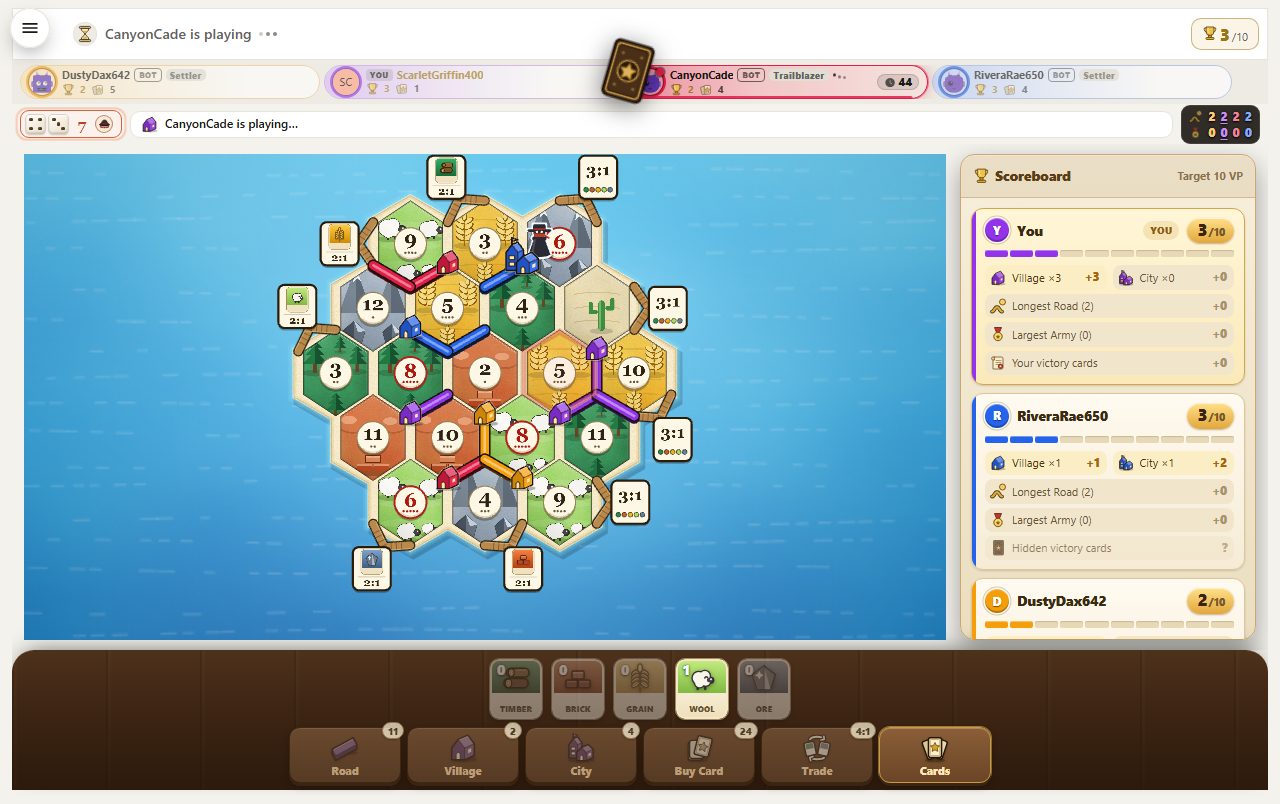
The first player whose full total reaches the target on their own action wins. Victory cards count for that check at once but stay hidden from the public scoreboard, so a rival shown on 9 of 10 may already hold the tenth point. A rival village or city placed on a corner of your route cuts it. A player who has never finished a Claimridge match gets 8 VP as the target on the first quick match. Details on the route award are in the longest road guide.
Trade ratios and the 7
| Trade | Ratio |
|---|---|
| Bank, no post | 4 : 1 any good |
| Generic trading post | 3 : 1 any good |
| Specific trading post | 2 : 1 that good |
| Players | Up to 3 open offers, expire at end of turn |
| When a 7 is rolled | Rule |
|---|---|
| Production | No hex pays |
| Discard | More than 7 cards: lose half, rounded down |
| Bandit | Roller moves it to another land hex |
| Steal | 1 random card from a player on that hex |
| Blocked hex | Pays nothing while the Bandit sits there |
The best ratio you own applies. A trading post helps if you have a village or city on either of its two corners. The 7 hand limit is the default; a Claimridge host can set it to 9, 12 or off. More in the trading posts guide and the 7 rules guide.
Dice numbers
| Number | 2 | 3 | 4 | 5 | 6 | 8 | 9 | 10 | 11 | 12 |
|---|---|---|---|---|---|---|---|---|---|---|
| Pips (of 36) | 1 | 2 | 3 | 4 | 5 | 5 | 4 | 3 | 2 | 1 |
There is no 7 token, because a 7 never pays. The pips under each token count how many of the 36 two-dice combinations make that number, so 6 and 8 are the strongest. Cities double the payout of whatever number they sit on. Claimridge offers a Balanced Deck dice option that deals all 36 combinations before reshuffling, so every cycle holds exactly six 7s. See the dice odds guide for the maths.
How to use the sheet in a game
Before you roll
Count your hand against the 7 limit. If you hold 8 or more cards, spend or trade down before ending the turn, because the next 7 costs you half.
When you are stuck
Check the trade table first. Two cards of a good you hold plenty of and a specific post turns into one card of anything. If a city is two goods away, the 4:1 line tells you whether the bank is cheaper than waiting for a partner.
Near the end
Add village, city and award points, then add one for every Victory card you may hold. If a rival sits one short of the target, the Bandit and a Gunslinger are how you slow them down. You can try all of this on Claimridge, free in the browser with bot opponents, and keep the PDF open beside it.
CATAN® is a registered trademark of CATAN GmbH. Playgridia and Claimridge are not affiliated with, sponsored or endorsed by CATAN GmbH, its licensees or publishers. The name is used only to identify the game readers are searching for and to describe the genre; Claimridge is an independent game with its own rules, names and artwork.
Frequently Asked Questions
What does a Catan cheat sheet need to show?
Four things: building costs, where victory points come from, trade ratios with the bank and trading posts, and what happens on a 7. A dice-pips line is a useful fifth. The tables above cover all five using Claimridge numbers.
How much does a village cost in Claimridge?
One timber, one brick, one grain and one wool. It must touch one of your own roads, and every neighbouring corner has to be empty. A village is worth 1 victory point and a city, which costs 2 grain and 3 ore, is worth 2.
What are the trade ratios?
The bank trades 4 to 1 for any good. A generic trading post makes it 3 to 1, and a specific post makes it 2 to 1 for that one good. The best ratio you have access to applies automatically.
What happens when a 7 is rolled?
No hex produces anything. Everyone holding more than 7 cards discards half, rounded down, with the default hand limit. The roller then moves the Bandit to another land hex and steals one random card from a player with a village or city there.
Which dice numbers are best?
6 and 8 have 5 pips each, out of 36 combinations. 5 and 9 have 4, 4 and 10 have 3, 3 and 11 have 2, and 2 and 12 have 1. There is no 7 token, since a 7 never produces goods.
Can I print the cheat sheet?
Yes. Use the printable cheat sheet (PDF) link in this post. It contains the tables only, on one page, so it can sit next to the board while you play.