Catan Ports Explained: 2:1, 3:1 and 4:1 Bank Trades
 Play Claimridge
Catan ports explained: a port lets you swap cards with the bank at a better rate than the default 4:1 — 3:1 for any good at a generic port, 2:1 for one named good at a specific port — but only if you own a building on one of its two corners. This guide covers the three ratios, how many ports a board has, where they sit and when one is worth a settlement. Claimridge is an independent game of the same genre with its own names and artwork, so the on-screen examples come from it.
The three bank ratios
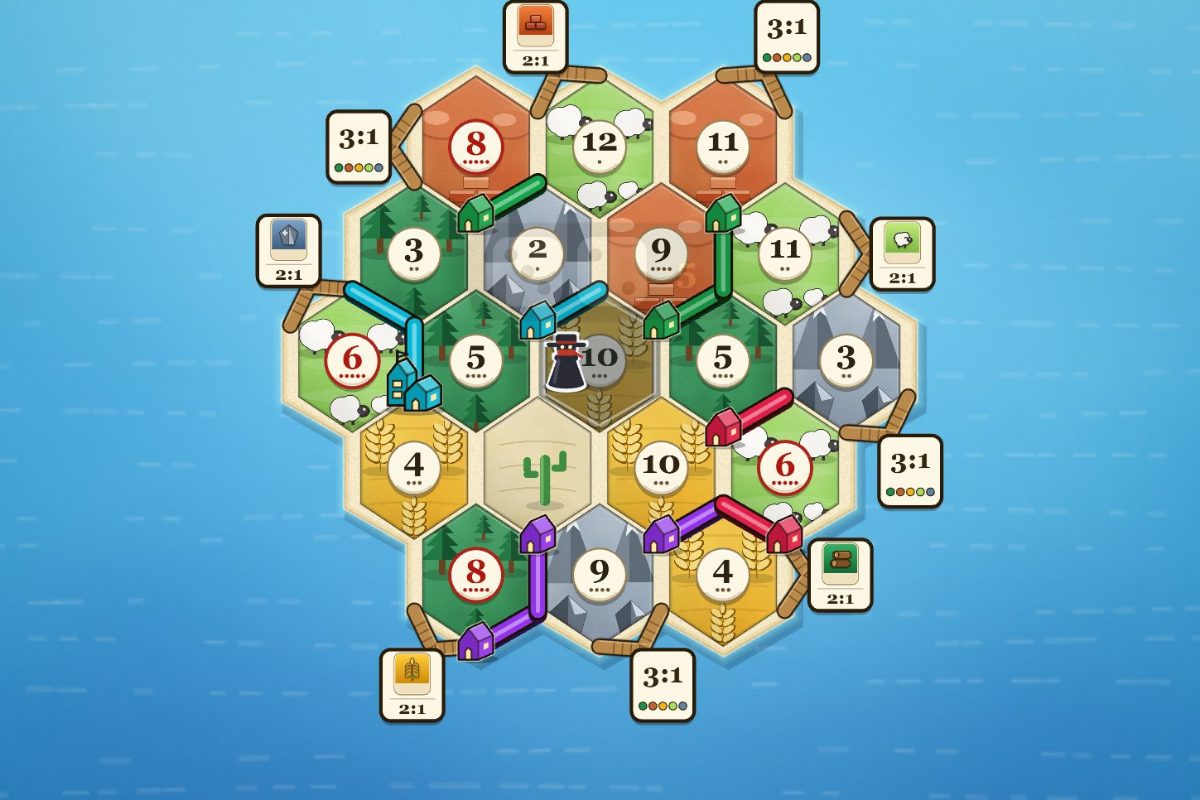
Every player can trade with the bank on their own turn, after rolling. With no port you give 4 cards of one good for 1 card of another. Ports lower the 4. In Claimridge a port is called a trading post (the in-game help text also says “harbour”); on the board it is a small tile on the coast, printed either “3:1” or “2:1” with the good it applies to.
| Ratio | Which post | What it means |
|---|---|---|
| 4:1 | None needed | Give 4 of one good, take 1 of any other good the bank still holds. |
| 3:1 | Generic post, the any-good tile with five coloured dots | Give 3 of any one good, take 1. Works for all five goods. |
| 2:1 | Specific post, one per good (timber, brick, grain, wool, ore) | Give 2 of the good shown on the tile, take 1 of anything. Other goods you give still trade at 4:1 or 3:1. |
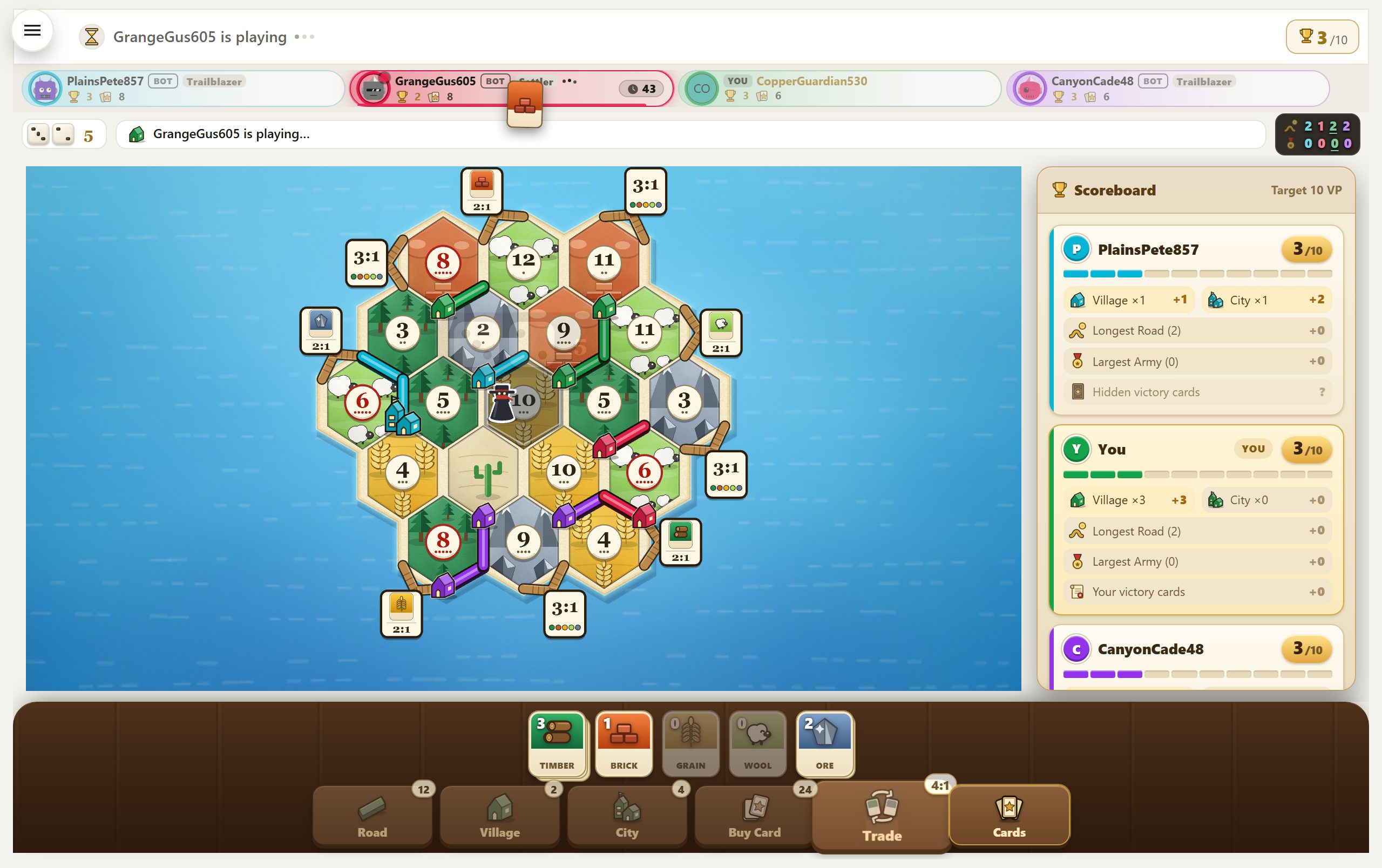
Ratios do not stack. The engine checks every post you touch and applies the single best ratio for the good you are giving, so a generic post plus a wool post means wool goes at 2:1 and everything else at 3:1. The Trade button on the dock carries a 4:1 badge in both screenshots below.
How many ports a board has
A full set is nine ports: four generic 3:1 and five specific 2:1, one for each good. Every board for 2 to 4 seats has exactly nine. At 5 or 6 seats the bigger boards have 10 or 11 ports depending on the map, and the extra ones are dealt from further shuffles of that nine-post bag, so the exact 4 + 5 mix is guaranteed only on nine-post boards. Do not assume a large board has every good covered the same way.
Where they sit and who can use one
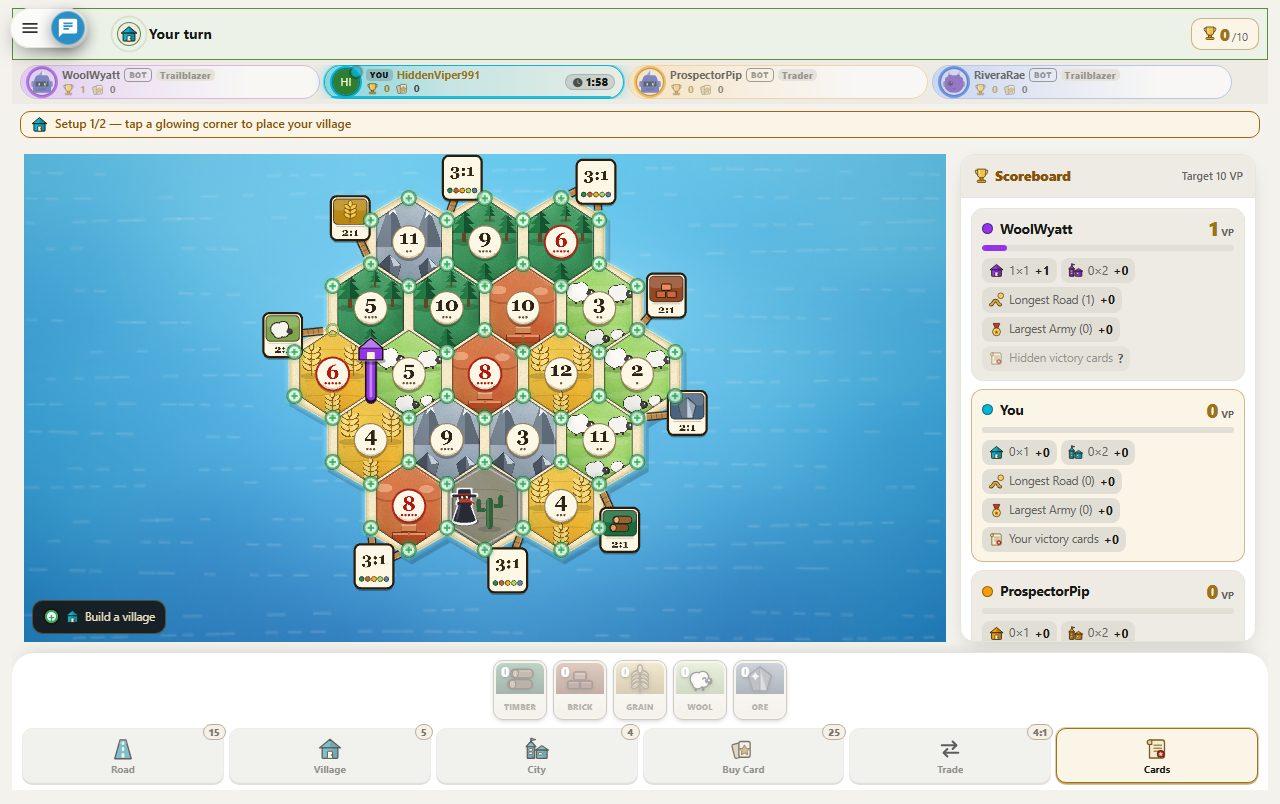
Each post sits on a coastal edge, and a coastal edge is worth two corners. You use a post if you own a village or a city on either of those two corners; one corner is enough, and a city does not trade any better than a village. Nothing needs to be activated: the best ratio is applied automatically when you trade.
Because the two corners of an edge are neighbours, the distance rule (every neighbouring corner must be empty) means only one of them can ever hold a building. In practice a post belongs to whoever builds there first. That is the real contest for a good coastal corner, and it is why opening placement matters; see our opening placement guide and the setup guide for the distance rule itself.
Bank trades in bulk
A bank trade can swap several lots in a single move, up to 19 lots. Claimridge validates the whole amount up front, so “4 wool for 2 ore at 2:1” is one action rather than two that could half-fail. The cost is the ratio multiplied by the lots, and the bank must hold enough of the good you want: it starts with 19 of each good (26 at 5–6 seats), and a trade is refused with “The bank is out of that” if it cannot pay. There is no per-turn limit on bank trades, only the cards in your hand.
When is a post worth a settlement?
Claimridge publishes no win rates for ports, so here is only the arithmetic.
- A 2:1 post pays for the good you produce. Sitting on a wool post with a strong wool hex means every second wool card can be turned into anything. A 2:1 post for a good you never produce saves nothing, because you rarely hold two of it.
- A 3:1 post helps most when your hand is lopsided. It saves one card on every lot, whichever good you are stuck with.
- A port is slow value, not income. It never pays out on a roll. A village on a port with weak numbers is a trade tool only, so weigh the numbers on the hexes beside it first.
- Compare it with asking players. A rival may accept your offer, and you can keep up to 3 offers open, but they can also decline. A post is a price nobody can refuse. See trading strategy for the player side.
What to do with this
Count your hand before you chase a port. If one good piles up because your numbers feed it, a 2:1 post for that good is worth a corner; if your hand is spread across five goods, a 3:1 post may do the same job. Check the dock badge to confirm which ratio you actually have, and remember the corner may be taken by someone else sooner than you think. For the wider rules questions try Catan rules questions, then play Claimridge and read the tiles on the coast before your first placement.
CATAN® is a registered trademark of CATAN GmbH. Playgridia and Claimridge are not affiliated with, sponsored or endorsed by CATAN GmbH, its licensees or publishers. The name is used only to identify the game readers are searching for and to describe the genre; Claimridge is an independent game with its own rules, names and artwork.
Frequently Asked Questions
How do ports work in Catan-style games?
Without a port you trade with the bank at 4:1. A generic port makes it 3:1 for any good, and a specific port makes it 2:1 for the one good printed on it. You need a village or city on one of the two corners of the port, and the best ratio you own is applied automatically.
How many ports are on the board?
In Claimridge a 2–4 seat board has nine: four generic 3:1 and five specific 2:1, one per good. At 5–6 seats boards have 10 or 11, and the 4 + 5 mix is only guaranteed on nine-port boards.
Do a 3:1 and a 2:1 port stack?
No. The best single ratio for the good you are giving is used. With a generic port and a wool port, wool trades at 2:1 and every other good at 3:1.
Does a city trade better than a village at a port?
No. In Claimridge a port helps a player who owns a village or a city on either of its two corners, with the same ratio either way.
Can I trade several sets of cards with the bank at once?
Yes. A single bank trade can exchange up to 19 lots, for example 4 wool for 2 ore at 2:1 in one move. The bank must still hold enough of the good you want.