Catan Tips for Beginners: 10 Mistakes and How to Fix Them
 Play Claimridge
Catan tips for beginners come down to ten habits that cost first-time players the game: hoarding cards past the discard limit, ignoring the number pips, skipping the bank and the ports, and building roads with no destination. This guide names each mistake and gives the fix, shown in Claimridge, an independent game of the same genre with its own names, rules and artwork.
Mistakes before your first roll
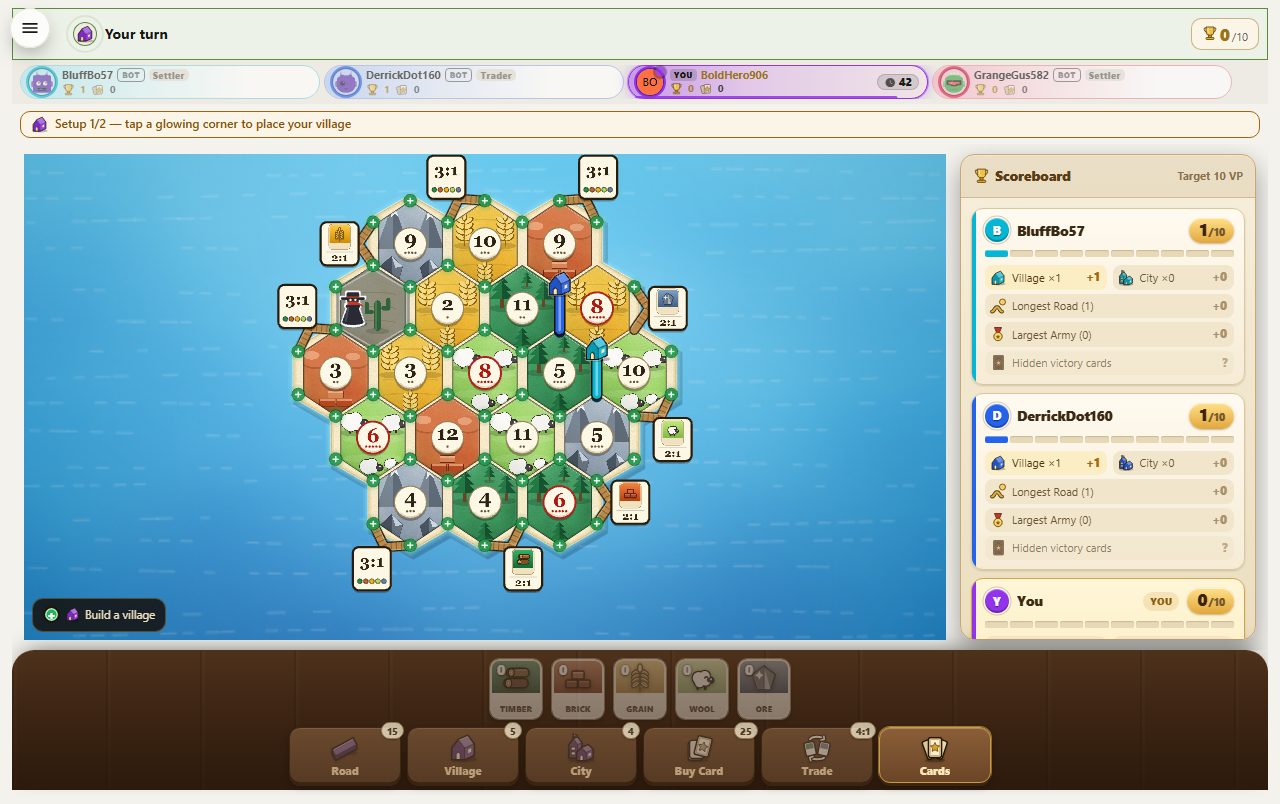
1. Placing your villages on looks, not numbers. Setup is a snake draft: each placement is one village and one road, and the order runs forwards, then backwards. Your second village pays out immediately, one good for every producing hex it touches, and that is your whole opening hand. Fix: make the second village cover the goods the first one lacks. Every corner next to a placed village must be empty (the distance rule), so good spots vanish fast. The full opening theory lives in opening placement strategy.
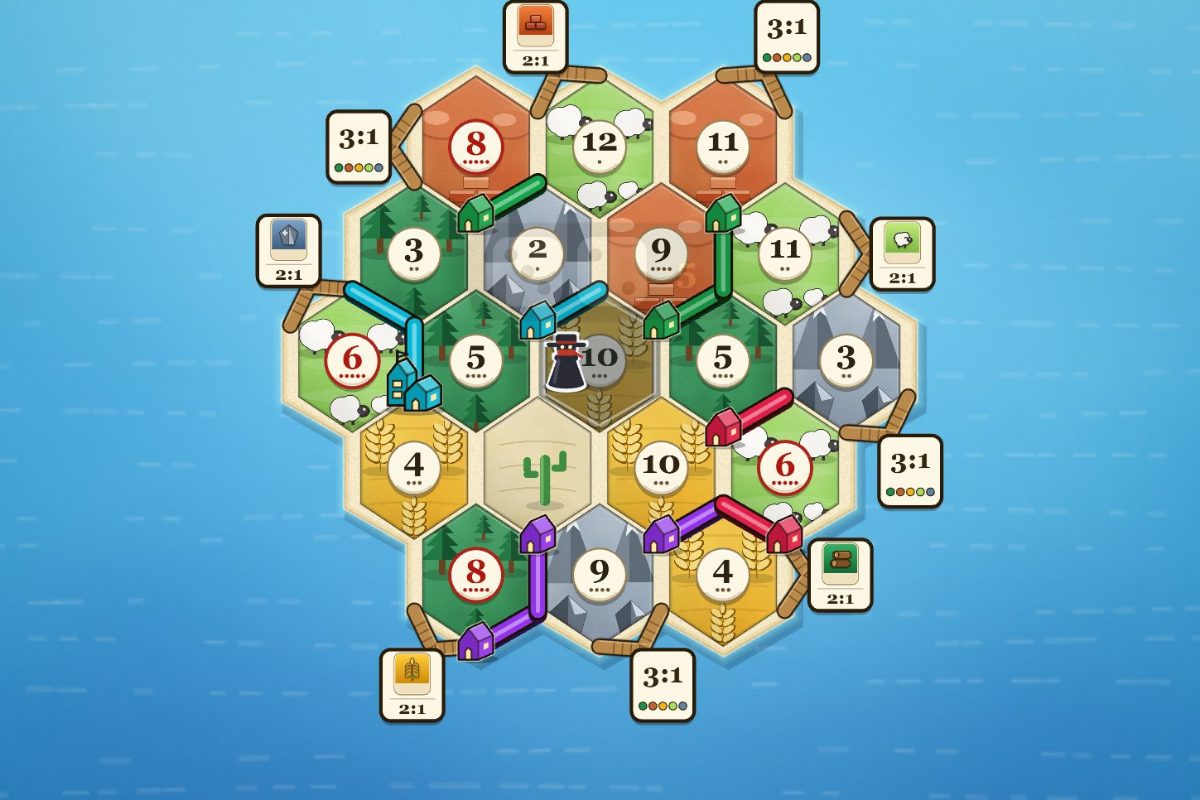
2. Ignoring pips. The dots under each number token show how many of the 36 dice combinations hit it: 6 and 8 have five, 5 and 9 have four, 4 and 10 have three, 3 and 11 have two, and 2 and 12 have one. There is no 7 token, because a 7 produces nothing. A village on a 6 or 8 is worth roughly five times a village on a 2 or 12. Fix: add up the pips on each corner before you tap it. More on the odds in dice odds.
Mistakes with your hand
3. Holding more than 7 cards. When a 7 is rolled, everyone with more than the hand limit (7 by default, so 8 or more) discards half, rounded down. An 11-card hand loses 5. Fix: spend before you end your turn. If you cannot build, trade the surplus. The rest of the 7 sequence is in the 7 explained.
4. Never using the bank or the trading posts. The bank always trades 4:1. Own a village or town on a generic post and it drops to 3:1; a post for one good makes that good 2:1, and the best ratio you have applies. Fix: if your numbers give you plenty of one good, aim a village at the matching post. See trading posts explained.
5. Never trading with players. On your turn you can keep up to three offers open, every rival is asked, and each rival can accept, decline, or counter with a price; you choose who to settle with. Fix: ask for the one card that finishes a build, not a vague swap.
Mistakes with building
6. Roads with no destination. A road costs one timber and one brick and scores nothing by itself. Fix: build a road only toward a legal village corner, to block a rival, or in a deliberate run for the Longest Trail, which needs an unbroken run of 5 and is worth +2 VP. A rival village on a corner breaks your run through it.
7. Forgetting that towns double your production. A town costs 2 grain and 3 ore, is worth 2 VP, and takes 2 cards from every payout instead of 1. On the standard 2 to 4 seat Frontier Valley map you have only 5 villages and 4 towns, so upgrading a village on a 6 or 8 often beats founding a new one on a weak number. Fix: once you hold grain and ore, upgrade your best-numbered village first.
Mistakes with the Bandit and the cards
8. Spending the Bandit badly. After a 7 the roller moves the Bandit to any land hex other than the one it is on; that hex produces nothing, and you steal one random card from a player with a village or town there. Stealing is automatic when a victim exists. Beginners park it on a hex that blocks themselves, or on a number nobody needs. Fix: pick a high-pip hex that feeds the leader and does not touch you. A Gunslinger card does the same move on demand.
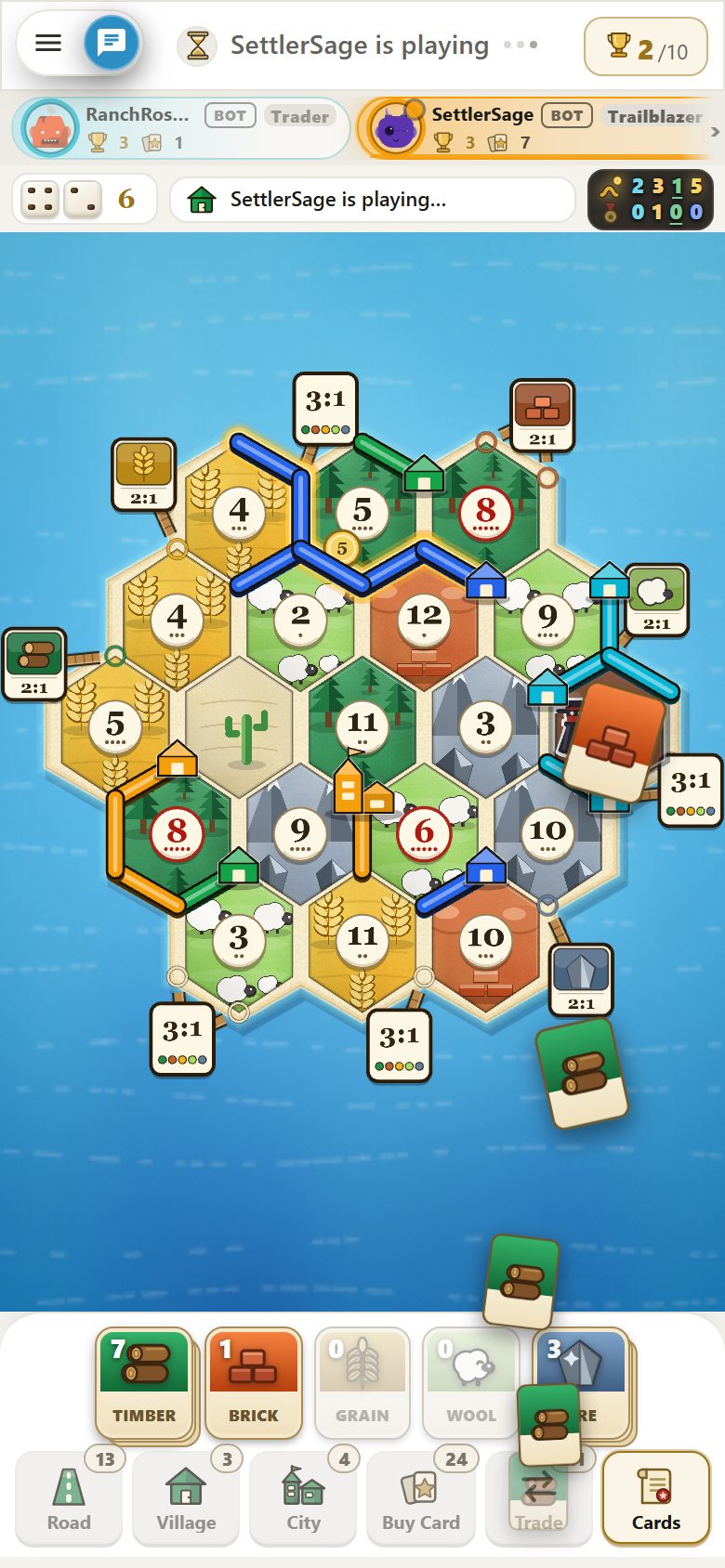
9. Misusing Fortune cards. A card costs 1 grain, 1 wool and 1 ore. A card bought this turn is locked until your next turn, and you may play only one card per turn. In the 2 to 4 seat deck of 25, 14 are Gunslingers, 5 are hidden Victory Cards worth +1 each, and 2 each are Road Master, Supply Wagon and Boom. Three played Gunslingers earn the Largest Posse, +2 VP. Fix: plan a card for next turn, not as a lottery ticket.
10. Trusting the scoreboard. The public score leaves out hidden Victory Cards, and the win is checked after the acting player moves. A rival shown at 7 of 8 can already hold 8. Fix: when anyone is within one point, assume a hidden card. Strategy beyond that is in how to win against bots.
The ten mistakes at a glance
| Mistake | Why it costs you | Fix |
|---|---|---|
| Placing on looks | The second village is your entire opening hand | Cover the goods your first village misses |
| Ignoring pips | 6 and 8 pay 5 times as often as 2 and 12 | Add the pips before you tap |
| Hoarding over 7 | A 7 makes you discard half, rounded down | Spend or trade before ending your turn |
| Skipping bank and posts | 4:1 wastes cards; posts give 3:1 or 2:1 | Aim a village at a matching post |
| Never trading | Rivals can accept or counter; you pick the partner | Ask for the one card that finishes a build |
| Aimless roads | 0 VP and a limited stock of pieces | Build toward a corner, a block or a run of 5 |
| Staying on villages | A town takes 2 per payout and scores 2 VP | Upgrade your best-numbered village |
| Poor Bandit move | Blocks yourself or hits nobody | Target the leader’s high-pip hex |
| Card lottery | A new card is locked a turn; one play per turn | Plan the next turn’s hand |
| Trusting the score | Hidden Victory Cards add +1 each | Assume one when a rival is a point away |
How to learn it here
Claimridge has a Learn now teaching match: two seats, a 6 VP target and coaching switched on,. Your first quick match is you plus two medium bots on three seats, and if you have never finished a Claimridge match the target is 8 VP; later quick matches use the map default, 10 on Frontier Valley.
Bot difficulty matters for practice. An easy bot never opens a trade offer, so you can focus on pips, builds and the 7. A medium bot opens at most one offer a turn and not more than once every four of its own rounds, so it teaches trading. In bot-only sims with mixed difficulties, easy seats won 3.1% of games and medium seats 23.8%; that is bot data, not human play. Start easy, then medium, with the cheat sheet open. You can start on the Claimridge page.
Fix one mistake per match: pips in the first, the 7-card limit in the second, a post in the third.
CATAN® is a registered trademark of CATAN GmbH. Playgridia and Claimridge are not affiliated with, sponsored or endorsed by CATAN GmbH, its licensees or publishers. The name is used only to identify the game readers are searching for and to describe the genre; Claimridge is an independent game with its own rules, names and artwork.
Frequently Asked Questions
What are the best Catan tips for beginners?
Count the pips on every corner, since 6 and 8 hit on 5 of 36 dice combinations. Keep your hand at 7 cards or fewer so a 7 does not cost you half of it, and use the bank and trading posts when a trade will not come. Upgrade a village on a strong number to a town early.
How many cards can I hold before I have to discard?
In Claimridge the default limit is 7. If a 7 is rolled and you hold 8 or more, you discard half, rounded down, so 11 cards means discarding 5. A host can set the limit to 9 or 12 or turn it off in the advanced room options.
Is it worth building roads early?
Only with a goal. A road costs one timber and one brick and scores no points. Build it toward a village corner you can legally take, to block a rival, or as part of a run of 5 for the Longest Trail, worth +2 VP.
How do I practise Catan-style strategy without a group?
Claimridge has a Learn now match with two seats, a 6 VP target and coaching on. Your first quick match is you and two medium bots, and a player who has never finished a match plays to 8 VP. Easy bots never open trades, so they make a calmer first opponent.
Why did I lose when the scoreboard said I was ahead?
The public scoreboard does not count hidden Victory Cards, and a win is checked after the acting player moves. A rival showing 7 of 8 may already hold 8. When someone is a point away, assume they have a card.