Blunder vs Mistake vs Inaccuracy in Chess: The Numbers
 Play Chess
In chess, a blunder, mistake or inaccuracy is a move that cost you a measurable share of your winning chance: under 10 points is an inaccuracy, 10 to 20 a mistake, and 20 or more a blunder. These are the thresholds the Playgridia game review uses, on a scale where 0 means no loss and 100 would be your whole winning chance.
The scale: winning-chance points lost
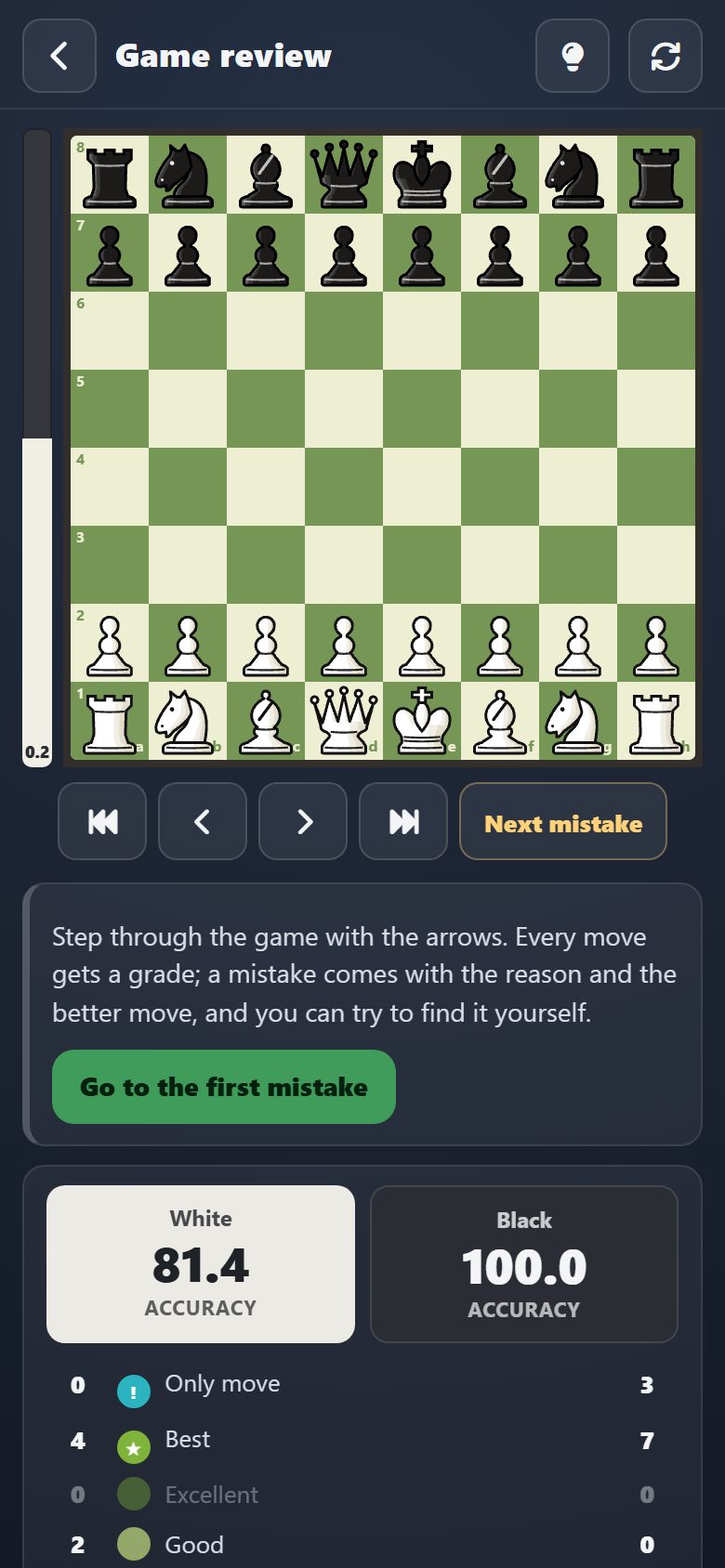
The review does not grade moves by how many pawns they lose. It converts the engine's evaluation into a winning chance between 0 and 100, then measures how far your move dropped that number compared with the engine's best move. The grades, from best to worst:
| Grade | Points lost | Mark | What it means |
|---|---|---|---|
| Only move | played the best move | ! | Your move was the engine's best, the runner-up was at least 20 points worse, and it was not a simple recapture. |
| Best | under 0.5, or the engine's own choice | ★ | Nothing meaningful was left on the table. |
| Excellent | under 2 | A tiny gap to the best move. | |
| Good | under 5 | A sound move that was not quite the best. | |
| Inaccuracy | under 10 | ?! | A real but small slip; the position is still playable. |
| Mistake | under 20 | ? | A move that clearly shifts the game, often a lost piece or a missed chance. |
| Blunder | 20 or more | ?? | A swing so large it usually decides the game, such as allowing a mate or hanging a piece. |
Two more labels are not about loss at all. Book marks a move from the bots' opening book within the first 16 plies, and Forced marks a position with exactly one legal move. The marks !, ?!, ? and ?? are the familiar annotation symbols; the review shows them next to the move, and the chess notation guide explains how moves themselves are written.
Why the same loss is graded differently
Evaluations are converted to winning chance with a logistic curve, an S-shaped curve that is steep near an equal position and flat when one side is far ahead. From the engine's numbers: +100 centipawns is about a 59% chance, +300 about 75%, and +600 about 90%. Going from +300 to +600 adds only about 15 points even though it is a huge material jump.
The practical result is the one every player has felt. In a balanced position, a small slip hands over a lot of winning chance, so it can be a mistake. In a game you are already winning, dropping from +12 to +8 pawns barely moves the number, so it is not called a blunder. Any move that allows a forced mate counts as the extreme: a mate score is treated as 100 or 0.
How accuracy is calculated
Each move gets an accuracy from 0 to 100 using this formula on the points lost: 103.1668 × e^(−0.04354 × loss) − 3.1669, limited to the range 0 to 100. That works out to about 100 for no loss, 80 for a 5-point loss, 64 for 10 points and 40 for 20 points. Forced moves score 100, and book and forced moves are left out of the average.
Your game accuracy is then the mean of two averages: the ordinary arithmetic mean and the harmonic mean, with every move floored at 5. The harmonic mean is dominated by the worst moves, so a single blunder pulls the final number down much more than it would in a plain average. That is why a game of nineteen good moves and one disaster can still land well below 100.
The review gives no universal verdict on what counts as a good accuracy, and a single game is a small sample. A more useful comparison is your own number over several games, ideally at similar lengths, since a short game with few moves swings easily.
What to do with the grades
- Fix blunders first. They are the moves that lose games. Use Next mistake to jump to them.
- Read the reason. The coach card says whether you allowed a mate, missed one, lost a piece, missed a piece or made a positional slip. The cause is more useful than the grade.
- Use Try again. A move within 2.5 points of the best counts, and the answer shows after the second miss.
- Look for patterns. If your blunders are all loose pieces or missed forks, work through chess tactics before anything else.
The tool itself, with its limits and where it opens from, is covered in the free chess game review guide, and you can open the analysis board directly. A grade is a signal, not a sentence: close calls can flip with a stronger engine, so spend your attention on the red marks that are obviously red.
Frequently Asked Questions
What is the difference between a blunder, a mistake and an inaccuracy?
It is a matter of winning-chance points lost compared with the best move. Under 10 points is an inaccuracy, 10 to under 20 is a mistake, and 20 or more is a blunder. They are shown as ?!, ? and ??.
What is a good accuracy in chess?
There is no fixed number the review treats as good. Accuracy is a 0 to 100 score for one game, so the most useful comparison is your own results across several games.
Why did one blunder lower my accuracy so much?
Game accuracy is the mean of an arithmetic average and a harmonic average of your per-move scores. The harmonic average is pulled down hard by the worst moves, so a single blunder costs more than it would in a plain average.
Why is a small slip a mistake in one game but not in another?
Grades are measured in winning chance, not pawns. The conversion curve is steep in balanced positions and flat when one side is far ahead, so the same evaluation drop matters more when the game is close.
What does the ! symbol mean in the review?
It marks an Only move: your move was the engine best, the second-best option was at least 20 points worse, and the move was not a simple recapture.