Fool's Mate: How to Win at Chess in 2 Moves (and Avoid It)
The Fool's Mate is the fastest checkmate in chess, and only Black can deliver it: 1.f3 e5 2.g4 Qh4#. White spends two moves on pawns that weaken the king, and Black's queen mates on the second move. No mate in one exists, because none of White's 20 possible first moves leaves Black's king in any danger. Below: why the king cannot escape, every version of the trap, the slower White-side version, and how to make sure it never happens to you.
The position after 2.g4 Qh4#
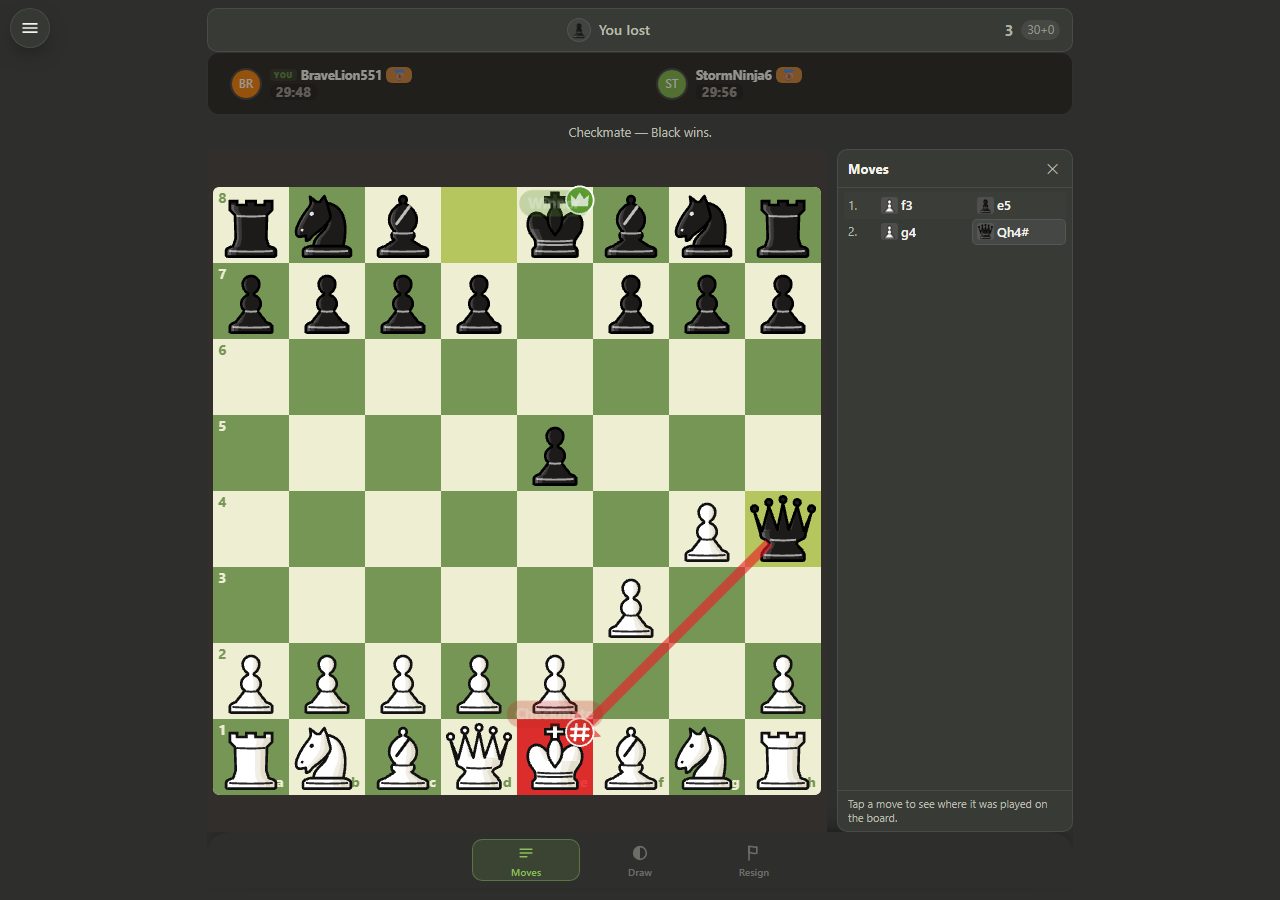
Look at the diagonal from h4 down to e1. It runs through g3 and f2. At the start of the game two pawns guard that diagonal: the f-pawn on f2 and the g-pawn on g2. The first can step to f3 or f4. The second can go to g3 and block. Once both are pushed up the board, the diagonal is wide open and the king stands at the end of it.
Black's own part is small. The pawn move ...e5 opens the diagonal for the queen on d8: d8, e7, f6, g5, h4. Then the queen slides to h4 and gives check.
Why White cannot escape
A checkmate means three things all fail at once. Check them on the board after 1.f3 e5 2.g4 Qh4#.
- Move the king: f2 is the only empty square next to it, and the queen attacks it along the same diagonal. The queen, bishop, d2 pawn and e2 pawn fill the rest.
- Block the diagonal: only g3 or f2 would do. Nothing can reach them. The h2 pawn only captures diagonally, the knight on g1 cannot get there, and the g-pawn is already on g4, past the square it needed.
- Capture the queen: no white piece attacks h4. The pawn on g4 attacks f5 and h5, not h4.
That is why the g-pawn move matters as much as the f-pawn move. With the pawn still on g2, ...Qh4+ would be answered by g3.
Step by step
Move 1: White weakens, Black opens a door
White plays 1.f3. It is a bad move because it takes the f-pawn off f2 and does nothing for development. Black answers 1...e5, a normal central move that also opens the queen's diagonal.
Move 2: the second mistake and the mate
White plays 2.g4, attacking nothing and removing the last blocker. Black plays 2...Qh4#. Game over after four half-moves. On the site, the board marks the king in red and the game ends with "Checkmate".
All the versions that work
The move order and the exact pawn squares can vary. All eight lines below were checked against the site's own rules engine, and each ends in checkmate on move 2.
| White move 1 | Black reply | White move 2 | Black mates |
|---|---|---|---|
| 1.f3 | e5 | 2.g4 | Qh4# |
| 1.f3 | e6 | 2.g4 | Qh4# |
| 1.f4 | e5 | 2.g4 | Qh4# |
| 1.f4 | e6 | 2.g4 | Qh4# |
| 1.g4 | e5 | 2.f3 | Qh4# |
| 1.g4 | e6 | 2.f3 | Qh4# |
| 1.g4 | e5 | 2.f4 | Qh4# |
| 1.g4 | e6 | 2.f4 | Qh4# |
The pattern is the same every time: the f-pawn leaves f2, the g-pawn goes to g4, and Black opens the queen's diagonal with an e-pawn move. Whatever the order, the queen needs one move to finish.
Can you do it as White?
Not in two moves. White's mirror trap takes one move more, and it needs Black to cooperate by playing ...f6 and ...g5. The queen mates on h5 through the diagonal h5, g6, f7, e8. The engine confirms these lines:
| Line | Final move |
|---|---|
| 1.e4 f6 2.d4 g5 | 3.Qh5# |
| 1.d4 f6 2.e4 g5 | 3.Qh5# |
| 1.e3 f6 2.Nc3 g5 | 3.Qh5# |
| 1.e4 g5 2.d4 f6 | 3.Qh5# |
Here the f-pawn has left f7 and the g-pawn has gone to g5, so nothing can block on g6 or f7. Against anyone who has seen a few games this rarely works. Against a total beginner it sometimes does, but never count on it.
How to avoid it
The defense is short, and it is the advice you hear for any opening.
- Do not push the f-pawn and the g-pawn together early. One of them is fine in some openings, but both is how the king's diagonal opens.
- Start with a center pawn and develop. Moving e4 or d4, then knights and bishops, keeps the king covered. Our beginner openings guide has setups that never let the pattern appear.
- Before each pawn move, check the diagonals to your king. Ask whether a queen could land on a square that attacks it.
- Never play both pawn moves while Black's queen has an open diagonal to h4. That one question is the entire defense.
After 1.f3 e5 you still have safe moves, such as 2.e4 or 2.Nc3. Even 2.g3 holds, because the pawn then stands on g3 and blocks the diagonal itself.
Keep the pattern in mind
The best way to remember the pattern is to see where the diagonal opens in your own games. For the four-move mate, read how Scholar's Mate works. For longer traps, read chess opening traps.
What to do with this
Learn the shape, not the moves: an open diagonal to a king with no pawn blocker. Use it as a check on your own first moves, and put a center pawn and a developed knight on the board before you touch f or g. Then play a game of chess on Playgridia, free as a guest with no signup, and watch your diagonals.
Frequently Asked Questions
What is the Fool's Mate in chess?
It is the fastest possible checkmate: 1.f3 e5 2.g4 Qh4#. White moves the f-pawn and the g-pawn, which opens the diagonal to the white king, and the black queen gives mate from h4 on move 2.
Can you win in 1 move in chess?
No. White has 20 possible first moves and none of them puts Black's king in check, so a mate in one does not exist. The shortest game ends after Black's second move.
How do you win in 2 moves as White?
You cannot, because only Black can deliver the Fool's Mate. As White the fastest version takes three moves and needs Black to play ...f6 and ...g5, for example 1.e4 f6 2.d4 g5 3.Qh5#.
Why can't White block or capture after Qh4?
The queen checks along the diagonal h4, g3, f2, e1. Nothing white can reach g3 or f2, the g-pawn has already moved to g4, and no piece attacks h4, so the only remaining option, moving the king, fails too.
How do I avoid the Fool's Mate?
Do not push both the f-pawn and the g-pawn in the first moves. Play a center pawn, develop your knights and bishops, and before every pawn move check whether the diagonal to your king is opening.