How to Play Ludo: Rules, Safe Squares and Captures
How to play Ludo: each player has four pieces and one die; you need a 6 to bring a piece out of its yard, race it clockwise round the shared track and up your own five-square home lane, and the first player to bring all four pieces home wins. This page covers the rules of the Ludo board on Playgridia, from the 15×15 cross to the exact-roll finish. House rules vary from table to table, so where a common habit differs from ours, we say so.
What you need and who goes first
A match seats two to four players. Each one has four pieces waiting in a coloured yard in a corner of a 15×15 cross-shaped board, and every roll uses a single die. The shared track is a loop of 52 squares, and each colour also has a private home lane of 5 squares leading into the centre. With two players you sit in opposite corners. Seats and colours are drawn when the match starts, so nobody picks theirs.
The player who starts is decided by the match's first locked roll, not by "highest die wins" and not by who made the table. The dice are locked in before anyone throws and can be checked afterwards (the fair-dice guide shows how), and that opening roll picks the starting seat.
Getting a piece out: the 6
A piece only leaves the yard on a 6. It lands on your colour's start square, which is a safe square, so it cannot be captured there. Rival pieces may already be standing on that square, and entering never captures anything.
Bringing a piece out is not forced. With a 6 you may enter a new piece or move one that is already out, whichever suits you. Some tables play this differently; on our Ludo board the choice is yours.
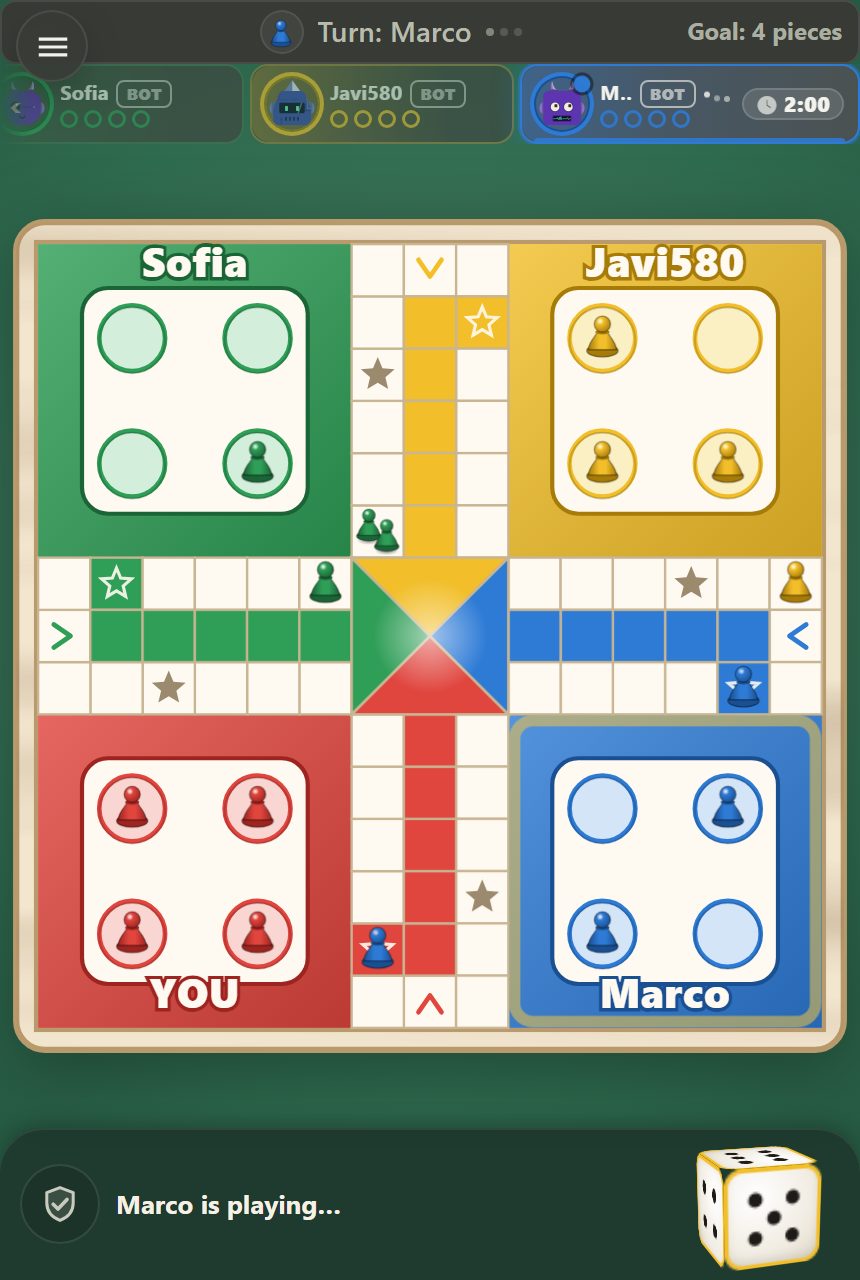
A 6 also gives you another roll, whichever piece you used it on. Three sixes in a row lose the turn: the third six is void, no piece moves, and play passes to the next player.
Choosing and moving a piece
Pieces travel clockwise. You roll, then move one piece exactly as many squares as the die shows. You cannot pass when a legal move exists, and if there is no legal move the turn simply passes (a 6 still rolls again).
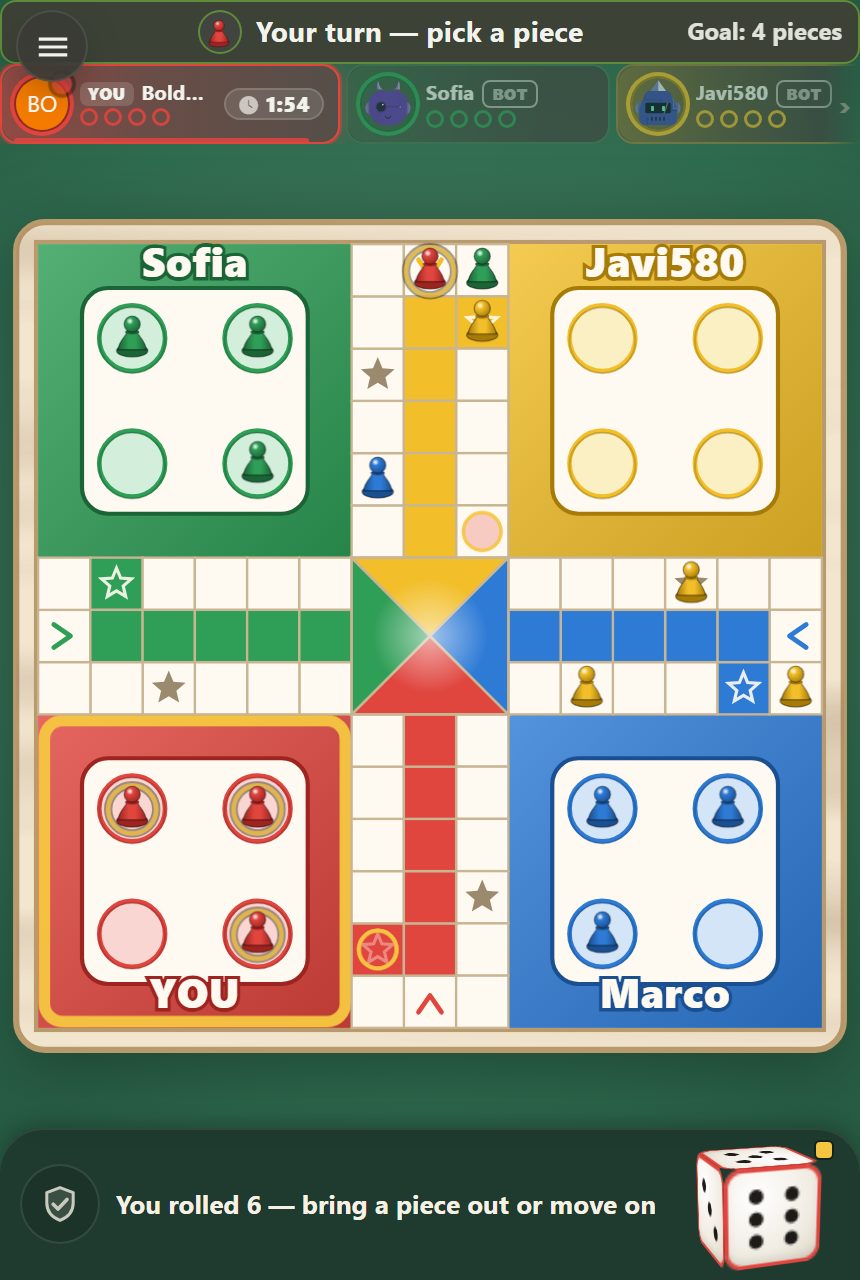
You only decide when there is a real choice. If every legal move is the same move, for instance several pieces still in the yard or several stacked on one square, the game plays it for you. When you do have a choice, your movable pieces glow with a gold ring and a faint ring marks the square each one would land on, so you see the result before you tap.
Safe squares and captures
Land exactly on a rival piece and it goes back to its yard, and you roll again. Only one piece is captured per landing.
Eight squares are safe: the four start squares and four stars, one star per colour, eight squares past that colour's start square. Nothing is captured on a safe square, and pieces of different colours can stand there together. The squares of a home lane are private as well, so no capture happens there either.
Pairs and the optional Walls rule
Two of your pieces on the same square form a pair, and a stack of three counts as one too. On an ordinary square a rival cannot capture a pair or land on its square, but may pass over it. On a safe square rivals can still land on the same square as a pair, and nobody is captured there anyway.
The host can also switch on the Walls option. With Walls on, a pair blocks passing as well: a rival cannot jump over it, except on a safe square, where a pair never blocks. Your own pair never stops you. Walls belongs to the Ludo board only.
The home lane, the exact finish and winning
After its trip round the track, a piece turns into the home lane of its own colour. Reaching the last square takes an exact roll, and a move that would overshoot is not allowed. A piece two steps from home can use a 1 or a 2 and nothing bigger. Some tables play the finish differently; here, overshooting is simply not a legal move. Every piece you bring home earns you another roll.
The first player to bring all four pieces home wins, and the match ends on the spot: nobody plays on for second place. The others are ranked by score, 100 points for each piece home plus up to 99 for how far the pieces still on the board have travelled.
Quick mode
Quick mode is a room option. One piece of each colour starts out on its start square, three wait in the yard, and the first player to bring 2 pieces home wins. Dice, safe squares and bonuses stay the same.
Ludo rules at a glance
| Rule | What happens |
|---|---|
| Players and pieces | 2 to 4 players, 4 pieces each, one die |
| Board | 15×15 cross, a 52-square loop, a 5-square home lane per colour |
| Who starts | The match's first locked roll decides the seat |
| Leaving the yard | A 6, optional; the start square is safe |
| Direction | Clockwise |
| Rolling a 6 | Roll again; the third six in a row loses the turn |
| Capture | Exact landing on a rival on a non-safe square sends it to its yard; you roll again; one piece per landing |
| Safe squares | 8: the 4 start squares and 4 stars, each star 8 squares past a start |
| Pair | Two of your pieces: cannot be captured or landed on (non-safe squares); with Walls on, cannot be passed either |
| Home lane | 5 private squares; an exact roll finishes, overshoot is not allowed |
| Piece home | Another roll |
| Passing | Not allowed if you have a legal move; a single possible move is played for you |
| Winning | First to bring 4 pieces home (Quick mode: 2) |
Other boards and teams
The same game has a second free board. The Parchís board is a 19×19 cross with a 68-square loop, a 5 to bring a piece out, anticlockwise travel and rules of its own, all laid out in the Parchís rules guide. With exactly four players you can also switch on 2v2 teams: opposite seats are partners, you can never capture your partner, and the team wins when both partners are home. The 2v2 guide covers how that plays.
Two rules decide most turns: whether to spend a 6 on a new piece or on one already out, and where your single pieces stand compared with the safe squares and your own pairs. The Ludo strategy guide works through those decisions, and when you want to try them, a table is waiting on the Ludo page.
Frequently Asked Questions
Do you need a 6 to start in Ludo?
Yes, on the Ludo board a piece only leaves its yard on a 6. It is optional, though: with a 6 you may bring a new piece out or move one that is already on the track. The piece lands on your start square, which is a safe square.
What happens if you roll three sixes in a row?
On the Ludo board the third six is void: no piece moves and the turn passes to the next player. The first two sixes are played normally, and each one gives you another roll.
Can you capture or pass a pair in Ludo?
On an ordinary square a pair, two of your pieces on one square, cannot be captured and rivals cannot land on it, but they may pass over it. On a safe square rivals can still land on its square. If the host switches on the Walls option, a pair blocks passing as well, except on safe squares.
Do you need an exact roll to finish in Ludo?
Yes. A piece gets home only by landing exactly on the last square of its home lane, and a move that would overshoot is not allowed. A piece two steps from home can use a 1 or a 2 and nothing bigger. Each piece that gets home earns you another roll.
How many players can play Ludo?
Two to four players, each with four pieces, and one die is rolled per turn. With exactly four players you can switch on 2v2 teams, where the players sitting opposite each other are partners. Seats and colours are drawn when the match starts.
What is Quick mode in Ludo?
Quick mode is a room option in which one piece of each colour starts on its start square and three wait in the yard. The first player to bring 2 pieces home wins, instead of 4. Dice, safe squares and bonuses are the same as in a classic match.