Is Online Ludo Rigged? How to Check Every Dice Roll
Is online Ludo rigged? From the outside nobody can tell: the dice code of other Ludo apps is not open to inspection, and this post does not claim to know how any of them work. What you can know is that fair dice feel rigged all the time, and that on Playgridia every roll of a match is locked in before the first throw and can be rechecked in your own browser once the match ends.
Why fair dice feel rigged
Ludo is a game of waiting for one number. On the Ludo board a piece enters the track only on a 6; on the Parchís board (Spain's version, a free board option on the same site) it needs a 5. Either way the chance is 1 in 6 on every roll, and a fair die has no memory. The table shows how ordinary a long drought is.
| Event (fair six-sided die) | Chance | In plain words |
|---|---|---|
| A 6 on one roll | 1 in 6 (16.7%) | The same chance for the 5 the Parchís board needs to enter |
| Average wait for a 6 | 6 rolls | Only an average; single waits vary a lot |
| No 6 in 6 rolls | 33.5% | About one run in three |
| No 6 in 10 rolls | 16.2% | Roughly one run in six |
| No 6 in 20 rolls | 2.6% | Rare for one player, not rare across many players and matches |
| At least one 6 in 3 rolls | 42.1% | Under half, so three tries often is not enough |
| Three 6s in a row | 1 in 216 (0.46%) | Rare, and a rule of its own applies (below) |
Why can't I roll a 6 in Ludo?
Because random sequences contain streaks, and people expect them to alternate. After five misses a 6 feels due, but the die owes you nothing: the next roll is still 1 in 6. Attention is lopsided too. Every dead roll costs you a turn and sticks in memory, as does the opponent's 6 that captures your piece, while dozens of ordinary rolls are forgotten.
Rules that feel like bad luck
Two rules are easy to mistake for rigging, because they take something away right after a good roll. On the Ludo board the third six in a row is void and your turn ends; on the Parchís board it sends the last piece you moved back to the yard, if that piece is still on the shared track. And a piece must land exactly on home: a roll that overshoots cannot be played, so the final step can take several turns. Both apply to every seat alike.
We also counted. In simulated matches with bots, over 39,000 rolls per setup, a 6 came up on 16.4% to 16.9% of rolls, against the fair 16.7%. That is a sanity check, not a proof. The proof is the lock below.
How the dice work here: locked first, checked after
Ludo on Playgridia uses a commit–reveal ledger, the same module that deals the dice in our backgammon (see the backgammon dice post), here with one die per roll.
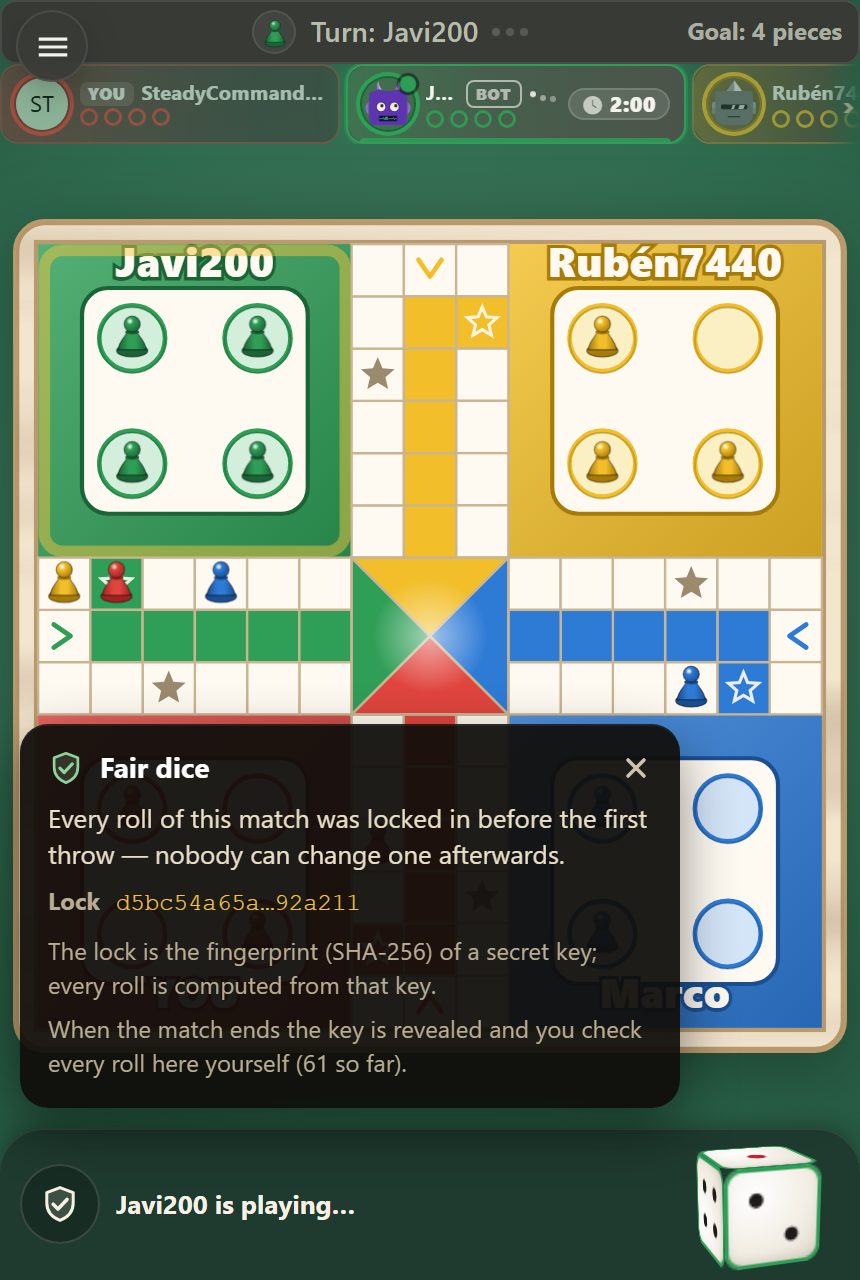
- Before the first roll the server creates a secret key and shows its SHA-256 fingerprint as the Lock. The fingerprint reveals nothing about the key, and in practice no other key can produce it.
- Every roll is computed from that key and the roll's number in the match (0, 1, 2, and so on). No die is rolled any other way.
- Bots roll through the same ledger as people, so a bot's roll is simply the next entry in the list. The bot's code never reads the ledger; it looks only at the board, and Ludo has no hidden information on it.
- The opening roll that decides who starts is entry number 0. The roll counter on the card includes it, so it reads one more than the rolls actually played.
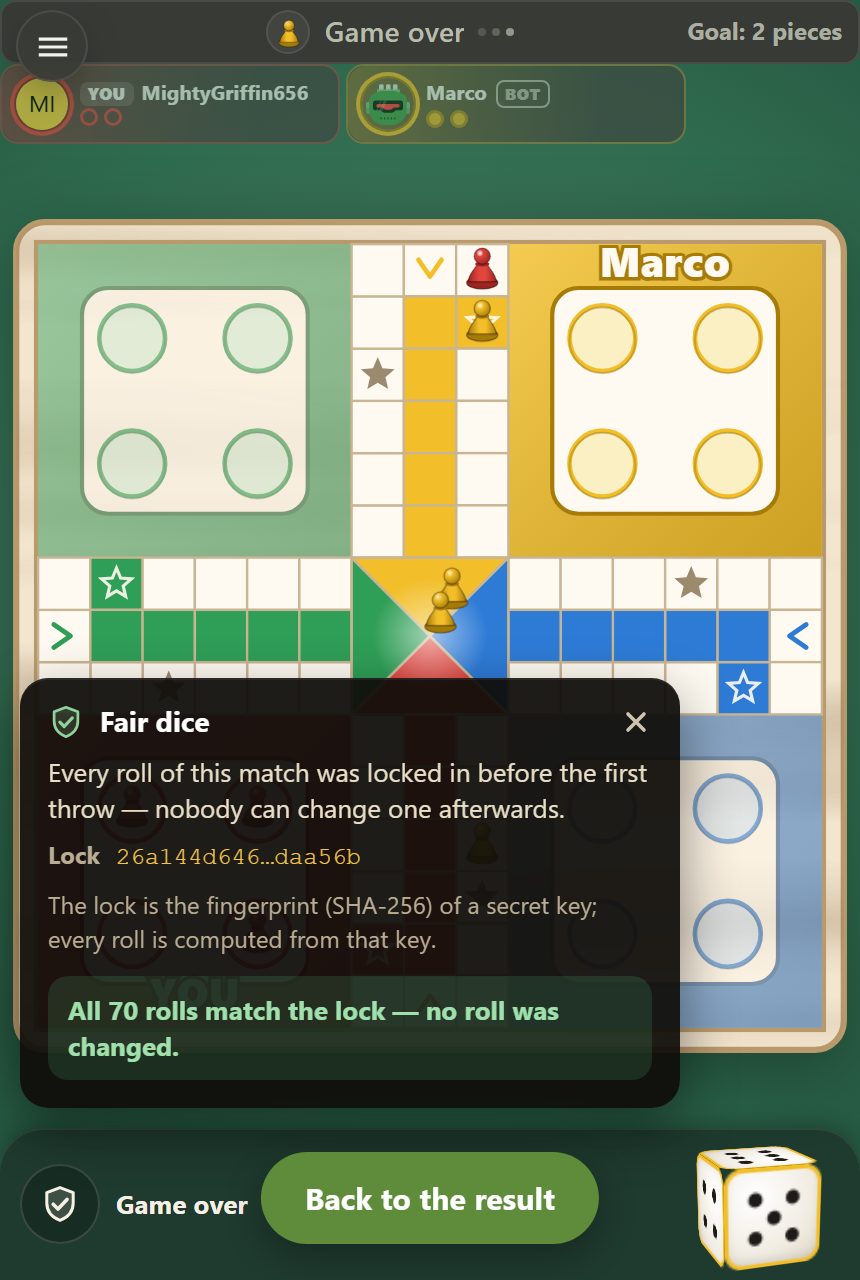
- When the match ends the key is revealed and the "Check every roll" button recomputes every roll in your own browser, without asking the server.
What the check proves, and what it does not
When the card says "All n rolls match the lock — no roll was changed", your browser has confirmed two things: the revealed key hashes to the Lock, and every roll in the list recomputes from that key. In plain terms, the dice were fixed before the first throw, and none was changed or chosen afterwards.
Here is what it does not show.
- It compares against the Lock in the same data. The card displays the Lock during the match, but nothing saves it for you. Note it or take a screenshot if you want to compare it yourself afterwards.
- The server makes the key. In Ludo no player contributes a seed, so the check cannot show that the key was not chosen with a particular seat in mind. It shows that nothing was altered after the Lock.
- It does not cross-check the numbers you saw on screen against the list; the card gives a verdict, not a replay.
- The seat draw is separate. Which colour you get, who sits opposite and who your partner is in a 2v2 match come from a different random draw, which the Lock does not cover.
What is never sold
Nothing here sells luck. There are no extra dice, rerolls, starting advantages, "lucky" dice, stake tables or entry fees. Both boards, Quick mode, 2v2 and Walls are free. The only thing the shop is built to sell is a Look: Azulejo, Palace and Midnight repaint the board, while Classic is always free. No rule reads which Look is on the table, and the shop's gate recognises only the Look option, so a rule cannot be put up for sale.
How to check a match yourself
- Start any Ludo match and tap the shield button at the left end of the dock under the board. The Fair dice card opens.
- Note the Lock, shown shortened (its first 10 and last 6 characters), or screenshot it. One tap closes the card.
- Play. When you open the card again mid-match it shows how many rolls so far.
- When the match ends, fold the end screen away with its view-board button, tap the shield and press "Check every roll".
- Read the verdict, "All n rolls match the lock — no roll was changed" or "k roll(s) do not match the lock", and compare the Lock on the card with the one you noted.
So what do you do with this?
Next time a streak of misses makes you suspect the dice, ask the one question that matters: could the rolls have been changed after the fact? Here you can answer it with one tap, and a fair die will still leave you waiting for a 6 now and then. For the rules behind those rolls, read how to play Ludo; for what to do with the numbers you get, see our Ludo strategy tips. Then play Ludo or Parchís on Playgridia and check a match yourself.
Frequently Asked Questions
Is online Ludo rigged?
We cannot speak for other Ludo apps, because nobody outside an app can inspect its dice code. On Playgridia each match's dice are locked in before the first roll as a SHA-256 fingerprint, and when the match ends you can recompute every roll in your own browser. The check proves the rolls were not changed after the lock; it says nothing about any other game.
Why can't I roll a 6 in Ludo?
A fair die gives a 6 one time in six, so the average wait is six rolls, and a run of ten rolls without a 6 happens about 16.2% of the time. The die has no memory, so missing five in a row does not make the next 6 more likely. On the Parchís board the number you need to enter is a 5, with the same 1 in 6 chance.
Is Ludo pure luck?
No. The dice decide how far you can move, but whenever more than one move is legal you choose which piece plays. On the Ludo board a 6 lets you bring a piece out or move one already on the track, and where you stop, on a safe square or in reach of a rival, is your decision.
Can the bots see the dice in Ludo?
Bots roll through the same ledger as people, and the bot's code never reads it; it looks only at the board, which holds no hidden information in Ludo. The check cannot show what a bot's code looked at. It shows that no roll was changed after the lock was published.
Can I verify a Ludo match myself?
Yes. During the match, open the Fair dice card with the shield button at the left of the dock under the board and note the Lock. When the match ends, open the card again and press Check every roll; your browser recomputes every roll and answers either that all rolls match the lock or how many do not.
Do you sell better dice or rerolls?
No. There are no extra dice, rerolls, lucky dice, stake tables or entry fees. The only thing the shop is built to sell is a Look, a repaint of the board that no rule reads.