Ludo 2v2: Team Rules for Playing with a Partner
Ludo 2v2 is the team version of the game: when four players are seated, the two seats opposite each other are partners, you can never capture your partner, and the team wins when both partners have brought their pieces home. This guide covers Ludo team mode on both free boards on Playgridia, the Ludo board (a 15×15 cross) and the Parchís board (a 19×19 cross). Where a common table plays a rule differently, we say so and then give ours.
When Ludo team mode is on
2 vs 2 is a room option, set in the room wizard, and it is free on both boards. Its other setting is "Every player", where everyone plays for themselves. The option only takes effect when exactly four players are seated, people or bots. With two or three seated, the match plays as every player for themselves, whatever was selected.
Partners are the two seats opposite each other. Everything below applies to both boards unless a heading says otherwise, and the table further down puts the differences side by side.
Partners are drawn, not picked
Seats are drawn at random when the match starts, so join order does not matter and the room creator is not automatically in the first seat. Your partner is whoever the draw puts across the board from you. You cannot choose your partner, your colour or your seat, and there is no seat swap. Two friends at the same table (see playing Ludo online with friends) may therefore end up as partners or as rivals.
The board tells you who is on your side. Your partner is marked with two linked gold rings beside their name, both on the board and on their seat card, whatever colour the draw gave them.
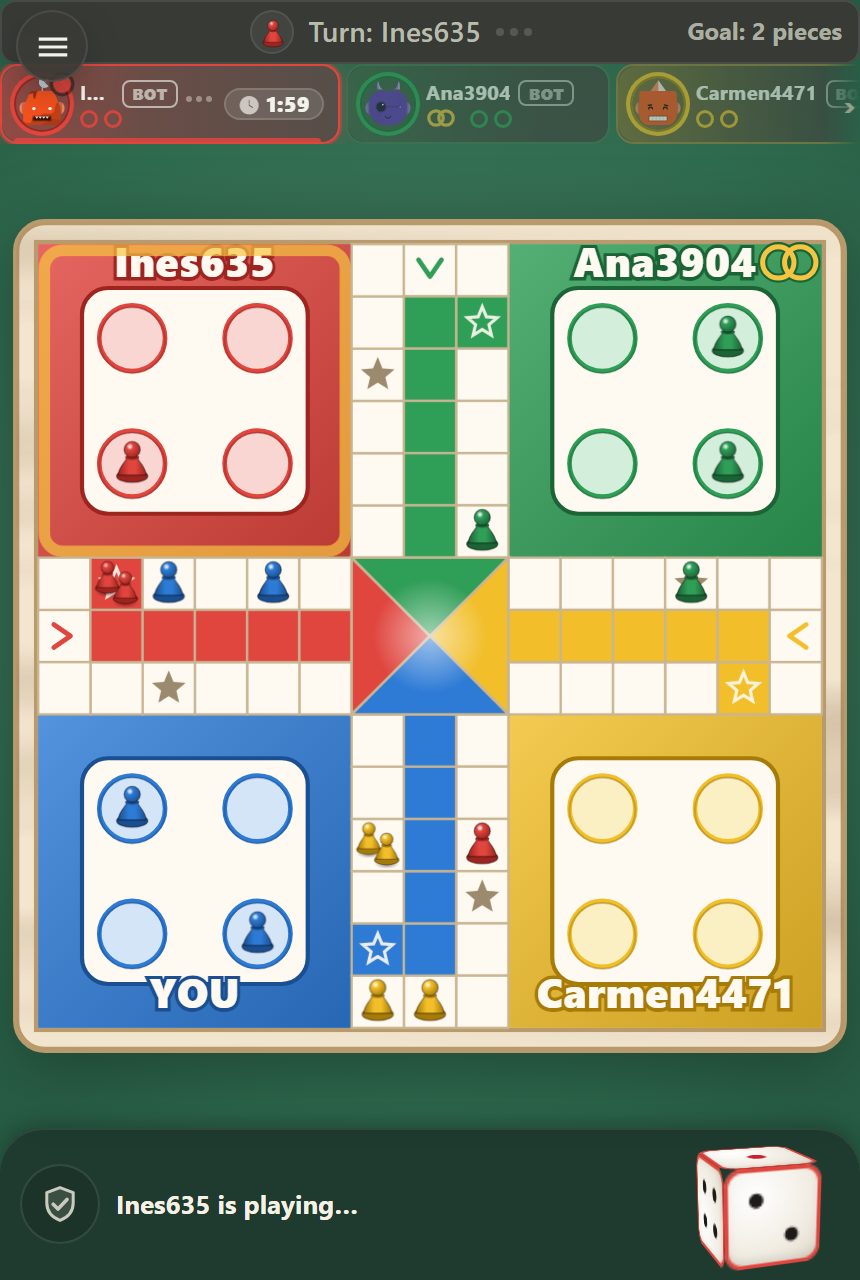
Capturing, pairs and blockades with a partner
You never capture your partner
On both boards, landing on a square that holds only your partner's piece simply stacks the two: nothing is captured. Some tables play this differently; in a 2v2 here, your partner's pieces are never a target.
On the Ludo board: pairs
Two pieces of one colour on an ordinary track square form a pair that rivals cannot capture or land on. Your own pairs and your partner's pairs never stop you. The same goes for the optional Walls rule, which lets a rival pair block passing too (except on safe squares): your own and your partner's walls never block you. Two single pieces of different colours that share a square, such as yours and your partner's, do not make a pair together, because pairs are counted per player.
On the Parchís board: blockades
On the Parchís board, two pieces of one colour on a square form a blockade, and a blockade stops everyone: nobody lands on it and nobody passes it, including its owner and the owner's partner. A blockade on a safe square still blocks. As with pairs, a blockade needs two pieces of the same colour, so two partners' single pieces on one square do not make one, although a Parchís square still holds at most two pieces. The Walls option is not offered on this board, because blockades are always on.
When your pieces are home, you keep rolling for your partner
The goal is 4 pieces home in a Classic match and 2 in a Quick match, where each seat starts with one piece already on its start square and three in the yard. In a 2v2, a player who reaches the goal does not drop out. On each of their turns they still roll, and the roll moves their partner's pieces instead. That includes bringing a partner's piece out of the yard with the usual entry roll (a 6 on the Ludo board, a 5 on the Parchís board). The bar under the board says so: "Tap one of your partner's glowing pieces — yours are home".
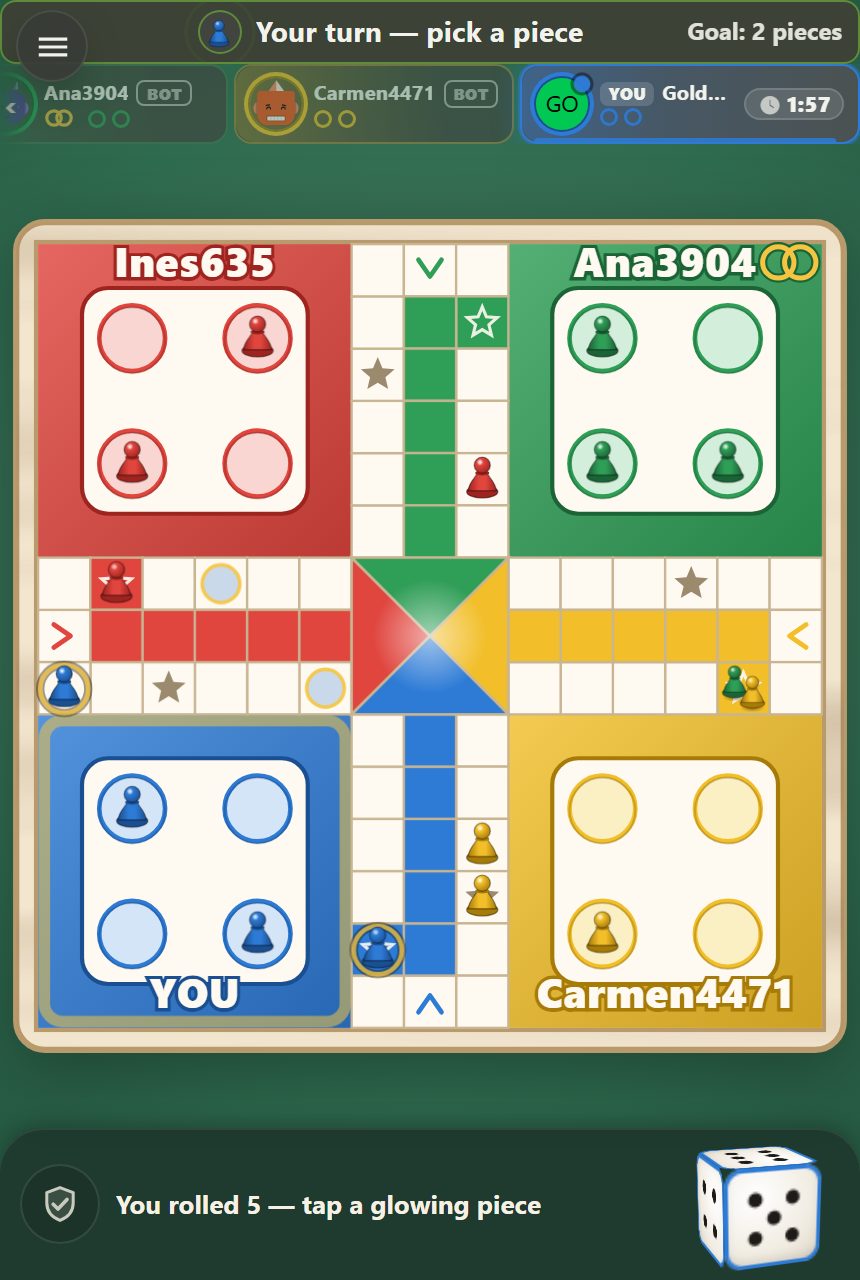
In a Quick 2v2 there is one extra step. When a player reaches the goal, their other pieces still on the board go back to the yard. That player now moves only their partner's pieces, so the leftovers could never move again and would block squares for good. In Classic this never happens, because the goal is all four pieces.
The team wins when both partners have reached the goal: 8 pieces home in Classic, 4 in Quick. The match ends at once. Both partners carry the same score: 100 for every piece the pair has brought home, plus up to 99 for the progress of pieces still on the board. A Classic win with all 8 pieces home shows 800 for each partner.
Ludo 2v2 on both boards at a glance
| In a 2v2 match | Ludo board | Parchís board |
|---|---|---|
| Capturing your partner | Never | Never |
| Your own pair or blockade | A pair never stops you | A blockade stops you too: nobody lands on it or passes it |
| Your partner's pair or blockade | Never stops you, Walls included | Stops you too |
| Two partners' single pieces on one square | No pair: they do not shield each other | No blockade: it takes two pieces of one colour (the square still holds at most two pieces) |
| After you reach the goal | You keep rolling and move your partner's pieces, yard pieces included | Same |
| Quick match, goal reached | Your other pieces on the board go back to the yard | Same |
| The team wins when | Both partners have reached the goal (4 pieces each in Classic, 2 each in Quick) | Same |
| Score | Both partners show the same number | Same |
How to play Ludo with partners: four habits
- Finishing one player early is not wasted. A finished player keeps taking turns for the partner, so the team still gets both seats' rolls, all spent on the partner's remaining pieces.
- On the Ludo board, stacking with your partner is not shelter. You can land on your partner's piece without capturing it, but two single pieces of different colours form no pair, so on an ordinary square a rival can still land there and capture one of them. Use a safe square or a pair of your own colour for cover.
- On the Parchís board, mind where your blockade sits. It stops your partner exactly as it stops the rivals, so a blockade in front of your partner's pieces holds up your own team.
- In Quick, time the last goal piece. When a player reaches the goal, their other pieces on the board return to the yard, and any pair or blockade they were holding disappears with them.
If a player leaves
If a player disconnects from a four-seat table, their seat goes to a bot after 120 seconds and the match carries on; they can take the seat back when they return. A player who leaves on purpose hands the seat to a bot for good. Either way the match is not stopped.
What to do with this
Switch on 2 vs 2 for a table of four, accept that the draw decides who sits where, and learn which board you are on: on the Ludo board your pairs always let your partner through, while on the Parchís board a blockade holds everyone up. The full rules of each board are in how to play Ludo and the Parchís rules, and you can set up a team table on the Ludo page.
Frequently Asked Questions
Can you capture your partner in Ludo 2v2?
No. On both the Ludo board and the Parchís board you can never capture your partner, and landing on a square that holds only their piece simply stacks the two. Some tables play this differently, but in a 2v2 here your partner's pieces are never a target.
Can I choose my partner or my colour in Ludo team mode?
No. Seats are drawn at random when the match starts, and your partner is the player seated opposite you. There is no seat swap, so two friends at the same table may end up as partners or as rivals.
What happens when all my pieces are home but my partner's are not?
You keep your turns. On each of them you roll and the roll moves your partner's pieces, including bringing one out of the yard with the usual entry roll. In a Quick match, your other pieces still on the board go back to the yard when you reach the goal.
How does a team win in Ludo 2v2?
A team wins when both partners have reached the goal: 4 pieces home each in a Classic match (8 for the team) or 2 each in a Quick match (4 for the team). The match ends at once, and both partners carry the same score.
Can I play Ludo 2v2 with three players?
No. 2 vs 2 only takes effect when exactly four players are seated, people or bots. With two or three seated, the match plays as every player for themselves, even if 2 vs 2 was selected.
Does my partner's blockade stop me in Parchís?
Yes. On the Parchís board a blockade stops everyone, its owner and the owner's partner included, even on a safe square. On the Ludo board it is the opposite: your own pairs and your partner's pairs never stop you.