Parchís Rules: How to Play the Spanish Ludo
Parchís rules in short: it is Spain's own member of the Ludo family, which grew out of India's Pachisi, and on its 68-square board you enter with a 5, two pieces of one colour form a blockade that nobody can pass, and every capture or piece that gets home is paid in extra squares. On Playgridia it is a free board option of the same game: choose Parchís under Board when you open a Ludo room. Below is the board as it plays here; house rules vary from table to table.
How to play Parchís: the board and the safe squares
The Parchís board is a 19×19 cross with a yard in each corner. Each player has four pieces, there is one die, and 2 to 4 people can play (two players take opposite corners). Pieces travel counter-clockwise round a loop of 68 squares.
Twelve of the loop's squares are safe squares, called seguros and marked with a round mark. In the classic 1–68 numbering they are squares 5, 12, 17, 22, 29, 34, 39, 46, 51, 56, 63 and 68. Nothing can be captured on one. Each colour's own exit square (5, 22, 39 and 56) is safe, and so is the last square before a piece turns into its home lane.
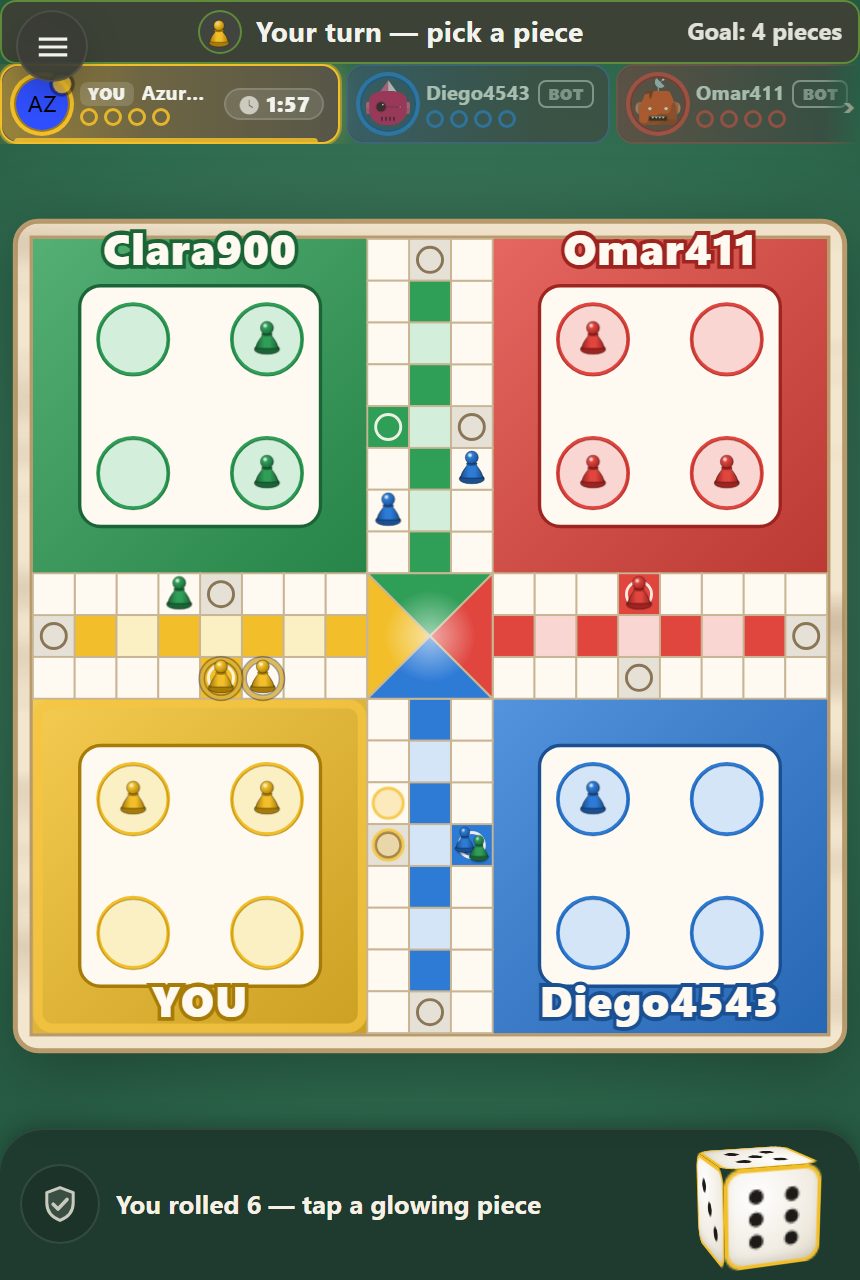
Getting out: you need a 5
A piece leaves the yard only on a 5, and it lands on your own exit square. Entering is compulsory: if you roll a 5 and have a piece in the yard, bringing it out is your only legal move. The one exception is when your exit square already holds two of your own pieces. Then you cannot enter, and the 5 is played as an ordinary move. A six never brings a piece out.
The exit square has one more rule. If it already holds two pieces and at least one is a rival, the piece you bring out captures a rival there (the one that arrived last), and that counts as a capture, so it earns the 20 described below. A single rival alone on your exit square is not captured. You simply share it.
Sixes: roll again, count 7, and the three-six penalty
A six rolls again. It also rolls again when you had no legal move to play with it. On the Parchís board a six has a twist: when none of your pieces is in the yard, it counts 7. While even one piece is still in the yard it counts 6. A piece that has already finished is not in the yard.
Three sixes in a row are punished. The third six is void, the last piece you moved goes back to the yard, and your turn ends. The piece goes back only if it is still on the shared loop; one in its home lane or finished stays put. "The last piece you moved" includes a piece moved with a 20 or 10 count. The count restarts at the start of each turn and after any roll that is not a six.
Blockades: two pieces nobody can pass
A square holds at most two pieces, of any colours, so you cannot land on a square that is already full. Two pieces of one colour on a loop square form a blockade: nobody can land on it and nobody can pass it. That includes the owner, and in a 2v2 match the owner's partner. A blockade on a safe square still blocks.
A blockade has an off switch you do not control. When you roll a 6 and any piece of one of your blockades can move, you must move one of those pieces. If none of them can move, nothing is forced. The rule applies to a rolled 6, not to a 20 or 10 count.
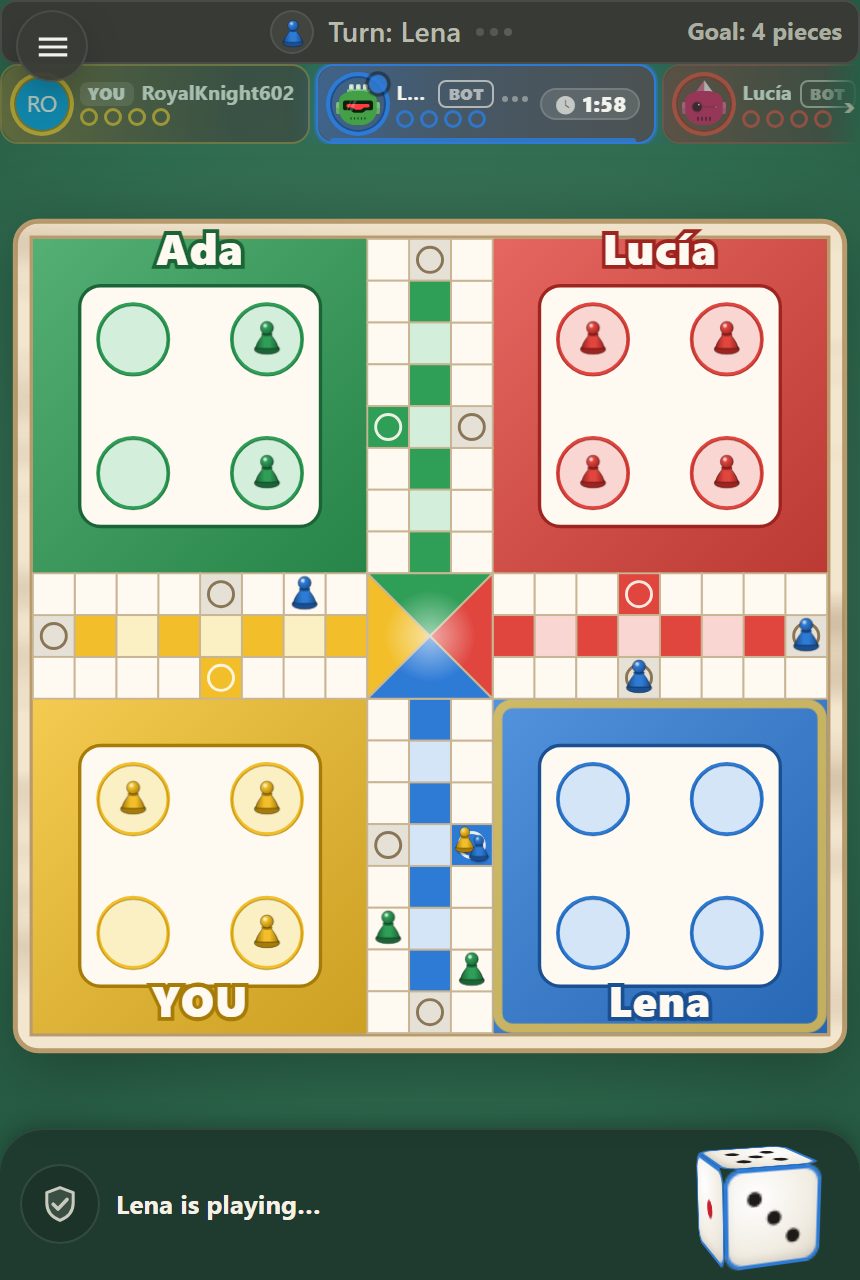
Captures, and counting 20 and 10
Land exactly on a rival piece that stands alone on a square that is not safe, and it goes back to its yard. You can never capture a partner in a 2v2 match.
Captures and homecomings pay out in squares you move with any of your pieces:
- Capture: count 20.
- A piece reaching home: count 10.
A count is a separate move. You spend it with any piece that can legally move exactly that many squares. If no piece can use it exactly, the count is lost. A count move can itself capture or bring a piece home, and that queues another count, so bonuses can chain.
The home lane and how you win
The home lane is 7 squares long and private to you: no captures happen there. A piece must finish with an exact roll: from its exit square, home is 71 steps away, and a move that would overshoot is not legal. Moves are never optional: if any legal move exists you must play one.
The first player to bring all four pieces home wins, and the match ends at once, with no play-on for second place. In Quick mode one piece starts on its exit square, three wait in the yard, and the first to bring two home wins. With four seated you can also play 2 vs 2 (por parejas): partners are the two players sitting opposite each other, seats are drawn at random, and the team wins when both partners have brought their pieces home. The 2v2 guide has the details.
Parchís board vs Ludo board
Both boards are free options of the same game, and the basic Ludo rules are the starting point. Here is what changes when you switch to Parchís.
| Rule | Ludo board | Parchís board |
|---|---|---|
| Grid and loop | 15×15, 52 squares | 19×19, 68 squares |
| Direction | Clockwise | Counter-clockwise |
| Entering | A 6, optional: you may move another piece instead | A 5, compulsory when your exit square lets you in |
| A six | Rolls again | Rolls again, and counts 7 when no piece is in the yard |
| Three sixes | The third six is void and the turn ends | The third six is void, the turn ends, and the last piece moved goes back to the yard (if still on the loop) |
| Safe squares | 8 | 12 (seguros) |
| Two of one colour | A pair: rivals cannot capture it or land on it (except on safe squares) and may pass it unless Walls is on | A blockade: nobody lands on it or passes it, the owner included, even on a safe square |
| Opening it on a 6 | Not required | Required when a blockade piece can move |
| Pieces per square | No limit | 2, of any colours |
| Capture reward | One extra roll | Count 20 |
| Piece home reward | One extra roll | Count 10 |
| Capture on the exit square | Never | When it already holds two pieces and one is a rival |
| Home lane | 5 squares | 7 squares |
What to do with this
Five numbers cover most of the board: 5 to enter, 7 for a six with an empty yard, 12 safe squares, 20 for a capture and 10 for a piece home. A blockade stops everyone, but a rolled 6 can force you to open it. To try it, open a room on the Parchís board at Playgridia's Ludo page, then read the strategy tips. If your family plays by different house rules, agree on them before the first roll.
Frequently Asked Questions
What number do you need to get out in Parchís?
A 5. On this board, if you roll a 5 and have a piece in the yard, bringing it out is your only legal move. The exception is when your exit square already holds two of your own pieces: then you cannot enter and the 5 is played as an ordinary move.
What is a blockade in Parchís?
Two pieces of one colour on the same square of the loop. Nobody can land on it or pass it, the owner included, and that holds even on a safe square. When you roll a 6 and any piece of one of your blockades can move, you must move one of those pieces.
Do you count 20 or 10 in Parchís?
Both. A capture earns a count of 20 and a piece reaching home earns a count of 10, each spent as a separate move with any piece that can legally move exactly that many squares. If no piece can use the count exactly, it is lost.
What does a six count in Parchís?
A six rolls again. It counts 7 when none of your pieces is in the yard, and 6 while at least one piece is still there. A six never brings a piece out of the yard, because that takes a 5.
What happens if you roll three sixes in a row in Parchís?
The third six is void, the last piece you moved goes back to the yard, and your turn ends. The piece is sent back only if it is still on the shared loop, so a piece in its home lane or already finished is safe.
How many people can play Parchís, and how do you win?
Two to four people can play, with friends or bots, using one die and four pieces each. The first player to bring all four pieces home wins, and in Quick mode the first to bring two home wins. With four seated you can also play 2 vs 2, where the team wins when both partners are home.