Ludo Strategy: 10 Tips to Win More Games
Ludo strategy starts with an honest admission: the die decides how far you move, but you decide which piece moves, and over a whole match that choice is where skill lies. These ten tips follow the rules as they play on Playgridia, on the Ludo board and on the Parchís board (Spain's version, a free board option of the same game), and each says which board it covers. House rules vary; the basic Ludo rules and the Parchís rules set out the ones used here.
Stay out of reach: safe squares, pairs and distance
1. Learn where the safe squares are (both boards)
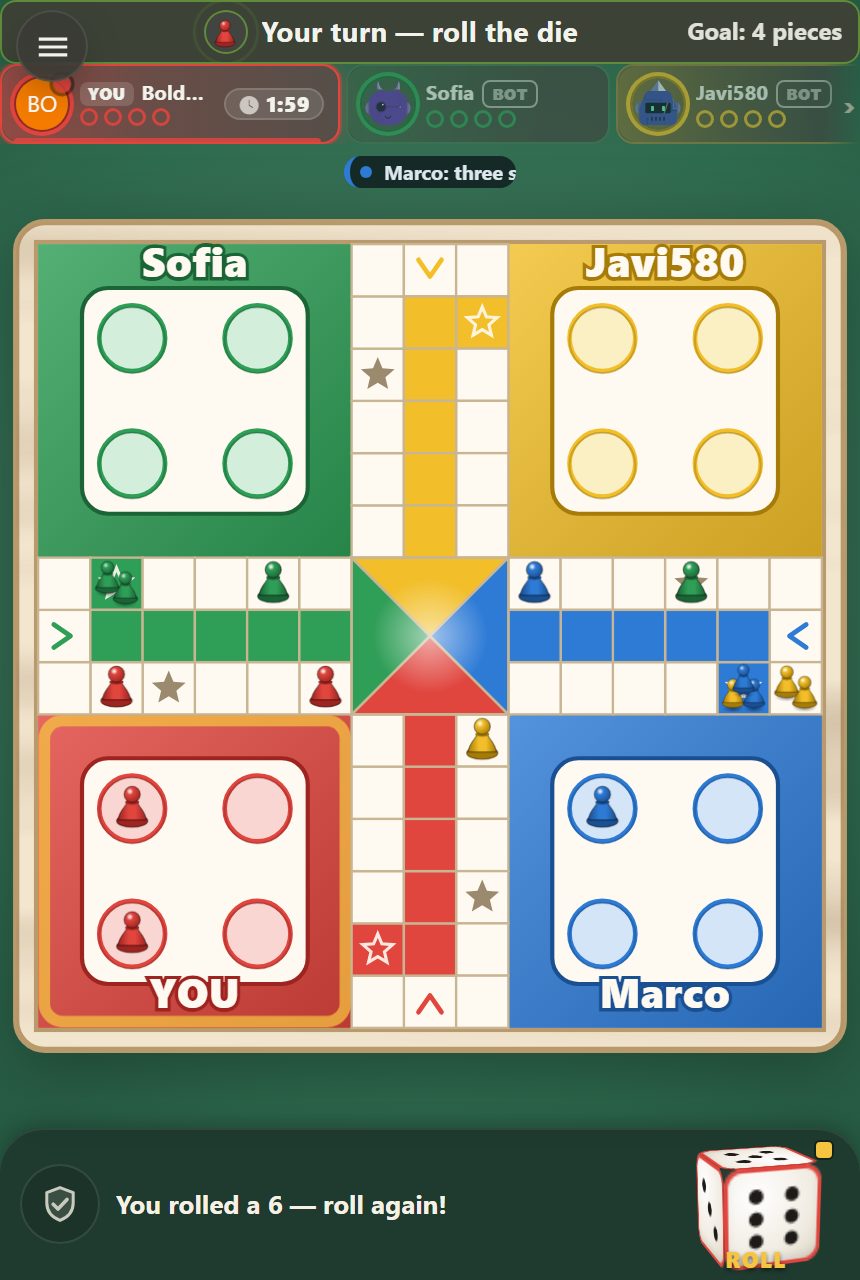
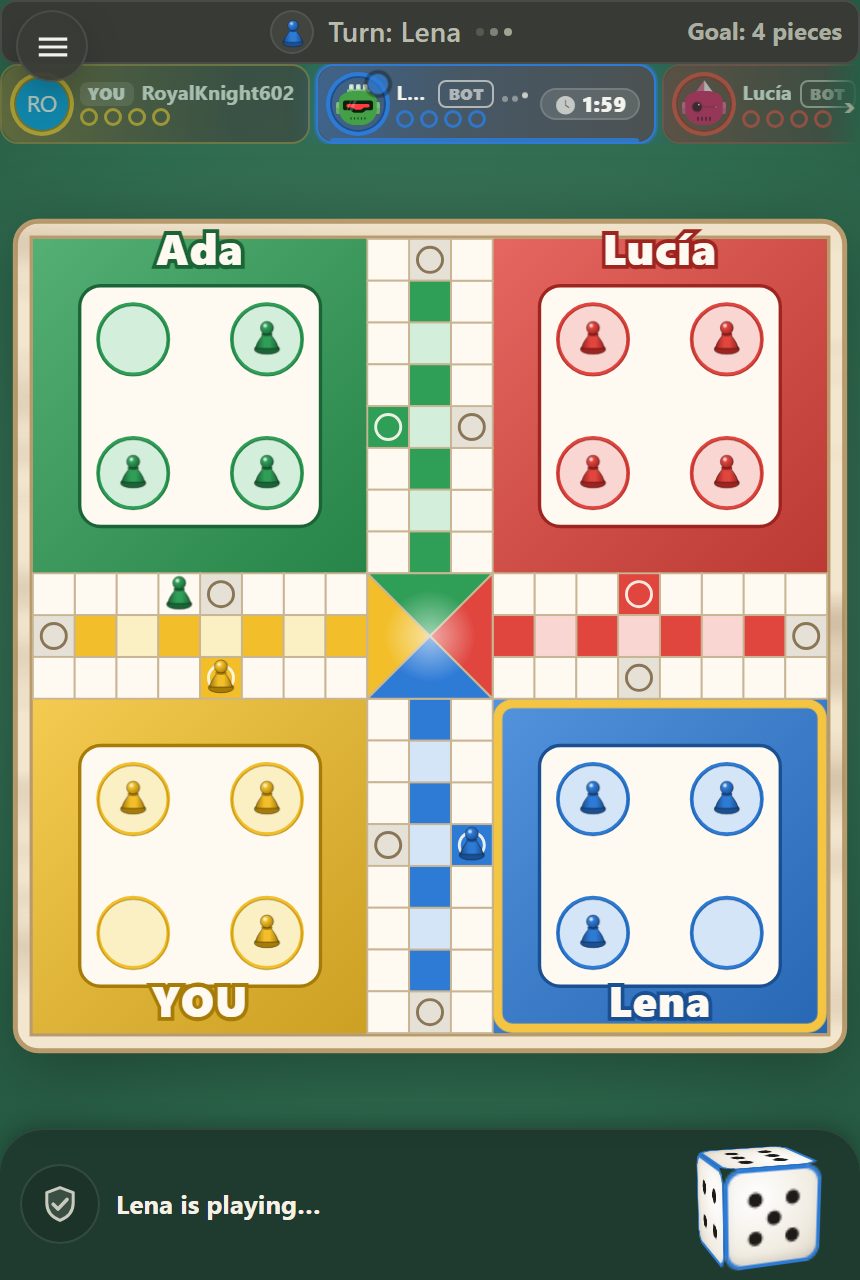
Nothing can be captured on a safe square. The Ludo board has 8: the four start squares and the four stars, each star 8 squares past a start square. The Parchís board has 12, called seguros and marked with a round mark, including each colour's exit square and the last square before a piece turns into its home lane. Home lanes belong to their owner alone on both boards. When a rival is within six squares behind you, ask first whether a safe square is one roll away.
2. Move in pairs (Ludo board)
Two of your pieces on one track square form a pair. A rival cannot capture a pair or land on its square, though it may pass over it; if the optional Walls setting is on, a pair also blocks passing. Your own pair never stops you. Moving either piece breaks it, so pair up where rivals are close behind.
3. Count the squares behind you before every move (both boards)
A rival can only hit you with a number it can roll, so distance is probability. Check it for the square you stand on and the square you are about to land on. The strongest bot does the same, counting how many different die numbers would hit a square.
| Where the rival is | Chance it hits you next turn |
|---|---|
| One rival 1 to 6 squares behind you | 1 in 6 (about 16.7%) |
| Two rivals at two different distances, both 1 to 6 behind | 2 in 6 (about 33%) |
| Two rivals at the same distance | 1 in 6: one number hits |
| Ludo board: one rival 7 to 12 behind you | at most about 1 in 36 (2.8%): a 6, then the exact rest |
| On a safe square, in your home lane, in a Ludo pair or in a Parchís blockade | 0: you cannot be captured |
The figures assume a fair die, a clear road and a rival that uses the roll on that piece. On the Parchís board a rival with an empty yard moves 7 on a six, so it hits at 1 to 5 squares and at 7, not at 6.
Getting out and getting round: entries and sixes
4. Get a second piece out early (Ludo board)
On the Ludo board you need a 6 to leave the yard, but it is not forced: with a 6 you may bring a piece out or move one already out. The new piece lands on your start square, which is safe, and nothing is captured on entry even if rivals stand there. You cannot pass when a legal move exists, so a lone piece must take every roll wherever it leads; with two out, you choose which one takes the risk.
5. Plan around the forced 5 (Parchís board)
On the Parchís board you enter with a 5, and it is compulsory: with a piece in your yard and an exit square that lets it in, bringing it out is your only legal move on a 5. So until the yard is empty, a 5 cannot be spent on a capture or an escape. The exception is an exit square already holding two of your own pieces: you cannot enter, and the 5 is played normally. A six never brings a piece out.
6. Respect the third six (both boards)
A six rolls again on both boards, even with no legal move. A third six in a row is void: on the Ludo board your turn ends, while on the Parchís board the last piece you moved (a bonus move counts) also returns to the yard, unless it is already in its home lane. After a second six on Parchís, choose that piece carefully: a third six, one roll in six, sends it back. A Parchís six also counts 7 once your yard is empty, so count distances with 7.
Captures, counts and blockades
7. Know what a capture pays, and be able to cash it (both boards)
A captured piece returns to its yard and needs a 6 (Ludo board) or a 5 (Parchís board) to start again, so the farther it had travelled, the more you take. A landing captures only one piece, the rival that arrived last. On the Ludo board a capture, like a piece reaching home, earns one extra roll. On the Parchís board a capture earns a count of 20 and a piece home a count of 10: a separate move with any piece that can move exactly that many squares. If none can, the count is lost, so before you hunt, check that you have a piece for 20 and another for 10.
8. Build a blockade where rivals must pass (Parchís board)
On the Parchís board a square holds at most two pieces, and two pieces of one colour form a blockade: nobody can land on it or pass it, even on a safe square. That includes its owner (and the owner's partner in 2v2), so build it in front of rival pieces, not your own. It is temporary too: when you roll a 6 and a piece of one of your blockades can move, you must move one of those pieces. A rolled 6 forces it; a count does not.
9. Wait out a rival blockade (Parchís board)
You cannot land on a blockade or on any square already holding two pieces, and you cannot pass a blockade, so spend your rolls on other pieces. If one must wait right behind it, a safe square is the place. A blockade lasts only until its owner rolls a 6 that one of its pieces can use. On the Ludo board a pair blocks passing only with Walls on, and nothing forces its owner to open it on a 6.
Finishing and the other modes
10. Plan the finish and the mode (both boards)
A piece finishes only by landing exactly on home, 56 steps from its start square on the Ludo board and 71 on the Parchís board; a move that would overshoot is not legal. If that piece is your last, every roll that does not fit passes the turn (a six still rolls again), so keep a second piece with useful moves while it waits. Quick mode starts with one piece on its start square and ends at two pieces home, so there is less time to wait. In 2v2 you can never capture your partner, and once your seat has finished you roll and move your partner's pieces; see the 2v2 guide.
What to do with this
Three habits cover most of it: count the distance behind you before every move, keep more than one piece in play so you always have a real choice, and know your board's bonuses so none goes to waste. To practise, open a room with bots on the Ludo page and try both boards.
Frequently Asked Questions
Is Ludo luck or skill?
It is both. The die decides how far you can move, but whenever you have more than one legal move you choose which piece moves, and that decides which pieces are exposed, which captures you make and whether your bonuses are used. When only one move is possible, the game plays it for you.
Should I bring all my pieces out early in Ludo?
Bring a second piece out early, but you do not need all four at once. On the Ludo board a 6 lets you bring a piece out or move one that is already out, and the new piece lands on your own start square, which is safe. You must play a legal move whenever one exists, so a single piece on the board has to take every roll, while two or more give you a choice of which one takes the risk.
Where are my pieces safe in Ludo?
The Ludo board has 8 safe squares: the four start squares and the four star squares. The Parchís board has 12, called seguros and marked with a round mark. Your own home lane belongs to you alone on both boards, and on the Ludo board two of your pieces on one non-safe square (a pair) cannot be captured either.
What happens if I roll three sixes in a row?
The third six is void and your turn ends. On the Ludo board nothing else happens. On the Parchís board the last piece you moved goes back to your yard, unless it is already in its home lane.
How do I get past a blockade in Parchís?
You cannot pass a blockade or land on a square that already holds two pieces, so you wait and move other pieces. The owner must open the blockade when they roll a 6 and one of its pieces can move, so it lasts only until then. If you have to wait close behind it, a safe square is the best place to stand.
What is the best strategy for Parchís?
Use the 12 seguros as stepping stones, plan for the forced 5, and count a six as 7 once your yard is empty. Keep one piece able to use a count of 20 and another able to use 10, so a capture or a piece home does not go to waste. After two sixes, move the piece you can best afford to lose, because a third six sends the last piece you moved back to the yard.