How to Set Up a Backgammon Board (Diagram and PDF)
To set up a backgammon board, give each side 15 checkers: 2 on its 24-point, 5 on its 13-point, 3 on its 8-point and 5 on its 6-point. The two sides mirror each other, so you place 30 checkers in total and every pip count starts at 167.
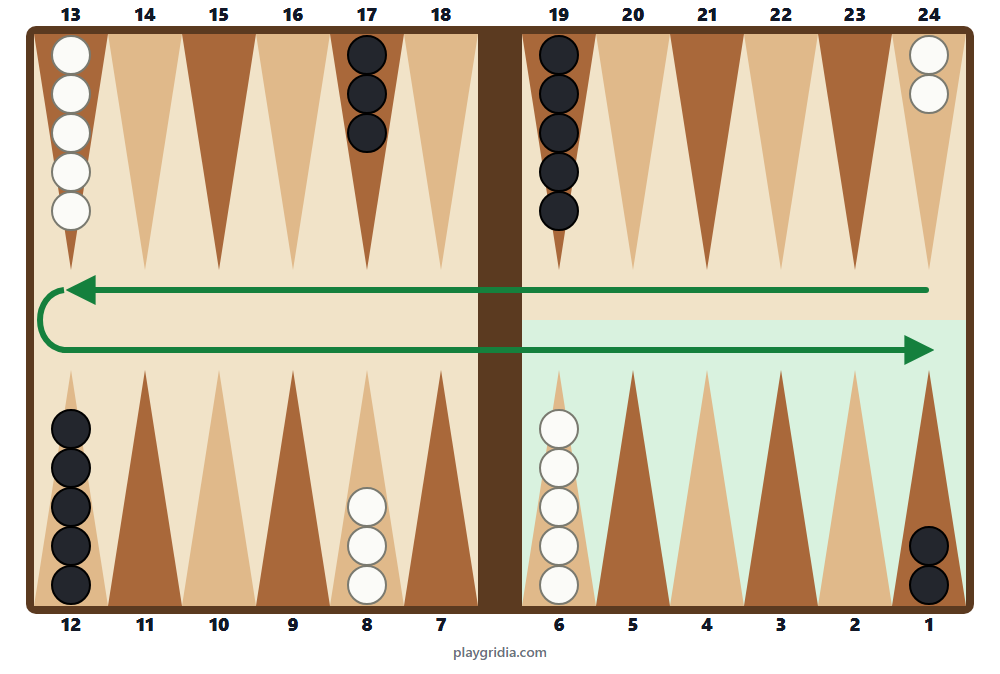
A free printable version is here: backgammon setup diagram (PDF).
The 2-5-3-5 memory trick
Read your own side from the far corner toward home: 24, 13, 8, 6. The checker counts are 2, 5, 3, 5. They add up to 15, and that sum is the first thing to check when a board looks wrong.
| Point (your numbering) | Your checkers | Opponent's checkers |
|---|---|---|
| 24 | 2 | 0 |
| 19 | 0 | 5 |
| 17 | 0 | 3 |
| 13 | 5 | 0 |
| 12 | 0 | 5 |
| 8 | 3 | 0 |
| 6 | 5 | 0 |
| 1 | 0 | 2 |
The opponent's column is the same 2-5-3-5, said from the other chair. Their 24-point is your 1-point, their 13-point is your 12-point, their 8-point is your 17-point and their 6-point is your 19-point.
How to read the diagram
Every player counts the points from their own side, 1 to 24. Your home board is points 1 to 6, and in a standard diagram it is the bottom-right quadrant. Your two back checkers start in the opposite corner, on your 24-point at the top right.
You travel the long way round. Move left along the top row, turn at the left edge, then go right along the bottom row until you reach home. That is the green arrow in the diagram above. The opponent travels the same 24 points in the opposite direction, which is why your 24-point is their 1-point.
The bar
The bar is the vertical divider between the two halves of the board. A checker that gets hit is placed on it, and it must re-enter in the opponent's home board before you can move anything else. A checker on the bar counts as 25 pips from home.
Mirrored boards are fine
Physical boards are sometimes laid out left-right reversed, with the home board on the other side. The game is identical as long as the structure holds: your home board and your 24-point sit in the same half, and your midpoint (the 13-point) faces the opponent's midpoint across the board.
Why the pip count is 167
A pip is one step of one checker. A checker on your 24-point is 24 pips from bearing off, so the starting position adds up as 2 x 24 + 5 x 13 + 3 x 8 + 5 x 6 = 48 + 65 + 24 + 30 = 167. The opponent has the same total, so the race is dead even before anyone rolls. Use 167 as a quick arithmetic check on a physical board: if your sum is off, a checker is on the wrong point.
How a hit changes the setup
Setup is only the first position. Once a lone checker is hit it leaves the point numbers and sits on the bar. It re-enters on a die roll into the opponent's home board, and it cannot land on a point where the opponent has 2 or more checkers. Nothing can move until every checker on the bar is back in.
How the first move is decided
Each side throws one die. The higher die starts, and that player uses both numbers as the first move. If the dice tie, both sides throw again. This applies at the start of every game, including each new game inside a match.
Common setup mistakes
- Count 15 on each side. A 14 or a 16 means a point is wrong.
- Check the back checkers: exactly 2 on your 24-point, in the corner farthest from your home board.
- Check that your 13-point stack faces the opponent's 12-point stack on the other edge of the board. If both 5-stacks sit on the same edge, a side is flipped.
- Check that your 6-point is the point next to the bar in your home board.
Setup on Playgridia
On Playgridia you do not place anything. The board sets itself, and it is always drawn from your chair, so your home board is bottom right and your side is at the bottom. The pip count of 167 is shown next to each name, and the point numbers are printed along the edges.
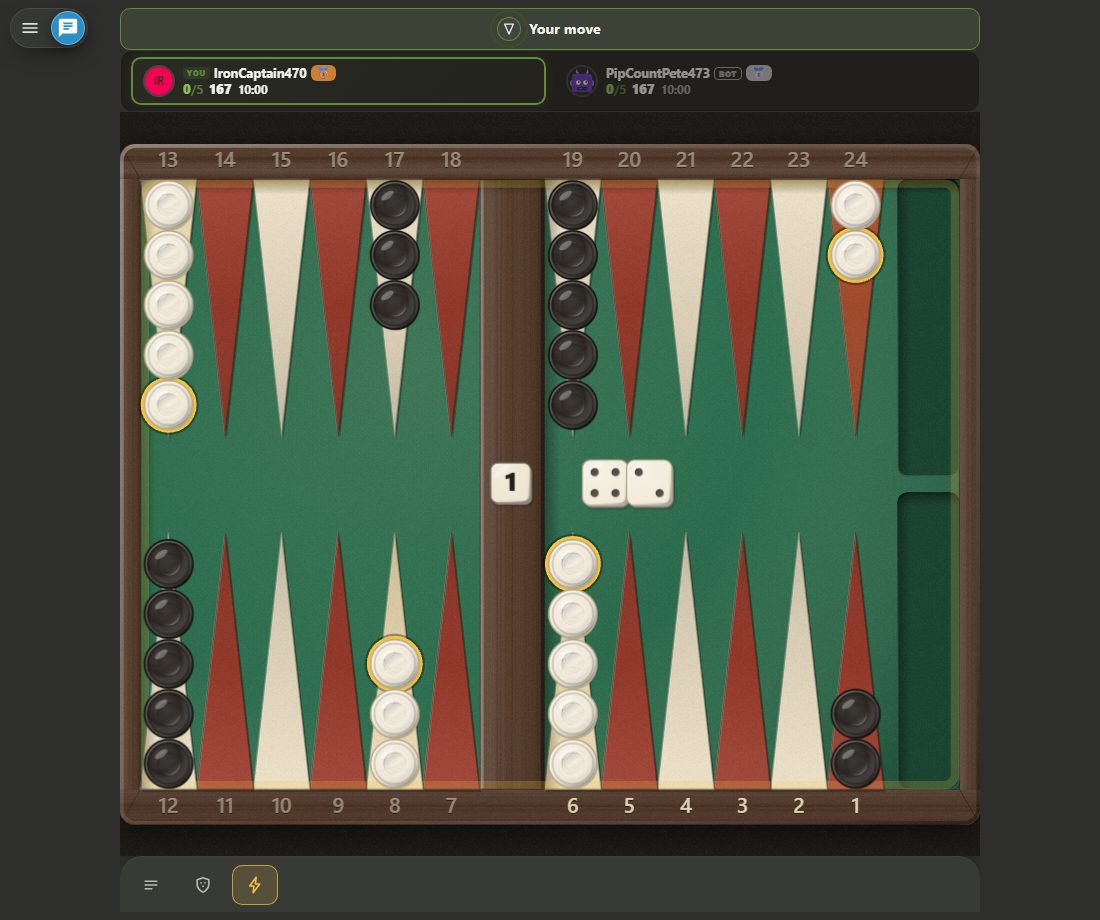
The match option "Opening" also offers other starting layouts. Those are covered in the backgammon variants guide, so this page sticks to the standard setup.
What to do next
Print the PDF if you want to set up a real board, or just open a game and watch the position appear. Then learn what to do with it in how to play backgammon, pick up your first moves in the opening moves guide, and keep the terms glossary open for words like bar and pip. When you are ready, play backgammon free with no signup.
Frequently Asked Questions
How many checkers does each player have in backgammon?
Each player has 15 checkers in the standard game. They start as 2 on the 24-point, 5 on the 13-point, 3 on the 8-point and 5 on the 6-point. That makes 30 on the board in total.
How do you set up a backgammon board?
Put 2 checkers on your 24-point, 5 on your 13-point, 3 on your 8-point and 5 on your 6-point. Your opponent does the same from their side, so their points mirror yours. Your 24-point is their 1-point.
Where does each player's home board go?
Your home board is points 1 to 6, the quadrant you finish in. On Playgridia and in a standard diagram it is the bottom-right quadrant. The opponent's home board is the top-right quadrant, which is your points 19 to 24.
Which way do the checkers move?
You move from your 24-point toward your 1-point. In the diagram that means left along the top row and then right along the bottom row. The opponent moves the opposite way over the same 24 points.
Who goes first in backgammon?
Each side throws one die, and the higher die starts. The starter plays both numbers as the first move. If both dice match, both sides throw again.
What is the pip count at the start of a game?
It is 167 for each side in the standard setup. A pip is one step on a point, and a checker on your 1-point has 1 pip left. Playgridia shows the pip count beside each player's name.