Rummy Rules for 2 Players: Deal, Melds and Scoring
Yes, rummy rules for 2 players work fine: the game plays with 2 to 6 seats, and with two you still get 13 cards each from the same 108-card pack (two decks plus 4 jokers). Nothing about the rules changes. What changes is the feel: every card on the discard pile came from one hand, yours or your rival's, so the table is much easier to read.
Setup and deal for two players
The pack is two 52-card decks and 4 jokers, 108 cards in all. Each player gets 13 cards. One more card is turned face up to start the discard pile, and the rest is the face-down stock, which is 81 cards in a two-player deal. Who plays first is random, so the host gets no edge.
In the room wizard the seat stepper runs from 2 to 6 and defaults to 4, so set it to 2 before you start. A room can also start with fewer seats than the maximum once everyone is ready. Every game is free for guests with no signup.
A turn: draw, play, discard
You draw the top stock card blind, or take the top discard. You can only ever take one card, never the pile. The first player may take the starting card. If the stock runs out, the discard pile (all but its top card) is shuffled back in, at most twice per deal. A third run-out blocks the deal and the lightest hand wins.
Then you may lay down melds, and you finish by discarding one card. There is one trap. A card you took from the pile must be placed in a meld or lay-off before you can discard anything. Changed your mind? Before you do anything else that turn, you can put the pile card back and draw from the stock instead. A card drawn from the stock has no such rule.
The move clock is a per-turn budget, 45 seconds by default. Draw, melds and discard all share it. Options are 30, 45, 60, 90 or 600 seconds.
What counts as a meld
- A set is 3 or 4 cards of one rank, each natural card in a different suit. With two decks, 7 of spades twice plus 7 of diamonds is not a set.
- A run is 3 to 13 consecutive cards of one suit. The ace is low (A-2-3) or high (Q-K-A), never both in one run, and K-A-2 does not wrap.
- A joker stands in for any card. A meld needs at least 2 natural cards, and no two jokers may sit next to each other in a run.
The opening requirement
Before you can lay off or add a meld, you must open. Your first melds, laid down in one action, must be worth at least the threshold. The room sets it to 30, 40 or 51, and 40 is the default. It is not cumulative across turns.
| Meld | How it is valued | Example |
|---|---|---|
| Set | Card value times cards. Faces 10, ace 11 | K-K-K = 30, A-A-A = 33 |
| Run | Sum of positions. Ace low = 1, ace high = 11 | 10-J-Q = 30, Q-K-A = 31 |
| Joker | Value of the card it replaces | 5-J-7-J-9 of hearts = 35 |
One more rule: if the opening leaves you with 0 or 1 cards in hand, the threshold is waived. If you take a pile card before opening, it has to be part of your opening. After you open, you can lay cards onto any meld on the table, yours or your rival's, and a natural card can free a joker from a meld if it fills that slot exactly.
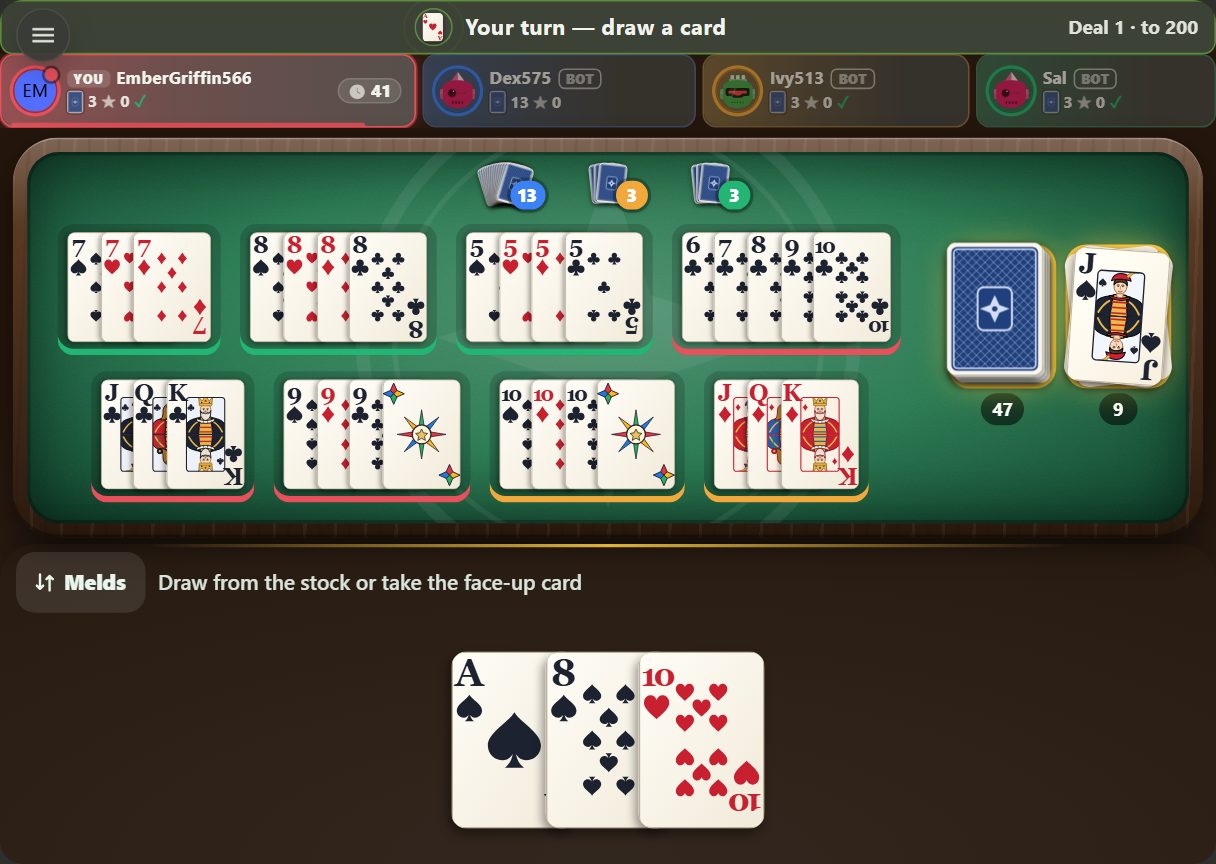
Going out and scoring
The deal ends when a hand is empty. You can go out by discarding your last card or by melding or laying it off, with no discard needed. The winner scores the penalty points left in the rival's hand. In a two-player game that is simply your rival's whole hand.
| Card | Penalty |
|---|---|
| 2 to 10 | Face value |
| J, Q, K | 10 |
| Ace | 11 |
| Joker | 20 |
If you go out on a turn that started before you had opened, the score doubles. That is Hand Rummy, and it includes opening and going out in the same turn. Unplayed cards count in full even if the rival opened earlier. A match is one deal by default. You can also play to a target of 200, and then the match ends when a deal winner reaches it.
Two-player tactics that follow from the rules
- Watch what your rival takes. With one opponent, a pile card taken is a card they want, and a card they discard is a card they do not. Do not feed them the cards you saw them pick up.
- Dump the heavy cards first. A stuck ace costs 11 and a joker costs 20. If you cannot use them, they are the expensive ones to be caught with.
- Do not hoard for a big opening. Your rival scores your whole hand, so a slow 51-point plan with a full hand is risky when they go out first.
- Keep a lay-off card in reserve. After you open, a single card can go onto any meld on the table, which is the fastest way to empty a hand.
- Consider the double. If you hold melds that total at least the threshold and can empty the hand in one turn, Hand Rummy doubles the score.
When to choose Gin instead
Gin Rummy is built for exactly two players. It uses one 52-card deck with no jokers, deals 10 cards, and melds stay in hand until someone knocks. You knock when your leftover cards (deadwood) are worth 10 or less. Going gin, with 0 deadwood, scores 25 plus your rival's deadwood. If your rival matches or beats your deadwood after you knock, they undercut you and score the difference plus 25.
| Rummy (2 players) | Gin Rummy | |
|---|---|---|
| Cards | 108, with 4 jokers | 52, no jokers |
| Hand | 13 cards | 10 cards |
| Melds | Laid on the table after an opening of 30, 40 or 51 | Kept in hand until a knock |
| Ending a deal | Empty your hand | Knock at 10 deadwood or less |
| Match target | 200 (or one deal) | 100 (or one deal) |
| Seats | 2 to 6 | Exactly 2 |
Pick Rummy if you want jokers, big openings and a hand that can end in one turn. Pick Gin if you want a short, tense duel about cutting deadwood. For the full side-by-side, read Rummy vs Gin Rummy, and for the basics of each, see how to play Rummy and how to play Gin Rummy.
Set the room to 2 seats, keep the opening at 40 and play one deal. Then try the same table with a friend by sharing a link-only room. When you are ready, play Rummy.
Frequently Asked Questions
Can you play rummy with 2 players?
Yes. The table takes 2 to 6 players, and with two you still get 13 cards each from the 108-card pack. Set the seat count to 2 in the room before you start.
How many cards do you deal in 2-player rummy?
Each player gets 13 cards. One more card is turned face up to start the discard pile, and the other 81 cards form the face-down stock. The hand size does not change with the number of seats.
What do you need to open in rummy?
Your first melds, laid down in one action, must total at least the threshold. The room sets it to 30, 40 or 51 and the default is 40. A set is valued at card value times cards, with faces at 10 and an ace at 11 in a set. If you lay down all but one card, the threshold is waived.
How do you win a deal in 2-player rummy?
Empty your hand, either by discarding your last card or by melding or laying it off. You score the penalty value of every card left in your rival's hand: 2 to 10 face value, J, Q and K 10, ace 11, joker 20. Going out on a turn that started before you had opened doubles it.
Is Gin Rummy better than rummy for two players?
It depends on what you want. Gin is made for two, uses 10 cards and one deck with no jokers, and ends with a knock when your leftover cards are worth 10 or less. Rummy keeps the jokers, lay-offs onto the table and a hand that can end in one turn.