Daily Minesweeper: One Field a Day, 3 Hearts, 4 Minutes
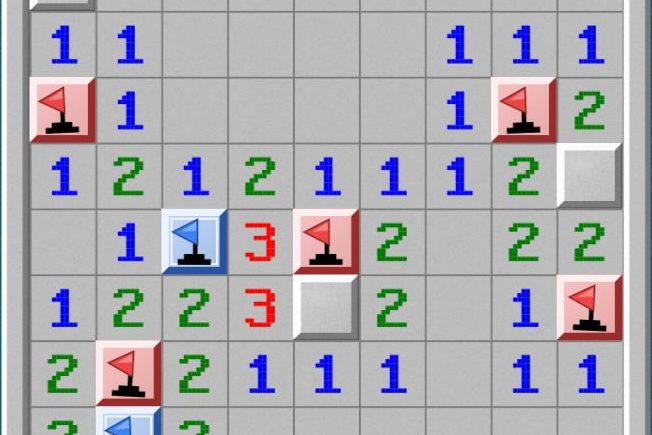 Play Minesweeper
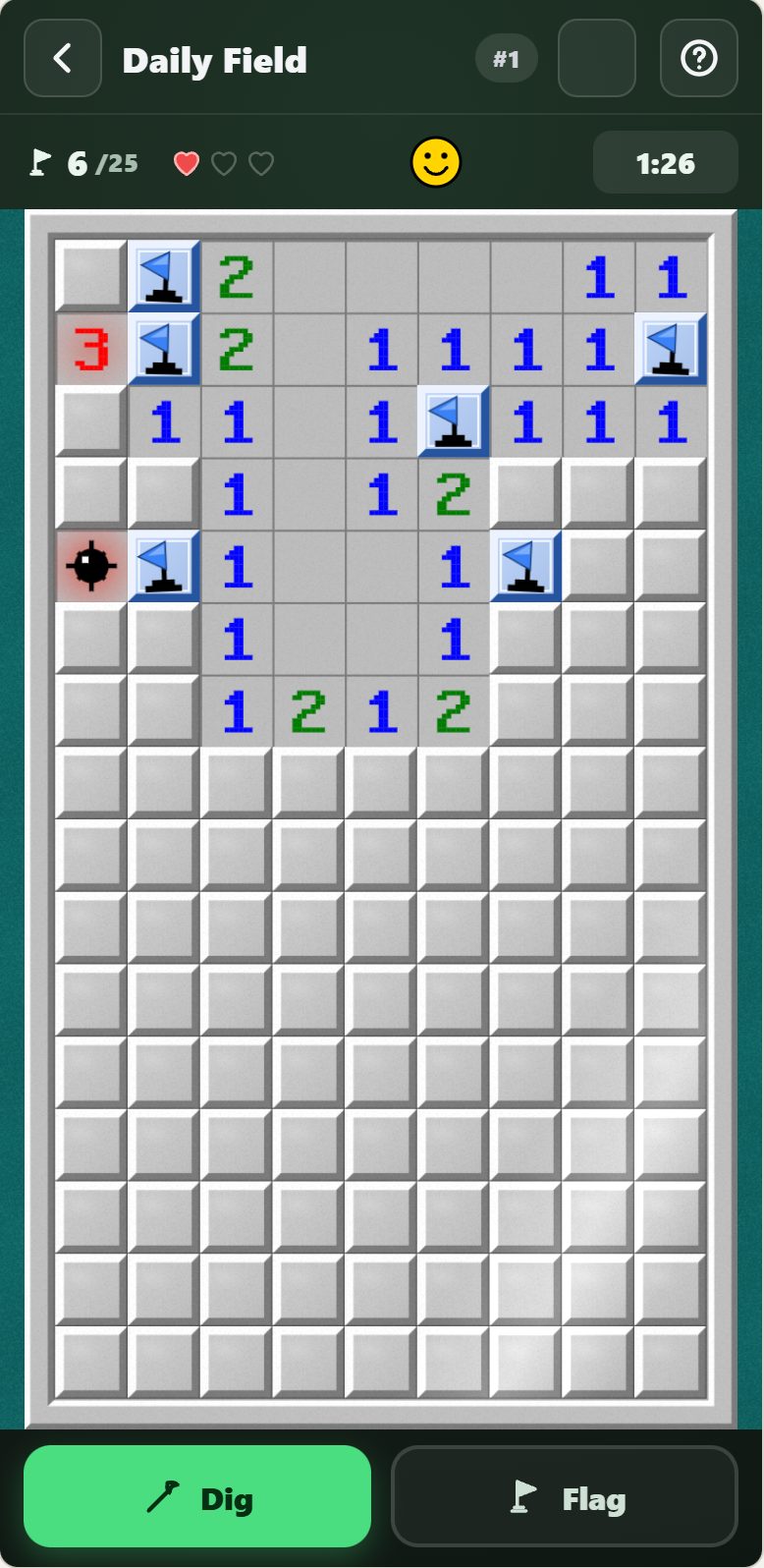
Daily minesweeper on Playgridia is one minefield a day: everyone gets the same field and the same opening, you play it alone against a 4-minute clock, and you have 3 hearts. It is not the rule set of the 2-player duel. Here you Dig or Flag, every mistake costs a heart, and the ranking asks who found the most mines, then who kept the most hearts, then who was fastest.
How a run works
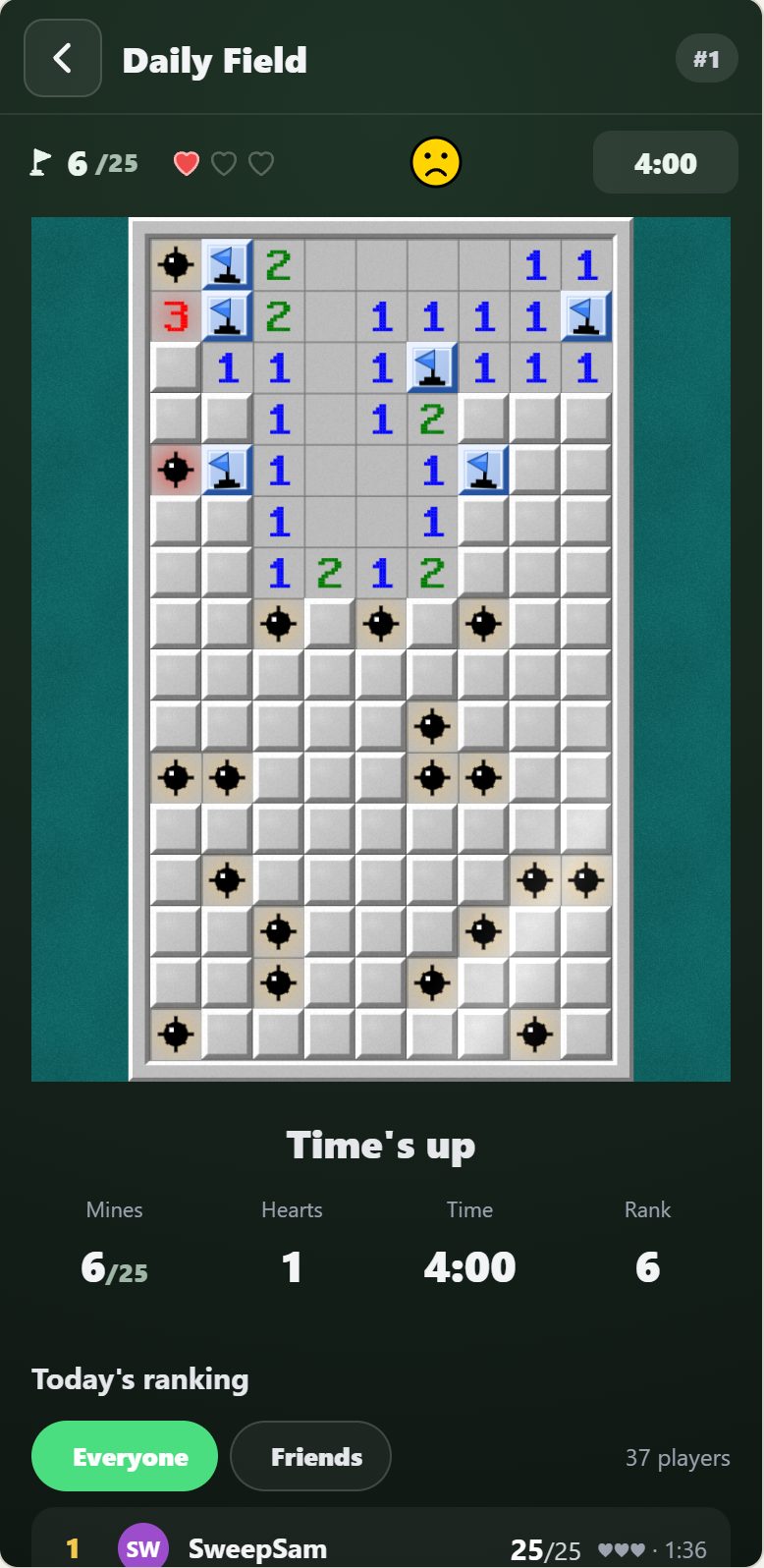
You press Start, and only then does the clock begin: 4 minutes and 3 hearts. A run ends in one of three ways: you clear the field, your hearts reach 0 (a boom), or the time runs out. The server owns the clock, and a run can never go past the end of the UTC day, so a start is refused in the last 60 seconds before the rollover.
The field is the same for every player, and the board is not sent to you before you press Start. While a run is open you never receive a mine you have not flagged or hit.
Dig, Flag and chord
- Dig a covered square and it opens; a zero floods outward as usual. Dig a mine and it costs you 1 heart, and that mine is lost: it is never counted as found.
- Flag a covered square and it is judged at once. A mine is found and locked (+1). A safe square costs you 1 heart, and the square opens, because it is known safe now.
- Chord: dig an opened number whose neighbouring mines are all identified (flagged or exploded) and the rest of its neighbours open in one tap. It is always safe, because every flag in this mode is verified.
Why a wrong flag costs a heart
Because a flag is judged instantly, a free wrong flag would let anyone find every mine by flagging everything. So a bad flag and a bad dig cost the same single heart. Flag only what the numbers prove, and dig only what the numbers prove safe.
The ranking: found, hearts, time
The order is mines found, then hearts left, then time, then who finished first. A found mine is a flagged one; on a clear, every mine you had not yet identified counts as found. So a clean run beats a fast sloppy one, and a failed run still ranks with what it found: a run you walk away from is stored as a timeout and still appears. Anyone can open the page and read today’s ranking, with an Everyone tab and a Friends tab.
Where the time goes
Four minutes sounds short, but the field is not big: the five fields run from 100 to 120 safe squares. The two costs to watch are hesitation and hearts. Every heart you keep is a tie-breaker, and the ranking compares hearts before time. If two players find the same number of mines, the one who lost fewer hearts ranks higher, even if they were slower.
Five fields, rotating
The daily rotates through the five fields of the 2-player duel. Day #1 was Classic (16 November 2026); then it goes Canyon, Quarry, Crossroads, Hot Zone, and repeats.
| Field | Size (wide × tall) | Mines | Safe squares |
|---|---|---|---|
| Classic | 9 × 16 | 25 | 119 |
| Canyon | 10 × 16 | 26 | 112 |
| Quarry | 9 × 16 | 24 | 100 |
| Crossroads | 9 × 17 | 24 | 109 |
| Hot Zone | 9 × 16 | 24 | 120 |
Every field can be solved without guessing
Each day’s layout is checked by a solver before anyone sees it, so the ranking is decided by reading the numbers and not by a coin flip that only some players were dealt. We measured this rather than assuming it; the whole story is in no-guess minesweeper.
How it differs from the 2-player duel
In the duel, a mine you tap scores a point and you keep the turn: it is a flag hunt against another person. The daily is a different game on purpose: one field for everybody, a clock, and mistakes that cost a heart. So the habits do not transfer one to one. In the duel you may chase mines; here a wrong flag costs the same as a wrong dig, so you only commit to what the numbers prove.
Free, with a sign-in, and easy to share
The daily is free and resets at 00:00 UTC. Anyone can open the Daily Field page and see the ranking; to play you sign in with a free Google account. The top three of yesterday’s ranking get a reward to claim in Rewards.
Sharing a result without spoilers
The share text carries the day number, a flag with mines found out of the total, your hearts as hearts, the time, and a mark for how the run ended (cleared, boom or timeout), plus the link. It says how well you did, never where the mines are, so it is safe to post in a group chat before everyone has played.
So what do you do with this?
Treat the first minute as reading time: work the opening with certain moves only, because each wrong move costs a third of your hearts. If you need the number rules first, start with how to play minesweeper and the pattern cheat sheet. If you want to play a person instead of a clock, the head-to-head rules are in the 2-player duel guide, and the regular board is at minesweeper.
Frequently Asked Questions
What is the daily minesweeper challenge?
It is one minefield per day, the same for every player and with the same opening. You play it solo with 3 hearts and a 4-minute clock that starts when you press Start. The field changes at 00:00 UTC.
How is the minesweeper daily challenge ranked?
By mines found first, then hearts left, then time, then who finished first. A run that ends in a boom or a timeout still ranks with the mines it found.
Why does a wrong flag cost a heart?
Flags are judged the moment you place them. If a wrong flag were free, you could flag every square and find every mine, so a wrong flag costs 1 heart, the same as digging into a mine.
Does every daily field need guessing?
No. Each day’s layout is run through a solver that never guesses, and a layout it cannot finish is rejected. We measured 60 out of 60 days fully logical, and the guarantee is a measurement rather than a mathematical proof.
Do I need an account to play the Daily Field?
Playing needs a free sign-in with Google, but anyone can open the page and see today’s ranking. The daily is free and does not use coins.
What happens when the clock or my hearts run out?
At 0 hearts the run ends in a boom, and when 4 minutes pass it ends as a timeout. Either way your result is saved and ranked by the mines you found.