No-Guess Minesweeper: How the Daily Field Is Solved by Logic
 Play Minesweeper
No-guess minesweeper means a field where pure logic, starting from the opening you are given, can clear every safe square without ever flipping a coin. The Daily Field on Playgridia is built that way: each day’s layout is run through a solver that never guesses, and a layout that gets it stuck is thrown away.
What "no guess" means
A guess is a moment when every move left is a coin flip: the numbers on screen do not prove any square safe or any square a mine. The classic case is a 50/50, two squares and exactly one mine. A no-guess field has no such moment: from the opening, there is always at least one proven move, all the way to the end.
Why an ordinary board can force a guess
A random layout does not care whether it is solvable. In our own simulation (a seeded script, not a live sample), a textbook 9 × 9 beginner board with a protected first click needed no guess in 36.0% of boards, an intermediate 16 × 16 in 20.4% and an expert 30 × 16 in 2.5%. The five fields of the 2-player duel, started from a random clear square, ranged from 0.0% (Canyon) to 12.9% (Classic). Those numbers are measured on those boards, not on the daily. For how much of the game is luck, see is minesweeper luck?
How the Daily Field guarantees it
- The game builds a candidate layout, using the field’s own mine placement.
- It finds the openings (a zero and its numbered rim). An opening is only allowed if it is no more than 40% of the safe squares, so it does not give too much away.
- A solver plays from that opening using only proven moves. If it opens every safe square, the layout is accepted.
- If not, the next candidate is tried: up to 1,500 per pass.
The fallbacks
If a field’s own mine placement never yields a fully logical layout, the same field shape gets a second budget with mines spread uniformly. If that fails too, the day falls back to the Classic field. The rotation then loses that day’s theme, but the promise holds.
What was measured
We say measured, not proven for all time. Building the field for 60 days from 16 November 2026 gave 60 out of 60 fully logical, with 0 fallbacks, and the daily gate script passes. A code note records an earlier run over 365 days: 365 of 365 logical, with 3 Canyon days handed to Classic. The check works on the layouts it generated; it is not a theorem about all possible ones.
The three rules the solver uses
The solver is deliberately simple. It uses the same three deductions you can use by hand.
| Rule | What it looks at | When you use it |
|---|---|---|
| Single number | One opened number, the mines already marked around it, and its covered neighbours | If the number is already satisfied, every other covered neighbour is safe. If the covered neighbours exactly equal the mines still missing, all of them are mines. |
| Subset | Two numbers that share covered squares, where one number’s covered squares are all inside the other’s | Compare their needs. If they are equal, the extra squares are safe; if the difference equals the number of extra squares, all are mines. |
| Total mine count | The mines still unplaced against the covered squares still unknown | Late in the field. If no mines are left, every unknown square is safe; if as many mines are left as unknown squares, all are mines. |
The bridge to the patterns
The shapes in the minesweeper pattern cheat sheet, such as 1-2-1 and 1-2-2-1 along an edge, are what these deductions look like when you have seen them often enough to skip the arithmetic. Learn the shapes, and when a shape does not match, fall back to the rule. The third rule is the easy one to forget, so before you call a field stuck, count the mines left.
What the guarantee does and does not promise
It promises that a path of proven moves exists from the shared opening to the end. It does not promise that the path is short, that every step is obvious, or that you will find it inside the 4-minute clock. It also does not tell you where to look: the solver works through the whole field, while you have to spot the next deduction yourself.
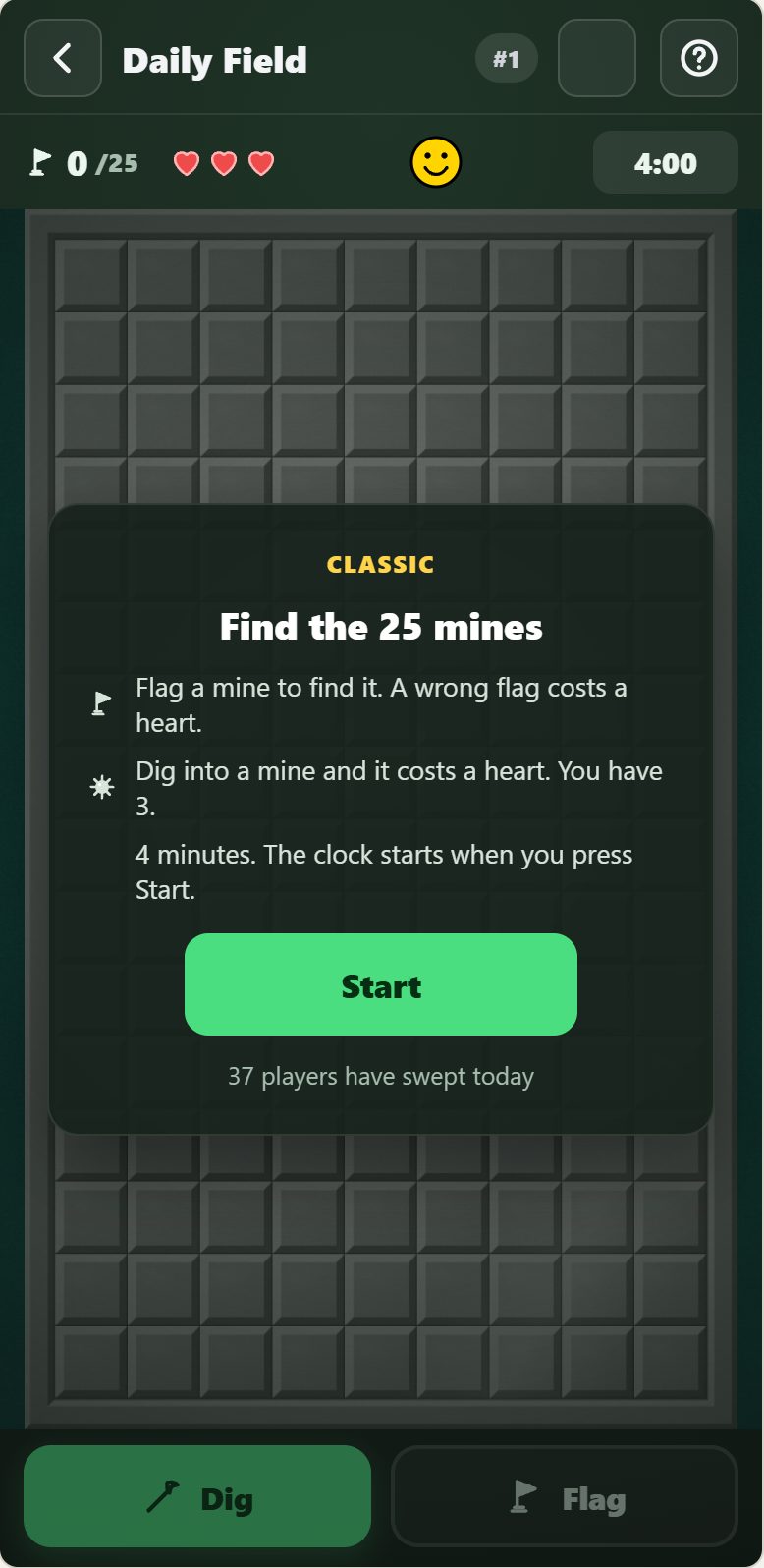
It also holds only from that opening. If you flag or dig a square the numbers did not prove, you are no longer on the solver’s path: a wrong flag costs a heart and opens the square, and a dig into a mine costs a heart too. Stay on proven moves and the guarantee is on your side.
Reading a stuck position
When you seem stuck on a field like this, there is a short checklist, and it follows the order of the table above. First, look at each number on the edge of the opened area and ask whether it is already satisfied by the flags around it. Then compare pairs of neighbouring numbers that share covered squares. Last, count the mines left against the covered squares left. A common stuck feeling at the end of a field is simply an unused third rule.
The duel’s boards are random draws, and as the measurements above show, a 50/50 is possible on them. That is a different game from the daily, where the ranking is meant to be decided by reading the numbers.
So what do you do with this?
On a no-guess field, a stuck position means you missed a deduction, not that the board was unfair. Re-read every number next to the frontier before you take a risk. Try it on today’s Daily Field, and read the daily’s rules, hearts and ranking first if you have not played it. More general habits are in the minesweeper tips.
Frequently Asked Questions
What does no-guess minesweeper mean?
It is a field that can be cleared by logic alone from the opening you are given, with no coin-flip moves. At every step at least one square is provably safe or provably a mine.
Is the Daily Field really solvable without guessing?
Each day’s layout is accepted only if a solver that never guesses clears it from the shared opening. Measured over 60 days, all 60 were fully logical, with no fallbacks needed. That is a measurement, not a proof for every future day.
What if a day has no logical field?
The game first re-tries the same field shape with mines spread uniformly, and if that also fails it uses the Classic field for that day. In a longer earlier run of 365 days, 3 Canyon days fell back to Classic.
Which deductions does the solver use?
Three: reading a single number, comparing two numbers where one covers a subset of the other’s squares, and counting the total mines left against the unknown squares. A player can use all three by hand.
Can an ordinary minesweeper board force a 50/50?
Yes. In our seeded simulation of textbook boards, only 36.0% of beginner boards, 20.4% of intermediate and 2.5% of expert boards finished with no forced guess when the first click was protected.