Ludo Rules for Sixes: Roll Again, Three 6s, Leaving Base
In Ludo rules for sixes, a 6 always earns another roll, and the third 6 in a row voids that roll and passes your turn. On the Ludo board a 6 also brings a piece out of the yard; on the Parchís board the third 6 also costs you a piece. House rules vary, so these are the rules this game runs, not a universal rulebook.
Leaving the yard
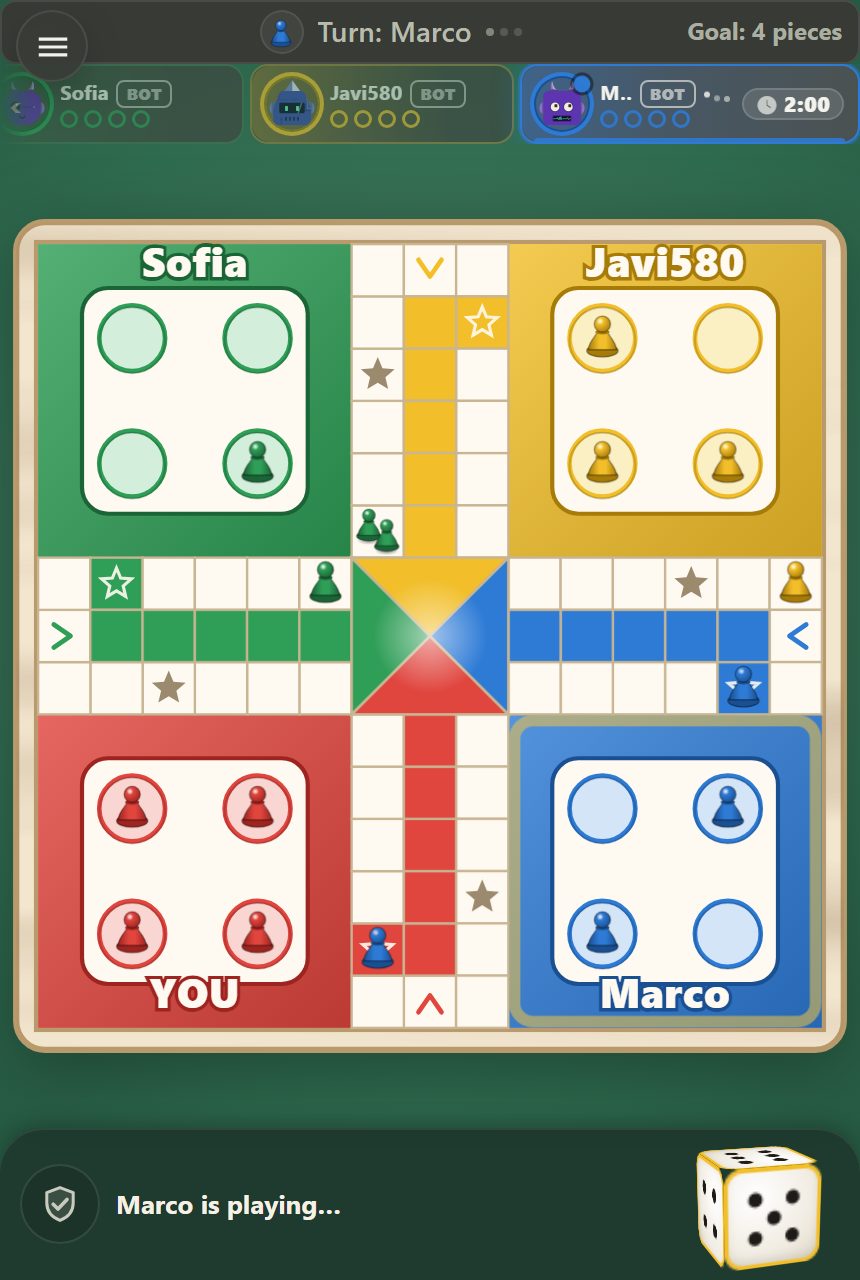
On the Ludo board you need a 6 to bring a piece out. It is not forced: with a 6 you may bring a new piece out or move one that is already on the track. The piece lands on your own start square, which is safe. Rival pieces may already sit there, and nothing is captured on entry.
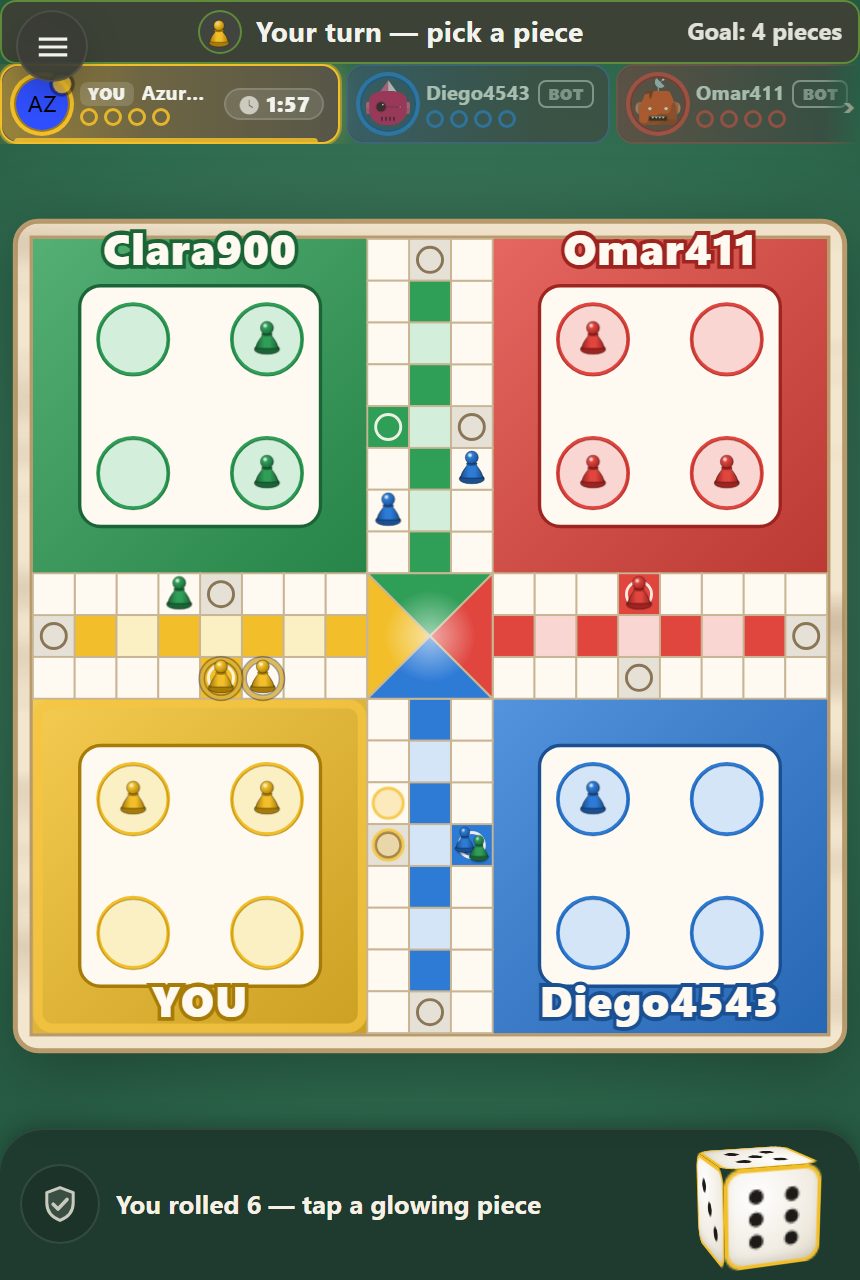
The Parchís board asks for a 5, not a 6, and it is forced. Roll a 5 with a piece in the yard and bringing it out is your only legal move. The one exception: if your start square already holds two of your pieces, you cannot enter, and the 5 is played as a normal move. A 5 also cannot be used as a bonus count.
So on the Parchís board a 6 never enters a piece. It is only a long move that gives you another roll.
Rolling again, and the fresh clock
A 6 on either board means the same seat rolls again. You do not choose this and you cannot pass. If a legal move exists you must play one.
The move clock treats the extra roll as a new turn. The default clock is 20 seconds per turn, with 15, 20, 30, 45 and 600 second options, and the roll and the move share one budget. A 6 starts a fresh clock for the follow-up roll. On the Ludo board a capture or a piece reaching home does the same. The Parchís bonus counts (20 and 10) keep the same clock instead.
A six with no legal move still rolls again
Say all your pieces are stuck behind a blocked square and the 6 cannot be played. The turn does not end. The game records that you had no move, and you roll again anyway. That 6 also still counts toward the three in a row.
If every legal move is the same move, the game plays it for you. That happens when several pieces are in the yard, or several pieces are stacked on one square. Two pieces on different squares are always a real choice, even when one move is obviously better.
The third six in a row
Roll three 6s in a row and the third roll is void. Your turn ends. What else happens depends on the board.
| Situation | Ludo board | Parchís board |
|---|---|---|
| Brings a piece out | 6, optional | 5, forced (unless your start holds two of your pieces) |
| A 6 rolls again | Yes | Yes |
| A 6 with no legal move | Still rolls again | Still rolls again |
| What a 6 counts | 6 | 7, but only when no piece of yours is in the yard |
| Third 6 in a row | Roll is void, turn passes, no piece touched | Roll is void, turn passes, last piece moved goes back to the yard |
On the Parchís board, "last piece moved" means the last piece you moved in this chain of rolls, including a 20 or 10 bonus move. It goes back only if it is still on the shared track. A piece already in its home lane or finished is safe, and then the turn simply ends. The count resets on any roll that is not a 6, and at the start of every new turn.
The Parchís six that counts 7
On the Parchís board a 6 moves a piece 7 squares when none of your pieces is in the yard. With one piece still in the yard it moves 6. Finished pieces do not count as being in the yard. In a team game the test looks at the pieces you are currently moving.
Practical effect: once your last piece is out, count 7 for every 6. It changes which squares you land on and which you can capture.
How rare three sixes are
With one fair die, the odds are plain arithmetic.
| Sequence | Fraction | Chance |
|---|---|---|
| One 6 | 1/6 | 16.7% |
| Two 6s in a row | 1/36 | 2.8% |
| Three 6s in a row | 1/216 | 0.46% |
That is about once in 216 chains, so it is a rare event, not something to play around. If you lose a piece to it on the Parchís board, it was bad luck, not a pattern.
What to do with a six
- Ludo board, pieces in the yard: bringing one out is usually the use of a 6, but remember it is optional. If a piece out on the track can capture or reach safety, that can be better.
- Parchís board: you cannot waste a 6 on entering. Use it as a long move, and remember it counts 7 once your yard is empty.
- After any 6 you roll again, so plan a move that still leaves a good follow-up.
- Parchís board, second 6 in a row: the next 6 sends your last moved piece home to the yard if it is on the shared track. Move a piece that is already in its lane when you have the choice.
Can you trust the sixes?
Every roll of a match is locked in before the first throw. The game shows a lock, the SHA-256 fingerprint of a secret key, during play. When the match ends the key is revealed and you can check every roll in your own browser. It proves the dice were fixed in advance, not chosen afterwards. For the limits, read is online Ludo rigged.
For the full rule set see how to play Ludo, the Parchís rules and Ludo strategy tips.
Next step: pick a board, decide whether your table plays Ludo or Parchís sixes, and test the three-6 rule in a match against bots. Play Ludo free, no signup.
Frequently Asked Questions
Do you roll again after a 6 in Ludo?
Yes, on both boards a 6 gives the same seat another roll. It also rolls again when the 6 had no legal move. The extra roll starts a fresh move clock.
What happens if you roll three 6s in a row in Ludo?
The third roll is void and your turn ends. On the Ludo board no piece is touched. On the Parchís board the last piece you moved goes back to the yard, if it is still on the shared track.
Do you need a 6 to leave the yard?
On the Ludo board, yes, but it is optional: with a 6 you can bring a piece out or move one already out. On the Parchís board you need a 5, and it is forced if you have a piece in the yard and your start square lets it in.
Why does my 6 move 7 squares in Parchís?
On the Parchís board a 6 counts 7 when none of your pieces is in the yard. If one piece is still in the yard it counts 6. Finished pieces do not count as being in the yard.
What are the odds of rolling three 6s in a row?
With one fair die it is 1 in 216, or 0.46%. Two in a row is 1 in 36 (2.8%) and one 6 is 1 in 6 (16.7%).
Can I choose not to move after a 6?
No. There is no pass action. If a legal move exists you must play one, and if there is none the turn passes, but a 6 still rolls again.