Chess Pawn Rules: Moves, Captures, En Passant, Promotion
 Play Chess
Chess pawn rules in one breath: a pawn only ever moves forward, one square onto an empty square (two from its starting square), captures one square diagonally forward, and must become a queen, rook, bishop or knight when it reaches the far rank. It can never move backwards, never capture straight ahead, and the special en passant capture is allowed for exactly one move. Below, each pawn question gets the rule as the Playgridia chess board enforces it, plus what you see on screen.
Can a pawn move backwards?
No. White pawns only move up the board and Black pawns only move down it; the engine never generates a backward or sideways pawn move. Forward movement has two forms:
- One step onto an empty square.
- Two steps, only from the pawn’s starting square (rank 2 for White, rank 7 for Black) and only if both squares in front of it are empty.
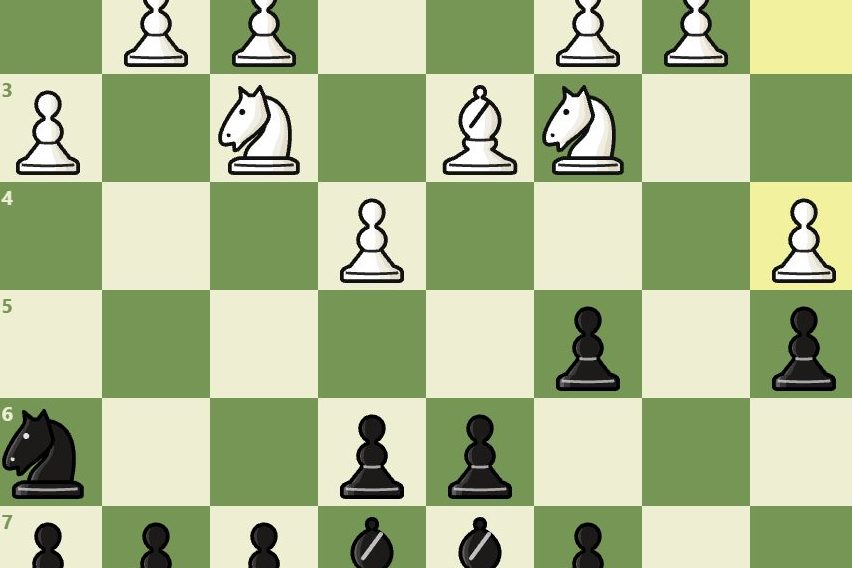
A pawn can never push into a piece, so a pawn facing an enemy pawn is simply blocked. When you tap one of your pieces, the board marks every legal destination: empty squares get a dot, capturable squares get a ring. A blocked pawn shows nothing, and the coach line says "That piece has no legal move right now." Chess is played with a tap-then-tap or a drag, and both send the same move. The full set-up and the other pieces are in chess pieces and how they move.
Can a pawn capture forward, or move diagonally?
A pawn captures only diagonally forward, one square, and only onto a square that holds an enemy piece. That is the one place where a pawn moves diagonally: an empty diagonal square is not a legal move, and the square straight ahead is never a capture. So two pawns nose to nose cannot take each other.
On the board this is easy to check. Tap a pawn: the straight-ahead squares are dots, while an enemy piece on a forward diagonal is ringed. If you see no ring, there is no capture. In the move list a pawn capture starts with the file the pawn left, as in exd5. Notation is explained in chess notation explained.
Can a pawn take a king?
A pawn can attack a king, but a king is never captured. A pawn gives check from one square diagonally in front of it, and the engine will not allow any move that leaves your own king attacked, so you must answer the check. If no move does, that is checkmate and the game ends on the spot. The king’s square glows red, a banner says "Check! Save your king", and a line is drawn from each checking piece to the king. Tapping a piece that cannot help explains why.
En passant: the one-move window
En passant ("in passing") is the pawn capture that confuses people, because the captured pawn is not on the square you land on. It happens when a pawn makes its two-square first move and lands beside an enemy pawn, passing over a square that pawn attacks. The enemy pawn may then capture it as if it had moved only one square, landing on the skipped square.
The rule that matters most: the window lasts exactly one move. The right appears only after a two-square pawn push and vanishes after the very next move by anyone. If you play something else first, the chance is gone for good. It is also optional: it appears among your legal moves, and you may ignore it.
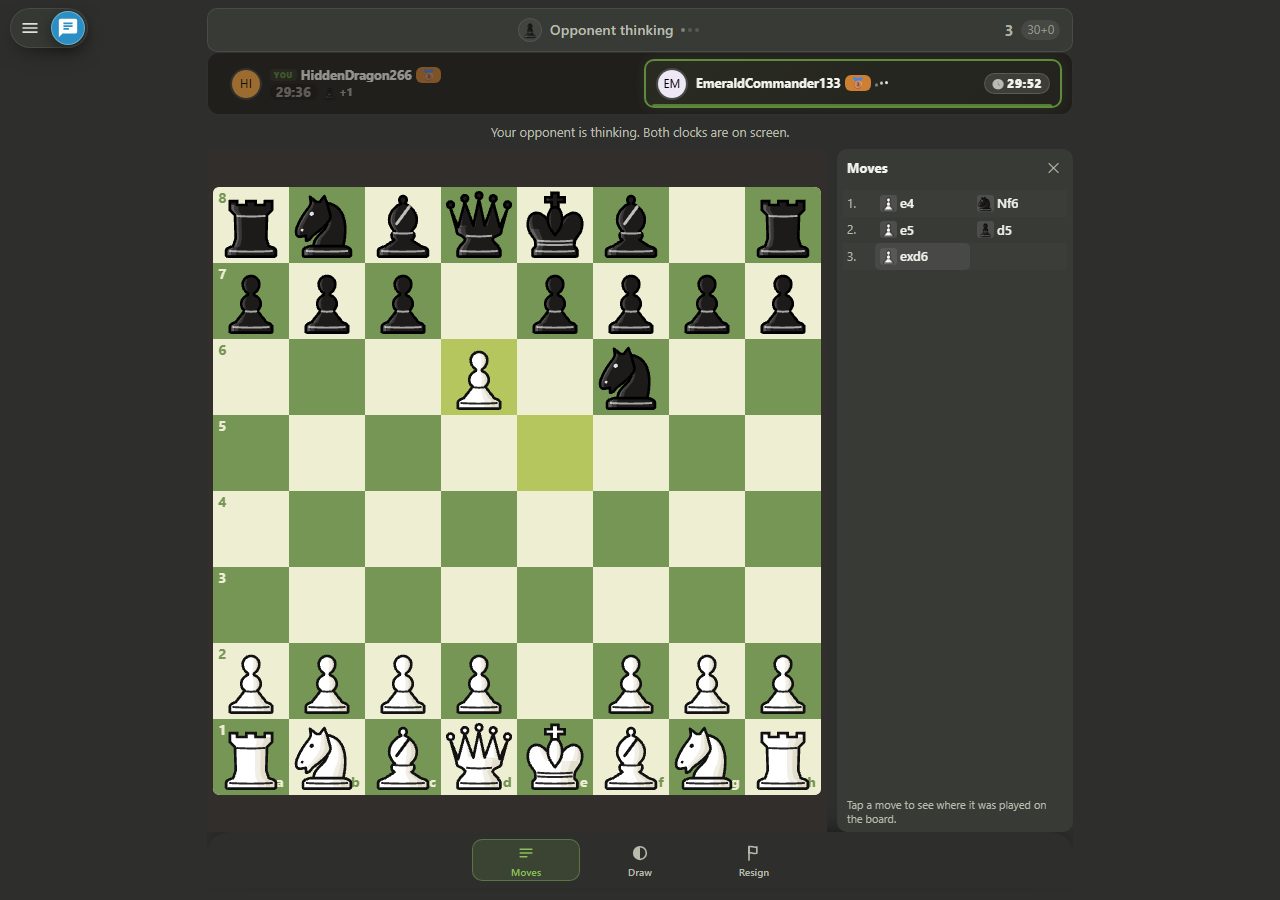
The same sequence in notation: 1.e4 Nf6 2.e5 d5 3.exd6. The en passant capture is written like any pawn capture. For the full list of special moves, see how to play chess.
Pawn promotion: queen, rook, bishop or knight
When a pawn reaches the last rank it must promote; there is no move that leaves it a pawn. A push to the last rank and a capture on the last rank both promote, and each offers four choices: queen, rook, bishop or knight. When you tap a pawn onto the last rank the board opens a picker titled "Promote the pawn to" with the four pieces in that order, so under-promotion is a real option, not a hidden one. The move list prints the result as cxb8=Q.
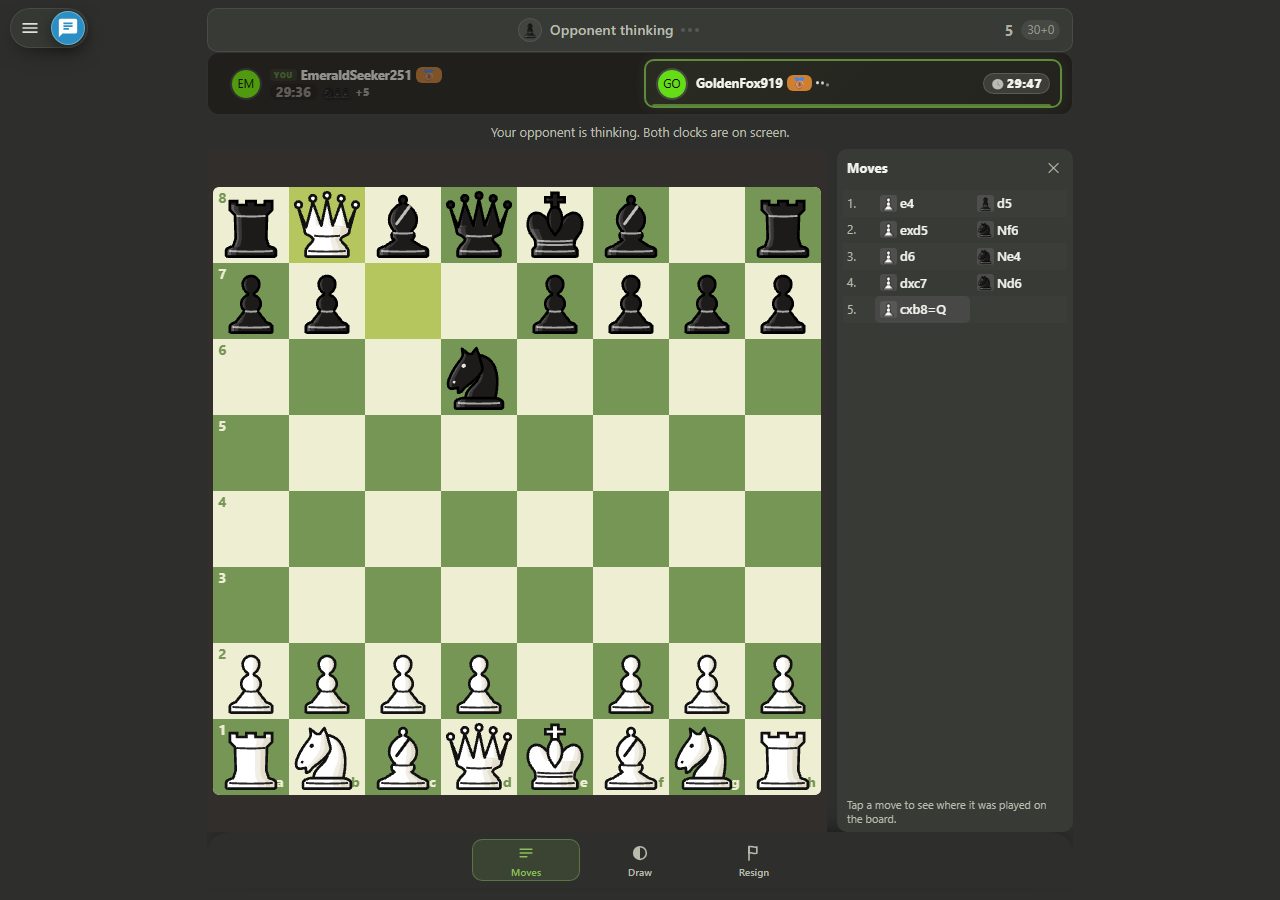
One exception to the picker: a premove. If you queue a move on your opponent’s turn, it is only sent if it is still legal when your turn arrives, and a premove onto the last rank always promotes to a queen. If you want a knight or rook, wait for your turn and choose in the picker.
Pawn rules at a glance
| Question | Short answer |
|---|---|
| Can a pawn move backwards? | No, never. |
| Can a pawn move two squares? | Only from its starting square, and only if both squares ahead are empty. |
| Can a pawn capture straight ahead? | No. It is blocked by any piece in front of it. |
| Can a pawn move diagonally? | Only to capture an enemy piece one square diagonally forward. |
| Can a pawn take a king? | It can give check; the king is never captured. No answer to the check means checkmate. |
| How long does en passant last? | One move, immediately after the two-square push. It is optional. |
| Can a pawn stay a pawn on the last rank? | No. It must become a queen, rook, bishop or knight. |
| Does a premove promote? | Yes, always to a queen. |
Common pawn myths
- "A pawn can capture the piece in front of it." It cannot; only the forward diagonals capture.
- "En passant works any time later." It works for one move only.
- "You can en passant any pawn." Only a pawn that has just advanced two squares and stopped beside yours.
- "Promotion is always a queen." Queen is only the default for a premove; a tap on the last rank asks you.
What to do with this
Press the Play button above and test each rule against a bot: tap a pawn and read the dots and rings, try to push it into a blocked square, and wait for a chance to promote. If you want a checklist of the other rules, keep the chess rules cheat sheet open, or head to the chess page to start a game.
Frequently Asked Questions
Can a pawn move backwards in chess?
No. A pawn only moves toward the far rank: White pawns go up the board, Black pawns go down. The engine never generates a backward or sideways pawn move.
Can a pawn capture forward?
No. A pawn captures only one square diagonally forward, and only onto a square holding an enemy piece. A piece directly in front of a pawn simply blocks it.
Can a pawn take a king?
A pawn can give check, but a king is never captured. A move that leaves your own king attacked is not allowed, and if you have no way to answer the check, it is checkmate.
What is the en passant rule?
If a pawn moves two squares and lands beside an enemy pawn, that pawn may capture it as if it had moved one square. The chance lasts exactly one move: if you do not take immediately, it is gone. It is optional.
Can a pawn become a queen, or something else?
When a pawn reaches the last rank it must promote, by a push or a capture. On Playgridia a picker offers queen, rook, bishop or knight. A premove onto the last rank always promotes to a queen.
Can a pawn move two squares at any time?
No. The double step is only available from the starting square (rank 2 for White, rank 7 for Black), and only when both squares in front of the pawn are empty.